 Nicholas J. Rego Accident Lawyer
A young man named Micah Slentz died on October 5, 2025 when his car crashed into a sign and shoulder wall just north of Laguna Canyon Road on the southbound 405 Freeway in Irvine, California. He was known to those who knew him as a student at college, working in a grocery store, and as someone who gave his time to Play Well Africa. The crash was reported at 11:33 p.m. by the California Highway Patrol. Minutes later a witness was summoned. The coroner arrived just after midnight. There has been no official cause identified.
That’s all the public record gives us. And that’s enough — not to speculate about what happened to Micah, but to use this real, documented crash as a starting point for something that matters to every driver on a California freeway: what the law actually does after a fatal single-vehicle accident, and what you need to know before you’re ever in that situation yourself.
California Is an At-Fault State — What That Means When There’s Only One Car
Most countries outside the U.S. operate on some version of a no-fault insurance system. California doesn’t. It’s a pure fault-based state, which means the driver found responsible for a crash bears the financial liability — for medical bills, property damage, lost wages, pain and suffering.
In a two-vehicle crash, fault determination is complicated but at least there are two parties to examine. A single-vehicle crash like the one on the 405 that night is a different legal exercise entirely. Investigators ask different questions: Was there a road defect? A tire blowout? A vehicle malfunction? A medical emergency at the wheel? Did another driver cut the vehicle off, triggering a swerve, and then leave the scene?
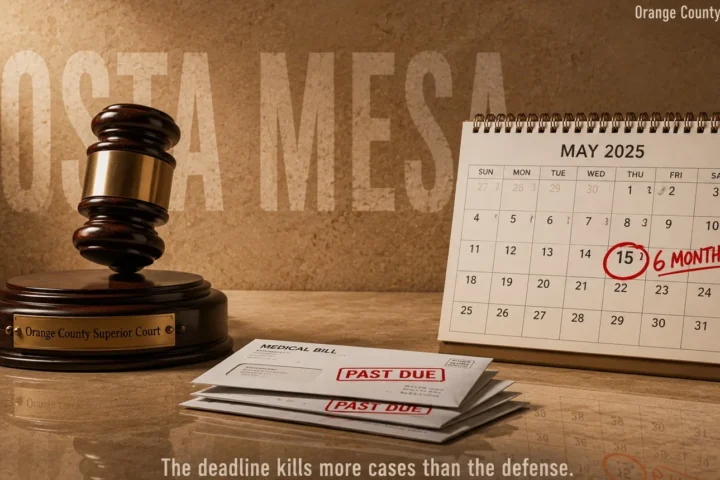
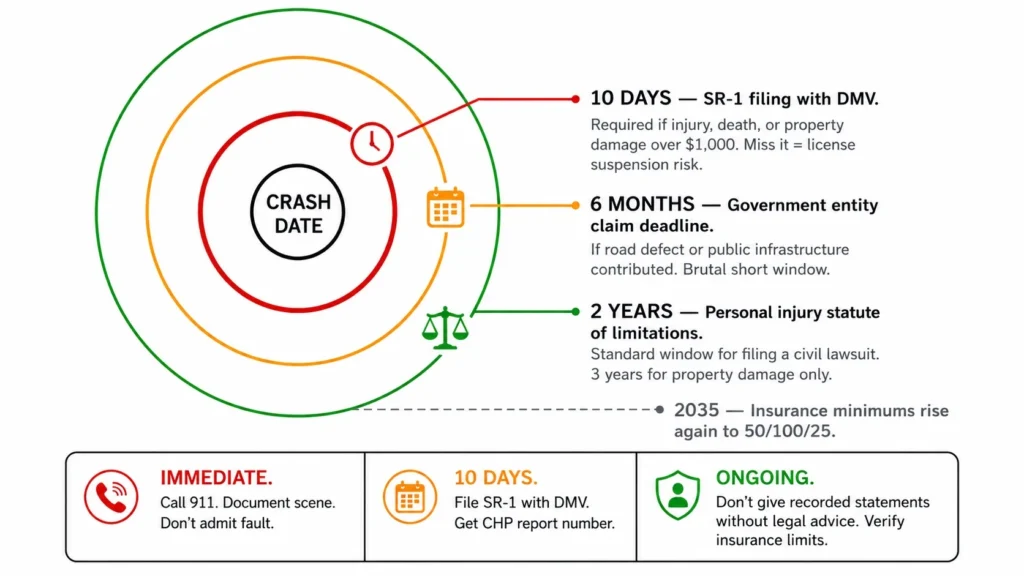
Each of those scenarios creates a completely different legal trail. A road defect points toward a potential government liability claim — and those have a brutal six-month filing deadline against public entities in California, compared to the standard two-year window for personal injury claims. A vehicle defect could open a product liability case against a manufacturer. A hit-and-run opens a different track entirely.
The point is this: in California, “single-vehicle accident” does not mean “no one is legally responsible.” It means the investigation hasn’t finished yet.
The Insurance Numbers Every Driver on a California Road Must Know
But something did change on January 1, 2025, and many travelers, including many taking cars right now are not fully aware of it.
The minimum auto liability coverage for the State of California has been 15/30/5 for more than 56 years. If you were responsible for causing an accident, your insurance company only had to pay up to $15,000 per person that was injured and a maximum of $30,000 for the entire accident. Those numbers don’t add up to one ambulance trip and one night in the intensive care unit on a modern fast-paced freeway.
Senate Bill 1107 – The Protect California Drivers Act – changed all that.That all changed with Senate Bill 1107 – The Protect California Drivers Act –. As of January 2025, the new minimums are 30/60/15: $30,000 per person, $60,000 per accident, $15,000 for property damage. Those limits will climb again to 50/100/25 in 2035.
For travelers, this has a direct practical implication. If you’re renting a car in California and declining the rental agency’s insurance add-on because your home-country policy “covers rentals” — stop and verify. Your home policy’s liability limits may have been written against a different legal minimum entirely. A $15,000-per-person limit, legal in many countries, is now below California’s floor.
| Coverage Type | Pre-2025 Minimum | 2025 Minimum (SB 1107) | 2035 Minimum |
|---|---|---|---|
| Bodily injury (per person) | $15,000 | $30,000 | $50,000 |
| Bodily injury (per accident) | $30,000 | $60,000 | $100,000 |
| Property damage | $5,000 | $15,000 | $25,000 |
One more thing worth knowing: California’s comparative negligence system means fault can be split. If you’re found 30% at fault for a crash, your compensation is reduced by 30%. You don’t lose everything for sharing partial blame — but you do lose a piece. That matters enormously for how you document the scene, what you say to responding officers, and why you should never admit fault at the roadside even if you feel responsible in the moment.
What to Actually Do in the First 30 Minutes — On a California Freeway
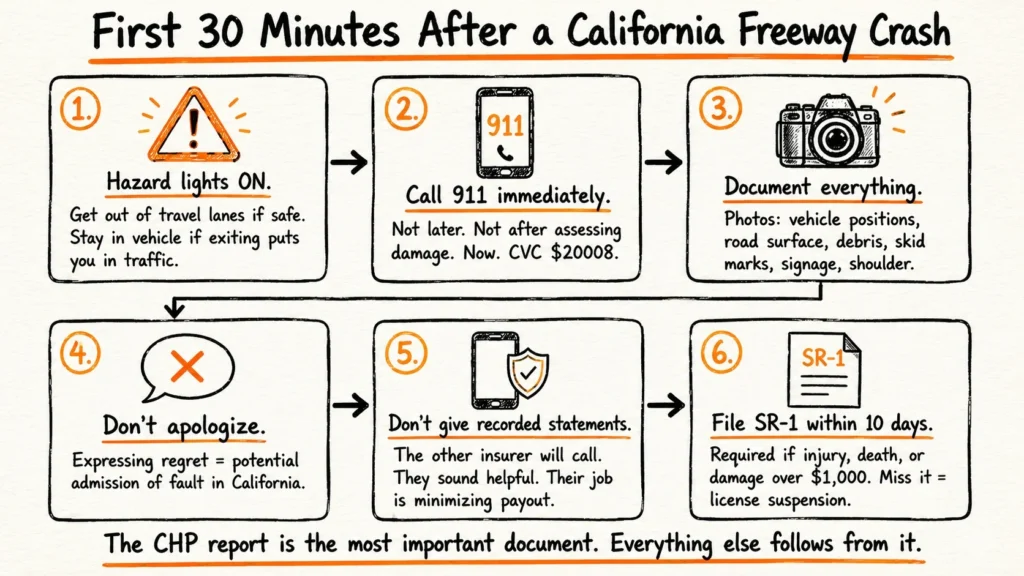
The 405 at night is not the place to figure this out for the first time. Eleven lanes of traffic at Laguna Canyon Road, vehicles moving at 70+ mph even in moderate conditions. If you’re in a crash there — or on any California freeway — the first physical priority is getting out of the active travel lanes if you can do so safely. Hazard lights on. Stay in the vehicle if exiting puts you in traffic.
Then: call 911. Not later. Not once you’ve assessed the damage. Now. California Vehicle Code §20008 requires that any accident involving injury or death be reported to law enforcement within 24 hours — but on a freeway, the CHP will almost certainly respond automatically once dispatch receives a report. The responding officer prepares a Traffic Collision Report. That document becomes the single most important piece of paper in any subsequent insurance claim or legal proceeding. Without it, fault disputes devolve into one person’s word against another’s.
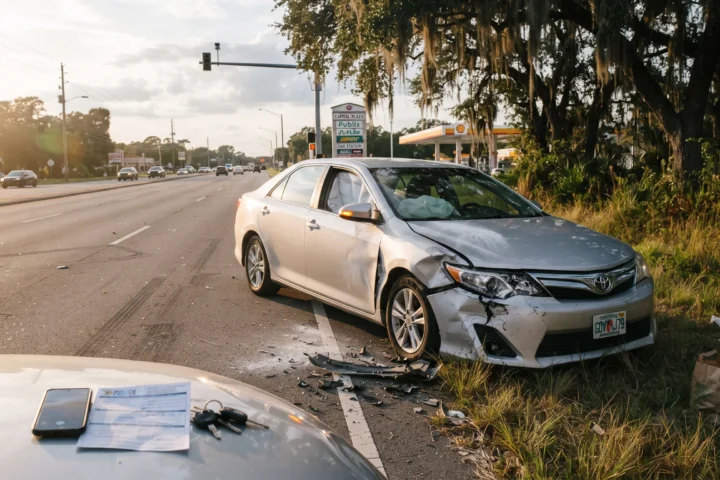
After that, if you’re physically able — document everything before anything moves. Photos of vehicle positions. The road surface. Any debris. Skid marks. Signage. The shoulder wall. Whatever is there. Your phone camera is your evidence locker.
Three things not to do, and this matters especially for international visitors who aren’t used to the U.S. claims environment:
Don’t apologize at the scene. In many cultures, expressing regret after an accident is basic courtesy. In California, it can be treated as an admission of fault and used against you in insurance negotiations or court.
Don’t give a recorded statement to the other driver’s insurance company without legal advice. They will call. They will sound helpful. Their job is to minimize the payout.
Don’t skip the DMV filing. California law requires you to file a SR-1 form with the Department of Motor Vehicles within 10 days if the crash involved injury, death, or property damage over $1,000. Miss that deadline and you risk license suspension — even if the crash wasn’t your fault.
The Part That Catches Travelers Off Guard: Rental Cars and Coverage Gaps
Most international visitors assume they’re covered. Their travel insurance covers “accidents.” Their credit card “includes rental car protection.” The rental agency’s base rate “includes basic insurance.”
None of those assumptions hold up cleanly under California law — and the gap between assumption and reality is where people find themselves personally liable for tens of thousands of dollars.
Here’s the actual picture. Rental cars in the USA are not insured by default. Local renters generally rely on their personal car insurance, credit card coverage, or travel insurance to cover them — and without any of these, the rental company offers optional products at the counter. For international visitors, the situation is more complicated. If you have a full-coverage auto insurance policy in the United States, it may provide some level of coverage for rental cars — but liability coverage from a U.S. policy generally doesn’t extend internationally, and the reverse is equally true: international policies often don’t extend into the U.S.
Credit card rental protection — the kind Visa and Mastercard advertise — typically covers collision damage to the rental vehicle itself. It does not cover liability to the other driver, their passengers, or anyone else injured. That’s a fundamentally different thing. You can have full credit card protection and still face a personal lawsuit from an injured third party.
California’s financial responsibility laws require drivers to carry a specified minimum amount of automobile insurance. If the requirements in California are higher than your home policy limits, your insurer is expected to meet California’s higher requirements — but only if your policy actually extends to the U.S. in the first place.
The practical checklist before you pick up any rental car in California:
- Confirm your home-country or travel policy explicitly covers third-party liability in the United States
- Verify the liability limits meet or exceed California’s 30/60/15 minimums
- If there’s any doubt — buy the rental company’s Supplemental Liability Insurance at the counter. It’s not glamorous, but it’s the cleanest gap-filler available
What California Law Examines — And What It Can’t Tell Us About Micah Slentz
The Micah Slentz car accident, as reported by the California Highway Patrol and covered by MyNewsLA.com, presents the exact fact pattern that California investigators follow in a single-vehicle fatal crash: a car leaves its lane, strikes a fixed object, and the driver is found unresponsive. No other vehicles were publicly identified as involved.
What the law looks at from there — absent any official findings — is a branching set of questions. Road condition at 11:33 p.m. on that stretch of southbound 405. The vehicle’s mechanical state. Whether any other driver’s actions contributed to the crash and then left the scene. Whether a medical event was a factor. Each branch leads somewhere different legally: toward a government entity, a manufacturer, an uninsured motorist claim, or simply a tragic accident with no recoverable liability.
None of that has been established publicly in Micah’s case. The cause remains unconfirmed. What his story does and why it belongs in a piece like this — is make the abstract concrete. A young man, a freeway most Californians have driven a hundred times, a Sunday night, and then a witness calling it in at 11:38 p.m. These things happen fast. The legal machinery that follows moves slowly. Knowing how it works before you ever need it is the only real advantage any driver has.
The Short Version, If You’re Skimming
California runs on a fault-based system. Whoever caused the crash pays — through their insurer, and sometimes personally if coverage runs out. The 405, the I-5, the 101: these are not forgiving roads, and the state’s legal framework reflects that.
If you’re driving in California — resident or visitor, rental car or your own:
- Carry at least 30/60/15 liability coverage, and ideally more.
- Know the SR-1 filing deadline (10 days) and the personal injury statute of limitations (2 years).
- Don’t assume your travel or home-country insurance covers California liability — verify it explicitly.
- At the scene: document everything, say as little as possible beyond the facts, and let the CHP report do its job.
Micah Slentz was 19 years old. He worked at a grocery store, studied, gave time to charity work in Africa, and by every account was the kind of person a community actually feels the loss of. This article exists because his death on the 405 is a matter of public record — and because the legal terrain around it is something every driver on that freeway deserves to understand.