 Nicholas J. Rego Accident Lawyer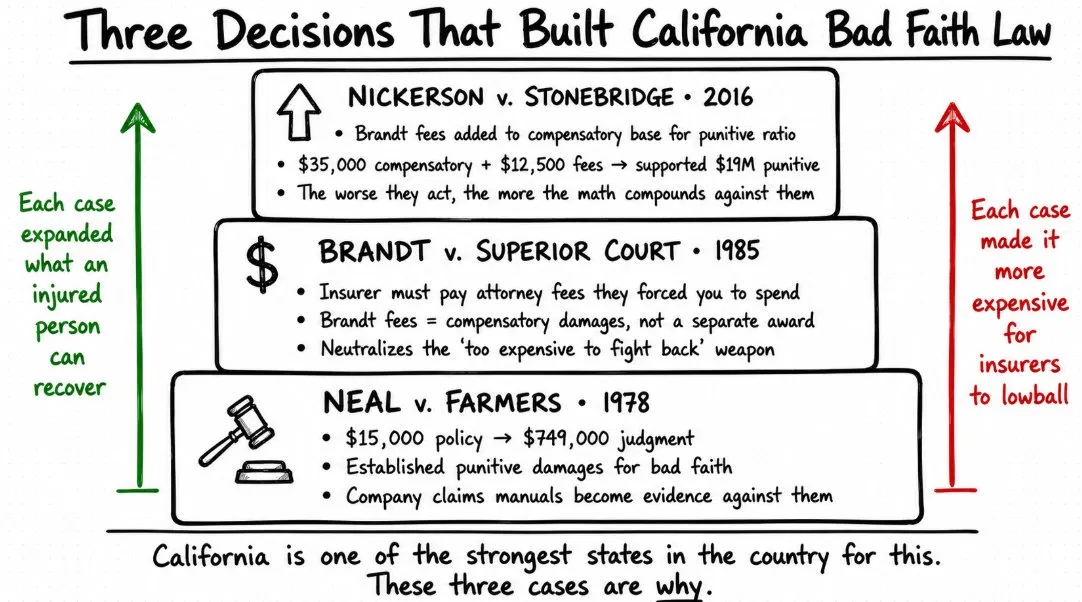
A bad faith insurance claim in California is a legal action against an insurer that unreasonably denies, delays, or underpays a legitimate claim.
Under California Insurance Code §790.03 and decades of Supreme Court precedent, the claimant can recover the original policy benefits owed, attorney fees the insurer forced them to spend (called Brandt fees), emotional distress damages, and punitive damages when the conduct is egregious enough. California is one of the strongest states in the country for this.
Three California Supreme Court decisions built this framework. Neal v. Farmers (1978) established punitive damages for bad faith claims handling. Brandt v. Superior Court (1985) made insurers pay the attorney fees they forced claimants to spend. And Nickerson v. Stonebridge (2016) ruled those fees compound against the insurer when courts calculate whether punitive awards are proportionate. Each one expanded what an injured person can recover and each one made it more expensive for insurers to lowball claims.
What California Law Defines as Unfair Claims Handling
Every insurance policy sold in California carries an implied covenant of good faith and fair dealing. That is not a vague ethical principle. It is a binding legal obligation and when an insurer violates it the consequences go far beyond the original policy limits.
California Insurance Code §790.03 subsection (h) lists 16 specific unfair claims settlement practices. The full list covers everything from misrepresentation to delays to improper investigation standards. The ones that come up most often in car accident disputes:
- Misrepresenting relevant facts or policy provisions to claimants.
- Failing to acknowledge communications about claims within a reasonable time.
- Not attempting in good faith to reach prompt fair settlements when liability is reasonably clear.
- Compelling claimants to file a lawsuit by offering substantially less than what ultimately gets recovered.
- Refusing to provide a reasonable explanation for denying a claim.
These are not theoretical. They describe what happens in car accident claims across California every day, the lowball offer before treatment is complete, the recorded statement designed to lock someone into an early position, the unexplained delay that pressures a person into accepting less because rent is due and medical bills keep arriving.
When an insurer crosses these lines the breach gives rise to a tort action, meaning the claimant can sue not just for the policy benefits owed but for consequential damages, emotional distress, and punitive damages under Civil Code §3294 if the conduct rises to malice, oppression, or fraud.
Neal v. Farmers: The Case That Built California Bad Faith Law
Neal v. Farmers Ins. Exchange, 21 Cal.3d 910 (1978)
Frances Neal was severely injured in a car accident caused by an uninsured motorist. She filed a claim under her own uninsured motorist policy with Farmers Insurance Exchange. The policy limit was $15,000.
What should have been straightforward turned into a years-long fight. Farmers raised defenses the court later found were “known to be invalid,” contributory negligence arguments and offset provisions designed to chip the payout down. The jury found Farmers was deliberately exploiting the Neal family’s desperate financial situation to force a bargain-price settlement.
And it was not just one adjuster making a bad call. There was evidence Farmers was carrying out an established company policy, a claims manual that instructed adjusters to exploit individual claimant vulnerabilities. That manual became a centerpiece of the trial.
The jury came back with $1,548,211. Trial court reduced it to $749,011. The California Supreme Court upheld that number.
What Neal established
The Supreme Court confirmed three principles that still govern every bad faith case filed in this state:
Punitive damages are available when an insurer acts with malice, oppression, or fraud in handling a claim. The standard of proof is “clear and convincing evidence” under Civil Code §3294, higher than the usual preponderance standard but far from impossible when internal documents get exposed in discovery.
Three factors size the punitive award: the reprehensibility of the conduct, the relationship between punitive and compensatory damages, and the financial condition of the defendant.
Company-wide bad practices are especially damning. When the problem is not one adjuster but a corporate claims manual designed to suppress payouts across the board, courts treat that as significantly more reprehensible than an isolated bad decision.
Neal did not just punish Farmers. It told every insurance company doing business in California that their internal claims-handling practices could be put on trial and their own training manuals used as evidence against them.
Brandt v. Superior Court: The Rule That Makes the Insurer Pay Your Attorney
Brandt v. Superior Court, 37 Cal.3d 813 (1985).
This is the provision that changes the economics of fighting back and most claimants have never heard of it.
The California Supreme Court resolved a split among appellate courts and ruled definitively: when an insurer’s bad faith forces a policyholder to hire an attorney to obtain benefits that should have been paid voluntarily, the insurer must pay those attorney fees as damages.
The reasoning was simple. If the insurer’s tortious conduct is what forced the policyholder to hire a lawyer in the first place then the insurer should bear that cost. Those fees are economic loss directly caused by the tort and they get treated as compensatory damages, not as a separate fee award. They are called Brandt fees and as The Hassell Law Group has noted in their analysis, they function differently from normal attorney fee awards precisely because they are part of the compensatory damages base.
Why does this matter for someone sitting on a lowball offer?
Without Brandt, fighting back is expensive. You hire a lawyer, spend months litigating, and even if you win the attorney fees eat into your recovery. The insurer knows this. It factors into every lowball calculation, the cost of fighting back is itself a weapon the insurer uses to pressure people into settling cheap.
Brandt neutralizes that weapon. When bad faith is proven the insurer does not just pay what it owed from the start. It pays the fees you spent forcing them to pay it.
Nickerson v. Stonebridge Made Brandt Fees Even More Powerful
Nickerson v. Stonebridge Life Ins. Co., No. S213873 (Cal. Supreme Court, June 9, 2016).
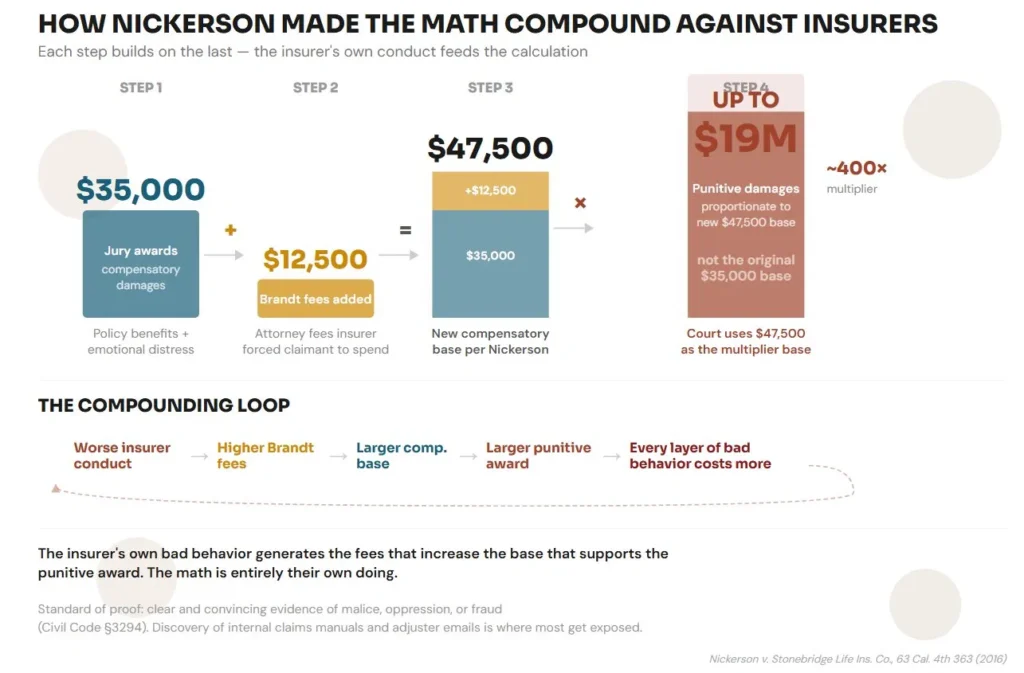
A jury awarded $35,000 in compensatory damages and $19 million in punitive damages. The ratio looked extreme. But the California Supreme Court held that Brandt fees, $12,500 in this case, get added to the compensatory damages base when courts calculate whether the punitive award is constitutionally proportionate.
Think about what that means practically. The insurer’s own bad behavior generates the Brandt fees. Those fees increase the compensatory base. The larger compensatory base supports a larger punitive award. The worse the insurer acts the more it costs them on every level and the math compounds in a way that is entirely the insurer’s own doing.
Allstate v. Tran: Where the Court Drew the Line on Brandt Fees
Allstate Northbrook Indemnity Co. v. Tran, No. 2:24-cv-00560-TLN-JDP (E.D. Cal. 2025).
Not every bad faith argument works and understanding the boundaries matters as much as understanding the tools.
Allstate declined a $250,000 policy limit demand following a car accident caused by its insured. The claimant went to trial and got a $3.8 million judgment. Allstate then paid its $250,000 policy limit in partial satisfaction.
The insured and the claimant sought Brandt fees arguing that the failure to settle within policy limits constituted bad faith and the excess judgment was a damage flowing from it.
The court said no.
Brandt fees apply to fees incurred to obtain policy benefits, the money the insurer contractually owed under the policy. An excess judgment beyond policy limits is not a policy benefit. It is a separate category of damage and Brandt does not reach it.
The distinction is clean. You can recover Brandt fees for the fight to get what the policy promised. You cannot use them for every cost tied to an insurer’s misconduct. The tool is powerful but it has edges and this case defined one of them.
What the Adjuster on the Phone Is Actually Doing
Worth understanding because most people do not.
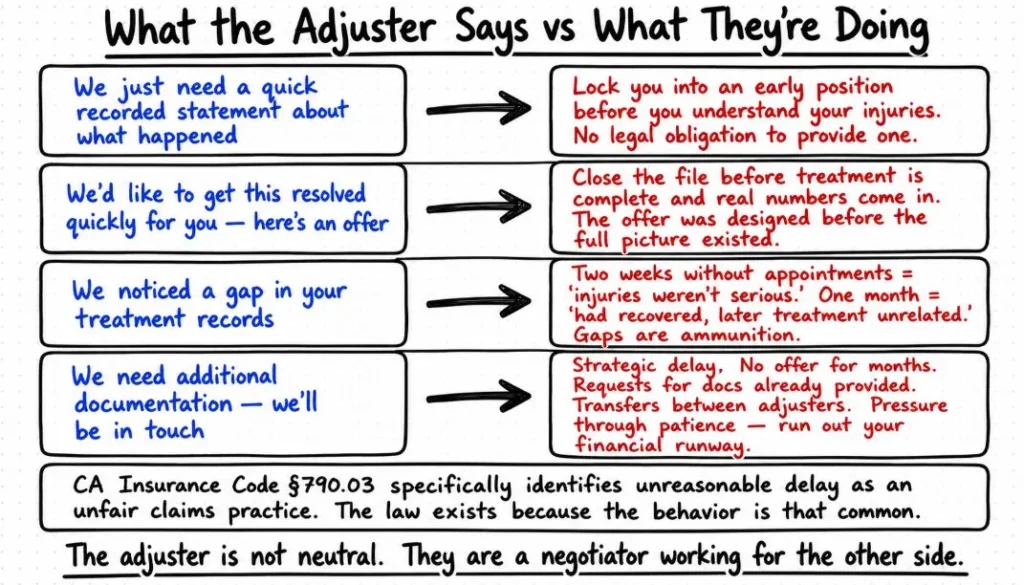
The adjuster who calls after an accident is not neutral and not an evaluator. They are a negotiator working for the other side and every conversation is part of the negotiation whether the claimant realizes it or not.
The recorded statement. Adjusters ask for these early, before you understand your injuries, before treatment is complete, sometimes before you have even seen a specialist. Anything said gets transcribed and filed and used later to argue the claim is exaggerated or inconsistent. There is no legal obligation in California to provide a recorded statement to the other driver’s insurer. None.
The early offer. An offer that arrives before treatment is complete and before full losses are known is not generosity. It is a calculation. What can the insurer pay right now to close the file before the real numbers come in? Accept it and you are almost certainly leaving money on the table because the offer was designed before the full picture existed.
The gap argument. Insurers track gaps in medical treatment the way auditors track financial irregularities. A two-week break between appointments becomes “the claimant’s injuries were not serious enough to require consistent care.” A month without treatment becomes “the claimant had recovered and subsequent treatment was unrelated to the accident.” Consistent treatment creates a medical timeline that connects the crash to the diagnosis and gaps in that timeline give the adjuster ammunition to use against you.
The delay itself. Sometimes the tactic is not a lowball offer but no offer at all. Months of silence. Requests for documentation that was already provided. Transfers between adjusters who each need to “get up to speed.” The delay is not incompetence, it is pressure. The insurer knows a person dealing with medical bills and lost wages and a damaged car has a finite amount of patience and financial runway. Run that runway out and the claimant accepts whatever gets offered just to make it stop.
California Insurance Code §790.03 specifically identifies unreasonable delay as an unfair claims practice. The statute exists because the behavior is that common.
Filing Deadlines That Eliminate Your Options No Matter How Strong the Case Is
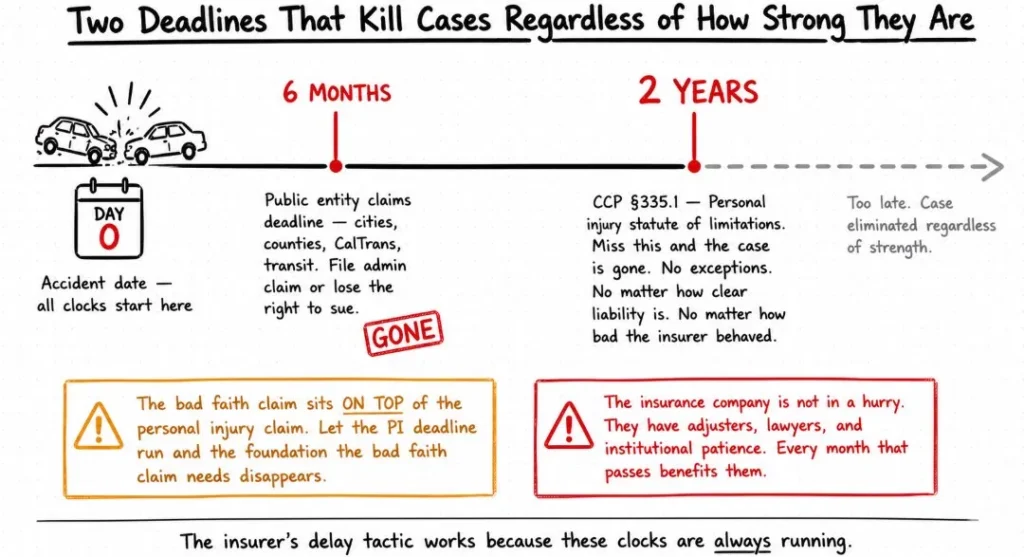
California Code of Civil Procedure §335.1 gives you two years from the date of injury to file a personal injury lawsuit. Miss it and the case is gone regardless of how clear the liability is or how bad the insurer behaved or how severe the injuries are.
Claims against public entities, cities, counties, the state, CalTrans, public transit authorities, have shorter windows. Often six months to file an administrative claim before you can even think about filing suit.
The bad faith claim itself has its own timing problem. Brandt fees and punitive damages require proving the insurer’s conduct was tortious, which means the underlying personal injury claim needs to be solid first. Let the statute of limitations run on the injury claim and the foundation the bad faith case sits on disappears with it.
The insurance company is not in a hurry. They have adjusters and lawyers and institutional patience. Every month that passes without action benefits them.
Not you.
References
- California Insurance Code §790.03 (Unfair Claims Settlement Practices). California Legislative Information.
- California Civil Code §3294 (Punitive Damages). California Legislative Information.
- Neal v. Farmers Ins. Exchange, 21 Cal.3d 910 (1978). Justia.
- Brandt v. Superior Court, 37 Cal.3d 813 (1985). Justia.
- Nickerson v. Stonebridge Life Ins. Co., No. S213873 (Cal. Supreme Court, June 9, 2016). Payne & Fears LLP.
- Allstate Northbrook Indemnity Co. v. Tran, 2025 WL 2610048 (E.D. Cal. Sept. 10, 2025). National Law Review.
- California Code of Civil Procedure §335.1 (Statute of Limitations — Personal Injury).