 Mohammad Abdel-Rahman Accident & Injury Lawyer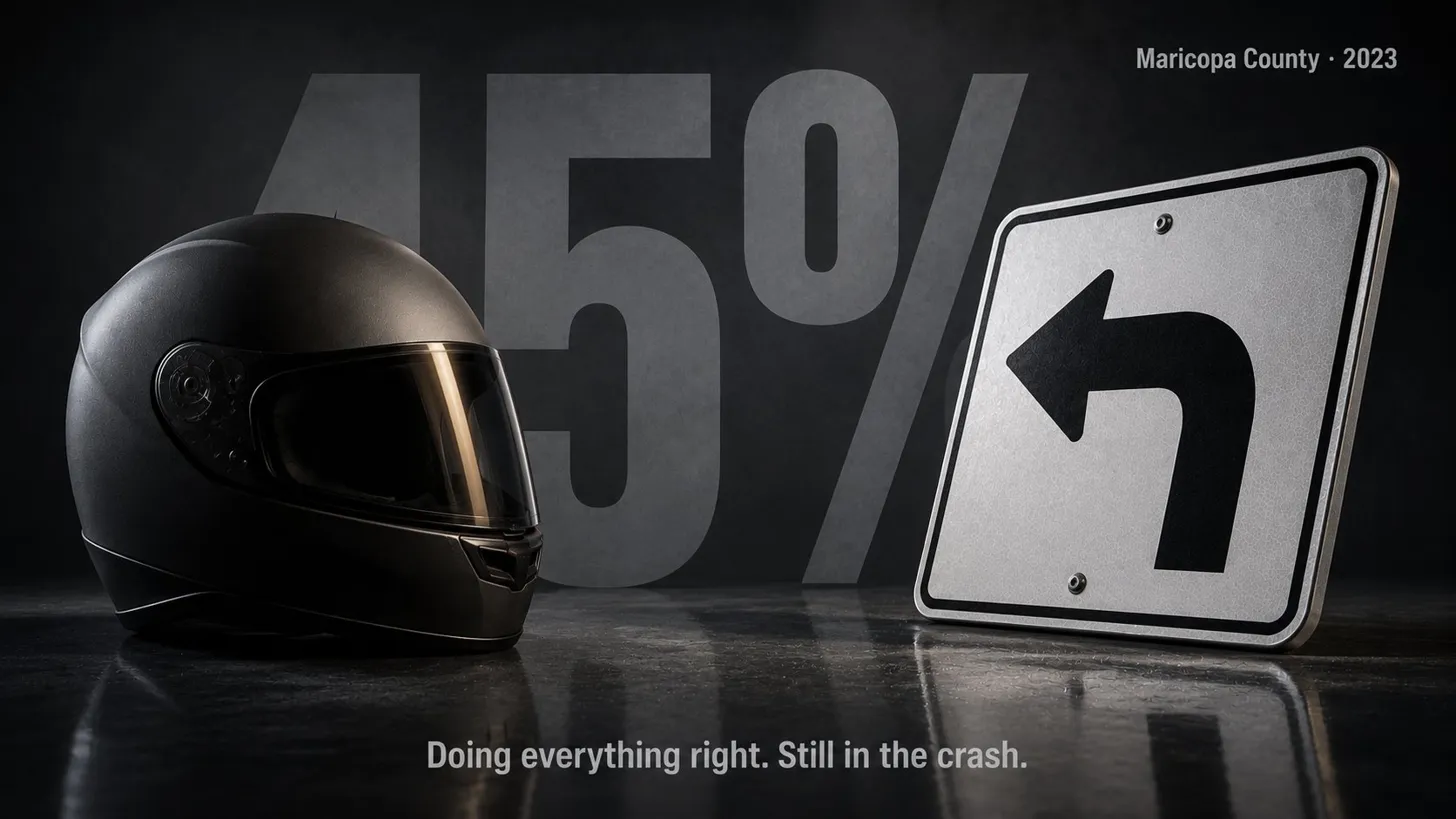
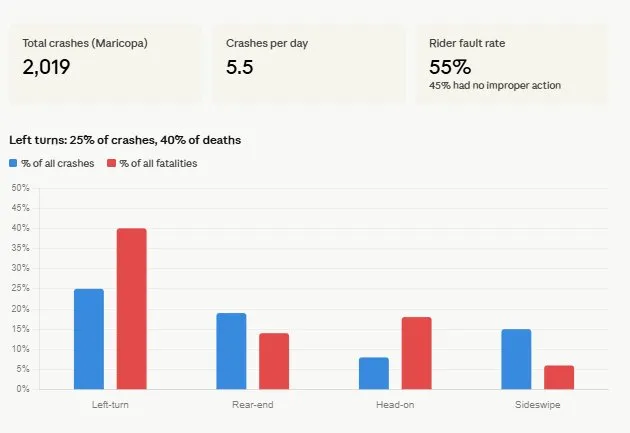
Maricopa County recorded 2,019 motorcycle crashes in 2023. That’s an average of 5.5 per day — one roughly every four and a half hours — in a single county. Nearly 64% of every motorcycle crash in Arizona that year happened here.
Phoenix alone logged 37,472 total traffic crashes in 2024. One every 14 minutes. Motorcycle crashes peaked between 4 PM and 5 PM, right when afternoon traffic builds and visibility starts dropping. Mesa lost 16 motorcyclists that same year — nearly half of all traffic deaths in the city were riders.
And here’s the number that should bother everyone: 45% of motorcyclists involved in crashes in 2023 committed no improper action. They were following the speed limit. They were obeying traffic signals. They were doing everything a rider is supposed to do. They still ended up in a crash because someone else made a mistake.
Left Turns Are Killing Riders at Twice the Expected Rate
If one data point explains why motorcycle crashes produce fatalities at rates wildly disproportionate to their share of total crashes, it’s this one.
Left-turn collisions made up roughly 25% of all motorcycle crashes in Arizona in 2023. Standard enough — it’s a common crash type across all vehicle categories. But those same left-turn crashes accounted for 40% of all motorcycle fatalities.
The mechanics are straightforward and brutal. A car or truck turns left across an intersection. The driver either doesn’t see the oncoming motorcycle or misjudges its speed. The rider hits the turning vehicle broadside, or gets hit broadside, at full intersection speed. There’s no crumple zone. No airbag. No steel frame absorbing the impact.
Rear-end crashes were the second most common — 600 incidents, 35 rider deaths. A car slamming into the back of a motorcycle at even moderate speed launches the rider off the bike. At highway speeds, the survival odds drop sharply.
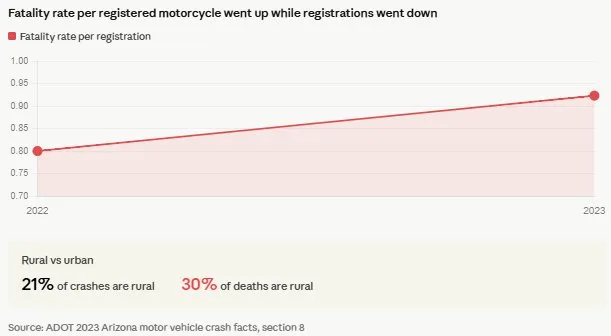
Motorcycles represent roughly 3% of registered vehicles in Arizona but account for 14% of all traffic deaths statewide, and that ratio has held steady for years. The fatality rate per registered motorcycle actually went up 15.4% between 2022 and 2023 — from 0.800 to 0.923 — even though the total number of registered motorcycles went down.
More riders dying while fewer motorcycles are on the road. That’s the part of the data that doesn’t get talked about enough.
Arizona’s Helmet Law Gap
Arizona Revised Statutes § 28-964 requires DOT-approved helmets for riders and passengers under 18 only. Adults ride without legal obligation to wear one. Arizona is one of 28 states without a universal helmet requirement.
NHTSA data from the Fatality Analysis Reporting System is consistent on this: unhelmeted riders are more than three times as likely to die in a crash compared to helmeted riders. Arizona’s above-average motorcycle fatality rate correlates directly with this policy gap.
This isn’t a political argument about personal freedom — it’s a legal one. When a crash goes to court, the defence will argue comparative fault. Arizona’s pure comparative negligence system under A.R.S. § 12-2505 means a jury can reduce the rider’s compensation by whatever percentage of fault they assign. If a rider wasn’t wearing a helmet and sustained a head injury, the defendant’s attorney will argue that the severity of the injury — not the crash itself — was partly the rider’s responsibility.
Whether that argument succeeds depends on the evidence and the jury. But it comes up in almost every Phoenix motorcycle case where the rider wasn’t helmeted and sustained head or brain trauma. Being aware of how helmet choice interacts with comparative fault isn’t about telling riders what to wear — it’s about understanding what happens legally after a crash.
Pure Comparative Negligence — Why Arizona’s System Helps Riders
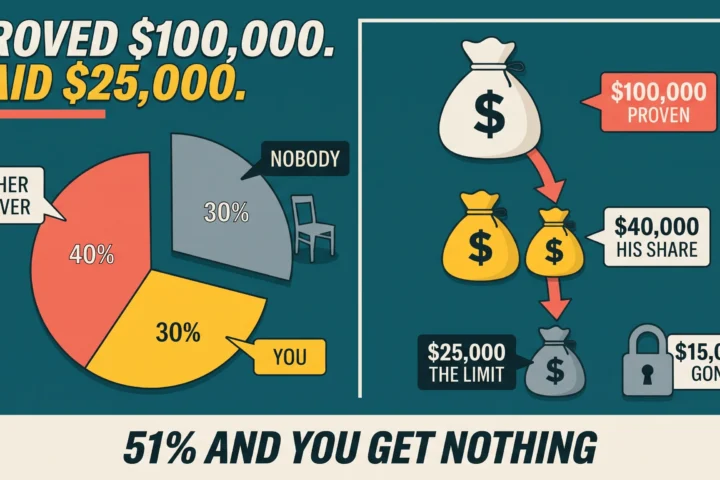
Unlike modified comparative negligence states (like Florida after its 2023 tort reform, where being 51% at fault bars recovery entirely), Arizona has no threshold. Under A.R.S. § 12-2505, a rider who is 80% at fault can still recover 20% of their damages.
That matters specifically because of the bias problem. Insurance adjusters and defence attorneys routinely argue that motorcyclists are inherently riskier road users. In jurisdictions with a 50% or 51% fault bar, pushing a rider’s assigned fault past that threshold eliminates the entire claim. Arizona doesn’t allow that — every percentage point of the other party’s fault translates to recoverable compensation.
But pure comparative negligence is a double-edged thing. It also means the defendant will fight over every single percentage point of fault attribution, because each point reduces their payout. If the rider was going 5 over the limit, if the rider wasn’t wearing a helmet, if the rider changed lanes without signalling — every detail gets scrutinised to shift fault percentages.
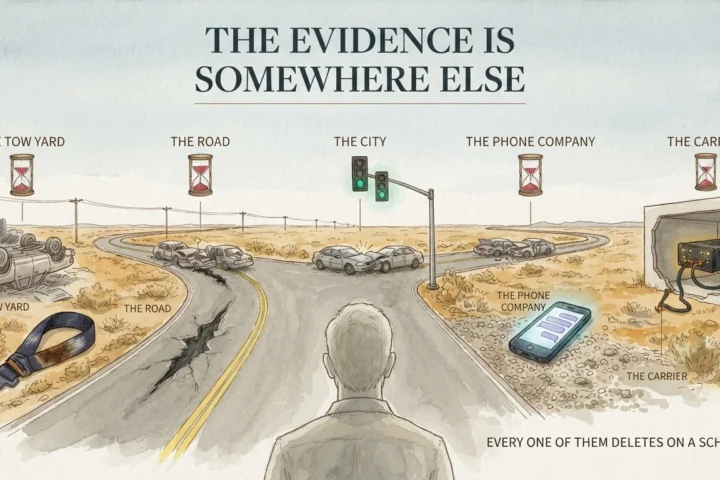
The evidence that determines those percentages — scene photos, witness statements, surveillance footage, the vehicle’s event data recorder — needs to be collected in days, not months. The statute of limitations under A.R.S. § 12-542 gives you two years to file suit, but the evidence that actually wins the case has a shelf life measured in hours.
The Insurance Problem Riders Don’t See Coming
Arizona’s minimum liability insurance requirements are the same for motorcycles as for cars:
- $25,000 per person for bodily injury.
- $50,000 per accident for bodily injury.
- $15,000 for property damage.
A motorcycle crash that results in a traumatic brain injury, spinal damage, or multiple fractures will blow past $25,000 in medical bills within the first hospital admission. A single surgery can exceed the entire per-person limit. An ICU stay of a few days will triple it.
If the at-fault driver is carrying only minimum coverage — and a significant number of drivers in Maricopa County are — the policy limit becomes the ceiling regardless of how severe the injuries are. The rider can sue for more, but collecting from an individual driver beyond their insurance limit is a separate problem that often yields nothing.
Uninsured/underinsured motorist (UM/UIM) coverage on the rider’s own policy is what fills that gap. Arizona doesn’t require it, but riders who carry UM/UIM at higher limits — $100,000/$300,000 or above — protect themselves against the scenario where the person who hit them can’t pay for the damage they caused.
Most riders don’t think about their own policy limits until after the crash. By then the policy is already written and the limits are fixed.
Where Phoenix Motorcycle Crashes Concentrate
ADOT crash data consistently flags the same corridors. Loop 101, Loop 202, I-10, I-17, US-60, and major arterials including Bell Road, Camelback Road, Thomas Road, McDowell Road, and Van Buren show up repeatedly as high-crash zones.
The West Valley — Buckeye, Goodyear, Avondale, Surprise — has seen motorcycle fatalities climb as population growth outpaces road infrastructure improvements. New residential developments generate traffic volumes that the existing road network wasn’t designed for.
Weekend mornings on I-17 northbound are a particular risk window. Recreational riders heading toward Sedona and Prescott share the highway with commercial trucks and passenger vehicles. Speed differentials between riders accelerating through curves and slower-moving traffic create exactly the conditions that produce high-severity crashes.
And rural stretches carry their own maths. Only 21% of Arizona motorcycle crashes in 2023 happened in rural areas — but those crashes produced 30% of motorcyclist deaths. Longer EMS response times, higher average speeds, and fewer trauma centres turn survivable urban crashes into fatal rural ones.
What Happens in the First 72 Hours After a Crash
The legal outcome of a Phoenix motorcycle crash is often determined by what happens before any attorney gets involved. The first three days matter more than the next three months.
Evidence disappears fast. The gas station camera that caught the intersection? Overwrites in 7-14 days. The dashcam of the car behind you? Owner might format the card this weekend. The skid marks on the road? Gone after the next rainstorm or street sweeper pass.
Insurance adjusters work fast too. The at-fault driver’s insurer will contact the rider — often within 24-48 hours — looking for a recorded statement. Anything the rider says in that conversation can be used to argue contributory fault later. “I didn’t see them coming” becomes evidence of inattention. “I think I was going about 40” becomes an admission that gets compared against the posted limit.
Medical documentation creates the causal link. Delaying medical treatment — even by a few days — gives the defence a gap to argue that the injuries weren’t caused by the crash or weren’t as severe as claimed. ER records from the day of the crash establish the baseline. Follow-up appointments establish the trajectory.
A Phoenix motorcycle accident attorney who handles Maricopa County cases will typically send spoliation letters to preserve surveillance footage and vehicle data within the first week, coordinate with law enforcement for the full accident report, and advise the rider on how to handle insurer contact before any recorded statement is given. The two-year filing deadline under Arizona law feels distant on day one, but the evidence that builds or breaks the case is already degrading.
Arizona’s Constitutional Prohibition on Damage Caps
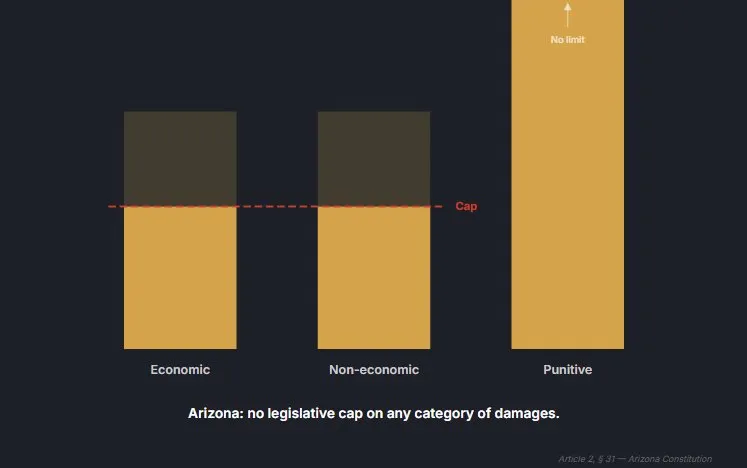
One final thing that makes Arizona different from most states in motorcycle litigation. Article 2, Section 31 of the Arizona Constitution prohibits the legislature from placing any cap on the amount of damages recoverable in personal injury or wrongful death cases.
No cap on economic damages. No cap on non-economic damages. No cap on punitive damages when the evidence supports them.
In a state where motorcycle crashes account for 14% of traffic deaths and the at-fault party is overwhelmingly another driver, that constitutional protection means there’s no artificial ceiling on what a jury can award. The case is worth what the evidence proves it’s worth — the severity of the injuries, the degree of the defendant’s fault, and the impact on the rider’s life going forward.
That protection only means something if the evidence exists to support the claim. Which brings everything back to the first 72 hours.
References
- ADOT, 2024 Arizona Motor Vehicle Crash Facts — https://azdot.gov/sites/default/files/2025-07/2024-Crash-Facts.pdf
- ADOT, 2023 Arizona Motor Vehicle Crash Facts — Section 8: Motorcycle Crashes. 3,165 total motorcycle crashes, 258 fatalities, 2,019 in Maricopa County.
- Arizona Revised Statutes § 12-2505 — Pure comparative negligence.
- Arizona Revised Statutes § 12-542 — Two-year statute of limitations for personal injury.
- Arizona Revised Statutes § 28-964 — Helmet requirement for riders under 18 only.
- Arizona Constitution, Article 2, Section 31 — Prohibition on legislative caps for personal injury damages.
- NHTSA FARS Data — unhelmeted riders three times more likely to die in crashes than helmeted riders.
- NHTSA early estimates, Q1 2025 — 6.3% national decline in motor vehicle fatalities; Arizona 4.7% reduction.