 Mark Scott
Iris Spencer was a 45-year-old who went to Lankenau Medical Center in February 2021 for a uterine biopsy.
When the slides were processed in the lab, the results were read as showing uterine cancer.
Following her diagnosis, her doctors advised a total hysterectomy, the removal of the uterus. Remove the cancer before it spreads. Spencer agreed. After signing consent forms, the operation was scheduled for March 2021.
The trouble was that Spencer made this decision without knowing something.
A second-opinion biopsy had been performed at Penn Medicine, and those results were read as negative. No cancer detected.
The treating physician had the negative result and did not inform Spencer of this prior to the surgery.
She went in the operating room and thought she had cancer. She did not.
The Surgery Happened. The Pathology Confirmed She Never Needed It
The hysterectomy was performed in March 2021, and post-operative pathology (laboratory examination of the tissue actually removed) confirmed what the second biopsy had already shown.
No cancer was present.
The entire surgical decision depended on the original biopsy being positive for cancer; those slides were contaminated with DNA from a different person. The diagnosis was wrong from the start.
Spencer had a hysterectomy, going into surgically-induced early menopause at 45 years old. The hormonal changes, the potential bone density risks, the cardiovascular risks, the symptoms she’d have for her whole life, all of it from a surgery that would not have happened if someone had told her about the negative second opinion before she signed the consent form.
In November 2025, a Philadelphia jury awarded a $35 million verdict against Penn Medicine and Main Line Health.
Under Pennsylvania law, was the physician required to disclose the negative second biopsy before performing the hysterectomy?
Yes.
Under Pennsylvania’s MCARE Act (Medical Care Availability and Reduction of Error Act, 40 P.S. § 1303.504), doctors must obtain informed consent before a patient can undergo surgery, radiation treatment, chemotherapy, or blood transfusions, and that consent must be based on “meaningful dialogue” with the patient.
Meaningful dialogue is not just a clipboard with a signature line.
The material risks of the procedure, the available alternatives, and the information that a reasonable person in the patient’s position would need in order to evaluate the risks and benefits of the procedure are the touchstones of informed consent. A second biopsy result that contradicts the original cancer diagnosis is not a footnote. It is the single most important piece of information the patient could receive before deciding whether to have her uterus removed.
The jury in Spencer found that the doctor didn’t meet the standard. The negative result existed. The doctor had it. The patient was not made aware of it until after the operation was done and the pathological results came back confirming the second biopsy.
The Contamination That Started Everything
The original biopsy slides with another person’s DNA on them are a lab error, a specimen handling failure at the pathology level. Contaminated slides resulting in a false cancer diagnosis is a systems failure beyond one physician’s decision not to disclose the second result.
But the informed consent violation is separate from the lab error.
Even if the first biopsy had been a perfect test and still showed cancer, the contradictory second result would create an obligation to disclose: Two tests, two different answers. The patient has to know that before deciding what to do next. Maybe she gets a third opinion. Maybe she asks for more imaging. Maybe she decides to go through with the hysterectomy anyway, but with full understanding that the diagnostic picture is not as clear as she was led to believe.
Spencer was denied all of those options because the contradictory evidence was not disclosed.
If something similar happened to you in Pennsylvania, how long do you have to act?
Two years. Under the general Pennsylvania statute of limitations for medical malpractice (42 Pa.C.S. § 5524), you have two years from the date you knew or should have known about your injury. Like many other states, Pennsylvania follows the discovery rule, which provides that the statute does not start running until the patient knew or should have known of the connection between the medical care and the injury.
There is also a hard outer wall, the seven-year statute of repose imposed by the MCARE Act at 40 P.S. § 1303.513. After seven years have elapsed since the treatment, the statute of repose operates even if the patient did not know of the problem. Exceptions exist for foreign objects left in the body and for cases concerning minors, but seven years is the maximum for most adults.
Spencer’s surgery was in March 2021. The verdict was given in November 2025. Four years and eight months. Inside both deadlines, but not by a comfortable margin.
The 60-Day Requirement Most Patients Find Out About Too Late
Pennsylvania has a procedural step that is not present in most states, and it kills cases when plaintiffs miss it.
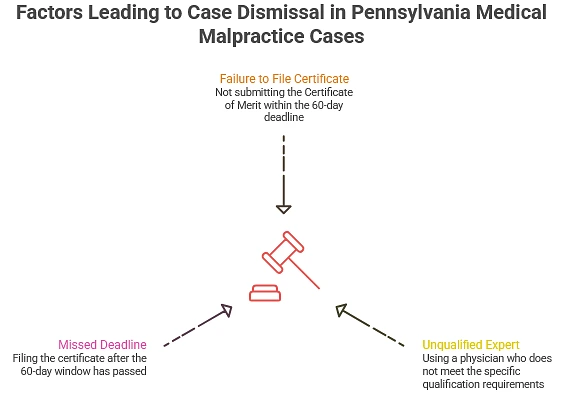
Under Pa.R.C.P. 1042.3, a plaintiff must file a Certificate of Merit within 60 days of filing a medical malpractice complaint. It is a written statement of a physician declaring the medical care provided by the defendant fell below the standard of care and that it caused the injury.
Not just any old family doctor saying they think something went wrong. The witness must be a physician in the same or substantially similar specialty as the defendant. They must have a full, unrestricted license and have practiced or taught in that specialty within the past five years. As MCARE Act § 1303.512 provides the qualification requirements, courts dismiss cases when the certifying expert does not meet them.
Fail to file the certificate within 60 days? The case is dismissed. File a certificate from an unqualified expert? Also dismissed. File it on time with a qualified expert? The case continues.
This explains why early malpractice lawsuit help matters more in Pennsylvania than in other states. The lawyer must have time to get the complete medical records, find an appropriate expert in the same medical specialty, submit the records to that expert for review, get a written statement, and file the certificate, all within that critical 60-day window. To accomplish all that in 60 days after the complaint is filed means that the process must start well ahead of the lawsuit, in other words, attorneys must be involved well in advance of the statute of limitations expiration.
Waiting until month 23 of a 24-month limitations period to contact a lawyer gives little time to complete the COM process before the deadline.
House Bill 2088 Would Make the Certificate of Merit Even Harder to File
As of December 2025, Representative Bryan Cutler has introduced HB 2088, a bill to further amend the MCARE Act to tighten Certificate of Merit standards.
The bill would require plaintiffs to file the contact information and curriculum vitae of the certifying physician. It would also set requirements for the certifying expert: a current Pennsylvania license, active practice or teaching, and board certification within a relevant medical specialty.
An expert who has a license to practice medicine in any state may act under the current law, but it would have to be a Pennsylvania-licensed physician under the proposed bill, which may reduce the number of available experts and make the 60-day window even harder to meet.
HB 2088 has not passed yet, but it seems that the legislature is leaning toward raising the procedural barriers rather than lowering them.
What the Spencer Verdict Tells You About Informed Consent in Pennsylvania
That number belongs to one case with egregious facts: a contaminated biopsy, a withheld second opinion, and an unnecessary hysterectomy. Not every informed consent case will yield a $35 million verdict.
But the principle underneath applies broadly. If a physician knew facts that would have affected the patient’s decision whether to proceed with a procedure, and did not disclose them, then the physician failed to obtain informed consent under the MCARE Act even if the patient signed the form. The form is irrelevant if the information behind it was incomplete.
Consent given without the full picture is not consent. That was true before Spencer and it remains true after. This is a case that put a $35 million price tag on what happens when a physician decides the patient does not need to know everything the physician knows.