 Dominique ( Personal Injury )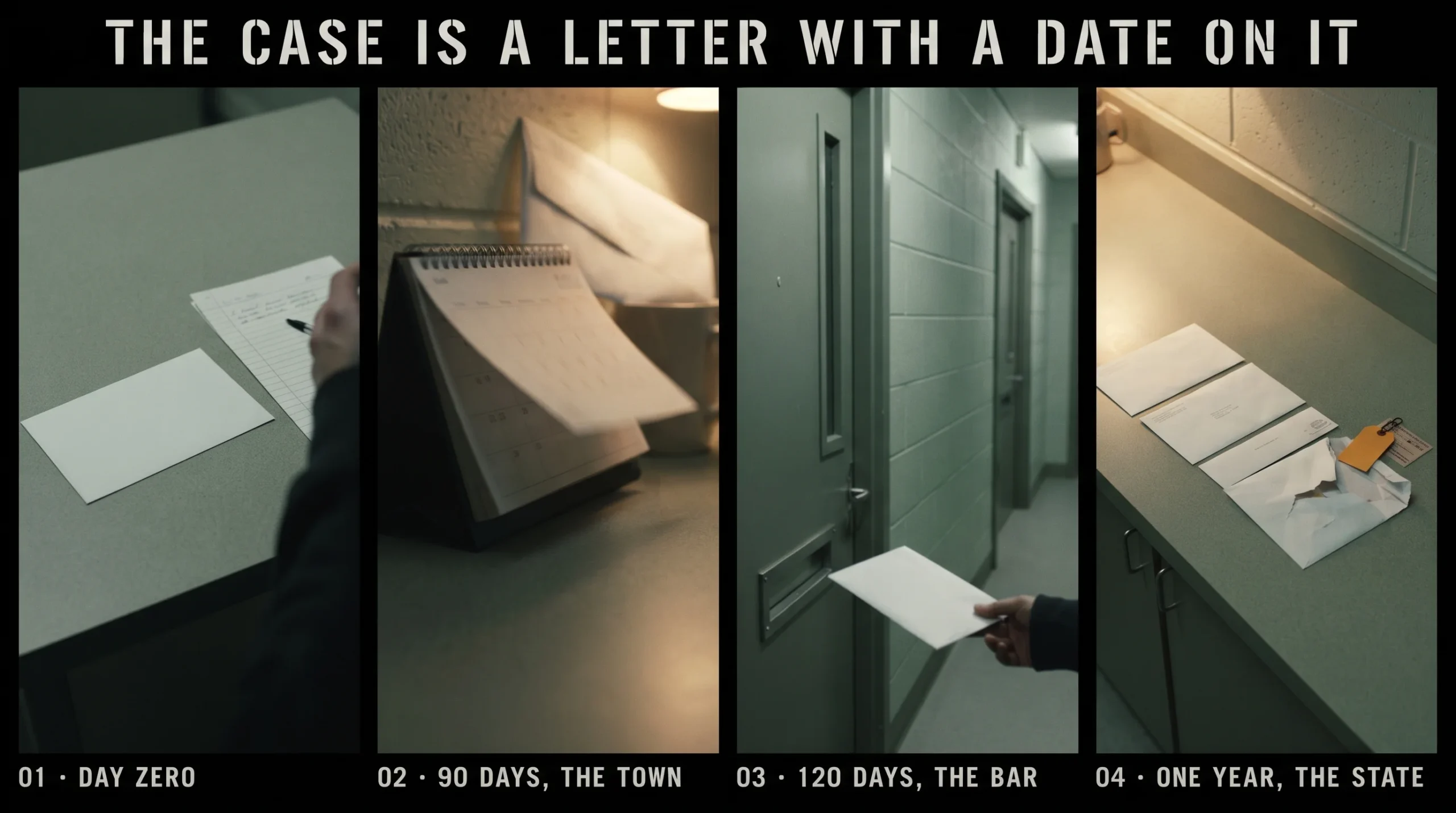
Most people who visit a Connecticut injury lawyer have already decided who they want to sue. The boss, the bar, the town, the hospital. And a good share of them hear, in the first ten minutes, that the lawyer cannot file that case, at least not the way they were picturing it, because a statute in this state says so and the lawyer is not being cautious when he says it.
There are seven of these in Connecticut, eight if you count the drunk driver’s own claim against the bar that served him. Four of them carry a deadline shorter than the two years everyone assumes they have, so they are worth reading before the lawyer’s appointment rather than after.
- Deadlines shorter than two years in this list: 90 days, 120 days, one year and “before you file”.
Your Injury At Work Cannot Be Filed Against Your Employer
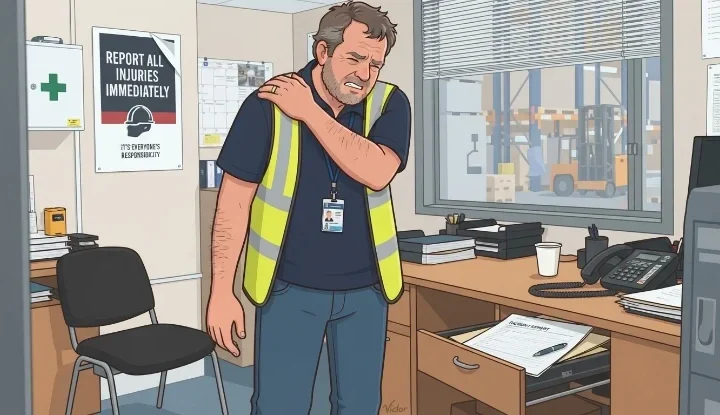
You were hurt on the job because the employer skipped something it should not have skipped. A guard off a machine, a ladder that should have been thrown out a year ago. Anywhere else that would be a negligence case, but at work in Connecticut the lawyer cannot bring one.
General Statutes 31-284(a) makes worker’s compensation the exclusive remedy for a workplace injury. The employer pays into the comp system and in exchange it cannot be sued for negligence, however bad the negligence was. Granted, there is one way around it, an employer who meant to hurt you, which the Supreme Court set out in Suarez v. Dickmont Plastics and it is as rare as it sounds.
Admittedly, comp money is smaller. It pays medical bills and a share of wages and nothing for pain. What the lawyer can do is run the comp claim properly and look for a third party, the machine’s maker, a contractor on site, a driver who was not a co worker, because those can still be sued.
A Co Worker Who Hurt You Cannot Be Sued Either, Unless He Was Driving
Same rule, one step further. Under General Statutes 31-293a a fellow employee is immune from your negligence suit for a workplace injury, so a lawyer cannot file against the forklift operator or the colleague who dropped the pallet.
Two exceptions. Either the co worker hurt you with a motor vehicle or he did it on purpose. The motor vehicle one matters more than it sounds, since a crash in the company truck between two employees is a normal car case, not a comp case and the other driver can be sued.
The Bar That Served The Drunk Driver Cannot Be Sued For Negligence, Only Under The Dram Shop Act
This surprises people more than any other item here and it is what I went over with James Harrington, Connecticut personal injury lawyer at Polito & Harrington LLC, who had the same view of it as I do.
A drunk driver hits you. The bar had been serving him for three hours after he was visibly drunk. We all assume the bar can be sued for that carelessness like anyone else. In Connecticut it cannot. The Supreme Court held in Quinnett v. Newman, 213 Conn. 343 (1990), that there is no common law negligence claim against a seller of alcohol for serving an intoxicated adult and when the court briefly reopened that door in 2003 the legislature shut it again the same year. The Appellate Court applied Quinnett again in Spiotti v. Clarke in 2025, so it is current law.
What exists instead is the Dram Shop Act, General Statutes 30-102 and it comes with three conditions that an ordinary injury claim does not have:
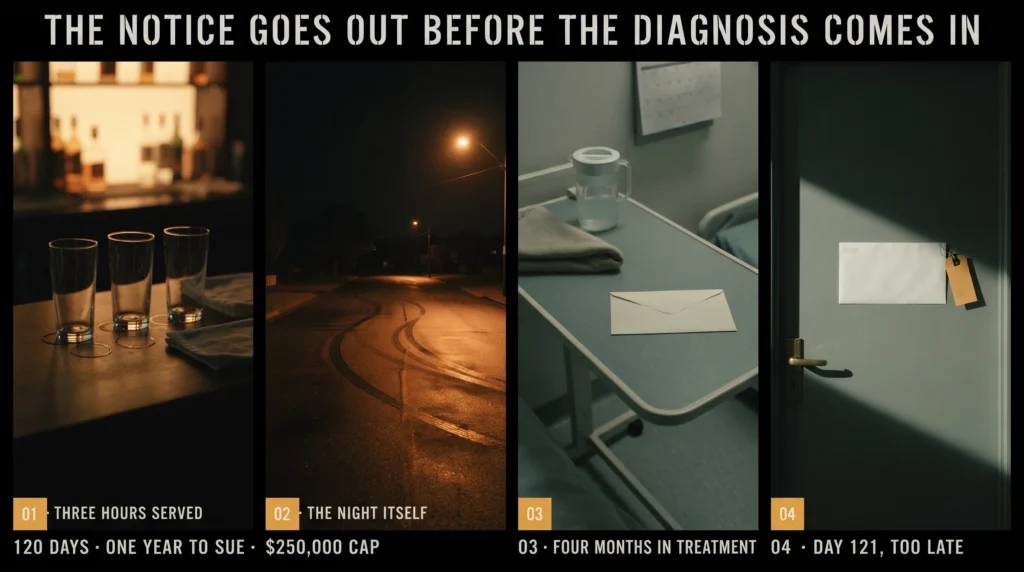
- written notice to the bar within 120 days of the crash, 180 if someone died
- a one year limit to sue, not two
- a cap of $250,000 on what the bar pays, however badly you were hurt, unless the serving was reckless
Neither the notice nor the one year can be fixed afterward. Unfortunately, a person who spends four months in treatment and then goes looking for a lawyer has already lost the bar as a defendant. If a drunk driver hit you in Connecticut, the 120 day letter to the bar is the first thing that has to go out, before the medical picture is clear, before anything else.
And the drunk patron himself cannot use the Act for his own injuries. The lawyer has to say no to him outright.
The State Of Connecticut Cannot Be Sued Until The Claims Commissioner Says So
A state plow truck, a state road, a UConn Health doctor, a DOT crew. True, the State is not the defendant in most crashes, but when it is, the lawyer cannot file in Superior Court. Sovereign immunity. Under General Statutes 4-160 the claim goes first to the Claims Commissioner, a state official who decides whether permission to sue is granted at all and a notice of claim has to be filed with that office within one year of the injury.
So what your lawyer is doing in the first weeks is sending a notice of claim to that office and after that both of you are waiting and the wait can be long and the answer can be no. If the State hurt you, you have one year to get that notice in and the two year limit you read about everywhere does not apply to you.
A Town Cannot Be Sued Over A Road Defect Except Through One Statute And Inside 90 Days
Say you fell because of a pothole on a town road or a sidewalk slab that a tree root had pushed up or ice the town never treated. You cannot sue the town for negligence over that in Connecticut and your lawyer cannot file it for you. General Statutes 13a-149, the highway defect statute, is the only way a claim like this can be brought and the courts have been turning away the other kind for a long time.
The statute also has a notice rule in it and more people lose their claim on this rule than on anything else in this article. You have to send the town a written notice within 90 days that says what the injury was, what the defect was and when and where it happened. If that notice has not gone out by day 90, the claim is over and a lawyer who first hears from you in the fourth month cannot do anything about it. Although the courts have allowed some room when a notice was sent on time but had a mistake in it, they have allowed none when it was late.
For a fall on a town road or sidewalk, the 90 day letter is the case and everything else comes after it.
Medical Malpractice Cannot Be Filed Without A Doctor’s Opinion Letter
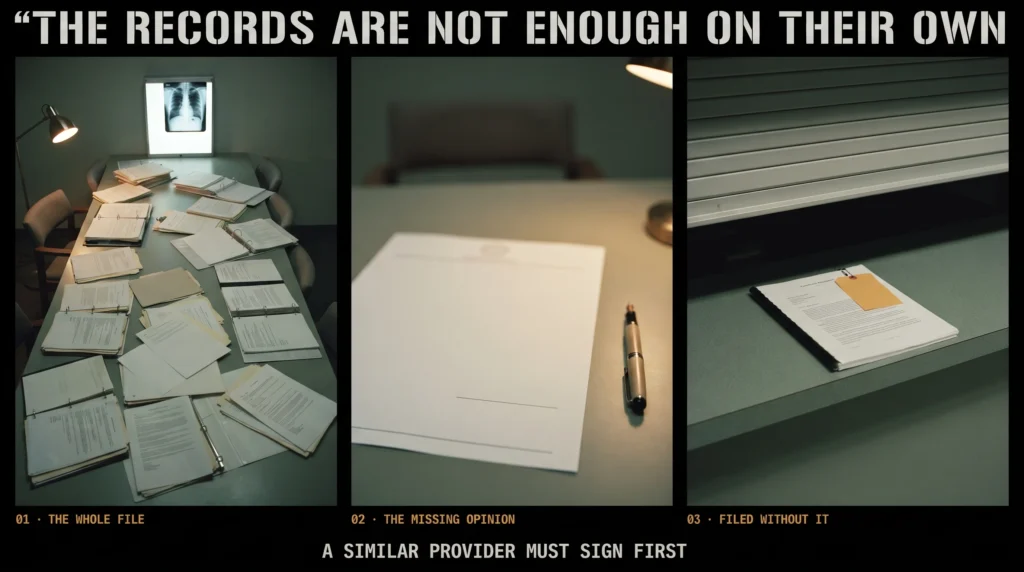
A lawyer cannot file a malpractice suit in Connecticut on the strength of your story and the records. General Statutes 52-190a requires that before the complaint is filed, the lawyer has made a reasonable inquiry and obtained a written opinion letter from a similar health care provider, a doctor in the same specialty, saying there appears to be evidence of medical negligence and that letter gets attached to the complaint. No letter and the court dismisses the case.
So the first months of a malpractice matter are spent finding that doctor and paying for that opinion, which is why the lawyer will not file quickly and will not promise to. If a lawyer says a malpractice case can be filed next week, he either has the letter already or he does not understand the rule.
A Product Injury Cannot Be Filed As Ordinary Negligence
A ladder that failed, a car seat that came apart, a space heater that caught. The lawyer cannot bring those as plain negligence claims. General Statutes 52-572n makes the Connecticut Product Liability Act the exclusive remedy for harm caused by a product, so the claim has to be pleaded under the Act, with it’s own elements and it’s own three year limit from the date of injury.
That is a rule about how the claim gets written rather than whether it exists, but it matters, because a complaint drafted as negligence against the maker gets struck and the time spent on it is gone.
What Each One Means On The Day, In One Table
Indeed, the list looks like seven separate rules and on the day they come down to the same question: what has to be sent and by when.
| Who hurt you | What the lawyer cannot file | What gets filed instead | Deadline that matters |
| Your employer, at work | Negligence suit | Worker’s compensation claim | Notice to employer promptly, claim within one year |
| A co worker, at work | Negligence suit | Comp claim or a car case if he was driving | Same as above |
| The bar that served the drunk driver | Negligence suit | Dram Shop Act claim, capped at $250,000 | 120 days for the notice, one year to sue |
| The State of Connecticut | Suit in Superior Court | Notice of claim to the Claims Commissioner | One year |
| A town, road or sidewalk defect | Negligence suit | Highway defect claim under 13a-149 | 90 days for the notice |
| A doctor or hospital | Complaint without an expert | Complaint with the opinion letter attached | Two years, but the letter first |
| The maker of a product | Negligence suit | Product Liability Act claim | Three years from injury |
A Connecticut accident lawyer handles all seven of these every year. What he is not allowed to do is handle them the way the client expects, as a straight negligence suit against the person who did it and the difference between the two is usually a letter with a date on it.