 Dominique ( Personal Injury )
An adjuster offers $60,000. That is the number that gets repeated to family, the number that makes the decision feel obvious and it is not the amount that ends up in anyone’s account.
The short version: a gross settlement is not a net recovery. Health insurers, Medicare, Medicaid, hospitals and worker’s compensation carriers may all have repayment rights against the same money and those get sorted out after you sign, not before. Which is why the question worth asking early is not what the case is worth. It is what is still unknown.
Four things that tend to decide how this goes:
- Whether anyone has counted the losses that are not medical bills.
- Whether treatment is finished, because signing while it continues means eating whatever comes next.
- Whether your own share of fault is in dispute and Florida bars recovery entirely past 50 percent.
- Whether evidence still exists, since video usually does not survive it’s first month.
Everyone who paid for your care may want it back out of the settlement
Say the offer is $60,000 and you take it. Before that money is yours, a set of other parties can assert claims against it and most people discover the list at the point where it is too late to factor into the decision.
Private health insurers assert reimbursement through subrogation, which is provided for in Florida’s collateral source statute at F.S. 768.76. If your coverage runs through a self-funded employer plan governed by ERISA, federal law can override the state protections that would otherwise limit what the plan takes and those plans tend to be the most aggressive of the lot. Medicare operates under the federal Medicare Secondary Payer framework and it’s recovery is not really negotiable, with failure to satisfy it capable of producing double damages. Florida Medicaid has it’s own recovery rights, though those are generally limited to the portion of a settlement allocated to past medical expenses rather than the whole thing. Hospitals may hold their own liens. If the injury happened at work, the compensation carrier is in line too.
Two doctrines cut the other way and are worth knowing you have. Under Florida’s made whole principle, an insurer generally cannot recover through subrogation unless the injured person has been fully compensated first, so a settlement that does not cover the actual losses may limit or wipe out the reimbursement claim. And under the common fund doctrine, a lienholder collecting from a recovery your attorney created can be required to carry a proportional share of the fees and costs, which reduces the lien.
None of that is a reason to panic about liens. It is a reason to know the lien picture before agreeing to a number rather than after, because “what is this worth” and “what do I keep” are questions with different answers and only one of them pays the mortgage. The Anidjar & Levine Fort Myers personal injury resource runs through several kinds of injury claims and what documentation does in each of them, which is a reasonable place to start if you are trying to work out which category yours falls in.
Signing while you are still in treatment is signing on a guess
A settlement usually closes the claim permanently. You give up the right to come back for more connected to the same event and that is the point of it from the insurer’s side.
So the timing question is really a medical one. If a doctor has not yet said where this ends, nobody in the conversation knows what they are pricing. An injury that resolves in eight weeks and an injury that turns into a surgery consult in month five produce very different numbers and the offer arriving in week three is priced on the version where you get better.
That is also the reason to keep track of the losses that never show up on a medical invoice:
| Usually counted | Frequently missed |
|---|---|
| Emergency room and hospital bills | Reduced hours or a return to work at lower capacity |
| Follow-up appointments and imaging | Mileage and parking for months of appointments |
| Prescriptions | Care or help at home somebody else provided unpaid |
| Days fully missed from work | Treatment a doctor has recommended but you have not had yet |
| Property damage | Work you can no longer do at all |
Save the wage records and the correspondence with your employer. Keep the invoices and the receipts. If a physician recommends further care, keep that recommendation in writing even if the appointment has not happened, because a documented recommendation is evidence of a future cost and a vague memory of one is nothing.
The point is not to attach a dollar figure to every inconvenience. It is that real losses become invisible when nobody wrote them down.
Write it down this week
Memory degrades faster than people expect and it degrades in a specific way that is unhelpful, which is that it gets tidier and more confident while getting less accurate.
Put down what you remember now. Where you were. What was happening in the minute before. Who else was there. Whether there were cameras, an incident report, a repair estimate, photographs anybody took on a phone.
Evidence goes on it’s own schedule regardless of yours. Cars get repaired and the damage pattern goes with them. Floors get cleaned. Equipment gets swapped out. Businesses overwrite surveillance on a loop that is often two or three weeks. People who saw it change jobs and move.
One folder, physical or digital. Not three inboxes, a text thread and the glove compartment.
Do not tidy any of it up to look better. Documentation is useful precisely because it is what happened and altered records get found and destroy the credibility of everything sitting next to them.
Florida stops paying you at 51 percent
People arrive at injury claims assuming fault sits entirely on one side. Insurers do not work from that assumption.
Under Florida Statute § 768.81, fault attributed to the injured person reduces the damages available in a negligence action and for most cases the statute covers, a person found more than 50 percent responsible for their own harm cannot recover at all. Not a reduced amount. Nothing.
A driver makes an unsafe turn and the other car may have been speeding. A property has a genuine hazard on it and there is an argument about whether a reasonable visitor would have spotted it. Both of those are live disputes about percentages and the percentages are the whole case.
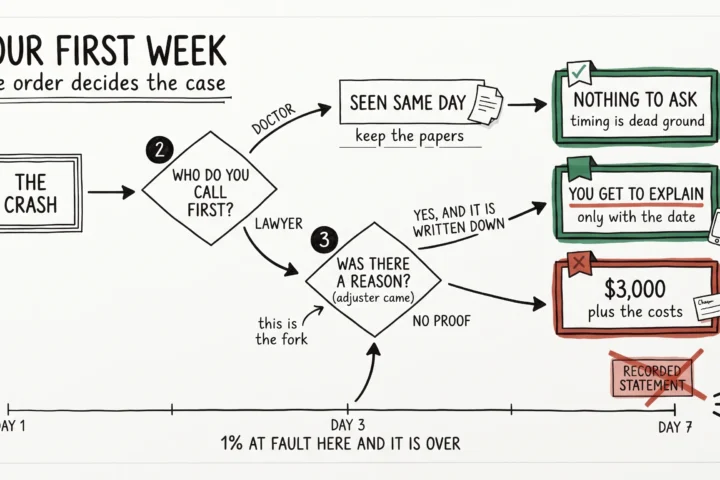
Which makes casual conversation expensive. Describe what you know and leave the rest alone, because a sentence offered helpfully in week one gets held up against photographs and witness accounts later and it does not get to be revised.
The 14-day rule is a car accident rule
Not every injury claim runs on the same track and this catches people who read one article about Florida injury law and apply it to a situation it does not cover.
If the injury came out of a motor vehicle accident, Florida’s Personal Injury Protection statute requires initial medical services within 14 days of the crash for PIP medical benefits to apply. Miss it and the PIP insurer owes nothing on the medical side.
That deadline does not govern a fall in a store, a defective product or most of the other ways people get hurt. Different claim, different rules and treating them as interchangeable is how somebody ends up either panicking about a deadline that was never theirs or missing one that was.
Two years and the useful stuff expires first
Florida’s statute of limitations generally allows two years to commence an action founded on negligence. Medical malpractice, claims against government entities and other categories carry their own procedures and timing, so a deadline should be confirmed for the specific case rather than taken from any general article, this one included.
Two years also sounds like more room than it is. The video is gone by month one. The witness who remembered clearly has moved and half forgotten by month eight. The hazard has been repaired, which is good for everyone walking past it and unhelpful for proving it was there.
If you are weighing representation, the Florida Bar’s consumer resources cover working with lawyers generally and the Statement of Client’s Rights is worth reading before signing any contingency fee agreement, because it sets out what you are entitled to expect from that arrangement.
A fast offer is not generosity and it is not an insult either, it is arithmetic. The adjuster is buying certainty at a discount and the discount is largest in the exact window when you have unpaid bills, no income and no idea yet how your back is going to feel in March. That is not a coincidence in the timing. It is the timing.
This article provides general information about Florida law and is not legal advice for an individual case.