 Mark Scott
Useful Points:
- The initial client consultation requires a full intake procedure to record particular claims about nursing home mistreatment or negligence which occur in Atlanta.
- Lawyers start their work by collecting essential proof which includes medical documents and incident reports and photographic evidence and initial witness accounts.
- The investigation team conducts planned interviews with family members and nursing home personnel and witnesses who might have witnessed the alleged abuse.
- Medical experts and geriatric care specialists help analyze treatment records during their assessment to find possible system errors and negligent conduct.
- The regulatory agency works with Georgia Department of Health and Adult Protective Services to perform formal documentation review and compliance investigation.
Something happens when families start asking questions about bruises that don’t add up, weight loss that seems too fast, or a parent who suddenly stops talking during visits. Most people don’t know what to do with that gut feeling that something is wrong at the nursing home. They don’t know Georgia has specific laws designed exactly for this situation, or that the state has seen some of the largest nursing home abuse verdicts in the country.
The process of getting answers is not as mysterious as facilities would like families to believe.
What Georgia Law Actually Says About Nursing Home Residents
Georgia has a Bill of Rights for Residents of Long-Term Care Facilities and it’s not just symbolic language sitting in a law book somewhere. O.C.G.A. § 31-8-100 guarantees residents the right to dignity, privacy, freedom from abuse, and proper medical care. Facilities have a legal obligation to provide safe environments and respect personal choices of residents.
The law goes further than general protections though.
Georgia Code § 30-5-3 defines something called “Willful Infliction” which covers situations where a caretaker causes harm to a resident either on purpose or through reckless behavior. This includes physical pain and injury obviously, but also sexual abuse, mental anguish, unreasonable confinement, and deprivation of essential services. That last part matters because neglect — not giving someone water, not changing them, not treating bed sores — falls under deprivation of essential services.
Then there’s the mandatory reporting requirement under O.C.G.A. § 30-5-4. Healthcare workers who suspect abuse or neglect are required by law to report it to the Georgia Department of Human Services. Not “should consider reporting” — required. This is often how investigations begin, when a staff member with a conscience sees something and makes a call.
The Federal Layer on Top of State Law
Georgia facilities also answer to federal regulations because most of them accept Medicare and Medicaid payments.
The Nursing Home Reform Act of 1987 combined with OBRA (Omnibus Budget Reconciliation Act) established standards meant to ensure elderly patients receive safe and dignified care. The Centers for Medicare & Medicaid Services enforces these federal requirements and conducts inspections of nursing home facilities on a regular basis.
CMS has real teeth when it comes to enforcement. They can impose fines, deny payments, or terminate contracts with homes that consistently fail to meet safety and care standards. A facility that loses its Medicare certification is essentially out of business since most residents rely on those programs to pay for care.
The Healthcare Facility Regulation division of the Georgia Department of Community Health handles licensing and oversight at the state level. HFR inspects nursing homes and is supposed to ensure compliance with state laws. Whether they catch everything is another question, but the regulatory framework exists.
How an Investigation Actually Begins
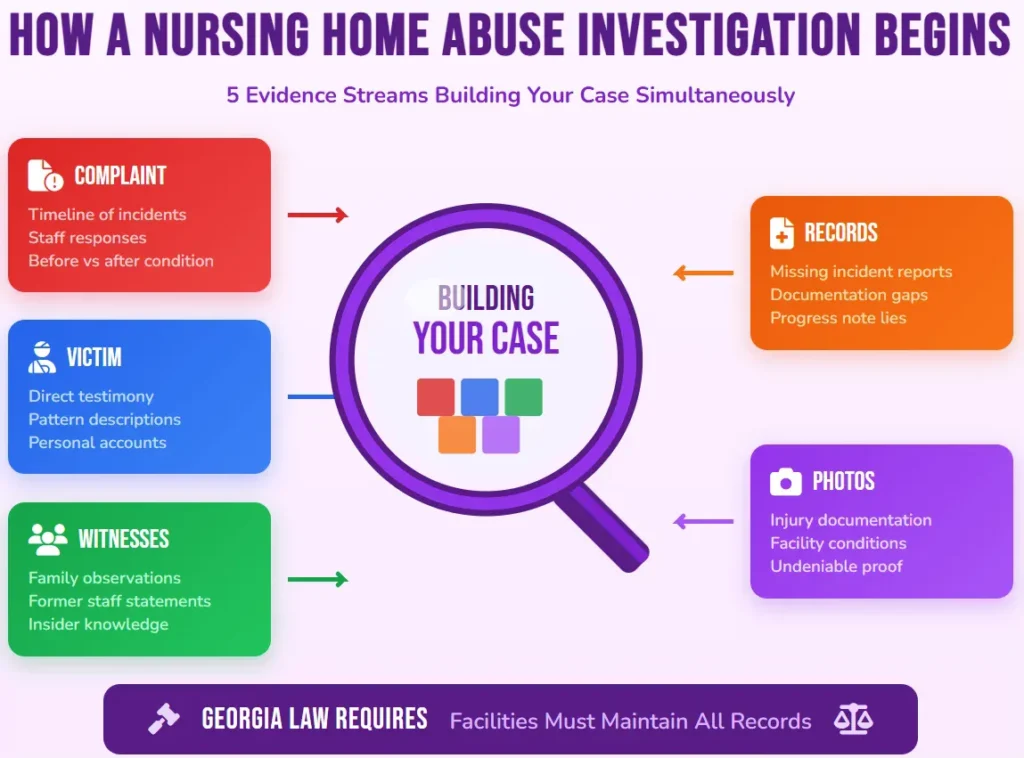
When a top-rated Atlanta nursing home abuse lawyer gets involved in a case, the investigation follows a process that builds documentation from multiple directions at once.
- The initial complaint gets examined in detail. Not just “mom has bruises” but when did you first notice them, what did staff say when you asked, did you take photographs, what was her condition before admission versus now. The timeline matters because it establishes when the facility knew or should have known something was wrong.
- Victim interviews happen if the resident can communicate. Sometimes dementia or other conditions make this difficult, but when residents can speak about their experiences, their accounts become central to the case. What they describe often matches patterns that staff members later confirm.
- Witness statements get collected from family members and sometimes current or former employees. Staff turnover at nursing homes is high, and former employees sometimes have information about practices they witnessed but couldn’t stop while they were employed there.
- Medical records and incident reports get requested. Georgia law requires facilities to maintain records, and these documents often reveal gaps between what actually happened and what the facility claimed happened. Incident reports might be missing for injuries that clearly occurred. Progress notes might show unchanged entries for days when the resident’s condition was obviously deteriorating.
- Photographic evidence gets gathered. Pictures of bed sores, bruises, unsanitary conditions, broken equipment. Visual documentation is difficult for defense attorneys to explain away during trial.
The goal is building a case file that shows a pattern rather than an isolated incident. One missed medication could be human error. Systematic understaffing that leads to residents not receiving basic care is something else entirely.
Three Georgia Cases That Show How This Plays Out
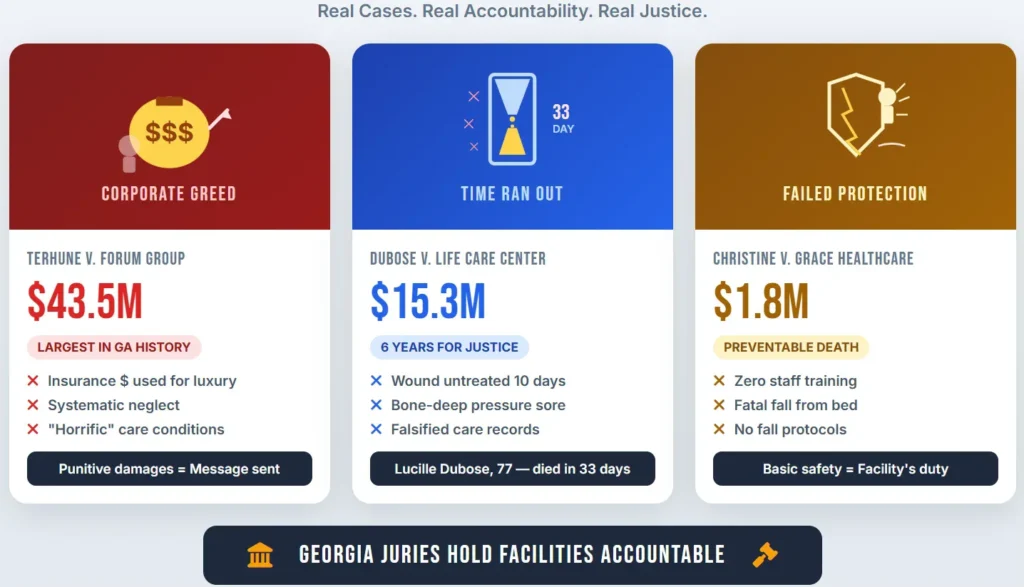
These aren’t hypothetical situations. They’re actual verdicts from Georgia courts.
Terhune v. Forum Group Corp — $43.5 Million
This case resulted in the largest judgment against a nursing home facility in Georgia history, and the facts explain why the jury responded the way they did.
The owner of the facility was using health insurance payments meant for resident care to fund his personal lifestyle. While he lived lavishly, residents were deprived of basic care. The lead counsel in the case described the care as “horrific” and explained that the large punitive damages award was meant to send a message that Georgia citizens will not tolerate those who abuse the elderly.
This wasn’t a case of one bad employee. It was corporate greed creating systematic neglect because money that should have gone to staffing and supplies was being diverted elsewhere.
Lucille Dubose v. Life Care Center of Lawrenceville — $6 Million+
Lucille Dubose died in 2016 from complications of an untreated pressure wound. She was 77 years old and had been admitted to Life Care Center of Lawrenceville following a stroke. Thirty-three days later she was dead.
By the time a doctor discovered a sore on her lower back, a hole the size of a hand had developed. It was so deep that a doctor could see the bone.
The investigation uncovered that staffing shortages at the facility likely contributed to her death. Former employees testified through court depositions that they were often too busy to give residents water, did not have enough time to give residents showers, and would falsify records to conceal these failures.
The Georgia Department of Community Health cited Life Care Center of Lawrenceville for numerous violations related to Dubose’s treatment. The facility failed to notify the physician of a newly developed pressure ulcer and failed to obtain treatment orders for 10 days.
Her family fought for years to get justice. The verdict, which some sources report as high as $15.3 million including punitive damages, came in 2022 — six years after she died.
Christine v. Grace Healthcare — $1.8 Million
Christine fell out of bed and hit her head while in the care of a Grace Healthcare employee at what is now called Tucker Nursing & Rehabilitation Center in the Atlanta area. She died from the injuries she sustained.
The case centered on the employee’s lack of training. This wasn’t a situation where trained staff made a mistake. The facility had failed to properly train the person responsible for Christine’s care, and that failure directly caused her death.
A jury awarded Christine’s family $1.8 million for the pain and suffering she experienced before she died.
Fall prevention is supposed to be basic nursing home protocol. Residents at risk of falling should have bed rails, call buttons within reach, regular checks, and staff trained to handle mobility issues. When those protocols don’t exist because staff aren’t trained, the facility bears responsibility for what happens.
What Victims and Families Can Actually Recover
Georgia law allows victims of nursing home abuse or neglect to seek compensation through civil lawsuits. The damages can cover medical costs, pain and suffering, and in cases involving intentional conduct or gross negligence, punitive damages.
The Georgia Bill of Rights provides for a private cause of action, meaning families can sue directly without having to exhaust administrative remedies first. You don’t have to wait for the state to investigate or file complaints through a bureaucratic process before taking legal action.
The statute of limitations is two years from the injury date under OCGA §9-3-33. This deadline matters because once it passes, the right to file a lawsuit is generally lost regardless of how strong the evidence might be.
Punitive damages in Georgia are normally capped at $250,000. But here’s the exception that matters in abuse cases — there are no limits when the case involves intentional acts. If a facility or employee intentionally harmed a resident, or if corporate decisions showed willful disregard for resident safety (like the Terhune case where the owner was diverting care funds), punitive damages can exceed that cap.
The Terhune verdict of $43.5 million demonstrates what juries will award when the conduct is egregious enough. That kind of number sends a message to the entire industry about what happens when profit gets prioritized over people.
Why Documentation From the Start Changes Everything
Families often wait too long to start documenting concerns because they don’t want to believe what they’re seeing, or they trust that the facility will fix the problem if they just complain enough.
By the time they contact an attorney, evidence has sometimes been lost. Photos weren’t taken when injuries were fresh. Medical records have been altered or entries added after the fact. Staff members who witnessed problems have moved on and become difficult to locate.
Starting documentation early — even before you’re sure something is wrong — creates a record that becomes valuable later. Dates and times of visits, observations about the resident’s condition, names of staff members present, photographs of any concerning marks or conditions, and notes about conversations with facility management.
This documentation also helps attorneys evaluate whether a case exists. Not every bad outcome means the facility did something wrong, but patterns of neglect or abuse become visible when there’s a documented timeline showing how conditions deteriorated while the facility failed to respond.
Georgia has laws protecting nursing home residents. The state has regulatory bodies supposed to enforce those laws. Courts have shown willingness to award substantial verdicts when facilities violate their obligations. But none of those protections work automatically. They require families who notice something wrong and take action before the evidence disappears and the statute of limitations runs out.