 Mohammad Ahsan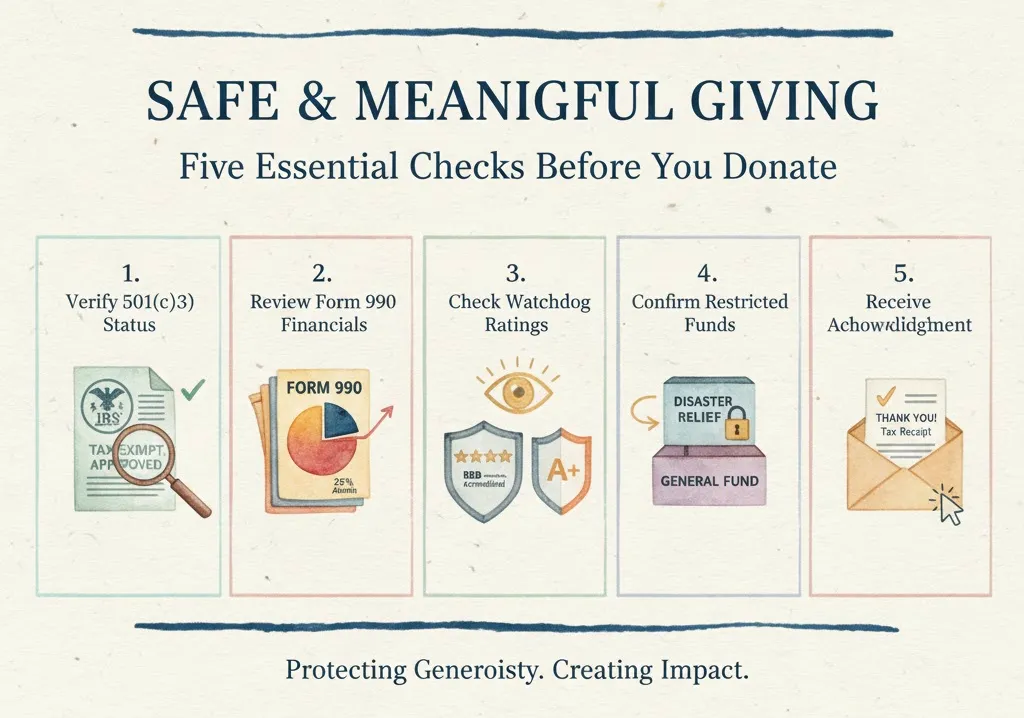
Supporting a cause brings a sense of purpose and connection. Many people feel a strong pull to help during emergencies, medical crises, and community struggles. At the same time, uncertainty often creates hesitation because stories of fake fundraisers and dishonest campaigns continue to surface online.
Even well-meaning donors worry about where their money will end up. A single rushed choice can lead to regret. With simple checks, giving can remain both safe and meaningful. This guide explains five clear actions that protect every contribution whilst keeping the process straightforward.
Why Donation Safety Matters More Than Ever
Digital giving made it easier for people to help across borders and time zones, but it also created new risks that did not exist before. Fake campaigns now appear within minutes of real disasters. Emotional stories pressure people into fast decisions without proper verification.
The Federal Trade Commission receives thousands of charity fraud complaints annually, with spikes following major disasters and during holiday giving seasons. These situations weaken public trust across the entire nonprofit space. Careful attention protects not only your money but the power of generosity itself.
Five Essential Checks Before You Make Any Donation
Before sending support to any cause, it helps to pause and review a few basic safeguards. These checks reduce risk and help ensure contributions reach the right hands.
1. Verify 501(c)(3) Registration with the IRS
Every legitimate US charity operating as a tax-exempt nonprofit holds 501(c)(3) status with the Internal Revenue Service. This registration confirms the organization follows federal nonprofit rules and that your donation may be tax-deductible.
How to check in under two minutes:
- Visit the IRS Tax Exempt Organization Search tool (apps.irs.gov/app/eos)
- Enter the charity’s name or Employer Identification Number (EIN)
- Confirm the organization appears with active exempt status
If a charity does not appear in this database, that is an immediate warning sign. Some legitimate newer organizations may still be processing their application, but established charities claiming years of work should always have verifiable IRS status.
State-level registration matters too. Most states require charities soliciting donations to register with the Attorney General’s office or Secretary of State. These databases are searchable online for each state and provide another layer of verification.
2. Review Their Form 990 Financial Disclosures
This is where you see exactly how a charity handles money, and it is the single most useful document for evaluating any nonprofit. The IRS requires most tax-exempt organizations to file Form 990 annually, and these filings become public record.
What Form 990 reveals:
- Total revenue and where it comes from
- How much goes to actual programs versus administrative costs
- Executive compensation and highest-paid employees
- Assets, liabilities, and overall financial health
- Specific program descriptions and accomplishments
Where to find Form 990s for free:
- Candid/GuideStar (candid.org) — requires free account
- ProPublica Nonprofit Explorer (projects.propublica.org/nonprofits)
- The charity’s own website (reputable organizations post these directly)
A healthy charity typically spends at least 65-75% of its budget on program services rather than fundraising and administration. If you cannot find a Form 990 or the organization refuses to share financial information when asked, that silence tells you something important.
Major established charities make this information readily accessible. The American Red Cross, for instance, publishes detailed annual reports and financial statements directly on their website, allowing donors to see exactly how disaster relief funds, blood services, and humanitarian programs receive support. This transparency sets the standard that other organizations should meet.
3. Check Charity Watchdog Ratings and Reviews
Several independent organizations evaluate charities based on financial health, accountability, and transparency. These ratings aggregate information that would take hours to compile yourself.
Useful watchdog resources:
- Charity Navigator (charitynavigator.org) — rates charities on financial health, accountability, and leadership with a four-star system
- BBB Wise Giving Alliance (give.org) — evaluates against 20 accountability standards
- CharityWatch (charitywatch.org) — provides letter grades and efficiency ratings
A quick search on these platforms shows whether a charity has been evaluated, what ratings it received, and any concerns flagged by reviewers. No rating means the organization has not been evaluated, which is not necessarily negative for smaller charities but should prompt additional research.
Beyond formal ratings, a simple Google search for “[charity name] scam” or “[charity name] complaints” often reveals problems that donors have reported. Check the organization’s social media presence too—an active, responsive charity with years of posts and genuine community engagement looks very different from a page created last week with stock photos and vague mission statements.
4. Confirm What Happens to Restricted Donations
When you donate for a specific purpose—disaster relief, a particular program, or a designated fund—you have a right to know whether those restrictions are honored. Legitimate charities take donor intent seriously and can explain how restricted gifts are tracked and used.
Questions to ask before giving:
- If I designate this donation for a specific program, will 100% go to that program?
- How do you report back to donors on how restricted funds were used?
- What happens if you raise more than needed for a specific campaign?
Reputable organizations have clear policies on these questions. Some will reallocate excess disaster funds to general disaster preparedness with donor notification. Others strictly apply all restricted gifts to the designated purpose even if it takes years to fully deploy.
If a charity cannot clearly explain how restricted donations work, or if their policies seem designed to give them maximum flexibility with your money, consider whether that matches your giving intentions.
5. Verify You Receive Proper Acknowledgment and Documentation
A legitimate charity always confirms receipt of support, and this acknowledgment matters for both your records and your confidence that the donation was processed correctly.
What you should receive:
- Written acknowledgment within days of your donation (email or mail)
- Organization’s legal name and address
- Amount contributed and date received
- Statement of any goods or services provided in exchange (or confirmation that none were provided)
- The organization’s EIN for tax purposes
For donations over $250, the IRS requires you to have written acknowledgment from the charity to claim a tax deduction. If you do not receive this documentation, follow up directly with the organization.
Beyond the initial receipt, many donors appreciate knowing their contribution made a difference. Charities with strong donor communication send periodic updates showing program outcomes, stories from beneficiaries, or reports on how campaigns progressed. Complete silence after your donation—no acknowledgment, no updates, no response to inquiries—is a significant red flag that something may be wrong.
If you donated for a specific purpose and never hear whether that purpose was fulfilled, you have every right to ask. A charity that cannot or will not answer reasonable questions about how your designated funds were used has failed a basic accountability test.
Quick Verification Checklist
Before completing any donation:
- [ ] Confirmed 501(c)(3) status through IRS Tax Exempt Organization Search
- [ ] Reviewed Form 990 or annual report showing program spending percentages
- [ ] Checked at least one charity watchdog site for ratings or complaints
- [ ] Understood policies on restricted donations if designating for specific use
- [ ] Confirmed you will receive written acknowledgment for your records
Conclusion
Safe giving begins with a few practical habits that take minutes but prevent real problems. IRS verification confirms legitimacy at the start. Form 990 review shows where money actually goes. Watchdog ratings and quick searches reveal patterns of concern. Understanding restricted donation policies protects your intent. Proper acknowledgment keeps documentation clear and confirms your contribution reached its destination.
These steps do not make giving difficult—they make it meaningful. With awareness and basic verification, generosity reaches the right hands and creates lasting impact where it matters most.