 Kristy Villalba (AU Family & Divorce Lawyer)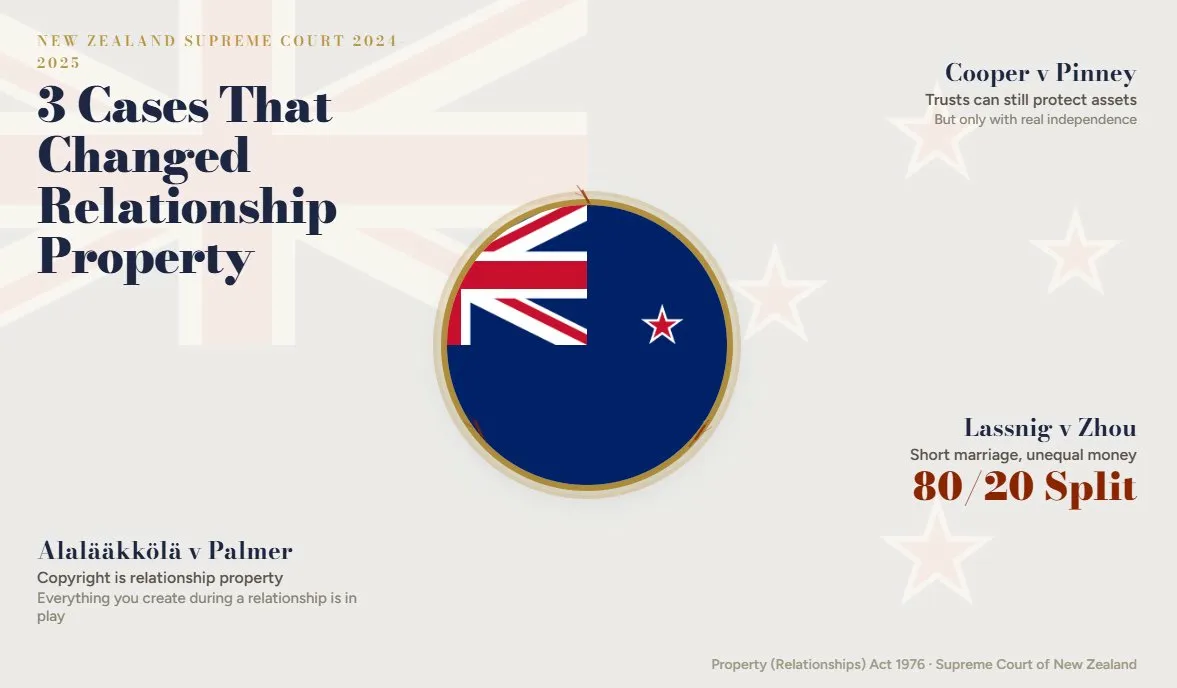
Most people going through a separation in New Zealand think they already know the deal. Three years together, 50/50 split, done. The Property (Relationships) Act 1976 lays it out pretty clearly — or so it seems.
But between late 2024 and September 2025, the Supreme Court handed down three decisions that genuinely shifted how relationship property works in this country. Not tweaks. Real, material changes to what counts as property, 2.who gets what portion, and whether that family trust actually protects anything.
If you’re separated, about to separate, or just moved in with someone and wondering what happens to your stuff — a family lawyer would tell you these cases matter. A lot.
The Trust That Didn’t Protect a Thing — Cooper v Pinney [2024] NZSC 181
You’re sitting there thinking your family trust has everything locked up. The house, the farm, maybe the business. Your partner can’t touch it because it’s in the trust, not your name. That’s the whole point, right?
Well, that depends entirely on how much control you actually have.
Raewyn Cooper and Marcus Pinney were in a de facto relationship from 2004 to 2014. They lived and worked together on a farm held inside the MRW Pinney Family Trust. When the relationship fell apart, Ms Cooper wanted a share of those trust assets — roughly $1.5 million worth of farm property.
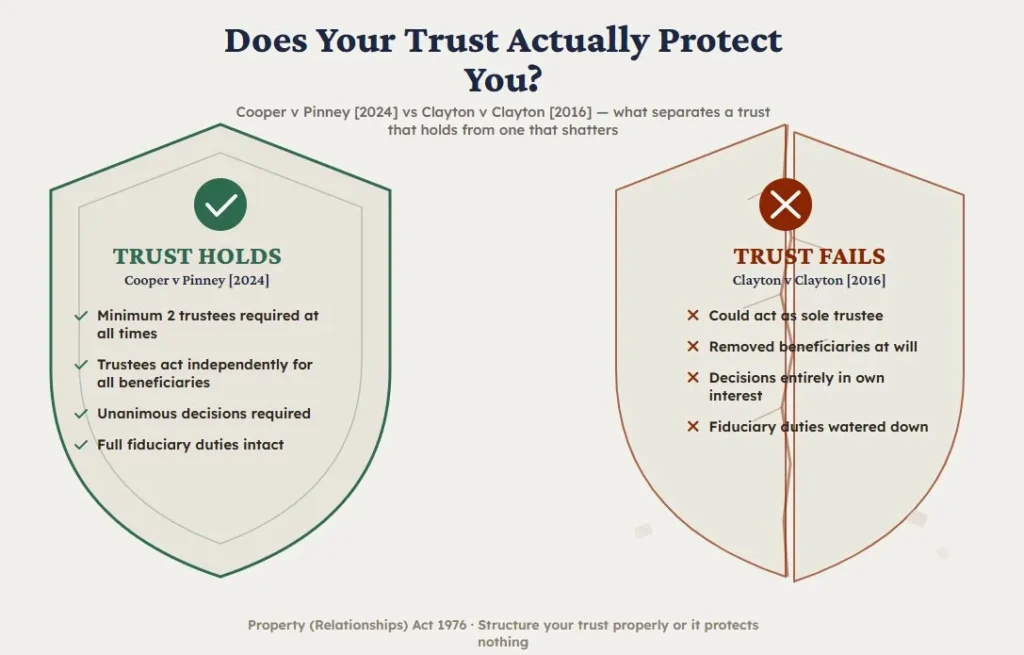
Her argument drew heavily on the Supreme Court’s earlier decision in Clayton v Clayton [2016] NZSC 29. In Clayton, a spouse had such sweeping control over a family trust that the court treated it as if he owned the assets outright. He could act as sole trustee, remove beneficiaries at will, and make decisions entirely in his own interest. The trust existed on paper, but in practice? It was his personal piggy bank.
Ms Cooper argued Mr Pinney had a similar setup. He held the power to appoint and remove trustees. He was a discretionary beneficiary. She said that bundle of rights gave him effective ownership of the trust property.
The Supreme Court disagreed.
Four critical differences separated the Pinney trust from the Clayton trust:
- The trust deed required a minimum of two trustees at all times. Mr Pinney could never act as sole trustee — Mr Clayton could.
- Trustees had to act independently and in the interests of all beneficiaries, not just themselves.
- Decisions required unanimous agreement between trustees. No one person could override the other.
- Mr Pinney’s fiduciary duties hadn’t been watered down or removed. If he tried to stack the board with friendly trustees to grab control, he’d breach the proper purpose rule.
The court dismissed the appeal. Mr Pinney’s powers were constrained enough that they didn’t amount to ownership. The trust held.
So What Does This Actually Mean?
Two things. First, if you’ve set up a family trust properly — with multiple trustees, genuine independence, and real fiduciary constraints — it can still shield assets from relationship property claims. Clayton didn’t open the floodgates the way some people feared.
Second, and this is the uncomfortable part. If your trust is structured loosely, with one person calling all the shots and no real checks? You’re basically holding property in your own name with extra paperwork. A relationship property lawyer will tell you that distinction is everything.
Short Marriage, Unequal Money, 80/20 Split — Lassnig v Zhou [2025] NZSC 116
This case wasn’t decided under the PRA’s equal-sharing rules at all. It was decided under section 182 of the Family Proceedings Act 1980, which gives courts power to vary a trust that was settled in connection with a marriage. But what about marriages under three years where one partner contributed far more money to that trust?
Mr Lassnig came to New Zealand from Germany in late 2011. He met Ms Zhou, and they married in 2012. They settled a family trust shortly after the wedding, and the trust purchased three properties over the next 15 months. The idea was that the trust would provide them with a home and fund their retirement.
The marriage lasted less than three years. No children together.
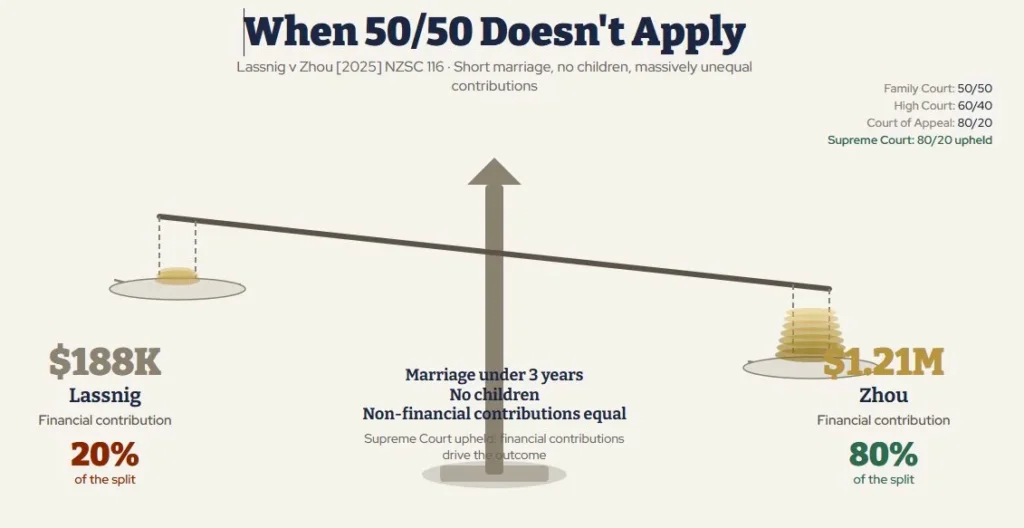
And here’s where it gets interesting. Ms Zhou contributed approximately $1,211,000 toward those property purchases — through her own funds, her companies, and advances to the trust. Mr Lassnig contributed roughly $188,000. The court accepted their non-financial contributions were about equal.
I’m reading those numbers and doing the maths. That’s not even close to a 50/50 situation in terms of financial input.
The Family Court initially split the remaining equity 50/50. Ms Zhou appealed. The High Court adjusted it to 60/40 in her favour. The Court of Appeal pushed it further to 80/20. Mr Lassnig took the fight to the Supreme Court.
The Supreme Court upheld the 80/20 split — though it took a different route to get there. It criticised the Court of Appeal for getting too deep into hypothetical modelling about what might have happened if the marriage had continued. The Supreme Court preferred a broader approach: in a short, childless marriage where one partner put in dramatically more money, financial contributions will generally drive the outcome.
Why This Case Stings for Some People
This applies specifically where the assets are held in a nuptial trust — one settled in connection with the marriage — not to all relationship property generally.
The court was careful to say this isn’t automatic. Countervailing factors — dependent children, health issues, a clear mutual intention to pool wealth regardless of source — could shift the balance. But absent those factors, the person who brought the money walks away with most of it.
If you’re entering a relationship where there’s a big gap in assets or income, this case is a blaring signal to get a contracting out agreement sorted before settling property into joint structures.
Your Art, Your Music, Your Copyright — It’s All Relationship Property Now. Alalääkkölä v Palmer [2025] NZSC 9
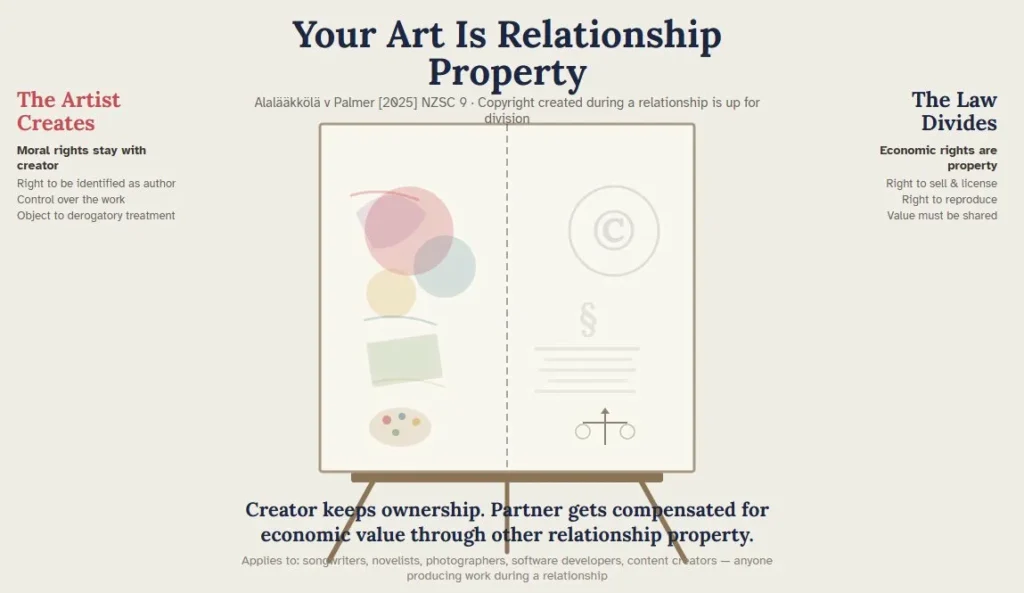
This one probably sent a chill through every artist, writer, musician, and content creator in the country.
Sirpa Alalääkkölä is a Finnish painter. Trained at the Academy of Fine Arts in Finland, attended a master’s programme at NYU on a Fulbright Scholarship, exhibited at the Finnish National Gallery. She came to New Zealand in 1993, married Paul Palmer in 1997, and separated in 2017 after 20 years.
During the marriage, her paintings became the family’s primary income source. She described herself as having become a “painting machine” — producing commercial work to support the household. Mr Palmer said he played a major role in marketing and promoting her art, creating prints and cards for sale.
Nobody disputed that the physical paintings were relationship property. The question was whether the copyright attached to those paintings — the right to reproduce, license, and sell copies — was also up for division.
I’m an artist and my partner helped sell the work. Does that mean they own half the rights to everything I created during the marriage? That’s the kind of question this case forced the court to answer.
The Family Court initially said no — the copyrights were Ms Alalääkkölä’s separate property, because they sprang from personal skills she had before the marriage. The High Court overturned that. The Court of Appeal agreed with the High Court but added a twist: Ms Alalääkkölä should keep ownership of the copyrights, with a compensatory adjustment in the property split.
The Supreme Court confirmed it. Copyright is property under the PRA. Copyright created during a relationship is relationship property. Full stop.
But here’s the nuance the court built in:
- Copyright has two sides. Economic rights (the ability to sell, license, and reproduce) are property. Moral rights (the right to be identified as the creator and to object to derogatory treatment of the work) are personal and stay with the artist.
- Ms Alalääkkölä retains sole legal ownership of the copyrights. She controls what happens to her work. But she has to compensate Mr Palmer for his share of their economic value through other relationship property.
- The court accepted her categorisation of the works: incomplete or damaged pieces, personal works including nudes and culturally sensitive pieces, unique one-offs, and works intended for reproduction. Each category gets valued differently.
The Ripple Effect for Creators
If you’re a songwriter, novelist, photographer, software developer, or any kind of creator producing work during a relationship — the copyright in that work is now firmly on the table during a separation. Not just the physical product. The rights themselves.
Ms Alalääkkölä reportedly plans to leave New Zealand as a result of this decision. Whether you think the ruling was fair or not, it makes one thing undeniable: creators need legal protection going into relationships, not coming out of them. A contracting out agreement addressing intellectual property is no longer optional. It’s essential.
What All Three Cases Point To
These aren’t isolated rulings. Together, they paint a pretty clear picture of where New Zealand family law is heading.
Trusts are not bulletproof. They can protect assets, but only if they’re structured with genuine independence, multiple trustees, and real constraints. The days of a one-person show hiding behind a trust deed are over — Clayton drew the line and Cooper confirmed where it sits.
Equal sharing has limits. The PRA’s 50/50 starting point remains the default for relationships over three years. But where a couple settles a trust in connection with a short, childless marriage and one partner contributes far more, the court — acting under s 182 of the Family Proceedings Act 1980 — now has a clear rule of thumb: divide it roughly in proportion to what each person put in. Lassnig v Zhou set that precedent for trust settlements, not the PRA equal-sharing regime generally.
Everything you create is in play. Copyright, intellectual property, creative works — if it was produced during the relationship, it’s relationship property. The economic value has to be shared, even if the creator keeps control. Alalääkkölä v Palmer closed that door.
The common thread? Getting proper legal advice before assets, trusts, and creative works become entangled in a relationship is vastly cheaper and less painful than fighting about them after a separation.
Disclaimer
The information in this article is general in nature and is not legal advice. It is intended to provide a summary of recent New Zealand Supreme Court decisions for informational purposes only. The law in this area is complex and fact-specific, and outcomes in any individual case will depend on the particular circumstances involved. You should not rely on this article as a substitute for advice from a qualified New Zealand family lawyer. If you are going through a separation or have questions about relationship property, trusts, or intellectual property rights, please seek independent legal advice.
References
- Cooper v Pinney [2024] NZSC 181. Supreme Court of New Zealand.
- Clayton v Clayton [Vaughan Road Property Trust] [2016] NZSC 29.
- Lassnig v Zhou [2025] NZSC 116. Supreme Court of New Zealand.
- Alalääkkölä v Palmer [2025] NZSC 9. Supreme Court of New Zealand.
- Property (Relationships) Act 1976, ss 8, 9, 10, 11. New Zealand Legislation.
- Family Proceedings Act 1980, s 182.New Zealand Legislation.
- Lane Neave, “When are trustee rights considered relationship property?” (January 2025).Lane Neave.
- Wynn Williams, “Supreme Court considers short marriages and nuptial settlements in Lassnig v Zhou” (September 2025).Wynn Williams.
- Cooney Lees Morgan, “Copyright & Relationship Property — Landmark Case in NZ” (March 2025).Cooney Lees Morgan.