 John Veale Solicitor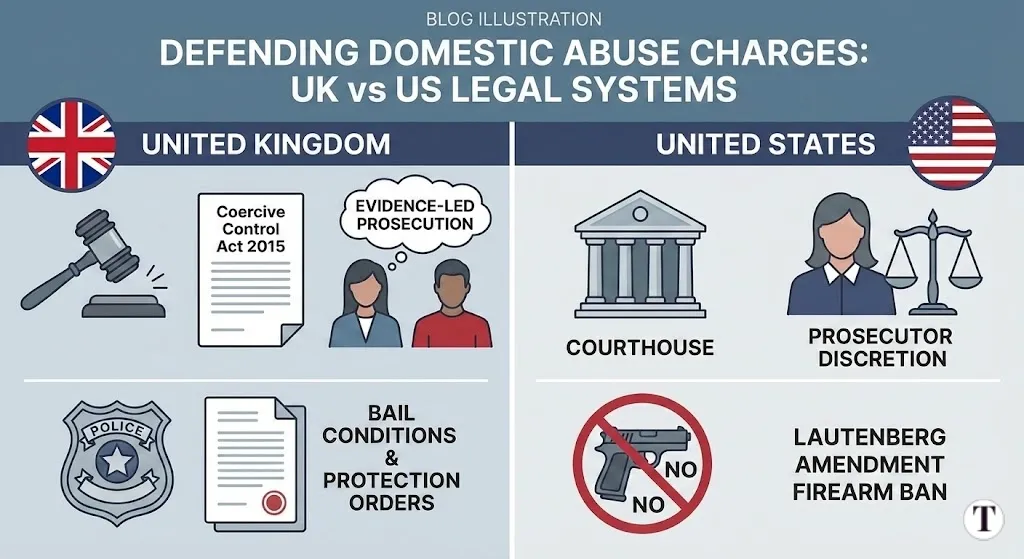
Two countries. Two legal traditions. Completely different approaches to the same problem.
If you’re facing domestic abuse allegations—or advising someone who is—understanding which system you’re operating under matters enormously. The UK and US handle everything from how charges get filed to what counts as abuse in fundamentally different ways.
Quick Takeaways
- The UK criminalised coercive control in 2015. Most US states still haven’t.
- US prosecutors have wide discretion. UK prosecutors can (and do) proceed without victim cooperation through evidence-led prosecutions.
- Firearms prohibition kicks in immediately upon conviction in the US under the Lautenberg Amendment—even for misdemeanours.
- UK bail conditions and Domestic Violence Protection Orders can restrict the accused before any conviction.
The Legal Framework: Federal vs. National
United States
Domestic violence law in the US operates on two levels simultaneously, and they don’t always align.
Federal law provides the framework via the Violence Against Women Act (VAWA), which was first passed in 1994 and most recently reauthorised in 2022. The Violence Against Women Act (VAWA) made crossing state lines to commit domestic violence or violation of protection orders a federal crime, created an Office on Violence Against Women in the Department of Justice, and funded law enforcement training programs that promoted pro-arrest policies (Violence Against Women Act 1994, Title IV of the Violent Crime Control and Law Enforcement Act 42 USC § 13701).
But the real prosecution of domestic violence? That occurs almost exclusively at the state level. And state laws vary wildly. California and Hawaii include coercive control within their civil and family codes. In 2021, Hawaii stepped up even further, enshrining coercive control as a petty misdemeanor—the only state in the US to codify this outright as a crime (Hawaii Revised Statutes § 709-906). Most states still define domestic violence in only physical terms, leaving patterns of psychological abuse almost entirely unrecognized by the criminal law.
United Kingdom
The UK took a different path. The Domestic Abuse Act 2021 created, for the first time, a statutory definition of domestic abuse that explicitly includes:
- Physical or sexual abuse
- Violent or threatening behaviour
- Controlling or coercive behaviour
- Economic abuse
- Psychological, emotional or other abuse
That definition applies whether the behaviour consists of a single incident or a course of conduct (Domestic Abuse Act 2021, Section 1(3)).
The Act also extended protection to post-separation abuse. Section 68 amended the Serious Crime Act 2015 to remove the requirement that victim and abuser live together for coercive control charges to apply. Since 5 April 2023, ex-partners and family members who don’t cohabit can be prosecuted for controlling behaviour.
Children who witness or experience the effects of domestic abuse are now recognised as victims in their own right under Section 3—a significant shift from treating them merely as witnesses.
How Charges Actually Get Brought
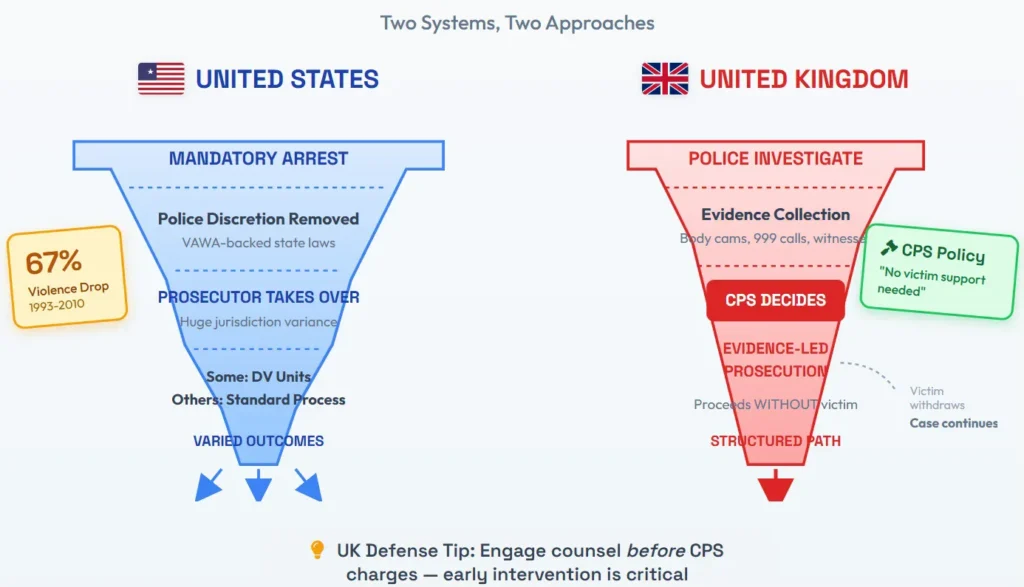
United States: Prosecutor discretion and mandatory arrest
VAWA supported programs that encouraged states to pass laws mandating arrests. The idea was simple: if police officers responding to domestic violence calls are stripped of discretion, abusers won’t be able to use it as an excuse not to face consequences.
In some respects it worked as intended. Availability of firearms was protected by the Second Amendment, leading to increased access in homes and raising risk for intimate partner homicide. Between 1993-2010, rates of intimate partner violence decreased by 67%, according to the Bureau of Justice Statistics. But there is resistance to mandatory arrest by countless others. Others argue that it discourages reporting in communities where the potential for additional harms from any police involvement, like loss of wages, immigration consequences or distrust of law enforcement, is high.
Prosecutors exercise their discretion after an arrest. And that discretion is very different in jurisdiction to jurisdiction. Some DA offices have specialized domestic violence units trained in trauma-informed prosecution. Others treat these cases like any other assault, with all the pressure to speed up and clear backlogs.
Police and CPS Collaborating in the United Kingdom
In England and Wales, charging decisions in domestic violence cases are made by the Crown Prosecution Service, not the police. Whether to charge is determined by the CPS after officers have carried out investigations and gathered evidence.
More importantly, the CPS is conducting “evidence-led prosecutions” — cases that proceed without aid from victims. Physically, even if the complainant no longer wishes to pursue the matter, what would be available for prosecutors would include footage from body-worn cameras, recordings of 999 calls or other witnesses interviews, or medical evidence.
The CPS Domestic Abuse Policy Statement says this very clearly, stating that “We have the ability to bring prosecutions through evidence-led prosecutions without victim support or direct involvement.”
This strategy acknowledges a reality that defense experts know all too well: women who suffer domestic violence often stop cooperating because they are scared, still communicating with their abusers or financially dependent. In any case, moving on relieves them of the burden.
Because the CPS moves very quickly on these types of cases, domestic abuse defence solicitors in the UK tend to get involved early. If counsel is instructed after the charge, the opportunity to influence the picture with respect to evidence is lost.
Coercive Control: Where the UK Led
As explained by Jessica Wilson LLB (Hons) (FCILEx) (From Eventumlegal UK Domestic Abuse Defence Lawyers in UK), The England and Wales criminalised coercive or controlling behaviour in December 2015 under Section 76 of the Serious Crime Act 2015. The offence carries a maximum penalty of five years’ imprisonment.
To secure a conviction, prosecutors must prove:
- Repeated or continuous behaviour toward a personally connected victim
- That causes the victim to fear violence on at least two occasions OR has a substantial adverse effect on their day-to-day activities
- The defendant knew or ought to have known the behaviour would have that effect
The Domestic Abuse Act 2021 expanded this further by removing the cohabitation requirement, meaning the offence now covers abuse between ex-partners who’ve separated and family members who don’t live together.
The US is playing catch-up. California’s Family Code Section 6320 now includes coercive control as grounds for a restraining order and creates a rebuttable presumption against awarding custody to perpetrators. Connecticut amended its domestic violence definition in 2021 to include coercive control patterns. Massachusetts signed similar legislation into law in 2024.
But criminal prosecution for coercive control remains rare in the US. Hawaii’s petty misdemeanor provision is the exception, not the rule. New York has a pending bill that would make coercive control a Class E felony, but it hasn’t passed.
For defence practitioners, this gap matters. In the UK, you’re defending against charges that encompass psychological manipulation, isolation tactics, and financial control. In the US, unless physical violence occurred, criminal exposure is typically limited.
What Happens to the Accused Before Trial
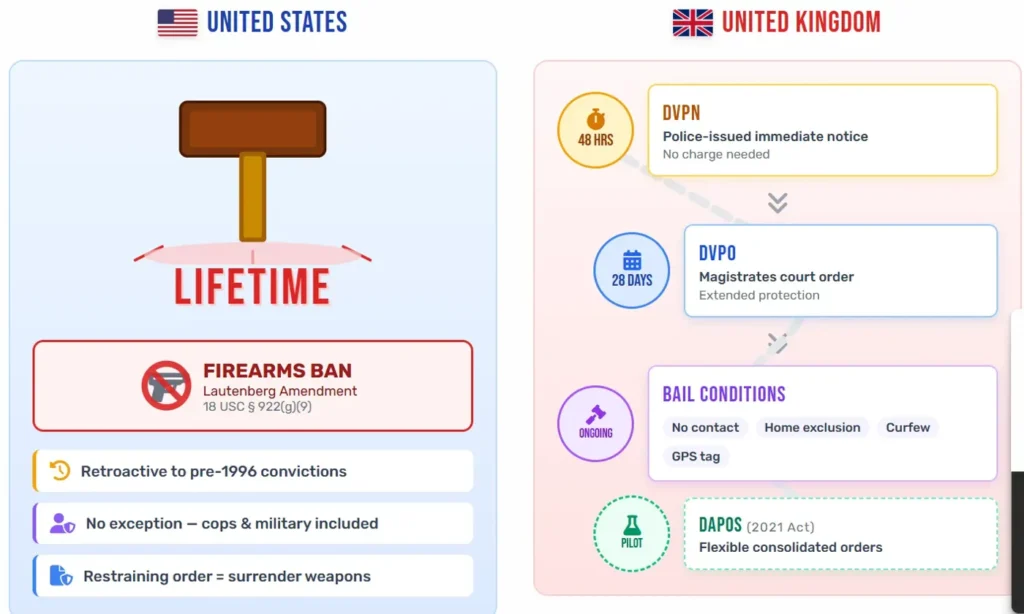
United States: Bail and Firearms
The Federal Lautenberg Amendment (18 USC § 922(g)(9)) establishes one of the most immediate repercussions for any domestic violence misdemeanor conviction: a permanent restriction on gun and ammunition possession anywhere in the United States.
And the ban is applied retroactively—convictions that occur before 1996 trigger the exclusion. There’s no law enforcement exception. Off duty and on duty, police officers and military personnel convicted of qualifying offenses are barred from possessing their service weapons.
Most states, before conviction, impose bail conditions that forbid contact with the person allegedly victimized. Firearms can be surrendered pre-trial where a protective order exists. The law, codified at 18 USC § 922(g)(8), provides that a person subject to a qualifying domestic violence restraining order is prohibited from possessing firearms for as long as the order is in effect.
United Kingdom: DVPOs and Bail Restrictions
The UK operates a parallel system of civil and criminal restrictions.
Domestic Violence Protection Notices (DVPNs) enable the police to impose instant limits immediately after an incident — even if there’s not enough evidence to charge. These can last up to 48 hours and may be followed by a Domestic Violence Protection Order (DVPO), issued by magistrates for up to 28 days.
Those conditions usually involve non-contact orders, exclusion from the family home and occasionally curfews or electronic monitors. Which is why its breach may lead to remand in custody before a trial.
Domestic Abuse Protection Notices and Domestic Abuse Protection Orders (when legislated in the Domestic Abuse Act 2021) will, when in a test phase, be able to draw upon existing protection orders but within a more flexible structure.
Court Process and Defence Strategies
Although the assumption of innocent underpins both systems, the actual circumstances are different.
Victim testimony is frequently the deciding factor in domestic abuse prosecutions in the US. Prosecutors may find it difficult to move further if the complainant withdraws or does not show up, unless there is strong supporting evidence. Credibility issues, allegations of self-defense, and negotiating down to lower charges are common defense tactics.
Until the complainant testifies, UK prosecution is evidence led meaning defense lawyers must prepare for trial. The CPS possesses witness testimony, medical records, 999 recordings, and bodycam footage. Although a complainant who is not present cannot be cross-examined, it remains open to challenge the reliability of the evidence.
Coercive control issues (141) are particularly problematic in both jurisdictions. To prove—or disprove—a “pattern of behavior,” one must examine context over time, not merely instances in isolation. Everything from third-party accounts to financial information, social media activity and text messages becomes relevant.
The accused should get legal counsel as early on as possible. Domestic Violence defense lawyers, especially in the UK, are involved at the investigatory stage before charges are brought by challenging what is being gathered as evidence and even influencing if CPS does anything at all.
Both systems are evolving. The US is slowly recognising that domestic abuse extends beyond physical violence. The UK continues refining how it prosecutes coercive control. For anyone caught up in either system—accused or accuser—understanding the specific rules that apply where you are isn’t optional. It’s foundational.
References
- Violence Against Women Act 1994 (42 USC § 13701) – https://www.congress.gov/crs-product/R45410
- Domestic Violence Offender Gun Ban (Lautenberg Amendment), 18 USC § 922(g)(9) – https://www.law.cornell.edu/uscode/text/18/922
- Domestic Abuse Act 2021 (UK) – https://www.legislation.gov.uk/ukpga/2021/17/contents/enacted
- Serious Crime Act 2015, Section 76 (Coercive Control) – https://www.legislation.gov.uk/ukpga/2015/9/section/76
- CPS Domestic Abuse Guidance – https://www.cps.gov.uk/crime-info/domestic-abuse
- Hawaii Revised Statutes § 709-906 (Coercive Control) – https://www.capitol.hawaii.gov/hrscurrent/Vol14_Ch0701-0853/HRS0709/HRS_0709-0906.htm
- California Family Code Section 6320 – https://leginfo.legislature.ca.gov/faces/codes_displaySection.xhtml?sectionNum=6320.&lawCode=FAM