 John Mattiacci (Personal Injury Lawyer)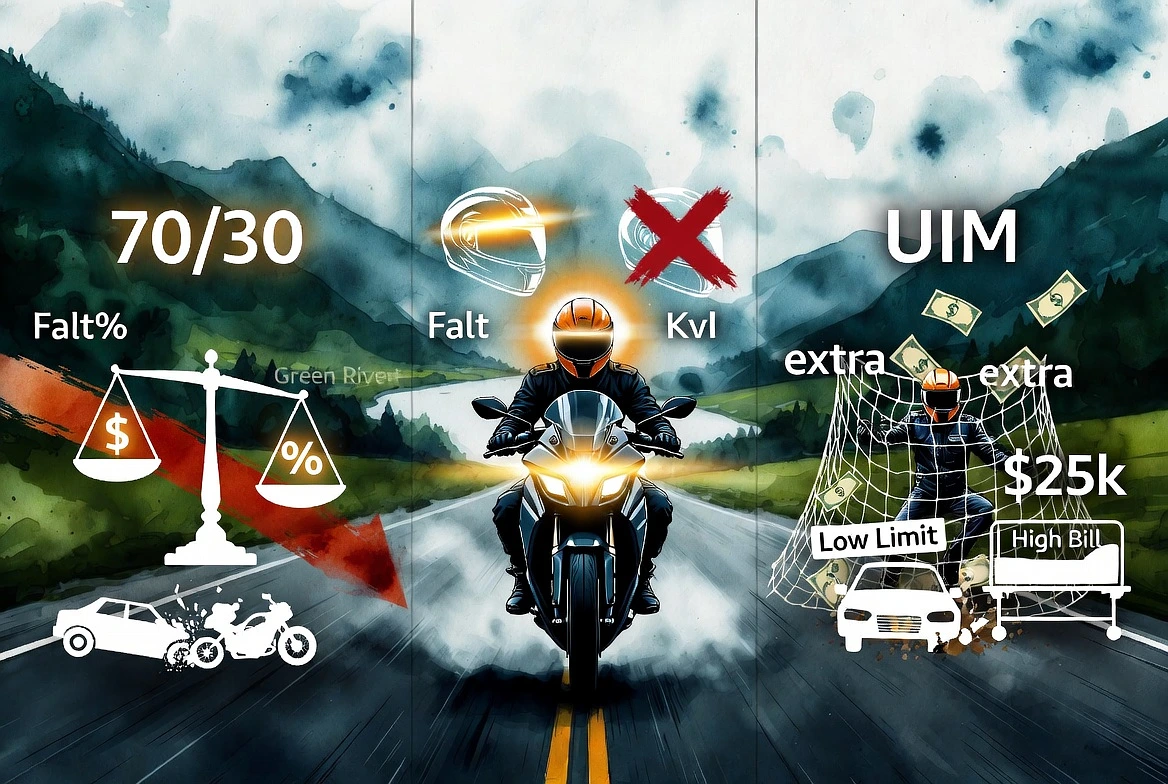
Riding through Kent means sharing road with SR-167 commuters, warehouse trucks cutting across the Green River Valley, and I-5 merge traffic that treats motorcycles like they don’t exist. About 75 motorcyclists die on Washington roads every year. One in five crashes ends in serious injury or death. And the legal fight that follows isn’t the same as a regular car accident case — not even close.
Three pieces of Washington law shape nearly every motorcycle claim filed in this state. Miss any one of them and money walks out the door. Pure comparative fault decides how much of the blame lands on you and what that costs in dollars. The mandatory helmet law doesn’t just protect your head — it protects your claim, and skipping it hands the insurance company a weapon. And underinsured motorist coverage is the safety net most riders don’t think about until a driver with a $25,000 policy puts them in a hospital bed that costs four times that.
This piece breaks down all three — what the statutes say, what happens in real scenarios, and what a rider in Kent actually needs to know before the insurance adjuster starts talking numbers.
Pure Comparative Fault — You Can Be 80% Wrong and Still Recover
Washington adopted pure comparative negligence in 1973. The statute lives at RCW 4.22.005 and the language is plain:
“Any contributory fault chargeable to the claimant diminishes proportionately the amount awarded as compensatory damages… but does not bar recovery.”
Read that last part again. Does not bar recovery. Even at 99% fault. Washington is one of a handful of states that work this way. Most states use a modified system that cuts you off at 50% or 51%. Not here. Here, if a jury says you were 80% at fault and your damages are $500,000, you still walk away with $100,000.
So why does this matter on SR-167 at 5pm?
Picture it. You’re heading south on 167 past the Kent Des Moines Road exit. Traffic slows. A delivery van changes lanes without checking mirrors and clips your front wheel. You go down. Broken collarbone, road rash, bike totalled. Clear-cut case, right?
Not according to the insurer. Their adjuster pulls the police report and finds you were doing 72 in a 60 zone. Now they’re arguing you were 30% at fault because the speed contributed to your inability to stop in time. Your $200,000 in damages just dropped to $140,000 — on paper, before any negotiation even starts.
That 30% number isn’t fixed. It’s arguable. It’s the product of evidence, investigation, and how aggressively your attorney challenges the fault allocation. The insurer’s job is to push your percentage higher. Your attorney’s job is to push it lower. The difference between 30% and 15% on a $200,000 claim is $30,000.
Here’s the thing most riders don’t realise: the at-fault percentage is not decided by the police report. A citation matters — it’s evidence — but civil fault is determined separately. Juries look at physical evidence, witness statements, road conditions, and expert analysis. A ticket doesn’t automatically equal a fixed number on the verdict form.
The Helmet Law — Wear One or Hand the Defence Their Best Argument
Washington requires every motorcycle rider and passenger to wear a DOT-approved helmet with the chin strap secured. That’s RCW 46.37.530. No exceptions for age. No exemptions for experience. No pilot programmes to opt out (a Senate Bill tried to create one in 2019 — it didn’t pass).
So what happens if you crash without a helmet?
Can you still file a claim? Yes. Washington’s pure comparative fault system means a helmet violation doesn’t automatically bar recovery. But does it hurt you? Absolutely.
How insurers weaponise the missing helmet
The defence argument goes like this: even though the other driver caused the accident, your head injuries were made worse — or entirely caused — by your decision to ride without a helmet. That’s contributory negligence. The jury gets to decide what percentage of your injuries are attributable to that decision, and your compensation gets reduced by that exact amount.
Real numbers make this concrete. Say you sustain a traumatic brain injury in a crash caused entirely by a distracted driver. Your total damages are $400,000. The defence argues that 40% of your head injuries resulted from not wearing a helmet. The jury agrees. Your recovery drops to $240,000.
Now compare that to the same crash where you were wearing a DOT-approved helmet. The defence has no helmet argument. The distracted driver carries 100% of the fault for 100% of your injuries. You recover $400,000.
That’s a $160,000 difference based on a single piece of equipment that costs about $150.
And here’s the part that trips people up: a helmet doesn’t just matter for head injuries. Defence attorneys in Washington have tried to argue that not wearing a helmet constitutes general negligence that should increase the rider’s fault percentage across all injuries — not just head trauma. Whether that argument sticks depends on the judge’s instructions to the jury and how the injuries are categorised in the medical records. A Kent motorcycle accidents lawyer who handles these cases regularly will know how to separate helmet-related injuries from injuries that would have occurred regardless, because that distinction directly controls how much money stays on the table.
Underinsured Motorist Coverage — The $25,000 Problem
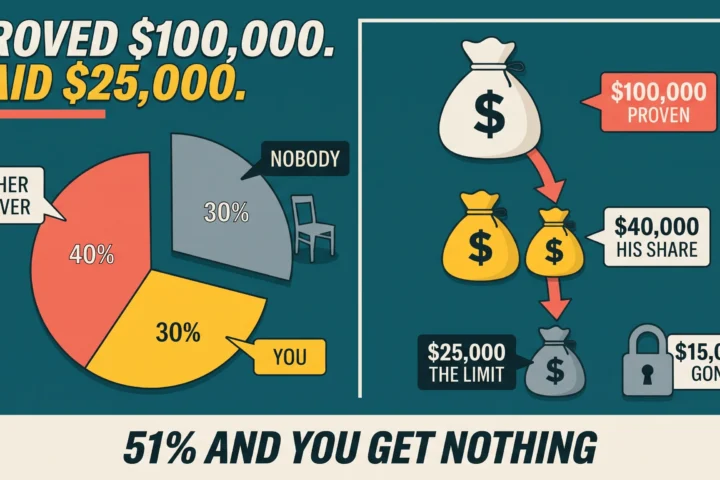
Washington’s minimum liability insurance for drivers is $25,000 per person for bodily injury. That’s set under RCW 46.29.090. Twenty-five thousand dollars. For context, a single night in a King County emergency room can exceed that. A broken femur with surgery runs north of $50,000. A spinal cord injury? You’re into six or seven figures before rehabilitation even starts.
Now picture the crash. A driver runs a red light in downtown Kent, hits you broadside. You need surgery, three months of physical therapy, and you miss eight weeks of work. Your damages are $175,000. The driver who hit you carries the state minimum. Their insurer writes you a cheque for $25,000 and says goodbye.
Where does the remaining $150,000 come from?
UIM coverage — and the motorcycle-specific catch
Under RCW 48.22.030, Washington requires auto insurers to offer underinsured motorist (UIM) coverage with every new policy. If a policyholder doesn’t want it, they have to reject it in writing. The idea is that your own insurance steps in to cover the gap when the at-fault driver’s policy isn’t enough.
But here’s the catch for motorcycle riders, and almost nobody knows this until it’s too late: the standard UIM mandate under RCW 48.22.030 specifically excludes people who are operating or occupying a motorcycle or motor-driven cycle.
The statute says UIM coverage must be provided “except while operating or occupying a motorcycle or motor-driven cycle.”
That means your regular auto insurance UIM policy? It probably won’t cover you when you’re on your bike. You need UIM coverage on your motorcycle policy specifically. And under subsection (10) of the same statute, an insurer who writes motorcycle coverage must give you the opportunity to purchase or reject UIM — but they’re only required to offer it. If you signed a rejection form when you bought the policy because you were trying to keep premiums down, you might not have it.
I’m reading my own motorcycle insurance policy right now wondering — do I actually have UIM on this? That’s the question. And if the answer is no, you’re riding every day with a gap that could cost you six figures.
What to do before the crash happens
Check your motorcycle policy. Look specifically for underinsured and uninsured motorist coverage and confirm the limits. Washington’s minimum liability is $25,000/$50,000. If your UIM matches those minimums, you’re still dangerously underinsured for any serious crash in the Kent-Seattle corridor where medical costs run high.
Bump it up. UIM coverage with $100,000/$300,000 limits typically costs a fraction of what you’d lose in a single uninsured claim. It’s the cheapest protection you can buy — and the one most riders skip.
What All of This Adds Up To
These three laws — comparative fault, the helmet requirement, and the UIM framework — don’t operate in isolation. They stack. A rider who was speeding slightly, wasn’t wearing a helmet, and doesn’t carry UIM coverage is looking at a claim where the fault percentage is inflated, the damages are reduced by the helmet argument, and the recovery is capped by the at-fault driver’s minimum policy. That’s a triple hit that can turn a $300,000 injury into a $40,000 payout.
Flip every one of those factors. Ride within the speed limit. Wear the DOT helmet every time. Carry UIM coverage that actually matches the cost of a serious accident in King County. The same crash with those protections in place produces a fundamentally different legal outcome.
And when the crash does happen — because nobody plans for it, and the Green River Valley corridor doesn’t get safer just because you’re careful — the quality of legal representation determines which side of that gap you land on. An experienced Kent motorcycle accidents lawyer isn’t filing generic paperwork. They’re fighting over the fault percentage, challenging the helmet argument with separated medical evidence, filing UIM claims against your own carrier, and calculating damages based on what King County healthcare actually costs.
Washington gave riders a legal framework that’s more favourable than most states. But frameworks only work if you know the rules before you need them. Now you do.
References
- RCW 4.22.005, Effect of Contributory Fault. Washington State Legislature.
- RCW 46.37.530, Motorcycles — Helmets, Other Equipment. Washington State Legislature.
- RCW 48.22.030, Underinsured, Hit-and-Run, Phantom Vehicle Coverage. Washington State Legislature.
- RCW 46.29.090, Financial Responsibility — Minimum Amounts. Washington State Legislature.
- Washington Traffic Safety Commission, Motorcycle Safety Data.