 kerry-gp ( law, procedures, system )
The brief, to the point. In order to receive an Ohio driver license, you will take a 40 question written exam in any Ohio BMV office, followed by a two part driving test- first maneuverability, followed by a road test- at OhioDrivingTest.com. Allow 40 on the driving tests alone and a separate licensing fee afterwards. You must be 21 or older to take driver’s ed anymore, which will be changed on September 30, 2025. And you will only be 18, six months with a learner permit will be the least of this.
That’s the overview. Now let’s get into what actually matters.
The Legal Eligibility Matrix: Who Can Test and When?
Before you book anything, you need to know where you stand legally. Ohio doesn’t run a one-size-fits-all system here — your age determines almost everything about your path to a full license.
| Requirement | Under 18 | Ages 18–20 | Ages 21 and Over |
| Minimum Permit Age | 15½ | 18 | 18 |
| Driver’s Ed Required? | Yes | Yes (new as of Sept. 2025) | No |
| Supervised Hours | 50 hrs (10 at night) | 50 hrs (10 at night) | Not required |
| Permit Holding Period | 6 months minimum | None specified | None specified |
A few things worth flagging in that table.
The 18–20 column changed recently. Before September 30, 2025, adults in that range could skip driver’s ed entirely and just show up to test. That’s gone now. If you’re 19 and just got around to getting your license — yes, even if you’ve been driving your parents’ car for two years — you need the 24 classroom hours and 8 behind-the-wheel hours first. No exceptions.
The 21-and-over column looks easy and honestly it mostly is. No supervised hours logged, no driver’s ed requirement, no mandatory waiting period. You study, you test, you’re done. That said, you still need to pass the same knowledge and driving tests as everyone else. The Ohio Driver Manual doesn’t get easier just because you’re older.
For the under-18 crowd — and the parents reading this alongside them — that six-month permit period isn’t just bureaucratic padding. Ohio’s Graduated Driver Licensing system is built on the idea that low-stakes supervised driving before solo driving actually reduces crashes. The data backs that up. So those 50 hours, including the 10 at night, aren’t a punishment. They’re the syllabus.
One more thing on eligibility nobody tells you upfront: you’ll need to pass a vision test at the BMV before the written exam. It’s not something you study for, but if you wear glasses or contacts, bring them. Showing up without corrective lenses when your records say you need them will end your appointment fast.
The Knowledge Test: The Paper Hurdle
People underestimate this one. It’s 40 questions, multiple choice, pulled straight from the Ohio Driver Manual — and you need 30 right to pass. That’s 75%. Sounds manageable until you’re staring at a question about the exact stopping distance required before a railroad crossing at night and you’re drawing a complete blank.
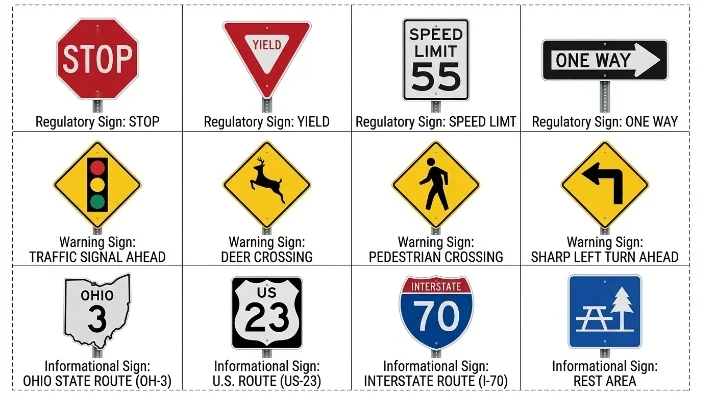
The test covers three broad areas: traffic laws, road signs and safe driving practices. Road signs trip people up more than the laws do, weirdly. A stop sign you know. But that yellow diamond with a truck on a hill? Or the difference between a regulatory sign and a warning sign? That’s where people lose points they didn’t expect to lose.
Where do you take it? Any Ohio BMV location. No appointment needed for the written exam — walk-ins are generally fine, though checking your local office’s hours first isn’t a bad idea.
Preparation is simple: read the manual. Not skim. Read. The official manual is the only source that matters because that’s exactly what the test pulls from. Online practice tests help too — there are several decent free ones floating around and r/Ohio has threads where people share which sections caught them off guard. Worth a browse.
The Maneuverability Test: The Box That Haunts Dreams
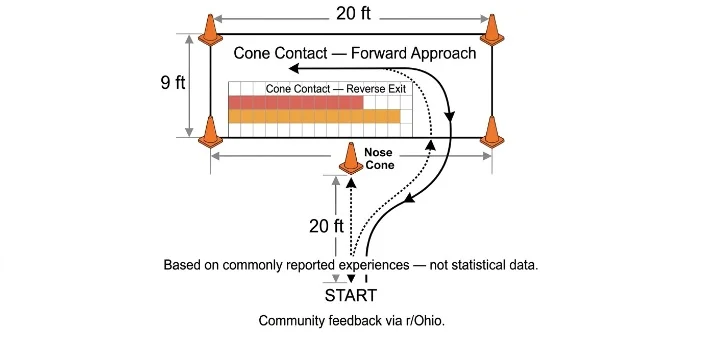
This is the one people genuinely stress about. And look, the anxiety isn’t irrational — it’s a tight course, the cones feel like they’re placed by someone who wanted you to fail and hitting even one means automatic failure. But it’s also a skill test with a clear, learnable pattern. Once you understand exactly what they’re measuring, it gets less intimidating.
Here’s the physical setup.
The course is a rectangle — 9 feet wide, 20 feet long — marked by cones at each corner. Twenty feet out from the center of that rectangle, there’s a single “nose” cone sitting by itself. That’s it. That’s the whole course.
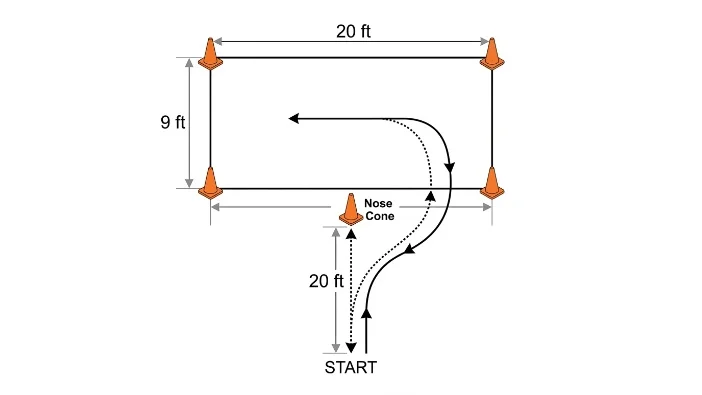
What you actually do: pull forward into the box, steering around the nose cone to whichever side the examiner directs — left or right, their call. Then reverse back out and return to your starting position without hitting anything.
The scoring system is based on a point system. You can get up to 24 points and pass. Striking a cone is not a deduction point, it is a full stop, failure. Other activities that deduct points: pausing in the middle of maneuver to see where you are, failing to park at the end of the maneuver, driving in a zigzag manner. The control which the examiner is observing is not your speed but your control. Slow and slow, they beat fast and sloppy.
A few things that actually help in practice:
- Know your car’s dimensions. Seriously. Practice in the vehicle you’re testing in, not whatever’s convenient. A sedan and an SUV handle completely differently in reverse.
- Use your mirrors constantly. The examiner notices when you don’t.
- Don’t rush the reverse. Most mistakes happen here because people speed up when they get nervous.
- Look where you’re going, not at the cones. Fixating on the cones is how you hit them.
You must pass the maneuverability test before they’ll let you move on to the road test. Fail it and you’re not getting on the road that day — and you’ll need to complete an online remedial course before rescheduling. More on that in a later section.
The Road Test & Common Legal Pitfalls
You made it through the box. Good. Now comes the part that actually feels like driving.
The road test is what it is all about, you get out of the BMV parking lot with an examiner in the passenger seat and go out on the real roads, in the real traffic with a clipboard observing everything you do. It’s uncomfortable. The maneuverability test is seen as scarier by most people going in and the road test is where people fail due to overconfidence.
Here’s what the examiner is specifically watching for:
- Smooth, properly signaled lane changes
- Mirror checks — actual ones, not the quick fake glance
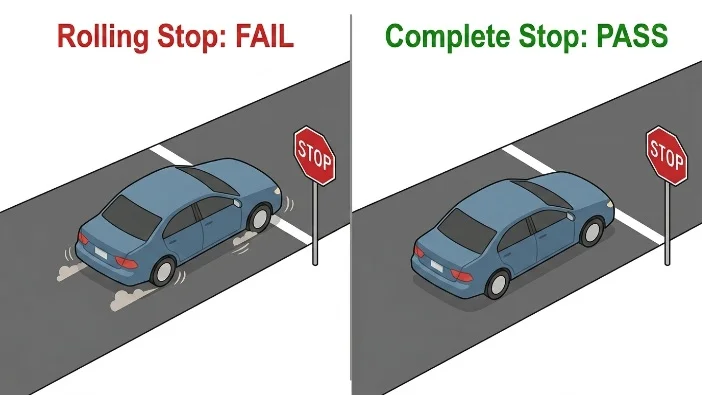
- Controlled stops at intersections, full stop, no rolling
- Turns executed at the right speed and from the correct lane
- Overall traffic law observance throughout the route
That rolling stop thing deserves it’s own moment. It’s probably the single most common reason people fail who genuinely know how to drive. You’ve been stopping at that intersection near your house for two years, you slow down to 2mph, nothing bad has ever happened — and then you do it on the test and it’s an automatic failure. Full stop means wheels completely stopped. Not almost stopped. Not briefly stopped. Stopped.
Other common failure points pulled straight from what Ohio test-takers report:
- Not following examiner instructions — if they say turn right and you hesitate or go left, that’s a problem regardless of why
- Nervousness causing overcorrection — jerky steering, braking too hard, drifting between lanes
- Improper mirror and blind spot checks during lane changes — looking isn’t enough, it has to be visible to the examiner
- Incorrect lane positioning during turns — turning right from anything but the rightmost lane or left from anywhere but the leftmost
- Speed issues — going too slow can fail you just as much as going too fast in some situations
The examiner isn’t trying to trick you. They’re running through a standardized checklist. Your job is to drive the way the manual says to drive, not the way you’ve watched everyone else drive for years. Those are sometimes very different things.
The Cost of Failure & The New 2025 Adult Ed Mandate
Let’s talk money and consequences, because both matter here.
What the tests cost:
| Test Component | Fee |
| Maneuverability Test | ~$20 |
| Road Test | ~$20 |
| Combined (scheduled appointment) | ~$40 |
| License Issuance Fee | Separate — paid after passing |
That $40 is per attempt. Fail and retake, you’re paying again. Budget accordingly.
Now the failure consequences, because Ohio doesn’t just let you reschedule and try again immediately.
If you fail the maneuverability test: You must complete an online remedial course before you can book another attempt. No exceptions, no skipping it.
If you’re 18 or older and fail either part of the skills test: Ohio now requires you to complete an abbreviated adult driver training course before retesting. This isn’t a slap on the wrist — it’s actual coursework. More time, possibly more money, definitely more delay.
That second point connects directly to the September 30, 2025 law change. Ohio extended driver’s education requirements to cover all new drivers under 21, not just teenagers. The reasoning is straightforward — new drivers between 18 and 20 were statistically undertrained compared to those who went through the full GDL system as teens. The legislature decided to close that gap.
What does this mean practically?
- Under 18: 24 hours classroom instruction + 8 hours behind-the-wheel. Always been required.
- Ages 18–20: Same requirement now applies. If you turned 18 after September 30, 2025 and haven’t gotten your license yet, this is you. Yes, even if you feel like you already know how to drive.
- 21 and over: Still exempt from the initial driver’s ed requirement — but if you fail your skills test, that abbreviated adult course kicks in.
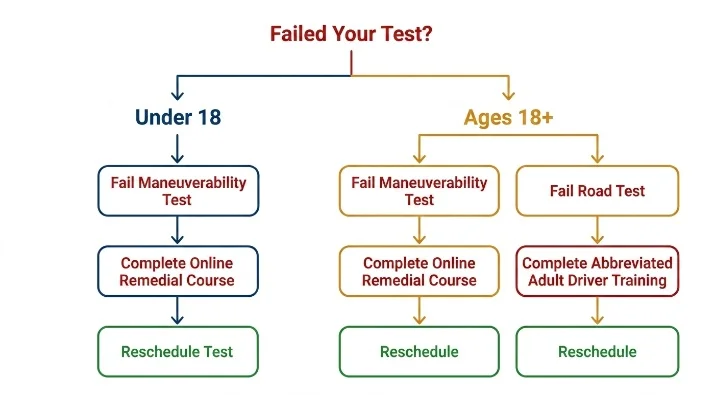
One thing worth noting for parents specifically: if your teenager fails, the remedial course requirement means the timeline stretches. Don’t book the retest date the same week. Give the course time to complete properly, then reschedule.
The $40 per attempt reality plus the mandatory coursework after failure makes a strong case for genuine preparation the first time around. Not because failure is catastrophic — it isn’t — but because the retry path has real friction built into it now.
The Graduated License: Probationary Restrictions
This section is specifically for the under-18 crowd and their parents, who are often more confused about these rules than the teenagers are.
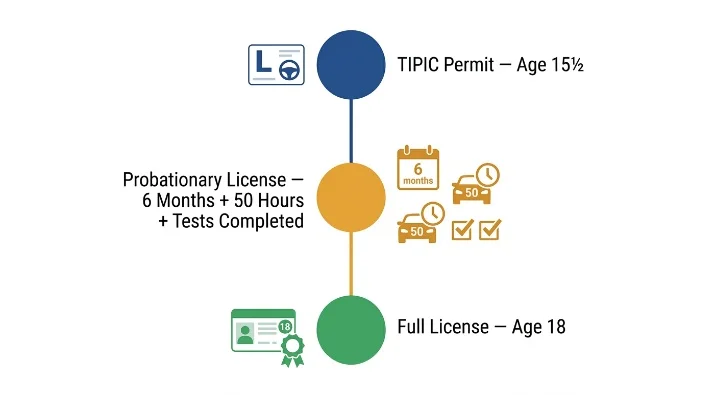
Ohio’s Graduated Driver Licensing system moves in three distinct stages. Each one unlocks more freedom, but each one also carries specific legal restrictions that aren’t suggestions. They’re enforceable law. Getting caught violating probationary restrictions doesn’t just mean a lecture — it means potential delays to your full license and possible fines.
Here’s how the three stages actually work.
Stage 1: The TIPIC (Temporary Instruction Permit)
TIPIC stands for Temporary Instruction Permit Identification Card. It’s the learner’s permit. You’re eligible at 15½, but you need to pass both the knowledge test and the vision screening at the Ohio BMV first.
While you’re on a TIPIC:
- A licensed adult 21 or older must be in the front passenger seat. Every single time.
- No driving between midnight and 6 a.m.
- No handheld electronic devices. Period.
That supervised driving period is also where your 50 hours get logged — including the mandatory 10 at night. Ohio requires a notarized affidavit confirming those hours. Not just a note. Notarized. Parents, plan for that paperwork step in advance because it catches people off guard on test day.
Stage 2: The Probationary License
Pass your driving test after holding the TIPIC for six months, complete driver’s ed, log the 50 hours — and you move to the probationary license. This is a real license. You can drive alone. But the restrictions aren’t gone yet, not for the first 12 months.
During that probationary year:
- No driving between midnight and 6 a.m. Limited exceptions exist for work, school or emergencies — but “I wanted to” isn’t one of them.
- One non-family passenger maximum unless a parent or guardian is physically present in the vehicle. One. Not your three closest friends.
- No handheld electronic devices. Same rule as the permit stage, still in effect.
That passenger restriction trips up more teenagers than the curfew does. The instinct is to think “I passed my test, I can drive my friends now.” Legally, no. Not more than one at a time and not family members who don’t count toward the restriction. An older sibling who lives elsewhere? Probably doesn’t count. Check the Ohio BMV guidance if there’s any ambiguity — don’t guess on this one.
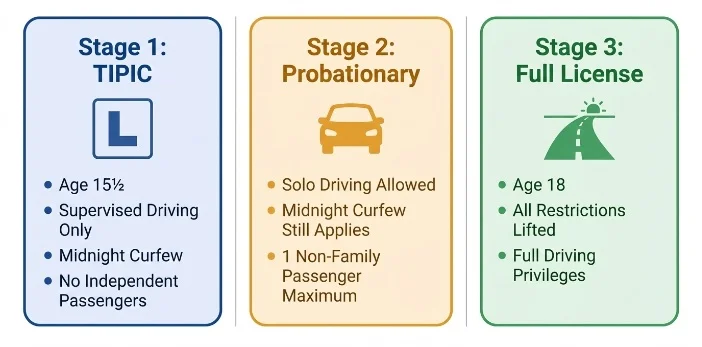
Stage 3: Full License
Turn 18, complete the probationary period and every restriction drops. No curfew, no passenger limits, no additional requirements. You’re on the same footing as any other Ohio driver.
Simple stage. Worth waiting for properly rather than rushing the earlier ones.
Conclusion: Your Legal Checklist Before Test Day
Here’s where everything lands. Not theory — actual steps, in order, with nothing left out.
If you’re under 18:
- Turn 15½
- Study the Ohio Driver Manual — properly, not a skim
- Pass the knowledge and vision tests at any Ohio BMV office to get your TIPIC
- Enroll in and complete driver’s ed (24 classroom hours + 8 behind-the-wheel)
- Log 50 supervised driving hours, 10 at night, in varied conditions
- Get the 50-hour affidavit notarized — don’t leave this to the last minute
- Hold your TIPIC for a minimum of six months
- Schedule your driving test at OhioDrivingTest.com
- Bring your TIPIC, driver’s ed completion certificate, notarized affidavit and a parent or guardian
- Bring a properly registered and insured vehicle
- Budget approximately $40 for the maneuverability and road tests combined
If you’re 18–20:
- Complete driver’s ed — yes, it’s required now as of September 30, 2025
- Pass the knowledge and vision tests at any Ohio BMV office
- Log 50 supervised driving hours including 10 at night
- Get the affidavit notarized
- Schedule and show up at OhioDrivingTest.com
- Budget $40 for tests, bring your vehicle and documentation
If you’re 21 or over:
- Study the Ohio Driver Manual
- Pass the knowledge and vision tests
- Schedule your driving test at OhioDrivingTest.com
- Bring a registered, insured vehicle
- Budget $40
One last thing worth saying plainly. The Ohio driving test isn’t designed to fail you. The maneuverability course is learnable. The road test rewards the habits the manual teaches. The written exam tests exactly what’s in the manual and nothing else. Preparation — real preparation, not the night-before cramming kind — makes most of the anxiety disappear.
And if you do fail something? It’s not over. It’s just slower. Do the required course, practice what went wrong and go back.
That’s the whole roadmap. Good luck out there.