 Kerry Splatt (AU Car Aciddent Lawyer)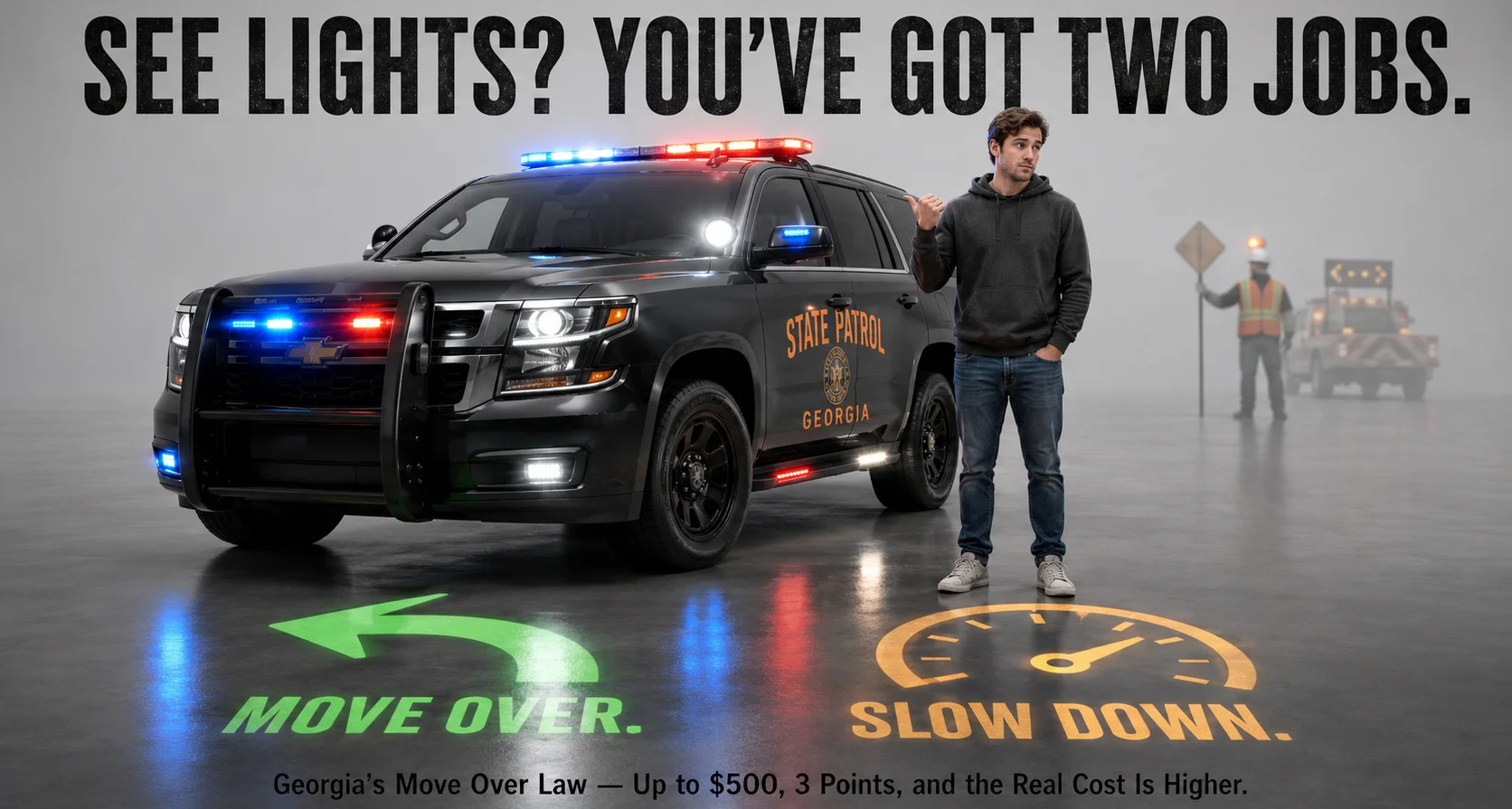
TL;DR — The 30-second version See flashing lights on a stopped vehicle ahead? You’ve got two jobs, in order. Move over — get out of the lane next to it if there’s room and it’s safe. Can’t move over? Then slow down below the posted speed limit and be ready to stop until you’re past. That’s the whole law. It covers police, fire, ambulances, tow trucks, highway-maintenance crews, utility trucks and (yes) sanitation workers. Blow it off and you’re looking at a fine of up to $500 and 3 points on your license — more if someone gets hurt. The rule runs 24/7, on every road in Georgia, interstate or back-country two-laner.
What the Law Actually Requires
Here’s the thing most people get wrong: they think “move over” is the law. It’s only half of it. The actual rule is a two-step decision you make in about three seconds as you come up on a stopped vehicle with its lights going. Georgia wrote it into O.C.G.A. § 40-6-16, the section titled procedure for passing certain stationary vehicles. It’s also called the Spencer Pass Law, named after a fallen officer — worth remembering when you’re tempted to treat it as a technicality.
The Golden Rule: Move Over
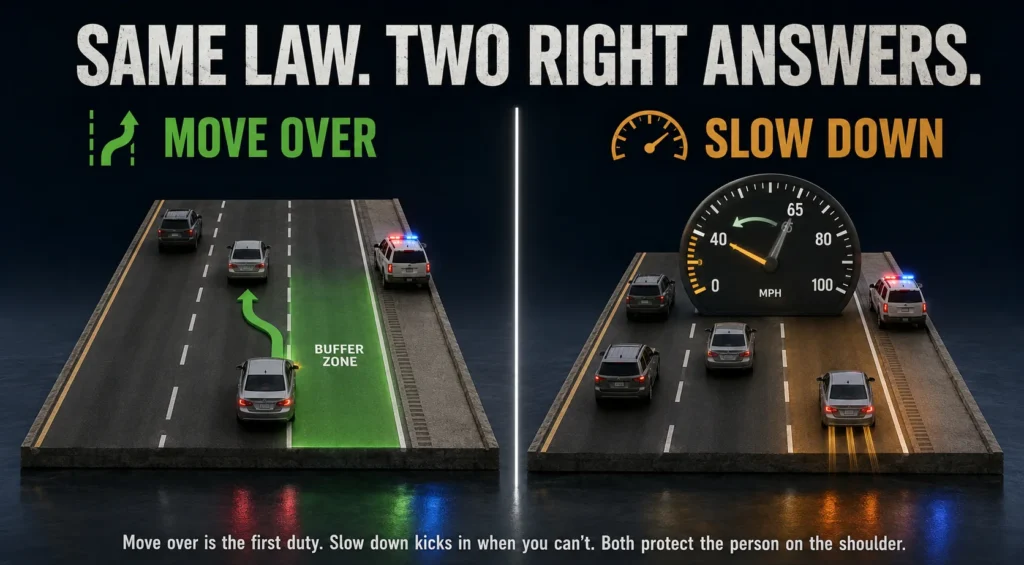
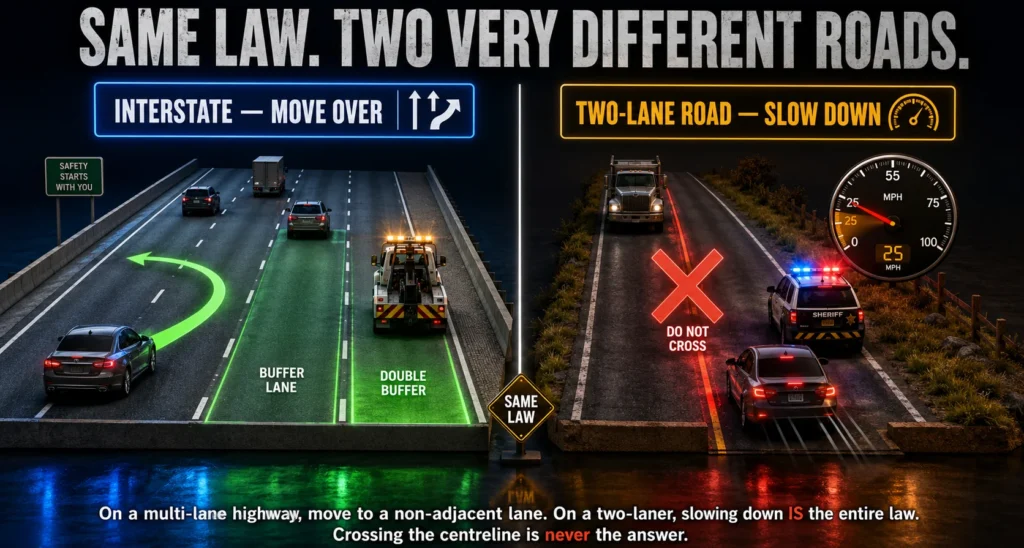
If you can change lanes away from the stopped vehicle, do it. The code is specific — you make a lane change into a lane not adjacent to the emergency vehicle, if that’s possible given the existing safety and traffic conditions. Note the wording: a lane not adjacent. Leave an empty lane as a buffer between you and whoever’s working the shoulder. Signal, check your mirror, merge clean. Don’t stab the brakes and lurch over at the last second — that’s how you cause the second wreck.
If You Can’t Move Over, Slow Down
Traffic’s too heavy to merge? Only one lane your direction? Then the second duty kicks in. You reduce speed to a reasonable and proper speed for the conditions — a speed that must be less than the posted limit and be prepared to stop.
Notice what the law does not do: it doesn’t hand you a number. No “exactly 20 under.” Georgia uses a judgment standard instead, which cuts both ways — flexible, but it means easing off by 2 mph won’t cut it. The point is to bleed off enough speed that you could actually stop if a worker stepped into your lane. A few practical reads on what “slow down and be prepared to stop” means in the real world:
- Lift off the gas early and let the car coast down — don’t wait until you’re on top of the scene.
- Cover the brake. Foot hovering, ready.
- Drop clearly below the limit, not a token amount. If everyone around you is doing it too, match the flow down, don’t be the one threading through at speed.
- Stay ready to come to a full stop if someone moves into the road.
Which Vehicles Are Covered
This is where the law has quietly grown. It started in 2003 covering emergency vehicles. Over the years the General Assembly kept widening it, most recently with an amendment effective July 1, 2024, so now it sweeps in a lot more than cop cars and ambulances. It reaches first responders, utility vehicles, DOT vehicles, tow trucks, HERO units and wreckers working a crash.
| Vehicle Type | Examples | Flashing Light Colors |
| Authorized emergency vehicle | Police, fire, ambulance, HERO units | Red, blue, white, amber or yellow |
| Towing / recovery vehicle | Tow trucks, wreckers at a crash | Yellow, amber or red |
| Highway maintenance vehicle | DOT crews, road work trucks | Yellow, amber or red |
| Utility service vehicle | Electric, gas, water, cable, telecom | Yellow, amber or white |
On “utility services,” the code is broad — it covers electric, natural gas, water, waste-water, cable, telephone and telecommunication work, including crews repairing or relocating poles, wires, pipes and cables. So that bucket truck with the amber light? Same rule applies.
Penalties & Points — What a Violation Costs You
Let’s talk money and your license, because this is where people start paying attention. A move-over ticket isn’t a felony and it won’t land you in jail by itself — but it’s not a parking ticket either and the points are the part that bites.
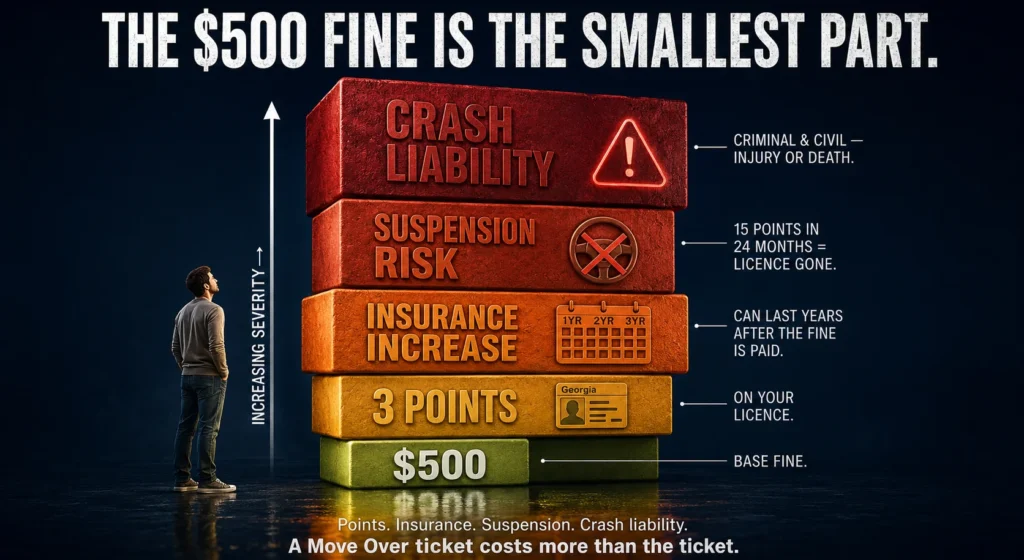
The fine depends on which type of vehicle you blew past. Violating the subsection covering emergency, tow and highway-maintenance vehicles carries a fine of up to $500, while the lower tier runs up to $250. Either way, a move-over conviction puts 3 points on your Georgia driving record.
| What happened | Fine | Points |
| Failure to move over / slow down (emergency, tow, maintenance) | Up to $500 | 3 |
| Lower-tier vehicle category | Up to $250 | 3 |
| Crash causing injury or death | Separate criminal & civil charges (not under this section) | — |
Three points doesn’t sound like much. Here’s why it matters anyway: for drivers over 21, racking up 15 points in any 24-month window triggers a license suspension. So this ticket isn’t dangerous in isolation — it’s dangerous as the one that tips you over after a couple of speeding tickets you’d half-forgotten about. And points have a quieter cost too. Insurers read them as a sign of risky driving, which tends to push premiums up — sometimes for years, long after the $500 is paid and gone.
One more thing the lawyers all flag and it’s worth hearing. A move-over stop gives an officer a legal reason to pull you over and that stop can open the door to investigating other offenses, including DUI. A two-second lane change you skipped can turn into a very long night. That’s the real downside risk, not the fine.
What about a crash? If failing to move over causes an injury or a death, you’re no longer in $40-6-16 territory. The driver can face criminal and civil liability — vehicle damage, a victim’s medical bills, pain and suffering, restitution, with the criminal side charged under Georgia’s separate homicide-by-vehicle and serious-injury statutes. Different ballgame entirely.
Special Situations: Two-Lane Roads, Night Driving and More
Here’s where drivers genuinely get confused and fair enough — the textbook version of the law assumes a wide-open multi-lane highway and that’s not where most of us actually drive.
The Two-lane Road
This is the big one. You’re on a rural state route, one lane each way and there’s a sheriff’s deputy stopped on the shoulder with his lights on. You can’t move over — the only other lane has oncoming traffic in it and crossing that centerline is both illegal and a great way to cause a head-on. So what do you do? The slow-down duty takes over completely. Drop well below the limit, ease off early and be genuinely ready to stop. On a two-laner there’s no “move over” option to fall back on — slowing down is the law for you in that moment. Treat it that way.
Night Driving
The law doesn’t change after dark, but the stakes do. Flashing lights are easier to spot at night — which is good — but you’ve got less time to read the whole scene: how many workers are out, where they’re standing, whether someone’s about to step into your lane. Start your reaction earlier than you would in daylight. The reduced speed the statute asks for is exactly the cushion that buys you reaction time you can’t get from your headlights alone.
The “is it even stopped?” Cases
What counts as a “stationary” vehicle? Strictly, the word means stopped. But the spirit of the law reaches the gray zone — a utility truck crawling along the shoulder, a patrol car that rolls forward a few feet during a stop. The safe move and the one that matches what the law is trying to do, is to treat any slow or stopped service vehicle with flashing lights the same way: move over or slow down. Don’t lawyer the word “stationary” at 70 mph.
A few situations where people wrongly assume the law switches off:
- Light traffic, empty road. Still applies. Nobody around to merge for doesn’t mean nobody’s working that shoulder.
- You’re already one lane away. On a wide highway, the rule wants a lane not adjacent — an empty buffer lane if you can manage it, not just “technically not the shoulder lane.”
- Daytime, clear weather, you can see fine. Doesn’t matter. The duty is the same; good visibility just means you’ve got no excuse.
- It’s “only” a tow truck or a garbage truck. Covered. Those amber and white lights count and those are the workers getting hit most often.
How Georgia’s Law Compares to Neighboring States
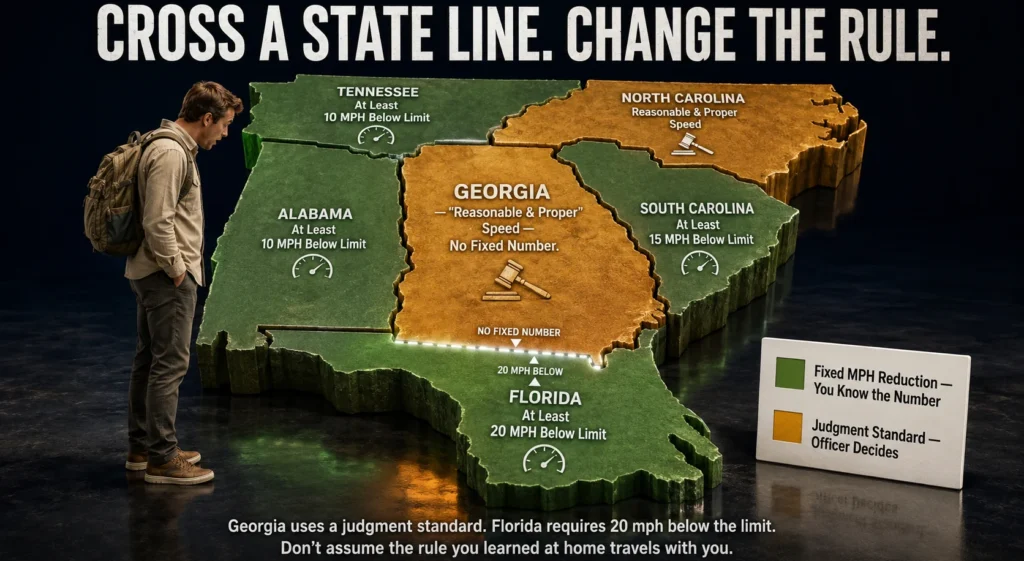
Every state has a move-over law now — all 50 of them — but they’re not identical and if you road-trip through the Southeast the differences actually matter. The big split is over one question: how much do you have to slow down when you can’t change lanes?
Georgia uses a judgment standard. The code just says slow to a “reasonable and proper speed” below the limit. No magic number. Cross into Florida, though and the rule gets specific — Florida requires drivers to slow to at least 20 mph below the posted speed limit when they can’t move over. That’s a meaningful difference in practice. In Florida you know exactly what’s expected of you. In Georgia, because there’s no fixed number, the officer is left to judge whether your speed was reasonable — which is more flexible but also a little more subjective if you ever have to argue it.
So what should a traveler actually take from that? Don’t assume the rule you learned at home travels with you. The safe play crossing state lines is to drive to the strictest standard you might encounter — slow down hard, leave the buffer lane, every time. You’ll never be wrong doing more than the minimum and you sidestep the guessing game entirely.
| Speed-reduction rule when you can’t move over | |
| Georgia | “Reasonable and proper” speed below the limit — no fixed number |
| Florida | At least 20 mph below the posted limit |
| General regional pattern | Many states specify a number; some, like Georgia, use a judgment standard |
Real-Life Stories & Why This Law Exists
Laws like this don’t get written in a vacuum. Somebody usually died first. That’s the uncomfortable truth behind the move-over rule and it’s worth knowing the name attached to Georgia’s version, because it changes how you see those flashing lights on the shoulder.
Georgia’s law is officially the Spencer Pass Law. The statute literally opens by saying it shall be known as the “Spencer Pass Law.” Who was he? Spencer Pass was a 47-year-old father, gospel singer and Georgia DOT Highway Emergency Response Operator — a HERO, one of the crew who help stranded drivers with flat tires and dead batteries and push broken-down cars to the shoulder. On January 31, 2011, he was working on I-85 near Metropolitan Parkway in Atlanta when a utility truck towing a flatbed trailer struck and killed him. He was the first HERO worker in Georgia to die in the line of duty and the legislature passed the law bearing his name shortly after. Georgia even named the I-85 bridge over Cleveland Avenue in Atlanta after him.
Sit with the detail for a second: he was killed by a utility truck — exactly the kind of vehicle the expanded law now protects. The person doing the rescuing got run down doing it.
And the heartbreaking part is how little the message has stuck. More than a decade on, his former coworkers are still out there practically begging drivers to pay attention. One of them, a fellow HERO operator named Jason Josey, lost Pass as a friend that day. His plea is almost unbearably simple: moving over helps these workers get home to their families at night and he adds, “it’ll help you get home” too. That’s the whole thing, really. It’s not about the points or the fine. It’s that the guy changing someone’s tire on the shoulder has a family waiting up.
That’s the answer to “why does this law even exist.” Not bureaucracy. A man named Spencer Pass.
10 Practical Tips for Georgia Drivers
Enough background — here’s the part you can actually use the next time you spot lights ahead. Quick, memorizable and the kind of stuff that keeps a ticket (or worse) off your record.
- Scan far ahead. Spot the flashing lights early — any color, red, blue, white, amber, yellow. The earlier you see it, the calmer your reaction.
- Decide your move at distance, not at the bumper. Move over or slow down — pick which one as soon as you can read the traffic, not when you’re right on top of the scene.
- Signal and merge smooth. If you’re changing lanes, indicate and ease over. No last-second swerve.
- Aim for a buffer lane. On a multi-lane road, get into a lane not adjacent to the stopped vehicle if you safely can — leave an empty lane between you and the worker.
- Can’t move over? Lift off the gas early. Let the car bleed off speed naturally instead of stamping the brakes.
- Get well under the limit — and mean it. A token 2 mph won’t satisfy the law. Drop enough that you could actually stop.
- Cover the brake. Foot ready, eyes on the workers, until you’re fully past.
- Two-lane road? Slowing down IS your job. You can’t cross the centerline, so the slow-down duty is the entire law for you there.
- Treat every flashing-light vehicle the same. Cop, ambulance, tow truck, garbage truck, bucket truck — all covered. Don’t pick and choose.
- Remember it’s 24/7, every road. Interstate or rural two-laner, day or night, light traffic or heavy. The duty never switches off.