 Nicholas J. Rego Accident Lawyer
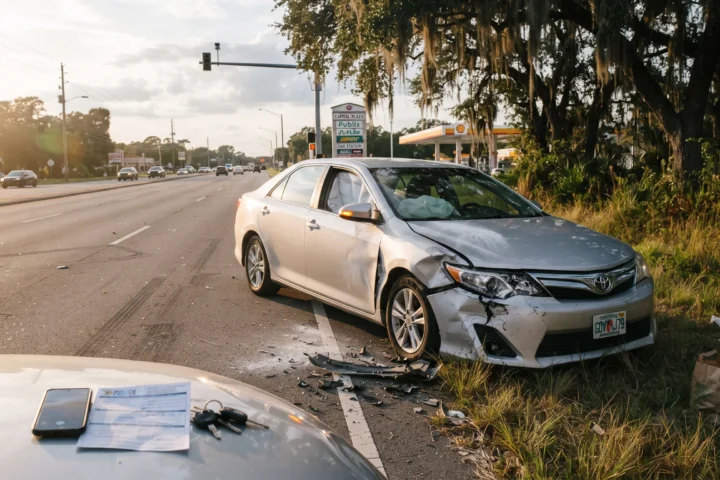
You’re stopped at a red light in Atlanta. A car clips yours. You feel the jolt. Your heart’s racing. The other driver takes off—doesn’t even slow down.
Or perhaps you are at the sidewalk. A car strikes one of your loved ones and disappears in a traffic jam. Months after that, law enforcement finally locates the driver.
Either, you will soon discover that the law of hit-and-run (OCGA 40-6- 270) is merciless in Georgia. But understanding it? That’s your power. Being the driver charged with the violation or the victim of the injustice, it may be a matter of life or death to know what the statute literally requires and what will be the results of it.
I have dealt with hundreds of such cases. Other clients did not know that they were on the point of committing a felony they left a scene. Some believed that they would be okay returning later on. Lots of victims were not aware of the fact that the criminal conviction could reinforce their civil claims. I will take you through the knowledge you need to know.
What the Hit-and-Run Statute of Georgia Says?
§ 40-6-270 is blunt: if you’re involved in an accident that injures someone or damages an occupied or attended vehicle, you have specific legal duties. Not suggestions. Duties.
Here’s what the law requires you to do:
- Stop immediately—or get as close as possible and come back if you can’t stop right there.
- Stay at the scene until you’ve finished your other obligations (no ducking out early).
- Give your name, address and vehicle registration number to any other driver, property owner or police officer.
- Show your driver’s license if asked.
- Render reasonable assistance—that means helping injured people. If someone needs a hospital, you arrange it. If they can’t communicate (unconscious, appears dead, can’t talk), you call 911 and make every reasonable effort to get EMS and police there.
- Don’t obstruct traffic unnecessarily while you’re handling all this.
That last one’s the trap people miss. You have to stay; you just can’t block the whole highway doing it.
In 2008, the statute was revised to ensure there was a crystal-clear duty of unconscious-victim. Previously, there are those drivers who have testified that they had no idea what to do with someone who is not responding. Not anymore.
Felony vs. Misdemeanor: Where the Hammer Comes Down
This statute is divided into two criminal levels according to what the accident entailed and not what you did afterwards.
Felony Hit-and-Run (§ 40-6-270(b))
You reach this level when the accident, the impact, the collision itself kills or grievously wounds one.
Here’s the punishment:
- 1 to 5 years in prison.
- That’s it for criminal penalties (the statute doesn’t specify a fine for felonies).
- But you’re a felon. Your employment options shrink. Background checks catch this forever.
The important fact: The prosecution must demonstrate that the accident was the probable cause of the death or grievous injury. A case in the Georgia appellate (Henry v.) A conviction for a vehicular homicide was thrown out in (State, 2007) because there was evidence that the victim killed immediately upon impact- no chance that first aid could have saved her. The hit-and-run itself was a felony itself but it could not serve to increase the homicide charge. That matters for sentencing.
What is considered to be serious injury? The statute does not give it a precise definition, but courts consider it as severe bodily harm: broken bones, internal trauma, serious dangers of death, permanent disfigurement, surgeries and hospitalization injuries. Usually a jury decides. The fact that he broke his arm is unlikely to be severe. “She ruptured her spleen” is.
Misdemeanor Hit-and-Run (§ 40-6-270(c))
All the rest: damage to property of an occupied or attended vehicle or non-serious injury.
Penalties escalate based on your record—and Georgia counts priors aggressively:
| Conviction # (within 5 years) | Minimum Fine | Jail Time | Other Notes |
|---|---|---|---|
| 1st | $300–$1,000 (mandatory, non-suspendable) | Up to 12 months | Nolo pleas count as convictions |
| 2nd | $600–$1,000 (mandatory, escalated) | Up to 12 months | Five-year lookback from arrest date to arrest date |
| 3rd+ | $1,000 (mandatory) | Up to 12 months | Same lookback window applies |
Here’s what kills people: that “non-suspendable” language. A judge can’t waive or reduce the minimum fine. You will pay it. The only break is hardship installments at judicial discretion—and you have to prove genuine hardship.
Nolo contendere (no contest) pleas? They count as convictions for everything: the mandatory fines, the lookback period, the driver’s license suspension. Don’t assume “taking a plea” protects you from collateral consequences. It doesn’t.
Driver’s License: You’re Getting Suspended
Conviction triggers automatic driver’s license suspension under OCGA § 40-5-54(a)(3). The DMV doesn’t email you a heads-up. The court reports the conviction and your license goes into suspension automatically.
Here’s the timeline:
| # of Convictions (within 5 years) | Suspension Length | Early Reinstatement? |
|---|---|---|
| 1st | 12 months | Yes—after 120 days if you complete an approved defensive driving course or DUI Risk Reduction Program + pay a $210 restoration fee (or $200 by mail) |
| 2nd | 3 years | Yes—same process after 120 days in most cases |
| 3rd | Habitual violator status → revocation | Extremely limited; usually 5 years minimum; special permits are rare |
The five year lookback involves arrest to arrest dates rather than conviction dates. Thus, in case you are arrested today and guilty in 6 months and re-arrested in 2 years, the two convictions would be counted in the 5 year window.
Another one: when you come back after 120 days, you may be subjected to a written examination to demonstrate the knowledge of the rules. It varies with the local DMV office.
Getting suspended isn’t just an inconvenience. It’s a chain reaction: lost job, can’t get to work even if you find one, insurance rates explode if you eventually get reinstated. I’ve watched clients lose their jobs because they couldn’t drive for work, then lost their homes because they couldn’t pay rent. The statute doesn’t care.
What Prosecutors Actually Have to Prove
The State has to establish three things beyond a reasonable doubt:
- You were the driver involved in a qualifying accident.
- You knew the accident happened and that it caused injury/damage/death.
- You knowingly failed to perform your statutory duties.
That sounds straightforward until you’re in the courtroom. “Knowledge” is often circumstantial—the other driver saw you; your vehicle has matching damage; you made false statements; you fled. A jury infers it from the evidence.
But here’s the gray area: the State doesn’t have to prove you knew the full extent of the injury. You don’t have to realize someone broke three ribs to be guilty. Knowing someone was hurt is enough.
Involved is the fact that your car actually hit something. It is not sufficient to be at the location afterward or drive away quick. It has to have physical contact or collision evidence.
Georgia Court Cases That Influence Your Case
Henry v. State (Ga. Ct. App. 2007)
The case altered the manner in which the courts dealt with felony hit-and-run based on vehicular homicide. The black defendant struck a passerby. The prosecution leveled felony hit-and-run and first-degree vehicular murder. The court of appeal said: stay your neck. To make the vehicular homicide case viable, the inability to stop and render aid, is not only the initial crash but also the contributory cause of the death. First aid would not have been important in the event that the victim died immediately he was hit. The conviction on felony hit and run was upheld yet the homicide conviction was reversed as causation was not established.
Why does this matter to you? When you are charged with several counts, your defense on one of the counts influences the defense on the rest. A jury may find guilty of hit-and-run but not guilty of vehicular homicide in case it is demonstrated that the victim perished immediately. Hire an attorney with this kind of interplay.
Johnson v. State (Ga. Ct. App. 2021)
This case supports the idea that the State has to demonstrate real participation- not only circumstantial suspicion. The eyewitness testimony, the damage of the vehicle is equal, the behavior of a flight, false statements made after that: all that constitutes a case. However, the lack of physical signs of being hit can raise some reasonable doubt.
Defenses Which Do and Do Not Work
Strong Defenses
No involvement. In case the prosecution is unable to establish that your car struck an object, no paint transfer, no person who recognized your car, no video surveillance, that amounts to reasonable doubt. This is your best shot.
No knowledge. You had no idea that you had struck anything. It is more difficult to sell (juries are suspicious), but when your car is not scratched and nobody saw you, then it is possible.
Substantial compliance. You went back to the scene days or a few hours later and finished your work. This is limited by courts and should not be counted upon. But in rare cases, it’s worked.
Defenses That Usually Fail
Necessity/duress. I was scared or I had to get to the hospital. The Georgia courts are unfriendly of these. You would have to have demonstration of a forthcoming wicked peril. It does not pay to come late to work.
Mistaken belief of no damage. “I thought it was just a scratch.” A jury will question why you left if you really believed that.
I came back later. Voluntarily returning helps mitigation at sentencing. It doesn’t erase the crime.
Related Statutes You Should Know
In the case of a charge of hit-and-run, other counts are often overlaid by the prosecutors:
- The code of the road is § 40-6-271: Inadvertently striking an unattended vehicle or property. Greater responsibility (no, leave a written note with your details). Misdemeanor only. Often charged alongside § 40-6-270.
- § 40-6-272: Hitting highway fixtures or railroad signals. Similar notice requirement.
- § 40-6-273: General accident reporting. In case of no police presence at the scene and injury/ damage exceeding limits, you must report to police within 10 days.
- § 40-6-394: Serious injury by vehicle. Another felony that can have manifold interactions with hit-and-run.
- Vehicular homicide ( 40-6-393): It is frequently coupled as predicate with felony hit-and-run.
Multi-count indictments are not unusual. They all possess various aspects and countering. Do not think they all sink and swim along.
What is Going on Georgia Roads Right Now
Crashes that are caused by hitting and running are increasing and particularly within the urban areas. Metro Atlanta, Augusta, Savannah–they have hundreds of serious crashes every year and a frightening percentage of those crashes are represented by drivers who ran.

What this translates in human terms is this: vulnerable road users, who are pedestrians, bicycle riders, are one in four lucky to have the driver of the car that hits them, drive away. Investigations stall. Immediate medical response is not provided to the victims. Civil claims take forever.
Georgia highway deaths dropped to 1,674 in 2023 (by 7 percent compared to 2022), although the rates of hits-and-run cases related to non-motorist collisions have not been significantly reduced. Distracted driving, speeding and impaired driving all increase upwards with hit-and-runs since 2019. It’s a mess.

If You’re a Victim: Your Civil and Insurance Angle
A hit-and-run conviction is gold in a civil lawsuit. It’s negligence per se—the court treats the criminal violation as proof of negligence without you having to litigate it again. Done deal.
That changes everything:
- Uninsured/underinsured motorist (UM/UIM) claims become stronger. Your own insurance has to cover you because the other driver fled or carried no insurance.
- Bad-faith and punitive damages are on the table. Juries get angry at hit-and-run drivers.
- Statute of limitations for civil suit is generally four years from injury, but criminal prosecution can run longer. Don’t sit on filing.
You need a personal-injury lawyer immediately, in case you are the victim. Having an insurance adjuster of the at-fault driver negotiate on your own is not advisable. The criminal conviction will be an asset to your case, however, you require someone who can know how to pull the two together.
Practice Pointers: What to Do When You Get Charged or Injured
If You’re Facing Charges:
- Do not speak to the police in the absence of an attorney. Not even to explain. Silence does not amount to confession; it is a right.
- Get a criminal defense lawyer on board. It is not a misdemeanor-plea case. Felony exposure is real.
- However, discover the scene by yourself. Photographs, contact details of witness people, damage or no damage on your car, surveillance videos of nearby stores.
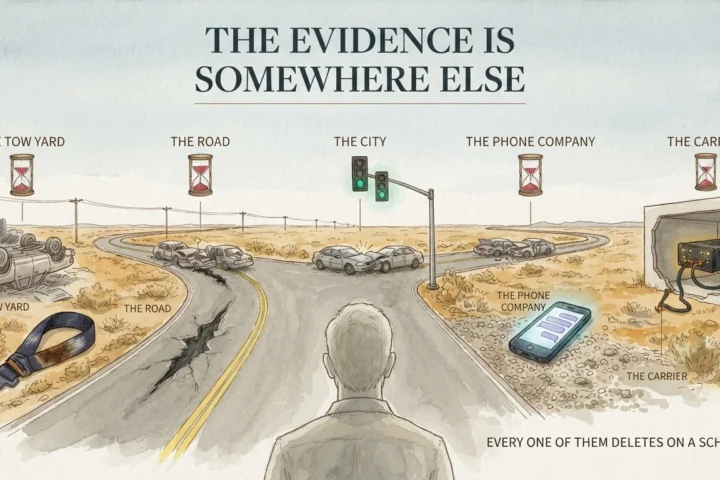
- Preserve cell phone data. GPS of your phone, your text messages, your call history, they count.
- Demand police statements and accident reports by discovery.
- Do not write a social media or talk to witnesses apologies and do not confess.
If You’re the Victim:
- Get medical attention immediately, even if you feel fine. Injuries sometimes show up later.
- Document everything. Photos of the accident scene, your injuries, vehicle damage, medical records.
- Collect witness information on the spot.
- Report to police. Get a report number.
- Notify your insurance company. Provide the police report number.
- Consult a personal-injury attorney before accepting any settlement from the at-fault driver’s insurer (if they’re eventually found).
- Follow through on the criminal case. Your testimony or statement can matter to prosecutors.
The Cascade Effect: Criminal + Civil Implications
This is what occurs in the real-life: A hit-and-run defendant who has been charged with a crime will frequently settle civil actions in a hurry since the threat of felony incarceration gets the concentration. To prevent adverse inferences (when a judge initially suspects you to be guilty in the civil case on the basis of the criminal charge) defense counsel arrange with civil counsel.
Conversely, victims use the criminal conviction to leverage civil settlements. The insurer knows they’re going to lose at trial if the defendant’s a convicted hit-and-run felon.
Nolo contendere pleas are risky for this reason. You avoid a criminal trial, but the plea is admissible evidence in the civil case—sometimes worse than a conviction after actual trial, because you didn’t get to mount a defense.
Bottom Line: Act Now, Think Later Never Works
Leaving a hit-and-run scene feels urgent. You’re panicked. You think you’ll come back. You don’t want trouble. None of that matters to the law.
If you hit something or someone:
- Stop. Immediately.
- Call 911 for any injury.
- Give your information.
- Get a lawyer if police are involved.
If you’re hit and the other driver vanishes:
- Get medical attention.
- Report it.
- Get a lawyer.
- Let the system work.
I’ve seen lives derailed by a split-second decision to leave. I’ve also seen victims fight back effectively because they knew their rights and acted fast. You control which story you’re in.