 Kerry Splatt (AU Car Aciddent Lawyer)
If you’re driving through North Carolina with a child under 8 and under 80 pounds, they need to be in a proper car seat or booster — full stop. Kids under 5 and under 40 pounds? Back seat only (if the car has a front airbag, which most do). The fine for getting this wrong is low, but the real cost isn’t the ticket. Here’s everything you need to know before you buckle up.
What North Carolina Law Actually Says
Most parents assume NC car seat law gets really specific — rear-facing until age 2, forward-facing after that, exact height cutoffs. It doesn’t, actually. North Carolina General Statute § 20-137.1 is simpler than you’d expect, and that simplicity trips people up.
Here’s the core of it: any child under 8 years old AND under 80 pounds must be in a weight-appropriate child passenger restraint system. Car seat, booster — whatever fits the child’s size and meets federal safety standards. The law doesn’t tell you which type of seat. It just says use one, use it correctly, and make sure it was manufactured to federal standards.
Once a child hits age 8 (regardless of weight) OR 80 pounds (regardless of age), a regular seat belt is legally sufficient.
One more rule worth knowing and this catches a lot of travelers off guard:
In vehicles with an active front passenger airbag and a rear seat available, any child under 5 years old AND under 40 pounds must ride in the back.
Renting a car in Charlotte? Road-tripping down to the Outer Banks? That rule applies to you too.
| Age/Size | NC Law Minimum | AAP/NHTSA Recommendation |
| Under 5 yrs & under 40 lbs | Rear seat (if front airbag present) | Rear seat always |
| Under 8 yrs & under 80 lbs | Approved car seat or booster | Rear-facing as long as seat allows |
| 8+ years OR 80+ lbs | Seat belt permitted | Booster until seat belt fits properly (~4’9″) |
| All children | — | Back seat through at least age 12–13 |
Infants Specifically — What the Law Says vs. What You Should Actually Do
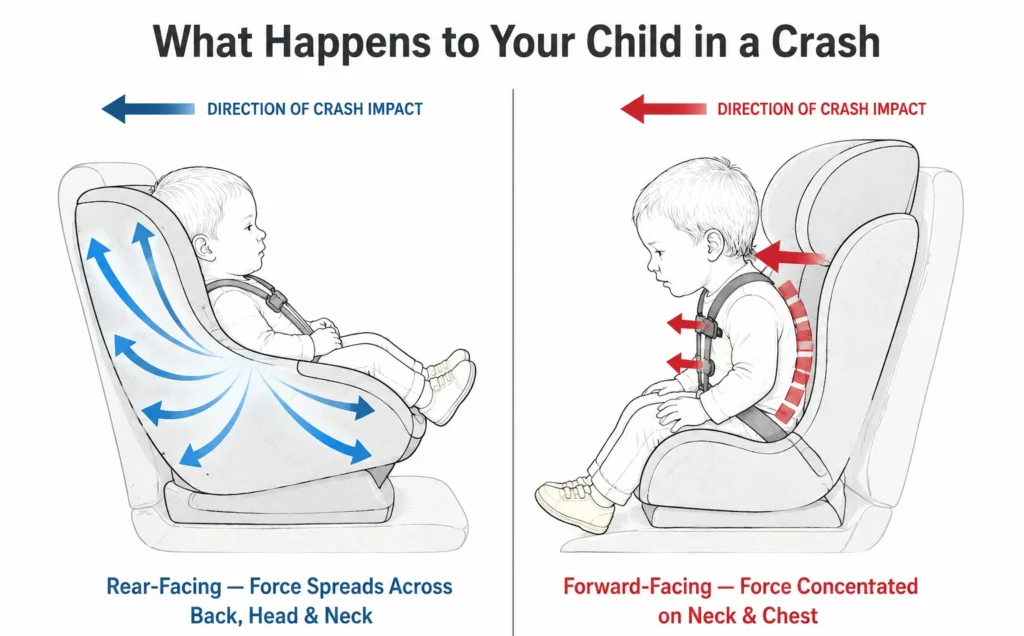
Here’s where it gets important. NC law does not explicitly require rear-facing seats for infants. That surprises a lot of parents. The law just says the seat must fit the child and comply with manufacturer instructions and federal standards (FMVSS 213, if you want the technical label to look for).
So legally? An infant in a properly installed forward-facing seat isn’t automatically a violation. But and this matters — virtually every infant seat manufacturer requires rear-facing for newborns. So using one forward-facing would violate the manufacturer’s instructions, which loops right back into violating the statute.
Practically speaking: rear-facing is both the safe choice and the legally sound one for infants.
The American Academy of Pediatrics recommends keeping babies rear-facing until they hit the maximum height or weight limit of their specific seat — often well past age 2. That’s not law in NC. But it’s the guidance that actually keeps small kids alive in crashes, and it’s what BuckleUpNC.org — the state’s own resource — points parents toward.
Penalties And Why the Fine Isn’t the Real Risk
Getting caught without a proper car seat in NC costs up to $25. Court fees push the real number higher, and you’ll pick up 2 points on your driver’s license. No insurance points though and no automatic negligence finding if something goes wrong civilly.
There’s also a useful out built into the law: if you’re charged for a child under 8, you can avoid conviction by showing up to court with proof you’ve since gotten a proper seat for that vehicle. It’s not a get-out-of-jail-free card, but it reflects the law’s intent — getting kids properly restrained matters more than punishing parents.
What the penalty structure doesn’t capture, obviously, is the actual risk. A $25 fine is nothing. The reason to get this right has nothing to do with the ticket.
Exemptions — When the Law Doesn’t Apply
Not every vehicle, not every situation. NC’s child passenger safety law has a handful of carved-out exemptions worth knowing, especially if you’re traveling in older vehicles or unusual circumstances.
The law doesn’t apply to:
- Ambulances and emergency vehicles — when a child is being transported for medical reasons.
- Vehicles manufactured before 1968 — these predate federal seat belt requirements entirely, so no belt-related mandate applies.
- Any vehicle not required by federal standards to have seat belts.
- Situations where all available belted seats are already occupied by other children in restraints.
That last one matters for large families on road trips. If every buckled seat is taken by a properly restrained child, the law recognizes the practical limit. Still — not an excuse to skip a seat when one’s available.
Travelers, Renters and Rideshare Riders — Read This Part
This is where out-of-state visitors and road-trippers get caught flat-footed. NC law applies to the driver, not just NC residents. Renting a car at RDU or Charlotte Douglas? The rental car driver is responsible for every passenger under 16 being properly restrained.
Rental companies will offer car seats — usually at a daily fee that adds up fast on a week-long trip. Honestly, most frequent travelers just bring their own or buy one locally. If you’re flying into NC with an infant, TSA allows car seats as checked baggage at no extra charge on most airlines. Worth knowing before you pay $15/day at the Hertz counter.
Rideshares are trickier. Uber and Lyft drivers in NC are generally subject to the same law. But enforcement is inconsistent, and most rideshare drivers don’t carry infant seats. If you’re using rideshares with a baby or toddler in NC:
- Uber offers a “Car Seat” option in select cities — check availability in your specific NC destination.
- Lyft has similar options in limited markets.
- Otherwise, bring a portable travel seat or plan around it.
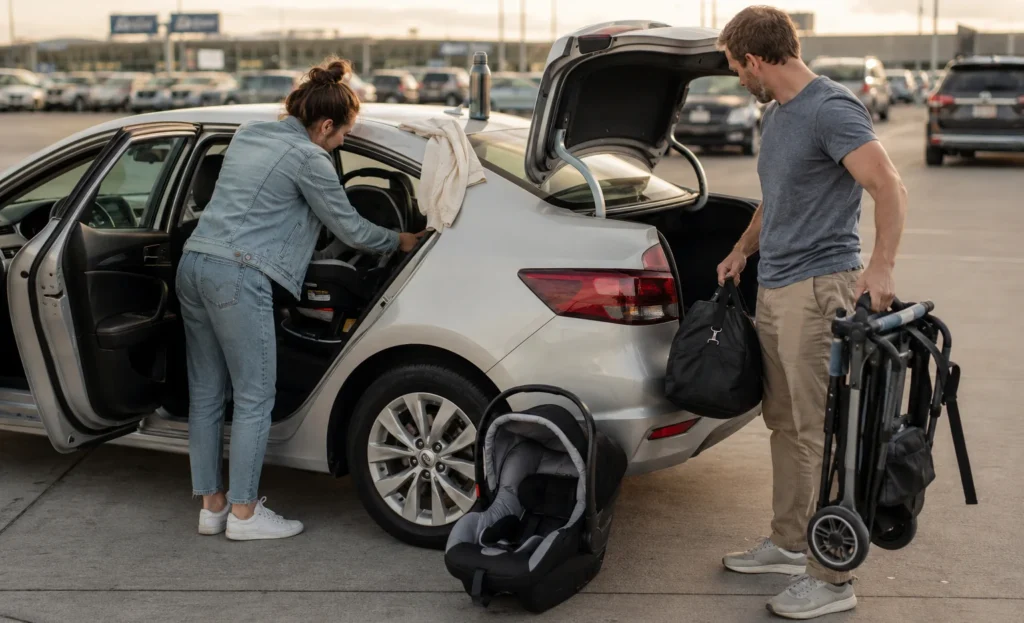
One more scenario — borrowed or unfamiliar vehicles. A lot of grandparents’ cars, older family vehicles, borrowed minivans on vacation. Before putting a child in any unfamiliar car, check: does it have an active front passenger airbag? Is there a rear seat? If yes to both, children under 5 and under 40 pounds go in the back. No exceptions.
Common Mistakes — What Actually Goes Wrong
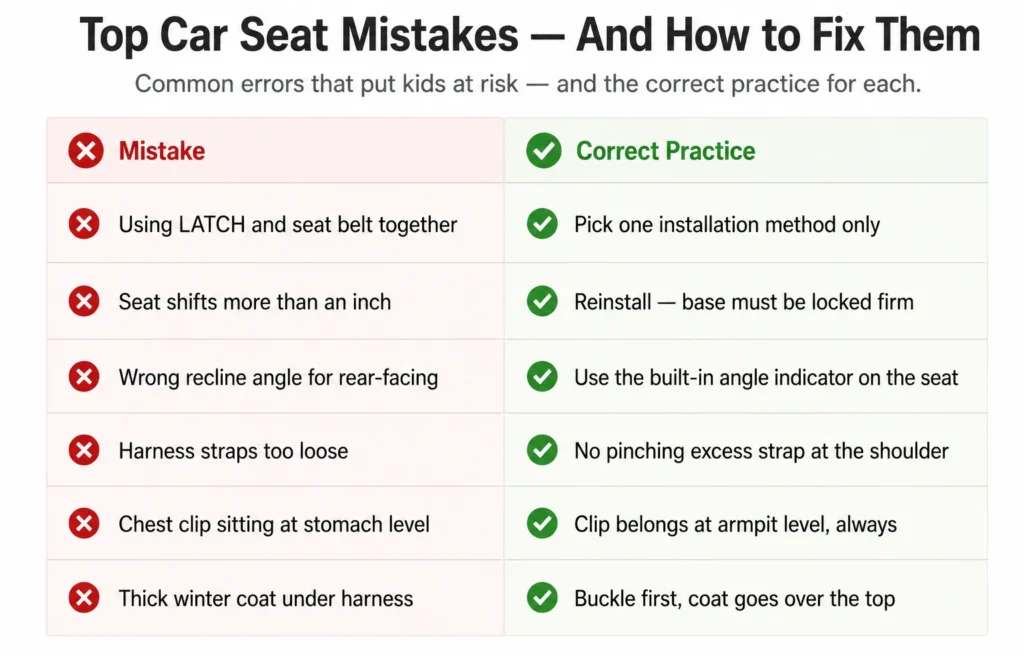
Car seat laws are simple enough. Installation and usage? That’s where things fall apart. According to NHTSA, a significant portion of car seats on the road are misused in some way — wrong recline angle, loose harness straps, incorrect belt routing.
The most common mistakes in NC and everywhere else:
Installation errors:
- Not using LATCH or seat belt — pick one, use it correctly, don’t combine both unless the manufacturer explicitly says you can.
- Too much movement — a properly installed seat shouldn’t shift more than an inch side to side or front to back at the base.
- Wrong recline angle for rear-facing seats — infants need more recline than toddlers; most seats have an indicator.
Usage errors:
- Harness straps too loose — you shouldn’t be able to pinch excess strap at the shoulder.
- Chest clip sitting too low — it belongs at armpit level, not the stomach.
- Bulky winter coats under the harness — this one’s huge. A thick coat compresses in a crash and creates slack. Put the coat on over the buckled harness, or use a blanket.
The “they seem fine” mistake: A seat that was in a moderate-to-severe crash should be replaced even if it looks undamaged. Most manufacturers say so explicitly. Many insurance policies cover replacement — check yours before assuming you need to pay out of pocket.
Best Practices Checklist for NC Travelers
Quick reference before any road trip through North Carolina:
- Confirm your car seat meets FMVSS 213 — look for the label on the seat itself.
- Rear-facing for infants until the seat’s maximum limit, not just until age 1.
- Back seat for all children under 5 and under 40 lbs in airbag-equipped vehicles.
- Check LATCH weight limits — many systems max out at 65 lbs combined (child + seat).
- Get a free inspection if you’re unsure — NC has certified technicians statewide.
- Rental car? Reserve a seat in advance or bring your own.
- Rideshare with an infant? Plan ahead — don’t assume the driver has a seat.
Where to Get Help in NC
Free car seat checks are available across the state through BuckleUpNC.org — run by UNC’s Highway Safety Research Center and backed by the state. You can find certified Child Passenger Safety Technicians by location, get installation checked, and in some cases receive a seat if you can’t afford one.
Safe Kids North Carolina runs similar programs through hospital systems and fire stations across the state.
For the actual statute: G.S. § 20-137.1 is publicly available on the NC Legislature’s site. If something’s changed — and there have been discussions around House Bill 368 potentially updating the law — that’s where you verify it.
Final Takeaways
NC’s car seat law is less prescriptive than most parents expect — but that doesn’t mean there’s wiggle room on safety. The law sets a floor. The research, the AAP, NHTSA, and every certified technician in the state are all pointing toward the same ceiling: rear-facing as long as possible, back seat as long as possible, properly installed every single time.
The $25 fine is almost irrelevant. What matters is that a correctly installed, size-appropriate seat is the single most effective thing between your child and serious injury in a crash. Get it checked if you’re unsure. NC makes that easy and free.
Safe travels.