 Jeffrey S. Kelly Group PLLC (Real Estate)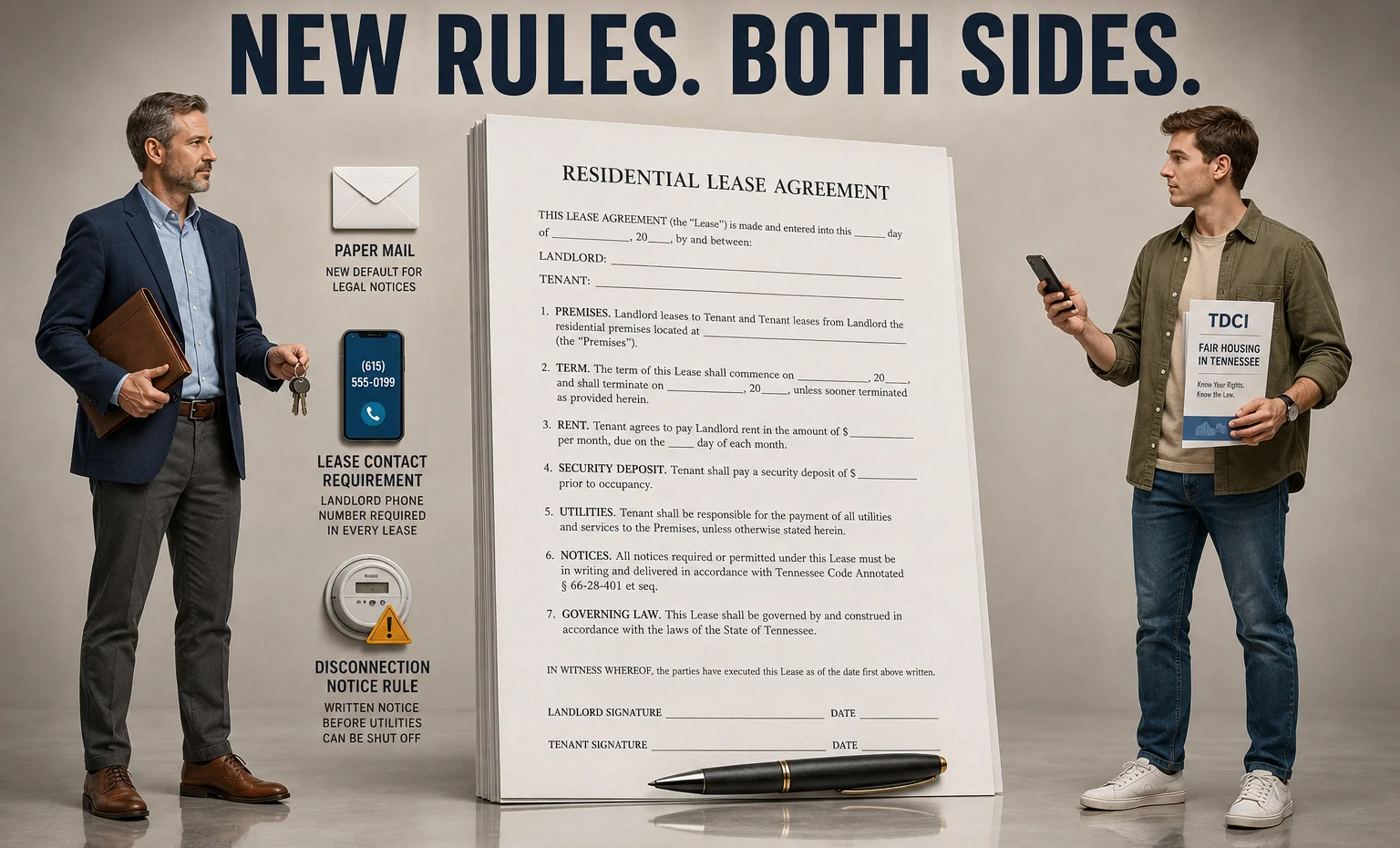
Tennessee quietly overhauled how landlords and tenants must communicate and if you’re renting or managing residential property in Nashville, Memphis, Knoxville or Chattanooga, these changes affect you directly. Between 2023 and 2024, the state legislature passed a series of amendments to the Uniform Residential Landlord and Tenant Act (URLTA) that now require written disclosures at lease signing, restrict electronic notices, mandate a state-published fair housing pamphlet and force landlords to relay utility shut-off warnings within one business day. Miss any of these steps and you’re either handing a tenant a legal defense or leaving your own rights on the table.
Who Does This Actually Apply To? (Don’t Skip This Part)
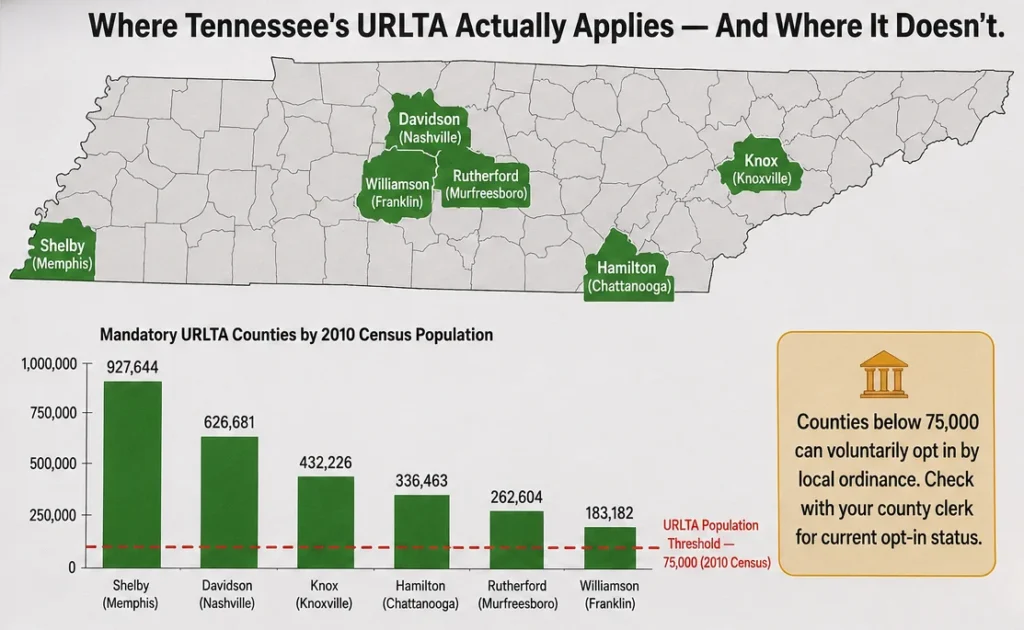
Here’s something that trips people up constantly. Tennessee’s URLTA doesn’t automatically apply everywhere in the state. Under Tenn. Code Ann. § 66-28-102, it only covers counties with populations over 75,000 based on the 2010 census — unless a smaller county has voluntarily opted in by local ordinance.
So right now, mandatory URLTA counties include:
- Davidson (Nashville)
- Shelby (Memphis)
- Knox (Knoxville)
- Hamilton (Chattanooga)
- Rutherford (Murfreesboro)
- Williamson (Franklin)
Outside those counties? Common law applies — mostly. Which means these new communication requirements technically don’t reach you unless your county opted in. If you’re unsure, check with your county clerk or a local attorney before assuming you’re exempt.
This matters enormously in practice. A landlord in a rural East Tennessee county and one managing apartments in Germantown are operating under fundamentally different legal frameworks. Same state, very different obligations.
The 2023 Reforms: Electronic Notices and Disclosure Got a Lot More Strict
Electronic Notice — Paper Is Now the Default
Before July 1, 2023, Tennessee’s URLTA said essentially nothing about electronic notices. Landlords were firing off eviction notices by text, emailing 14-day pay-or-quit letters and generally assuming digital delivery was fine. The 2023 amendment to Tenn. Code Ann. § 66-28-105 changed that entirely.
Paper is now the legal default. Full stop.
A landlord can only switch to electronic delivery if the tenant gives written, affirmative consent not a checkbox buried in the lease, not a verbal agreement. A separate, knowing act. And the tenant can revoke that consent any time, in writing and the landlord must immediately go back to paper.
There’s one more piece that catches landlords off guard: every single electronic notice — every one — must include clear instructions explaining how the tenant can opt back out of digital delivery. Send a rent increase notice by email without that language? The notice could be defective.
What that means practically:
- An email eviction notice sent without prior written consent = void.
- A tenant who never signed an e-consent form has a legitimate motion to dismiss an unlawful detainer.
- “But they always replied to my emails” is not a legal defense.
Written Disclosure of Who Owns and Manages the Property
Same 2023 legislation — Public Chapter 300 — also tightened up the disclosure requirements in Tenn. Code Ann. § 66-28-302. Landlords now must provide in writing, at or before the start of the tenancy, the name and address of:
- The person authorized to manage the property
- The property owner (or their agent authorized to receive legal notices and service of process)
This can be included directly in the lease. But here’s the penalty for skipping it — it’s a sharp one. If a landlord fails to provide this disclosure, they cannot collect rent during the period of noncompliance. Courts have interpreted similar provisions strictly. It’s not a technicality; it’s a statutory bar on rent collection.
Before vs. After: 2023 Disclosure Changes
| Requirement | Before July 1, 2023 | After July 1, 2023 |
| Manager/owner disclosure | Required, but delivery method unspecified | Must be in writing at or before tenancy start |
| Electronic notices | Not addressed in URLTA | Opt-in only; paper is default |
| Tenant’s right to revoke e-consent | No provision | Revocable at any time, in writing |
| Revocation instructions in notices | Not required | Required in every electronic communication |
| Penalty for missing disclosure | Unclear/case-by-case | Landlord loses right to collect rent |
The 2024 Laws: A Phone Number in the Lease and a Pamphlet at Signing
Contact Information Is Now a Lease Requirement
Public Chapter 692, effective July 1, 2024, added another layer to § 66-28-302. Now, beyond disclosing the manager and owner’s information separately, the lease itself must contain a current phone number and mailing address for the landlord or their agent.
Current — that word is doing real work here. It implies the information needs to stay accurate. The statute doesn’t spell out an explicit penalty for a mid-tenancy change (say, you switch property managers in month eight), but practically speaking, courts will hold landlords to whatever address and phone number appears in the lease when tenants send repair requests or legal notices. Safest move? Issue a written addendum the moment contact information changes.
The TDCI Pamphlet — Hand It Over at Signing
This one’s new enough that a lot of landlords still haven’t heard about it. New Tenn. Code Ann. § 66-28-107 now requires landlords to hand every tenant a state-published informational pamphlet at the time of signing — not a week later, not attached to a welcome email. At signing.
The pamphlet is developed and published by the Tennessee Department of Commerce and Insurance (TDCI) and covers fair housing protections, habitability standards, tenant and landlord duties, repair-and-deduct rules and eviction procedures. It also includes contact info for the Tennessee Human Rights Commission and local legal aid.
The statute doesn’t specify a private penalty for skipping this but don’t read that as a pass. A tenant who wasn’t given the pamphlet has reasonable grounds to argue they didn’t know their rights when they signed. That becomes especially pointed if there’s a habitability dispute or an eviction where the tenant claims they never knew about repair-and-deduct remedies.
Best practice: print the pamphlet, hand it over at signing and get a signed acknowledgment of receipt. Keep that acknowledgment in the lease file for the entire tenancy plus whatever the local statute of limitations runs.
2024 Lease-Signing Compliance: At a Glance
| What’s Required | Where to Find It | Timing |
| Manager/owner name + address (written) | In lease or separate disclosure | At or before lease start |
| Current landlord phone + address | Inside the lease itself | At signing |
| TDCI fair housing pamphlet | Download from tn.gov/commerce | At signing |
| Signed acknowledgment of pamphlet receipt | Your own form | At signing |
| Electronic notice consent (if desired) | Standalone consent form | Before first e-notice is sent |
The Part Nobody Talks About: Utility Disconnection Notices
Public Chapter 1041 — also effective July 1, 2024 — created a brand new statute, Tenn. Code Ann. § 66-28-518 and it targets a specific situation that’s more common than people realize, especially in older multi-unit buildings.
Here’s the scenario: the utility account is in the landlord’s name, but the tenant is the one actually paying — either directly to the utility company or by reimbursing the landlord. Master-metered apartment buildings, single-family rentals where the landlord never transferred the account, that kind of setup. If the landlord receives a disconnection warning from the utility provider, they now have one business day to get a written notice to the tenant.
One business day. That’s tight.
And “written notice” means written notice — paper slipped under the door or posted on the unit is the safest approach. Electronic delivery works only if the tenant previously signed that e-consent form under § 66-28-105. Don’t assume.
Why does this matter so much? Because a tenant who comes home to no heat in January and can prove the landlord sat on a shut-off notice for four days — has a real damages claim. Spoiled food, hotel costs, actual losses. Under the URLTA’s general remedies, willful violations can expose landlords to treble damages. It also gives the tenant strong grounds to break the lease without penalty.
If you’re a landlord managing master-metered utilities, build a system now. The moment a disconnection notice hits your inbox or mailbox, it triggers an obligation. Some property managers set up a dedicated email alert, flag it immediately in their management software and generate a tenant notice on the same day. That paper trail matters if it ever goes to court.
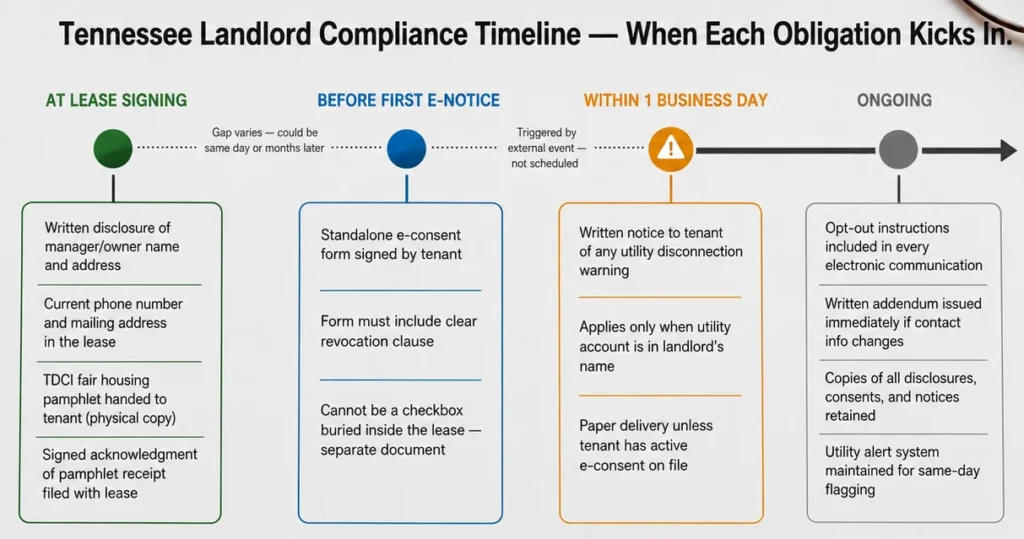
Landlord Compliance Checklist & Tenant Rights Quick-Reference
For Landlords: What Your Process Needs to Look Like
This isn’t meant to be overwhelming — it’s actually a pretty clean list once you build it into your standard lease workflow.
Before or at lease signing:
- Update your lease template — embed the landlord’s or agent’s current mailing address and phone number directly in the document
- Prepare a written disclosure form — listing the property manager’s name and address, plus the owner’s name and address for service of process (this can live inside the lease itself)
- Download and print the TDCI pamphlet from tn.gov/commerce — have physical copies ready at every signing
- Create an acknowledgment slip — one line, tenant signs to confirm they received the pamphlet; file it with the lease
- Prepare a standalone e-consent form — only if you want to use email or text for legal notices; it must include a clear revocation clause and cannot be buried in the lease
During the tenancy:
- Include opt-out instructions in every electronic communication — yes, every one, not just the first.
- Issue a written addendum immediately if your phone number or address changes.
- Set up a utility alert system — if any utility account stays in your name but the tenant pays, flag incoming disconnection notices for same-day or next-business-day tenant notification.
- Keep copies of everything — disclosure forms, pamphlet acknowledgments, e-consent forms, utility notices served.
For Tenants: Your Rights Under the New Framework
These laws were written with you in mind. Here’s what you’re actually entitled to:
| Your Right | The Legal Basis | What It Means Practically |
| Paper notice as default | § 66-28-105 | Landlord cannot legally serve you by email or text without your written consent |
| Revoke e-consent anytime | § 66-28-105 | Change your mind? Put it in writing and paper delivery resumes immediately |
| Know who owns and manages your unit | § 66-28-302 | You get names, addresses — in writing — before or when you move in |
| Direct contact info in your lease | § 66-28-302 (2024) | A current phone number and address must be inside your rental agreement |
| Fair housing pamphlet at signing | § 66-28-107 | You get the state pamphlet explaining your rights before you sign anything |
| Utility shut-off warning | § 66-28-518 | If the account’s in the landlord’s name, you get written notice within one business day of any disconnection warning |
If something goes wrong:
- Eviction notice came by email and you never signed an e-consent form? That’s grounds to challenge the notice in court — potentially getting the case dismissed
- Landlord never provided the written management disclosure? Rent is technically not owed during that period of noncompliance — raise it as a defense
- Utility got shut off and you had no warning? Document your losses immediately — food, lodging, anything and consult an attorney about damages
- Never received the TDCI pamphlet? While no direct penalty is written into the statute yet, it can support a broader argument about landlord bad faith, especially in habitability disputes
For legal help, the Tennessee Alliance for Legal Services connects tenants with free legal aid across the state. The Tennessee Human Rights Commission handles fair housing complaints.
Wrapping Up
None of this is particularly complicated once you see it laid out — but the consequences of ignoring it are real on both sides. Landlords who skip the pamphlet, forget the phone number in the lease or keep sending email notices without consent are handing tenants legal ammunition they didn’t have two years ago. Tenants who don’t know these rules exist are leaving protections unused.
The state built these requirements to make sure nobody in a Tennessee rental — landlord or tenant — can claim they didn’t know who to call or what the rules were. That’s actually a reasonable goal.
Start with the TDCI pamphlet. Download it at tn.gov/commerce, read through it yourself and make it part of every lease signing going forward. If you’re a tenant and you never got one, it’s worth knowing what’s in it — the Tennessee General Assembly’s public chapter search lets you read the actual statutes these rights come from.
And if the situation is already complicated — an eviction in progress, a utility that got cut, a lease that predates 2024 — talk to a licensed Tennessee attorney before assuming you know how it plays out. These laws are new enough that case law is still developing.
This article is for educational purposes only and does not constitute legal advice. Laws vary by county. Consult a licensed Tennessee attorney for guidance specific to your situation.