 Crystal A. Davis (Disability Lawyer)
When Maria’s building elevator malfunctioned for the third time that month, it wasn’t just an inconvenience – it was a barrier that prevented her from accessing her workplace. As someone who uses a wheelchair, Maria found herself stranded on the ground floor while her colleagues continued their meetings four floors above. Her landlord’s response? “We’ll get to it when we can.”
This scenario plays out across Canada more often than most property owners realize. Building accessibility isn’t just about compliance checkboxes or avoiding lawsuits. It’s about creating environments where everyone can participate fully, and it requires genuine partnership between property owners and tenants who understand disability needs firsthand.
The collaboration brings in an understanding and feasible solution, which can avoid the legal conflicts and enhance the satisfaction of the tenants. Engaging other professionals including an LTD lawyer could also help building owners to seek the right path towards optimal legal needs and make suitable accommodations.
The positive performance of collaboration is beneficial not only to disabled tenants but also to the reputation of the building and increases its efficiency in the performance. Upon assuming a constructive attitude, building owners show that they are open to inclusivity and legal adherence. Learning to interact with tenants positively can work out to improve the long term results of both parties.
Understanding Legal Obligations
As explained by Tom S. Yen long term disability lawyer Toronto, Canadian property owners face specific legal requirements under federal and provincial legislation. The framework varies by jurisdiction, but certain core principles remain consistent across the country.
Federal Requirements:
- The Canadian Human Rights Act covers federally regulated businesses – banks, telecom companies, airlines. If your tenants fall into these categories, stricter rules apply.
- Accessible Canada Act kicks in for federal buildings and contractors. The 2040 deadline means planning starts now, not later.
- Employment Equity Act matters when your tenants employ people with disabilities. Workplace accommodations often require building modifications.
Provincial Rules Vary Dramatically:
- Ontario’s AODA hits hard – 50+ employee businesses must file compliance reports. Miss the deadline, face fines up to $100,000.
- BC’s Accessible BC Act just started enforcement in 2024. Many property owners still don’t realize they’re covered.
- Manitoba requires accessibility plans from any organization serving the public. Property management companies often fall under this umbrella.
Building Codes Get Complicated:
- National Building Code sets bare minimums. Most provinces demand more.
- Door widths, ramp slopes, elevator specs – provincial codes often exceed federal standards.
- Municipal bylaws pile on extra requirements. Vancouver’s parking rules differ from Toronto’s signage requirements.
Accommodation Requests Create Gray Areas:
- “Undue hardship” defense exists but courts define it narrowly. Financial difficulty alone rarely qualifies.
- Tenants can pay for their own modifications, but landlords can’t refuse reasonable requests without solid justification.
- Medical documentation requests must be specific and limited. Asking for full medical records crosses the line.
Clear Prohibitions:
- Refusing tenancy based on disability status lands you in human rights tribunals.
- Charging extra fees for disability accommodations violates federal and provincial law.
- Demanding unnecessary medical information opens you to privacy violations.
Establishing Open Communication Channels
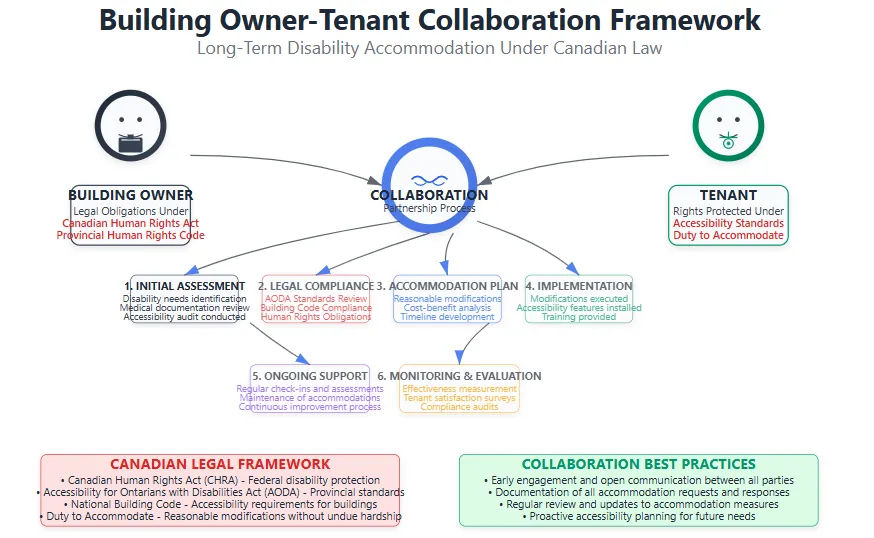
Among the best options that could help building owners deal with the long term disability needs is an open communication to its tenants. It is important to encourage the tenants to talk about their particular needs without the fear of discrimination or even punishment. Through this dialogue the building owners can know what accommodations are necessary hence planning on adjustments toward it.
Meetings or surveys done periodically can be a helpful tool in this regard of gathering the feedback of tenants regarding accessibility and disability-related concerns. Owners of buildings are supposed to establish a friendly atmosphere in which tenants will not fear expressing their experiences and recommendations. Trust is a factor that is hard to achieve without open communication.
Collaborative Problem Solving
Collaboration is not only about the process of listening: it involves the owners of the buildings to engage the tenants in seeking realistic options. Tenants should be included when making decisions whether to make changes to the common areas or provide special accommodation to the tenants. The collaborative tactic usually leads to more acceptable and workable results.
Owners of buildings must also know of the need to collaborate with disability advocacy and other times consult the professionals. Such resources might be useful to reveal the best practices and new legal standards. The discussions may be facilitated by a long term disability lawyer and all the measures should be undertaken and adhered to the concerned laws.
Documenting Agreements and Procedures
Once you find the accommodations you need, as an owner of a building, you should write down agreements with tenants. Responsibilities and expectations are also outlined in written documents, and this aspect helps avoid misunderstandings. When some legal issue arises, this record is also a record of compliance.
It is also good to have instituted formal means of requesting and putting in place of accommodations. It makes it more efficient and consistent thus helping the tenants and the management of the building.
Promoting Ongoing Education and Training
In order to ensure continued cooperation, the owners of the buildings must pursue continuous education and training, regarding disability law, and the practices and rituals of accommodations. Such training can provide property managers and employees with the information that can be used to act adequately in reaction to the requirements and demands of tenants and the regulations and rules.
It is essential to be updated with regard to alterations in the area of long-term disability legislation. Intensive training creates a culture of understanding and sensitivity in regard to the disabled tenants, hence improving the general environment of the building. One of the key elements of this learning experience may be consulting with a long term disability lawyer via updates and training resources.
Partnering with tenants to meet the long term disability needs is an important task of building owners. By improving legal knowledge, by maintaining open communication channels, by participating in team problem-solving activities and by explicitly documenting accommodation, building owners can develop accessible and supportive living conditions. Regular education and professional legal advice given by an LTD lawyer Toronto or a long term disability lawyer keeps building owners up-to-date and on toes.
Common Accommodations
- Wheelchair accessible entrances and bathrooms
- Elevator access and visual/audio alerts
- Accessible parking spaces
- Modification of lease terms or payment schedules