 Jeffrey S. Kelly Group PLLC (Real Estate)
If you searched the Costco Sonoma County lawsuit expecting a class action with a settlement check at the end, stop here. There is no consumer payout, no claim form and no eligibility list. This was a land-use fight over whether Costco could build a warehouse on Stony Point Road and it produced two separate lawsuits, not one. Costco won the first round and lost the one that counted.
To close the loop on the searches that bring people here:
- There is no settlement fund and no consumer payout of any kind.
- There is no claim form, eligibility rule or filing deadline for the public.
- It was not a class action, a product case or an employment case.
This was a public-agency land-use dispute between Costco, the County and local residents, decided on CEQA and referendum law and it ended with the County prevailing. Any site promising a check is inventing it.
What Costco Wanted to Build
The project was a Costco Wholesale warehouse of roughly 155,000 square feet with a gas station, at 3900 Stony Point Road in unincorporated Sonoma County, just outside Santa Rosa city limits. On October 16, 2020, the Sonoma County Board of Supervisors certified the final Environmental Impact Report, approved the project and adopted Ordinance No. 6348, which authorized a development agreement between the County and Costco.
That approval set off both lawsuits. Here is how they line up side by side.
| CEQA challenge | Referendum / rescission case | |
|---|---|---|
| Who sued | Sonoma County Citizens for Responsible Development | Costco Wholesale Corporation |
| Who was sued | County of Sonoma (Costco as real party) | County of Sonoma |
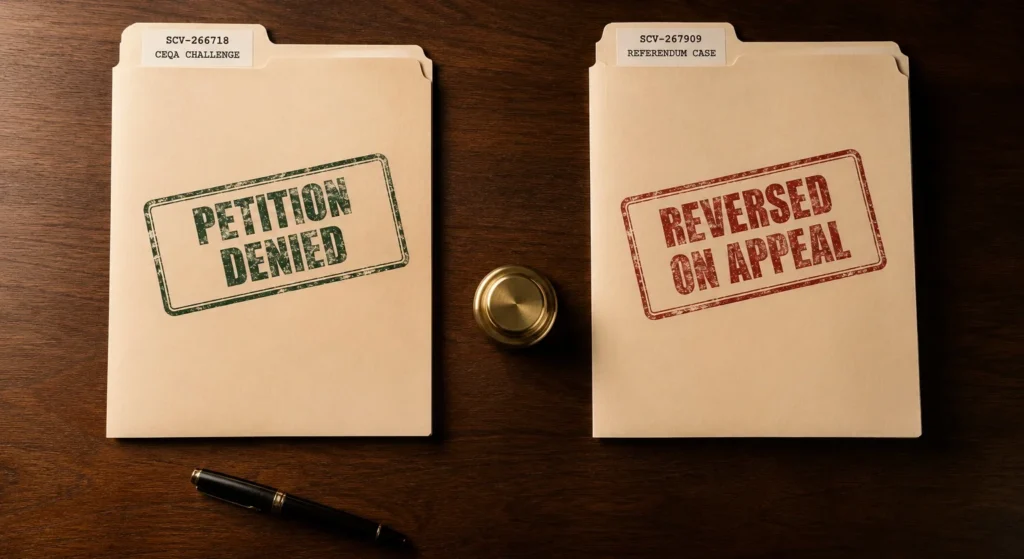
| Trial case no. | SCV-266718 | SCV-267909 |
| Trial judge | Hon. Patrick Broderick | Hon. Jennifer V. Dollard |
| Trial result | Petition denied, County wins | Writ granted, Costco wins |
| Appeal case no. | A165043 (unpublished) | A166128 (published) |
| Appeal result | Affirmed, County wins | Reversed, County wins |
| Final outcome | Project’s EIR upheld | Development agreement stays repealed |
Lawsuit One: Residents Challenged The Environmental Review And Lost
A community group called Sonoma County Citizens for Responsible Development sued the County in November 2020, with Costco named as the real party in interest. The case, SCV-266718, was a petition for writ of mandate under the California Environmental Quality Act and it argued the EIR fell short on greenhouse gas emissions, traffic, air quality and noise.
It did not work. On December 14, 2021, Judge Patrick Broderick issued a 55-page decision denying the petition in full, finding the EIR’s analysis adequate on every challenged point and the mitigation measures backed by substantial evidence. The group appealed to the First Appellate District (case A165043), narrowing it’s attack mostly to the greenhouse gas analysis. On April 26, 2023, the Court of Appeal affirmed. That decision was not certified for publication and no further appeal followed. The environmental challenge was over.
Lawsuit Two: The Referendum, The Reversal and Costco Suing the County
This is the part that matters and it is where most summaries get lazy. It moved in three stages: a citizen referendum, the County’s reversal and then a two-year court fight that swung twice.
The Referendum Forced The County’s Hand
After the 2020 approval, opponents launched a referendum petition to overturn Ordinance No. 6348. In December 2020, the County Registrar certified that the petition had enough valid signatures, which under Elections Code section 9237 suspended the development agreement and forced the Board to choose: repeal the ordinance or put it to a public vote. On April 6, 2021, the Board voted 4 to 1 to rescind the ordinance outright, citing the cost of a special election and the ongoing controversy.
Costco Won At Trial
Costco sued on May 21, 2021, as case SCV-267909, bringing four claims:
- Breach of contract, on the theory the development agreement was a valid, binding contract.
- Breach of the implied covenant of good faith and fair dealing, arguing the County acted in bad faith to dodge the referendum.
- Promissory estoppel, based on Costco’s reliance on the County’s promises.
- Petition for writ of mandate, seeking to void the rescission as an unlawful repeal of a binding contract.
On August 15, 2022, Judge Jennifer V. Dollard granted the writ, holding that the development agreement was a contract creating vested rights, that it was therefore not subject to referendum and that the Board’s repeal was an impermissible impairment of contract. The County was ordered to reinstate the ordinance. For about two years, that ruling stood and the project looked revived.
The Court of Appeal Reversed and That Ruling Stands
The County appealed and on September 30, 2024, the First Appellate District reversed in a published opinion, Costco Wholesale Corp. v. County of Sonoma (2024) 105 Cal.App.5th 200.
The holding is the takeaway lawyers will actually cite. A development agreement is a legislative act, a point the Legislature made explicit in Government Code section 65867.5 and legislative acts are subject to the referendum power. Once the referendum petition qualified, Elections Code section 9237 gave the Board the lawful option to repeal the ordinance directly. The court rejected Costco’s contract clause and vested rights arguments, reasoning that any contractual rights were contingent and did not change the legislative character of the adoption. The repeal was not a breach; it was a valid legislative response to a qualified referendum. Judgment reversed, remanded with directions to enter judgment for the County.
That published decision remains the governing authority. It has not been depublished or superseded, so it stands as citable California precedent and the practical result is that the development agreement stays repealed and the 2021 rescission holds.
Why The Case Matters Beyond Sonoma County
For anyone working in California land use, the value here is the confirmation, in a published opinion, that developers cannot treat a development agreement as a referendum-proof contract. A city or county can lawfully rescind an adopted development agreement once a referendum qualifies, even after the developer has spent money in reliance on it. The decision reinforces Government Code section 65867.5 and the reasoning in Santa Monica Chamber of Commerce v. City of Santa Monica (2002) 101 Cal.App.4th 786.
The lesson for developers is blunt: a signed development agreement is durable, but it is not immune from the voters and reliance spending does not convert a legislative act into a private contract.