 Mohammad Abdel-Rahman Accident & Injury Lawyer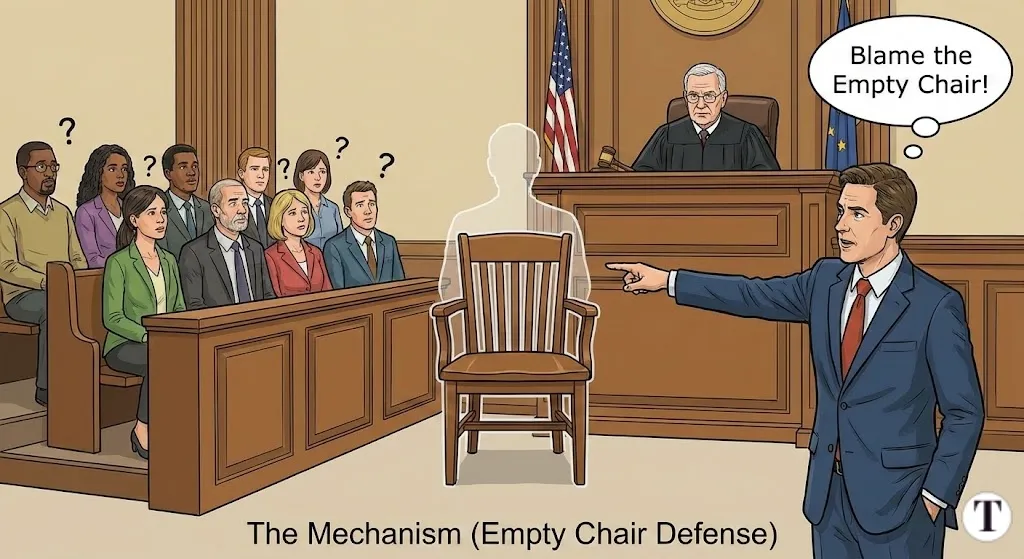
Key Takeaways:
- The Mechanism: Defendants can file a motion (usually up to 60 days before trial) to designate an RTP. This RTP does not become a party to the suit and pays no money; however, the jury is required to assign them a percentage of fault.
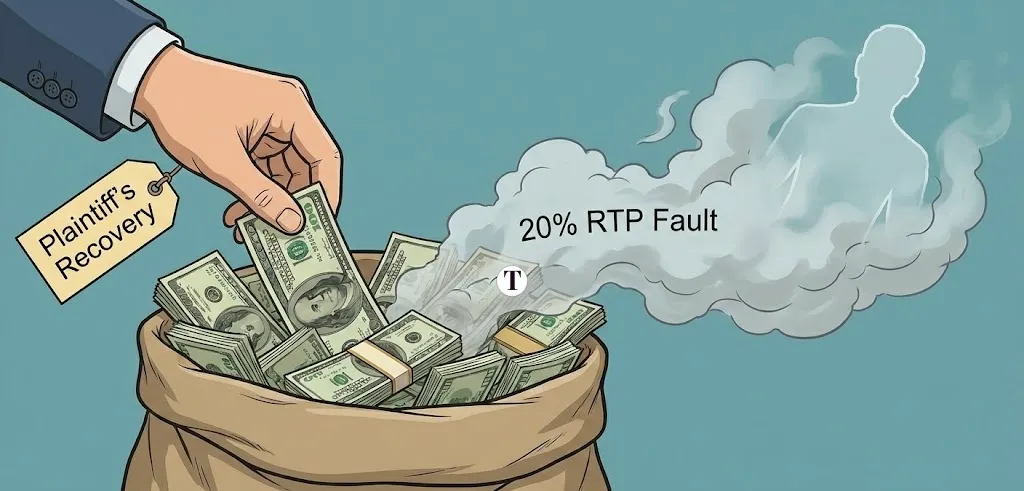
- The “Vanishing” Recovery: Any fault assigned to an RTP “evaporates.” If an RTP is found 20% liable, that 20% of the damages is simply deducted from what the plaintiff can recover, and no one pays it.
- The 51% Bar Weapon: Texas uses a “modified comparative fault” system. If a defendant can use an RTP to push the plaintiff’s own fault percentage to 51% or higher, the plaintiff recovers zero dollars.
- Strategic Flexibility: Courts are highly permissive regarding who can be designated. Defendants can blame “phantom” drivers, bankrupt companies, or even the plaintiff’s own employer (who might be immune from direct lawsuits).
- Legal Precedents: The article cites Texas Supreme Court cases (In re YRC Inc. and In re Mobilpipe) to show that defendants can often designate RTPs very late in the process or even after the statute of limitations has expired for the plaintiff to sue that party.
- The Imbalance at Trial: Because the RTP isn’t there, the plaintiff’s lawyer is forced to defend an absent party while simultaneously trying to prove the actual defendant’s guilt.
Texas possesses such a mechanism that allows defendants to accuse individuals that are not even members of the suit. They are able to assert that that other individual was more or less liable, and the jury compelled to put the blame on that ghost party although that party was not sued by anyone and is not present in the trial room.
It is what is referred as the empty chair defence. This is legally known as responsible third party designation in CPRC Section 33.004. And it is not some esoteric procedural gimmick 5 defendants and their insurers employ it to their strategic advantage, to blur the percentage of their own fault and even to drive the plaintiffs beyond where the 51 percent recovery threshold will wipe it out completely.
It is quite simple in its functionality after you have viewed it. The defendant is sued, the defendant enters into a motion of saying wait this other person or company was guilty as well, the court grants the designation and the jury now has to split the blame among them including this non-party who is not defending themselves and who may not actually exist anymore as a going concern.
What CPRC Section 33.004 Actually Allows
The statute lays out a specific process for designating what it calls a “responsible third party” or RTP. This is someone the defendant claims shares responsibility for the plaintiff’s injury but who the plaintiff didn’t sue or couldn’t sue.
The Designation Process
A defendant has to file a motion for leave to designate an RTP on or before the 60th day prior to trial. If they miss that window, they need to show good cause for why they’re filing late. Courts generally grant leave unless the opposing party can demonstrate that the pleading is insufficient under Texas Rules of Civil Procedure.
Here’s the thing that makes this powerful for defendants—designating someone as an RTP doesn’t impose any liability on that person. The RTP doesn’t get dragged into the lawsuit. They don’t have to pay anything. The designation just means the jury considers their fault when dividing up percentages.
Who Can Be Designated
The statute allows designation of pretty much anyone the defendant can plausibly claim shares responsibility. This includes:
- Former employees of companies that have since gone bankrupt
- Unknown drivers who fled the scene
- Companies that have dissolved or been acquired
- Contractors or subcontractors not named in the suit
- Even the plaintiff’s own employer in some circumstances
For unknown persons, the defendant has to plead with enough specificity—identifying traits, criminal probability if relevant, and sufficient facts to support the designation. But courts interpret this requirement loosely enough that “unknown driver of dark colored vehicle” can sometimes suffice.
What Designation Accomplishes
Under CPRC Section 33.003, the jury assigns responsibility percentages to everyone—claimants, defendants, settling persons, and RTPs. All these percentages have to add up to 100%.
So if a defendant can get 20% of fault assigned to an RTP, that’s 20% the defendant doesn’t have to pay. The RTP pays nothing because they’re not a party to the lawsuit. That 20% just evaporates from the plaintiff’s recovery.
How This Connects to the 51% Bar
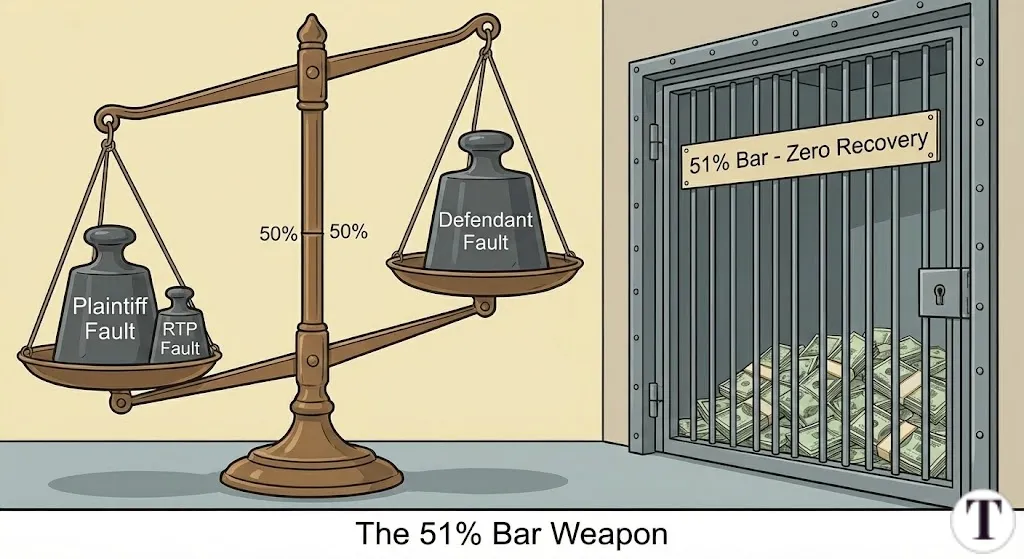
Texas operates under what’s called modified comparative fault with a 51% bar. Under CPRC Section 33.001, a plaintiff cannot recover anything if their percentage of responsibility exceeds 50%. Not reduced damages—zero recovery.
The empty chair defence becomes a weapon in this context. Here’s how the math works against plaintiffs.
A Scenario That Shows the Problem
Say you’re in a car accident. You sue the other driver. Their insurance company’s lawyers file a motion to designate an unknown third vehicle as an RTP, claiming this phantom car contributed to the collision by cutting off their insured.
At trial, the jury has to assign fault to you, the defendant, and this unknown third party. If the jury decides:
- Plaintiff: 35%
- Defendant: 40%
- Unknown RTP: 25%
You recover 65% of your damages (100% minus your 35% fault). The defendant pays only their 40% share. The remaining 25% assigned to the unknown RTP? Nobody pays that. It vanishes.
But here’s where it gets worse. If the defendant’s lawyers can push those numbers to:
- Plaintiff: 51%
- Defendant: 30%
- Unknown RTP: 19%
Now you recover nothing. Zero. The 51% bar kicks in and your entire claim disappears. The defendant and their insurer pay nothing. The RTP obviously pays nothing. You absorb the total loss.
The Comparison Makes It Stark
This outcome is specific to Texas and states with similar modified comparative fault systems. Other states handle it differently.
| State | System | Bar Threshold | Recovery if Plaintiff 60% at Fault ($100K damages) |
| Texas | Modified comparative | >50% bars | $0 |
| California | Pure comparative | None | $40,000 |
| New York | Pure comparative | None | $40,000 |
Same accident, same injuries, same fault allocation—plaintiff walks away with $40,000 in California or New York but gets absolutely nothing in Texas. The empty chair defence makes this disparity even more pronounced because it gives defendants an additional tool to inflate plaintiff fault.
Real Cases Where This Played Out
The mechanism works in practice, and this has been demonstrated by a number of cases in the Texas courts that have dealt with RTP designation.
In re YRC Inc. (Texas Supreme Court, 2021).
One of the workers has got an on-job injury. Denial of claims at the workers compensation. The injury at the work place led to the employee suing YRC. YRC had relocated to request the employer to designate an RTP over five years after the injury had taken place, 62 days prior to the actual trial date in the case.
This was too late the plaintiff contended. The case was a few years old. Nevertheless the Texas Supreme Court decided in favor of YRC. They granted the mandamus relief and ruled that the motion was timely. The court reasoning was that it had not restricted time to the designation of RTP as it limits time to the suing of a person because it did not render the RTP liable.
In practice, what this means is that defendants are allowed to sue and still make attempts to incriminate the non-parties even though it can take them several years to do so. It does not matter whether the case has been pending long or short but 60 days before trial deadline.
In Mobilpipe Inc. (Texas Supreme Court, 2020).
Covarrubias was suing Mobilpipe on an injury. In the process of discovery, Mobilpipe revealed that Nolana could be a possible party of liability. Mobilpipe had not in fact filed the RTP designation motion until the statute of limitations period expired on any direct claim made against Nolana.
Plaintiff contended that this was inappropriate- you cannot appoint someone as an RTP when the plaintiff can no longer suit the party in person. The Supreme Court disagreed. Instead, they believed that disclosure was made in time, and expiry of limitations did not prevent designation.
The court pointed out that responsibility is one thing and liability another. The RTP does not need to make any payments irrespective of being assigned either before or after limitations executions. Why then should restrictions be important to designation purposes?
This decision has greatly increased the tactical possibilities of defendants. Although the plaintiff might have lapsed the time to sue a prospective defendant, the real defendant can adopt the same to adopt the party on any empty chair.
Smith v. East (Texas Court of Appeals, 2013)
Derivative claimants people whose claims were derived out of a claim by an injured person such as loss of consortium or wrongful death beneficiaries were involved in this case. The jury ruled that the primary claimant (the individual who had been injured) had greater than 50%-liability.
Issue was, did that discovery bar the derivative claimants as well. They had not done anything in themselves.
The court responded with yes, they are barred. In the statute under 33.001 and 33.002, the recovery is restricted to the first degree person who is at fault. Derivative claims do fail in case such a person goes beyond 50. None of the statute had any exceptions written into it, and therefore was no exception.
This indicates how the 51 per cent bar is passing out in all directions. It does not only work against the individual who is partially at fault- it can wipe away claims of family members, and any other individual whose recovery will depend upon the primary claims.
Tactics Defendants Use With Empty Chair
The empty chair tactic has been perfected by insurance companies and defence counsel into a game book. It is made aware of what they are good at so that the plaintiffs know what they are in for.
A Find of Blame on Bankrupt or Dissolved Entities.
Ten years ago the company that manufactured a defective product went bankrupt? They are referred to as an RTP by the defendant. The jury is blaming a party that is not able to defend itself, to pay anything at all and even be cross-examined on what actually happened.
This happens especially in product liability and toxic exposure cases in which the manufacturers are out of business.
Accusing Unidentified or Missing Parties.
Hit-and-run driver not caught? Defendant names unknown driver of vehicle that left scene as an RTP. At this point, the jury must now attribute some blame to this phantom.
The plaintiff is not able to investigate this unidentified driver. Their version of events they lack, and therefore, can not challenge. Impossible to show that they were not guilty because they are not there to be interrogated.
Whether to Blame the Employer of the Plaintiff.
Frequently, in cases of workplace injuries, where the workers do not have workers comp insurance or where the insurance is denied, the employer of a plaintiff is appointed by a defendant as an RTP. Workers compensation exclusivity often protects the employer against direct liability, though he may be appointed.
This places plaintiffs in a strange situation the organization that is most likely to possess relevant records and witnesses is now a blank chair devouring blame.
Strategic Timing.
Most defendants do not file RTP designations until they have done discovery and they have the theory of the case that the plaintiff has come up with. The 60-day-before-trial time allows them the leeway to observe the turn of events before making their minds up on who to accuse.
Late names further deprive the plaintiffs of time to research the RTP and come up with evidence to refute the alleged fault.
How Texas Jury Instructions Handle This
Texas Pattern Jury Charges lay out exactly how fault allocation questions get presented to jurors. Understanding this shows why the empty chair approach works.
The Broad-Form Submission
PJC 4-3 provides the standard format. Jurors receive a question asking them to assign percentages of negligence or responsibility to all identified parties. The instruction requires these percentages to total exactly 100%.
The submission lists everyone the jury has to consider:
- Plaintiff
- Each named defendant
- Any settling persons (parties who settled before trial)
- Each designated RTP
Jurors assign whole-number percentages to each. The numbers go on the verdict form. And that’s what determines recovery.
The Problem for Plaintiffs
The RTP is on that list even though no one is there to defend themselves. The jury hears the defendant’s lawyer argue why the RTP should bear significant fault. The RTP doesn’t have a lawyer arguing back.
This creates an inherent imbalance. The plaintiff’s lawyer can argue against RTP fault, but they’re essentially defending an absent party while also trying to minimize plaintiff fault and maximize defendant fault. It splits focus and resources.
Jurors may also feel more comfortable assigning substantial fault to an empty chair. Nobody’s sitting in the courtroom looking sympathetic. No witness is explaining their side. The RTP is just a name on a verdict form.
Countering the Empty Chair Strategy
The empty chair defence is legal and defendants will keep using it. But it’s not unbeatable. The approach requires evidence and argument that plaintiffs need to prepare for.
Challenging the Designation Itself
If the defendant’s RTP motion lacks sufficient facts or specificity, plaintiffs can object. The standard isn’t high, but defendants do sometimes file bare-bones designations that don’t meet even the loose pleading requirements.
Timing objections can work in some circumstances—if the defendant waited past the 60-day deadline without good cause, or failed to make required disclosures during discovery.
Minimizing RTP Fault at Trial
If designation stands, the trial battle shifts to how much fault gets assigned to the empty chair. Plaintiffs need evidence and argument showing the RTP wasn’t actually responsible, or was minimally responsible.
This might mean investigating what the RTP actually did, deposing witnesses who know what happened, or retaining experts who can testify about causation.
Protecting Against the 51% Threshold
Every percentage point matters when you’re anywhere near 51%. Plaintiffs need strategies specifically aimed at keeping their own fault number below that bar, not just at maximizing defendant fault.
This is where pre-trial preparation becomes critical. By the time you’re in front of a jury, the evidence is what it is. The investigation and preparation that happened months or years earlier determines what arguments are available.
References
- Texas Civil Practice and Remedies Code Chapter 33: https://statutes.capitol.texas.gov/Docs/CP/htm/CP.33.htm
- CPRC §33.004 (Responsible Third Party Designation): https://statutes.capitol.texas.gov/Docs/CP/htm/CP.33.htm#33.004
- In re YRC Inc., 646 S.W.3d 805 (Tex. 2021)
- In re Mobilpipe Inc., 620 S.W.3d 898 (Tex. 2020)
- Smith v. East, No. 03-12-00509-CV (Tex. App.—Austin 2013, pet. denied)
- Texas Pattern Jury Charges, General Negligence (2024 ed., Vol. 4, Ch. 4-3)