 Jeffrey S. Kelly Group PLLC (Real Estate)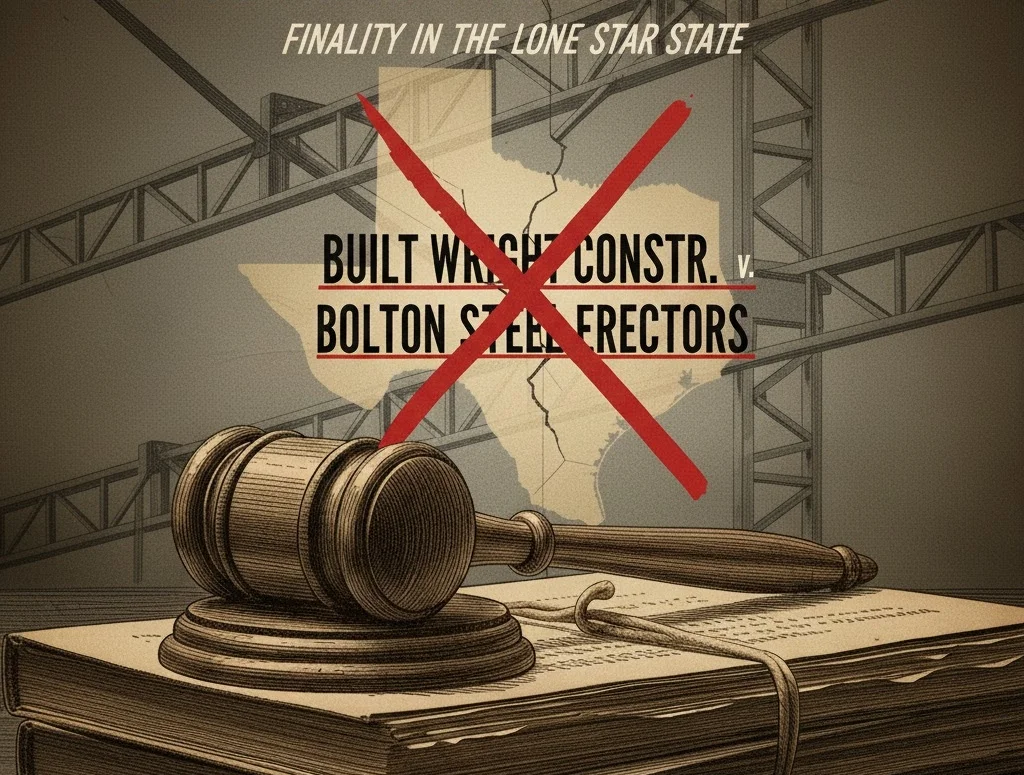
Summary:
The “Texas Built Construction lawsuit” everyone’s talking about? It’s actually Built Wright Construction—and that mix-up matters. This case involves a $1.2 million steel erection subcontract for Prairie View A&M’s stadium that turned into a payment nightmare. Bolton Steel Erectors sued Built Wright Construction over unpaid invoices, won $576,000 total in arbitration and Texas courts refused to overturn it. Built Wright tried challenging the award for being late and exceeding authority, but the Fourteenth Court of Appeals wasn’t having it. Bottom line: Texas has “extraordinarily narrow” arbitration review and incorporating AAA rules can blow up your fee expectations. It’s a expensive lesson in reading the fine print.
You have that feeling when you are searching through the records of the court and find out that the case everybody is discussing is not exactly what they think it is? That was the case of this case. The Texas Built Construction lawsuit that has been on the rounds is actually over an entity named Built Wright Construction, which is run by a company that by the name Tom Wright Construction, LLC. Close, but not quite.
Such confusion is important since the construction law is everything about details. A misplaced name of entity and you are going after ghosts.
Background: A Stadium Project Gone Sideways
Picture this: Prairie View A&M University wants to renovate their football stadium. Big project, lots of moving parts. Skanska USA Building gets the general contract in 2016. They need steel work done, so they subcontract to Built Wright Construction (BWC). BWC? They turn around and hire Bolton Steel Erectors for the actual steel erection work.
Classic construction chain. What could go wrong?
Everything, apparently.
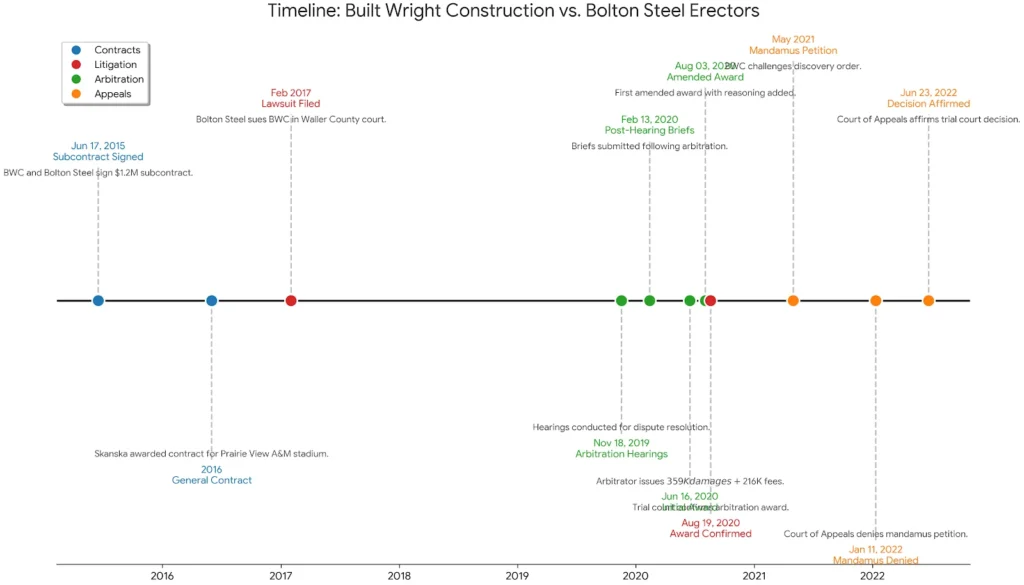
The subcontract was signed June 17, 2015—yeah, before Skanska even got the main gig. These guys were planning ahead. Contract value? Around $1.2 million for steel erection services. Not massive, but not pocket change either.
We begin to get interested here. The subcontract contained the binding arbitration according to the American Arbitration Association (AAA) rules. In case of a down turn, BWC could have forced arbitration.
They went south.
Significant Facts: When Good Contracts Go Bad
By February 2017 Bolton Steel was fed up. They filed suit against BWC in the 506 th Judicial District Court of Waller County ( Case No. 17-02-24157). Their beef? BWC is claimed to have shortchanged them in payments to employees on completed work and extras.
BWC responded by making their own allegations concerning poor performance. Hegemonic he-said-she-said construction controversy.
However, there is one more thing–that arbitration clause? BWC sought to arbitrate and the trial court acquiesced.
Hearings on arbitration were held November 18-22, 2019. Post-hearing briefs were to be filed February 13, 2020. The scheduling order of arbitrator indicated that they would give directly a brief reason award within 30 days of briefing closure.
Then COVID hit.
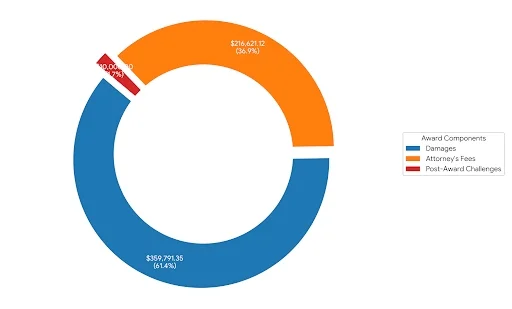
The award did not arrive till June 16, 2020. Bolton Steel won big:
- $359,791.35 in damages.
- $216,621.12 in attorney’s fees.
- $10,000 for post-award challenges.
BWC wasn’t having it. They resented the time wasting and unreasonableness. On August 3, 2020, the arbitrator, with reference to COVID interference and the complexity of the cases, corrected the award and elaborated on it. thereupon revised it a little later.
Almost one can feel the lawyers of BWC tearing their hair.
Legal Analysis: Why Texas Loves Arbitration (Maybe Too Much)
The Timeliness Issue
BWC’s first argument? The award came too late. The 30-day time lapsed and the amendments can be declared as invalid under the Texas Civil Practice and Remedies Code 171.054.
It was not being sold to the Fourteenth Court of Appeals.
Their reasoning: BWC waived the timeliness objection by not notifying the arbitrator before delivery (§ 171.053(e)). Plus, the scheduling order allowed extensions for “good cause.” COVID-19? That’s definitely good cause.
The court cited Broemer v. Houston Lawyer Referral Service for the proposition that “briefly reasoned” doesn’t require exhaustive detail. Just enough to show the arbitrator considered the evidence.
The Attorney’s Fees Battle
This one’s trickier. BWC argued the arbitrator exceeded authority by awarding fees to Bolton Steel. The subcontract’s fee-shifting clause only favored BWC in default scenarios.
Here’s where those AAA rules mattered. Rule 48(d)(ii) permits attorney’s fees if all parties request them. Both sides did in their pleadings.
The court applied Nafta Traders, Inc. v. Quinn: arbitrators derive power from the parties’ agreement and courts only vacate for clear overreach. BWC waived their conflict arguments by not raising them at trial.
Bottom line: Texas has “extraordinarily narrow” arbitration review. The court’s job isn’t to second-guess the arbitrator—it’s to enforce what the parties agreed to.
The Mandamus Side Show
While the main case was grinding through appeal, BWC filed a separate mandamus petition (No. 14-21-00269-CV). They wanted relief from a trial court order compelling discovery of financial information.
The Fourteenth Court denied it per curiam in January 2022. Translation: “You haven’t shown you deserve this extraordinary relief and we’re not explaining why.”
Mandamus requires clear abuse of discretion without adequate appellate remedy. BWC couldn’t meet that standard.
Implications for the Construction Industry
This case reinforces what construction lawyers already know: arbitration clauses have teeth in Texas.
For Contractors
Draft carefully. When you incorporate AAA rules, you’re potentially expanding fee recovery beyond your contract terms. BWC learned this the hard way—their own contract language got trumped by the rules they agreed to follow.
Object early, object specifically. BWC’s waiver arguments failed because they didn’t preserve their objections properly. In arbitration, timing is everything.
COVID isn’t a free pass, but it’s something. The pandemic created legitimate delays and arbitrators got some leeway. Don’t expect courts to be unsympathetic to force majeure-type situations.
For Subcontractors
This case shows arbitration can work for the little guy. Bolton Steel, presumably smaller than BWC, got their day before an arbitrator and collected substantial fees on top of their damages.
The key? Both sides requested fees in their pleadings. That triggered AAA Rule 48(d)(ii), opening the door for the arbitrator to award them.
For Everyone Else
Texas’s pro-arbitration stance isn’t going anywhere. The state sees arbitration as efficient dispute resolution, especially for complex construction projects.
But narrow review cuts both ways. If you win in arbitration, you’re golden. If you lose and think the arbitrator screwed up? Good luck convincing a Texas court.
Related Cases: A Pattern Emerges
| Case Name | Court/Year | Key Issues | Outcome | Relevance |
|---|---|---|---|---|
| Tom Wright Construction v. JDM Steel Construction (No. 10-17-00124-CV) | Texas 10th Court of Appeals, 2017 | Breach of subcontract for steel work; TCPA motion | Affirmed dismissal; remanded for fees | Similar subcontractor dispute pattern |
| Great American Insurance Co. v. Tom Wright Construction (No. 4:17-cv-01322) | S.D. Texas, 2017 | Payment bond claims from construction defaults | Settled/resolved | Shows bond liability risks |
| Fox v. Tom Wright Construction (No. 6:10-cv-00019) | W.D. Texas, 2010 | Fair Labor Standards Act wage disputes | Resolved with jury demand | Labor management issues |
BWC shows up in these cases repeatedly, often as defendant. Steel erection seems to be a particular problem area. Not saying there’s systematic misconduct, but patterns matter in construction law.
What the Pattern Tells Us
- Steel work generates disputes. Complex, dangerous, expensive—prime litigation territory.
- Payment issues recur. Whether it’s subcontractors, bonds or wages, money flows seem problematic.
- Public projects carry extra risk. Government contracts come with bond requirements and additional exposure.
Key Takeaways for Practitioners
Before signing anything:
- Read arbitration clauses line by line.
- Understand which rules apply and what they permit.
- Consider fee-shifting provisions carefully.
During disputes:
- Preserve objections early and specifically.
- Don’t assume contract language controls if you’ve incorporated outside rules.
- COVID delays may be excusable, but document everything.
In arbitration:
- Request attorney’s fees in pleadings if you want them.
- Brief reasoning requirements vary—check your arbitrator’s style.
- Appeals are nearly impossible, so get it right the first time.
The Broader Context
This case fits Texas’s historical preference for alternative dispute resolution. The state legislature has consistently strengthened arbitration statutes and courts follow suit.
But some practitioners question whether the pendulum has swung too far. When review is “extraordinarily narrow,” does arbitration become too insulated from legal oversight?
The counterargument: parties chose arbitration for finality, not endless appeals. If you wanted court review, you shouldn’t have agreed to arbitration.
BWC made their bed with that AAA clause. The Fourteenth Court made them lie in it.
Conclusion
What looked like a straightforward payment dispute turned into a master class in arbitration law. BWC thought they had solid grounds to challenge the award—wrong entity name confusion aside—but Texas courts don’t second-guess arbitrators absent clear misconduct.
The real lesson? Construction arbitration is serious business in Texas. Draft your clauses carefully, understand the rules you’re incorporating and don’t count on courts to bail you out if things go sideways.
Bolton Steel walked away with over half a million dollars. BWC learned an expensive lesson about arbitration finality.
For the rest of us practicing construction law in Texas, this case reinforces the fundamentals: good contracts, timely objections and realistic expectations about appellate review.
The next time someone mentions the “Texas Built Construction lawsuit,” you’ll know what really happened. Built Wright Construction tried to build their way out of an arbitration award.
They couldn’t.