 Mason (Driving Law Expert)
A rider in Chicago gets hit by a car that ran a red light. Clear liability on the driver who was not paying attention. The rider was not wearing a helmet because Illinois does not require one, has not required one since 1969, is one of three states in the country where any age being has no law applied to wear the helmet.
The insurance adjuster calls two days later and the first thing they bring up is the helmet. Not the red light the driver ran. Not the injuries. The helmet the rider was legally allowed to not wear.
If this rider had just grabbed the helmet off the shelf on the way out, if he had spent two seconds putting it on, the adjuster would have had nothing to say about it. Two seconds. And now instead of arguing about what the driver did wrong the whole conversation has shifted to what the rider was not wearing, and honestly that shift is where these cases get lost because juries hear “he was not wearing a helmet” and something changes in how they think about the person even though the person broke absolutely no law.
In 1969 Illinois Dropped the Helmet Requirement

Fifty-six years without a helmet law. The state decided adults can ride bareheaded and that has been the position ever since, no pending bills, no serious legislative movement to change it. The only protective gear Illinois actually requires is eye protection under 625 ILCS 5/11-1404, glasses or goggles or a face shield of some kind, because the legislature apparently decided your corneas need defending but your temporal bone is on its own.
Insurance adjusters who work motorcycle claims in this state know all of that perfectly well and they raise the helmet issue anyway because the legal argument, even though it feels like it should not work, is not completely without teeth. There is a gap between “you broke no law” and “you acted reasonably” and that gap is where the defence lives. A jury can look at a rider who chose not to wear a $200 helmet at highway speed and think yeah, nobody required it, but was it a smart decision? And if enough jurors answer no to that question the fault percentage starts climbing.
“Illinois motorcycle riders have certain rights under the law, but if you’re not familiar with the law in Illinois, you could end up with a settlement that is nowhere near enough,” attorney Jess Jordan of McCready Law Injury Attorneys.
How the Stacking Works Against You at the 50% Bar
Illinois comparative fault under 735 ILCS 5/2-1116 says if a jury puts more than 50% of the responsibility for your injuries on you, recovery is zero. Not reduced. Gone.
The helmet argument on its own probably does not get a rider to 50%. But adjusters do not use it on its own, they layer it with everything else they can find. Going 7 over the limit gets assigned maybe 10%. Missing a signal, another 5 to 10%. And then the biomechanical expert comes in and says a DOT-approved helmet would have cut the impact force to the skull by 40 to 60 percent, and the jury hears that and thinks well that is another 15 or 20% on the rider for choosing not to protect their own head, and suddenly the rider who was hit by a driver who ran a red light is sitting at 45% and the insurer only needs one more thing, one more small thing, to push the number past the line where a million dollar claim becomes worth nothing.
The stacking is what makes the helmet argument dangerous. Individually it is one factor among several. Combined with speed and lane position and signalling and anything else the adjuster can pull from the police report, it becomes the piece that tips the scale.
Courts in Illinois Have Not Fully Settled Whether the Helmet Defence Is Even Admissible
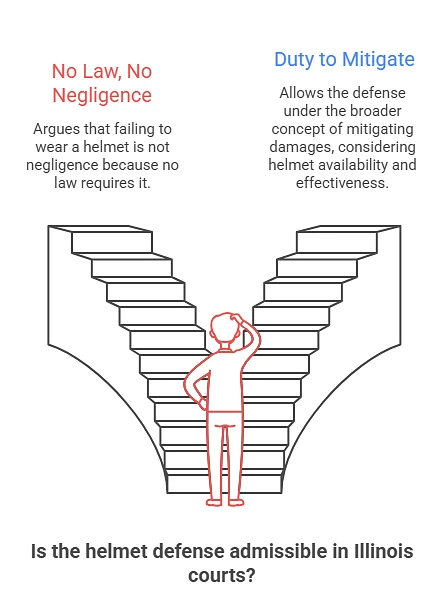
Some attorneys in this state argue that because no law requires a helmet, failing to wear one cannot constitute negligence. You cannot be negligent for skipping something the statute does not demand. If the legislature wanted riders to wear helmets it would have passed a law, the absence of the law means the choice is legally protected, end of analysis.
Other attorneys and some judges have allowed it under the duty to mitigate damages, which is a broader legal concept that says even without a specific statute a person has an obligation to take reasonable steps to prevent foreseeable harm to themselves. And the question of whether riding at highway speed without head protection when helmets are widely available and demonstrably effective is “reasonable” is exactly the kind of question that different judges and different juries answer differently.
Which means the outcome on the helmet defence can depend on which courtroom you end up in and how the motion to exclude or admit the evidence gets argued. A rider who assumes the argument cannot be used against them because no law was broken may not find out they were wrong about that until the defence expert is already testifying about what a helmet would have done to the force dynamics at the point of impact.
What Keeps Coming to Mind Reading These Cases
I keep coming back to the same thought with these and it is not a legal thought, it is just a practical one. Every one of these claims where the helmet became the central argument, every one where the insurer’s expert testified about impact reduction percentages and the jury started thinking about whether the rider was being reasonable, every single one of those arguments evaporates if the rider had a helmet on.
Not because the law required it. Because the insurer cannot argue what a helmet would have done if the rider was already wearing one.
A $200 piece of equipment. Weighs nothing. Sits in the garage or strapped to the back of the seat. And the rider who grabs it before heading out has removed the single strongest argument the insurance company has for cutting their claim in half or killing it entirely. The rider who does not grab it has given the insurer something to talk about for the next two years of litigation.
Whether Illinois should have a helmet law is a political question and people on both sides have strong feelings about it. Whether a rider in Illinois should wear a helmet even though the law does not require one is a different question and after reading enough of these cases the answer feels pretty clear, not because of safety statistics but because of what happens in the claims process when you did not have one on and the adjuster starts building the file.