 Armand Avazian (US Immigration Lawyer)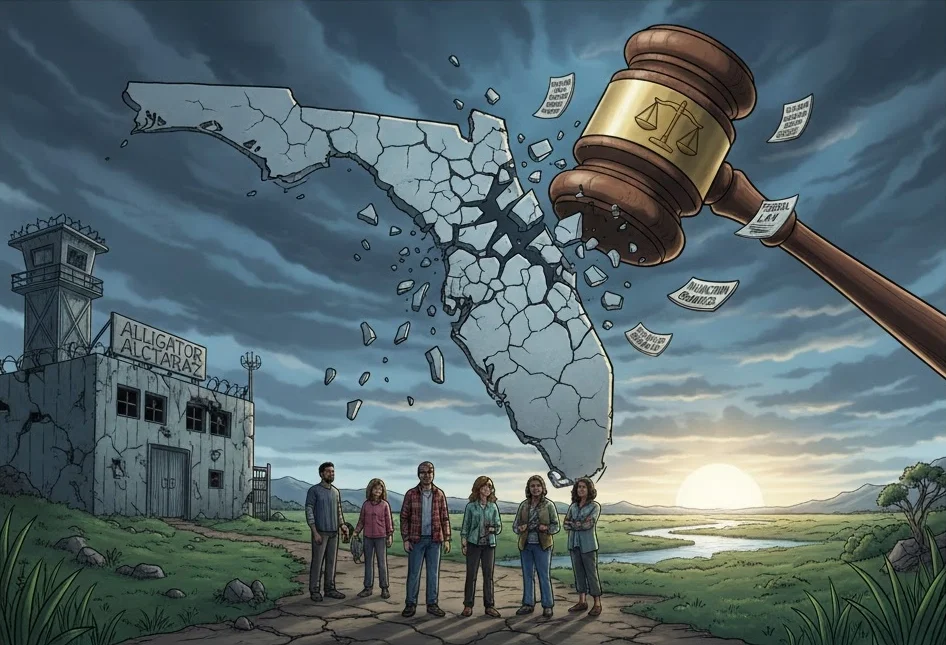
The state of Florida has turned into a point of concern in the national immigration argument, Florida having passed in recent years some of the most hostile florida immigration law injunctions. Nevertheless, federal courts have intervened to prohibit the most important provisions, which has led to a complicated legal environment, which is still in flux. This is the situation and the reason.
The Laws Under Challenge
The immigration enforcement activities of Florida revolve around two key legislations which have been faced with a lot of legal challenges.
SB 1718 (2023) the first significant immigration enforcement legislation that Governor Ron DeSantis had ever attempted on a state level. The legislation also contained a number of clauses such as obliging companies that employ 25 or more workers to employ the use of E-Verify and renewing in-state driver licenses provided to unlawful immigrants. However, the most debatable was Section 10 that criminalized the intentional taking of an undocumented individual to Florida as a third-degree felony even when it was done under a family or humanitarian basis.
SB 4-C (2025) did even more, which was trying to criminalize unauthorized entry into Florida as a state felony and permit local police to imprison individuals according to their immigration status. This was a massive extension of the conventional state police authority to what has historically been federal territory.
Federal Courts Step In
The court challenges came swiftly and so far, the federal judiciary has sided consistently with those opposing the laws.
In the case of SB 1718, in May 2024, a federal judge in Miami struck down Section 10 claiming it was incompatible with federal immigration law. Until January 2026, this injunction is still in effect despite state appeals. The rest of the law such as E- Verify requirements are still being enforced.
SB 4-C received even greater criticism. In April 2025, U.S. District Judge Kathleen Williams was granted a temporary restraining order, contending that the law infringed federal powers. This decision was affirmed by the 11th Circuit Court of Appeals in June 2025 and the U.S. Supreme Court refused to take action in July 2025 leaving the law in limbo.
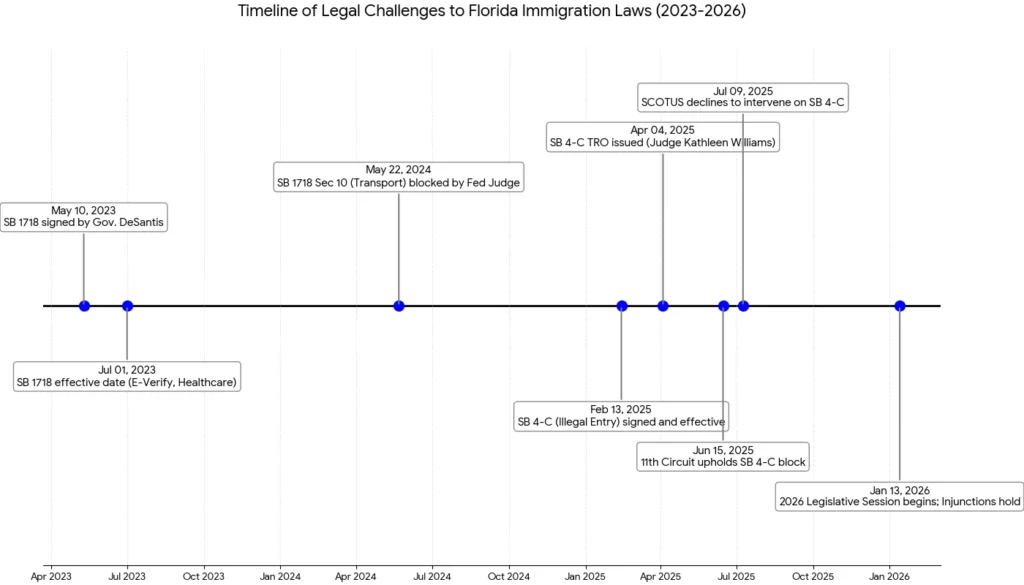
| Date | Event | Legal Outcome / Status |
| May 10, 2023 | SB 1718 Signed | Governor DeSantis signs the comprehensive immigration bill into law. |
| July 1, 2023 | Effective Date | SB 1718 takes effect, including E-Verify and healthcare data mandates. |
| May 22, 2024 | SB 1718 Sec. 10 Blocked | U.S. District Judge Kathleen Williams blocks the “human smuggling” provision that criminalized transporting undocumented individuals. |
| Feb 13, 2025 | SB 4-C Passed | The “Illegal Entry” law is enacted, creating new state-level crimes for unauthorized entry. |
| April 4, 2025 | SB 4-C TRO Issued | Judge Williams issues a Temporary Restraining Order, ruling the law likely unconstitutional. |
| June 15, 2025 | 11th Circuit Appeal | The 11th Circuit Court of Appeals upholds the injunction against SB 4-C. |
| July 9, 2025 | SCOTUS Ruling | The U.S. Supreme Court declines Florida’s emergency request to lift the block, leaving the law on hold. |
| Jan 13, 2026 | Current Session | The 2026 session opens with both the transport ban and illegal entry laws still blocked by ongoing injunctions. |
The Reason Why These Laws Are Being Blocked by Courts
The jurisprudential concept under consideration is known as federal preemption the notion according to which where there is a clash in federal and state laws, the federal law prevails. Immigration has always been a federal prerogative as per the Constitution.
The courts have always stated that Florida laws exceed the authority of the state by attempting to prosecute warrants and offences of immigration violations that are already within the federal laws. Judge Williams particularly observed the issue of the Commerce Clause and how the laws might disrupt the traveling and commerce between the states.
Enforcement Continues Despite Injunctions
Interestingly, though these high-profile laws have been held, Florida has managed to stay aggressive in terms of immigration enforcement by collaboration with the federal partners.
This approach is shown in the Operation Tidal Wave, which was launched in April 2025. According to the current agreements with Immigration and Customs Enforcement (ICE), Florida is reported to have arrested more than 10,400 illegal immigrants by January 2026. These federal partnerships programs are being implemented in all 67 Florida counties that authorities say are unique in the country.
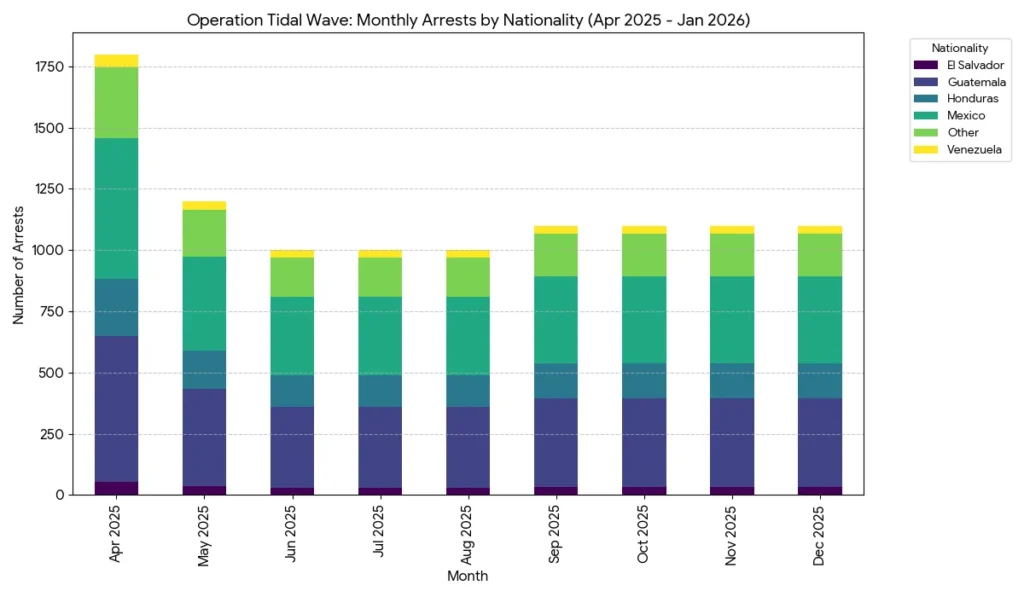
| Nationality | Number of Arrests | Percentage |
| Guatemala | 3,435 | 33.0% |
| Mexico | 3,331 | 32.0% |
| Honduras | 1,353 | 13.0% |
| El Salvador | 312 | 3.0% |
| Venezuela | 312 | 3.0% |
| Other Nationalities | 1,657 | 16.0% |
| Total | 10,400 | 100% |
The Controversy of the Alligator Alcatraz
One of the strangest elements in the Florida immigration policy is possibly a state-operated jail in the Everglades, also known as Alligator Alcatraz by the critics. This accommodation with a capacity of 3,000 individuals is a massive state investment in immigration detention that has never been attempted before.
This facility has not been spared of legal problems, however. It was ordered to cease taking in new detainees and close within 60 days by August 2025 by a federal judge, however, as of early January 2026, it was still evidently operational despite continued appeals and environmental issues.
What’s Coming in 2026
The Florida lawmakers are not deterred by the legal battles they have been fighting to propose more comprehensive measures in relation to immigration. The bill would include proposals in the 2026 legislative session that started January 13 and would:
- Increase E-Verify to any employer.
- Penalize businesses that employ illegal immigrants with up to half a million dollars.
- Limit the banking services of the undocumented immigrants.
- Demand identification of the citizenship to register as a voter.
Introduced Florida Immigration Bills of 2026:
| Measure | Bill Number(s) | Key Provisions | Potential Penalties |
| Expand E-Verify Requirements | HB 197 / SB 1278 & SB 1542 | Eliminates the 25-employee threshold; requires all private employers to use E-Verify. SB 1542 expands “employee” to include 1099 contractors. | Fines of $1,000 per day for continued non-compliance; potential suspension of all business licenses. |
| Business Hiring Fines | SB 1542 | Dramatically increases penalties for knowingly hiring undocumented workers. | $10,000 to $250,000 for repeat violations; up to $500,000 if an undocumented employee’s actions result in a person’s death. |
| Restrict Banking & Financial Services | HB 1307 / SB 1380 | Prohibits state licensing for undocumented individuals; allows counties to require proof of legal presence for borrowers. | Denial of loans, professional licenses, and state financial assistance or claim reimbursements. |
| Proof of Citizenship for Voting | HB 991 / HB 985 / SB 1334 | Requires documentary proof (e.g., passport, birth certificate) to register; mandates a state review of all current voter rolls. | Immediate removal from voter registration system; referral for felony prosecution for false affirmations. |
Broader Implications
The aggressive strategy of Florida is closely monitored by other states and may affect the immigration policy in the country. The unsuccessful court injunctions underscore the constitutional restriction of the state authority in immigration enforcement, yet they also illustrate the way that states can circumvent this restriction by collaborating with the federal authorities.
The economic effect is still a major issue especially to Florida agriculture industry, as well as the building industry which is highly dependent on immigrant labor. Other reports indicate that there are job losses by the workforce in these areas after the 2023 law.
Looking Ahead
With these legal issues still winding their way through the courts, the immigration laws in Florida are in the state of partial enforcement. The criminalization elements of most of the controversial state-levels remain blocked but with federal cooperation enforcement activities are still allowed.
This case might end up in the Supreme Court as the issue of state versus federal powers in terms of immigration enforcement needs to be resolved and this ruling would extend well beyond Florida.
At least in the short term, the injunctions are a major checkpoint on state authority, but they did not prevent Florida in the quest to achieve its objectives of immigration enforcement in other ways. This legal play/political play will probably be one that is going to be experienced to influence the immigration policy debate in the country.