 Leland D. Bengtson
General Motors filed a motion in June asking a federal judge to throw out the class action over it’s 6.2-liter L87 V8. The argument runs simply enough: the company recalled the vehicles, repaired them at no cost, extended the warranties and so the plaintiffs have nothing left to win.
Five months before that filing, the National Highway Traffic Safety Administration opened a formal investigation into whether those repairs actually work.
Both of those things are true right now and the gap between them is where this case sits.
The recall covered 597,571 trucks and SUVs and most of them got an oil change
GM’s Safety Field Action Decision Authority approved the recall on April 17, 2025. It went out as 25V-274, covering 2021-2024 model year Chevrolet Silverado 1500, Suburban and Tahoe, GMC Sierra 1500, Yukon and Yukon XL and the Cadillac Escalade and Escalade ESV.
Engine teardowns pointed at two causes, both of which GM attributed to suppliers rather than to it’s own design:
- Rod bearing damage from sediment on the connecting rods and in the crankshaft oil galleries
- Crankshafts built to out-of-specification dimensions and surface finish
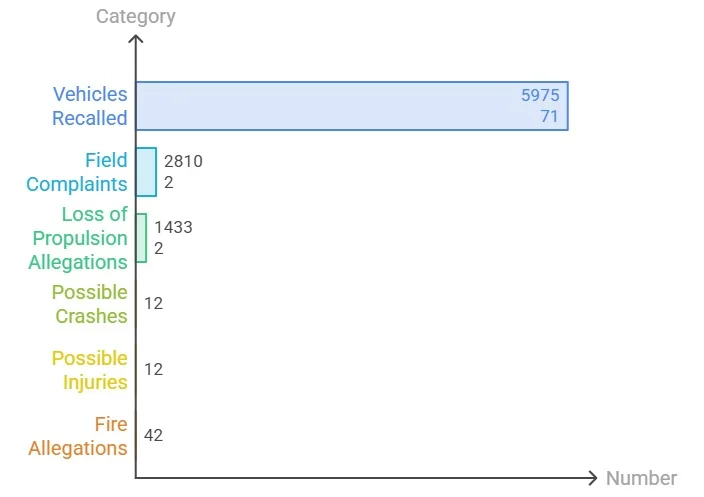
By the time GM filed the recall report, it had logged 28,102 field complaints in the U.S. tied to crankshaft, connecting rod or bearing failure, received between April 2021 and February 2025. Of those, 14,332 alleged loss of propulsion. The company also identified 12 possible crashes, 12 possible injuries and 42 fire allegations, most of them contained to the engine compartment.
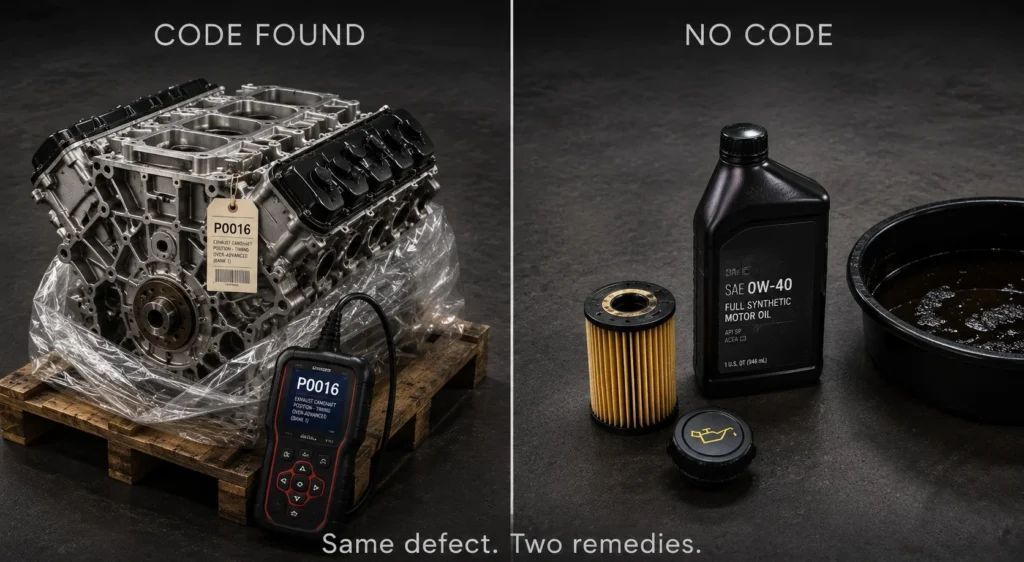
The remedy had two paths. Dealers inspect the engine and look for diagnostic trouble code P0016. Find it and the engine gets replaced. Miss it and the vehicle gets it’s 0W-20 oil drained and refilled with heavier dexos R 0W-40, a fresh filter and a new oil cap printed with the updated spec. Every recalled vehicle also picked up a 10-year, 150,000-mile warranty extension.
So for the large majority of those 597,571 owners, the federal safety remedy for a machining defect was thicker oil.
NHTSA opened RQ26001 on January 16 to test whether the remedy holds
A Recall Query is not a new recall. It is the agency going back over a manufacturer’s homework and the trigger here was owners reporting that their engines failed after the dealer had already performed the fix.
The Office of Defects Investigation opened with 36 owner questionnaires. The complaints covered both remedy paths, which matters: not only engines running the heavier oil, but engines that had been fully replaced. By the time ODI sent GM it’s information request in February, the letter put the count at 139 reports.
Population under review: the full 597,571.
Another 286,000 vehicles sit outside the recall altogether
The original probe, PE25-001, opened in January 2025 on 39 complaints and closed that October. It did not close quietly. NHTSA upgraded it to an Engineering Analysis, EA25-007, covering 2019-2024 vehicles that GM’s recall window never touched. Investigators had by then collected 1,157 reports of bearing failure in that population and case documents put total recorded incidents at 3,315. Whether GM has to widen the repair campaign is still open.
Twelve lawsuits became one case in Michigan
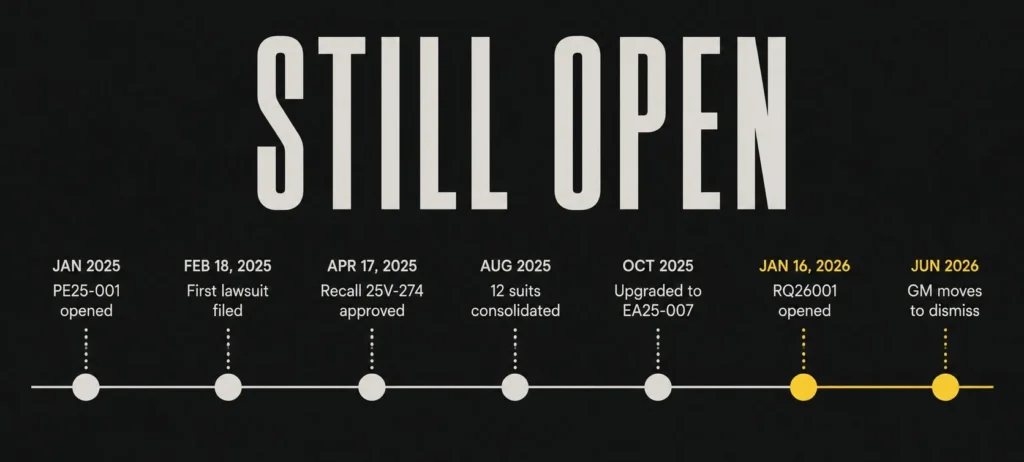
The first complaint, Powell v. General Motors, was filed on February 18, 2025, about a month after NHTSA started asking questions. Ten more followed through the spring and summer, filed in Georgia, Pennsylvania and elsewhere, all making overlapping claims for overlapping classes.
In August 2025 the parties stipulated to consolidate twelve actions in the Eastern District of Michigan before Judge Shalina D. Kumar, with Powell as the lead case at No. 4:25-cv-10479. Judge Kumar appointed four firms as interim co-lead counsel. The consolidated complaint landed on February 26, 2026, running 389 pages on behalf of 44 named plaintiffs.
Their central claim goes further than the recall does. They allege the L87 suffers a design problem that starves lubrication between the crankshaft and the bearings, that the recall excludes vehicles carrying the same flaw and that the inspection gate is unreliable, since engines have failed shortly after passing it.
GM’s answer is that a 3% failure rate is not a design defect
The motion to dismiss leans on the distinction GM has held since the recall report: what failed was supplier quality on a limited run of parts, not the engineering of the L87 itself. Most engines are fine. The ones that were not have been repaired for free.
I find the mootness half of that argument harder to accept than the design half. GM may well be right that the L87 is fundamentally sound and that a supplier let it down and the recall report reads like a company that did the teardown work honestly. But the claim that the plaintiffs already have everything they asked for depends entirely on the remedy working and the federal agency responsible for making that call has not made it. RQ26001 exists precisely because it might not be working.
Three percent, incidentally, is not a small number against a population of 597,571. It is around eighteen thousand engines.
The last time GM fought an engine class action, it ran nine years
Siqueiros v. General Motors was filed in December 2016 in the Northern District of California over excessive oil consumption in the Generation IV Vortec 5300 LC9 5.3-liter V8. In October 2022 a jury found GM liable on implied warranty claims in California and North Carolina and under Idaho’s consumer protection statute, returning $102.6 million across roughly 38,000 class members, about $2,700 each.
It settled in the end for $150 million, approved in 2025. Plaintiffs’ counsel took around $53 million of it.
Nothing about that case predicts this one. It does suggest what a fight of this kind costs when a manufacturer decides to have it.
The thicker-oil remedy always read as a bet that a heavier film would cover for tolerances that were already out of spec, which is a maintenance answer to a machining problem. That bet is now being graded by a federal agency rather than a warranty department. Arguing your case is moot while the government is still deciding whether your fix works strikes me as a difficult position to hold for long and if RQ26001 lands badly, the recall GM is currently pointing to as it’s defense becomes the thing it has to do over.