 Mohammad Abdel-Rahman Accident & Injury Lawyer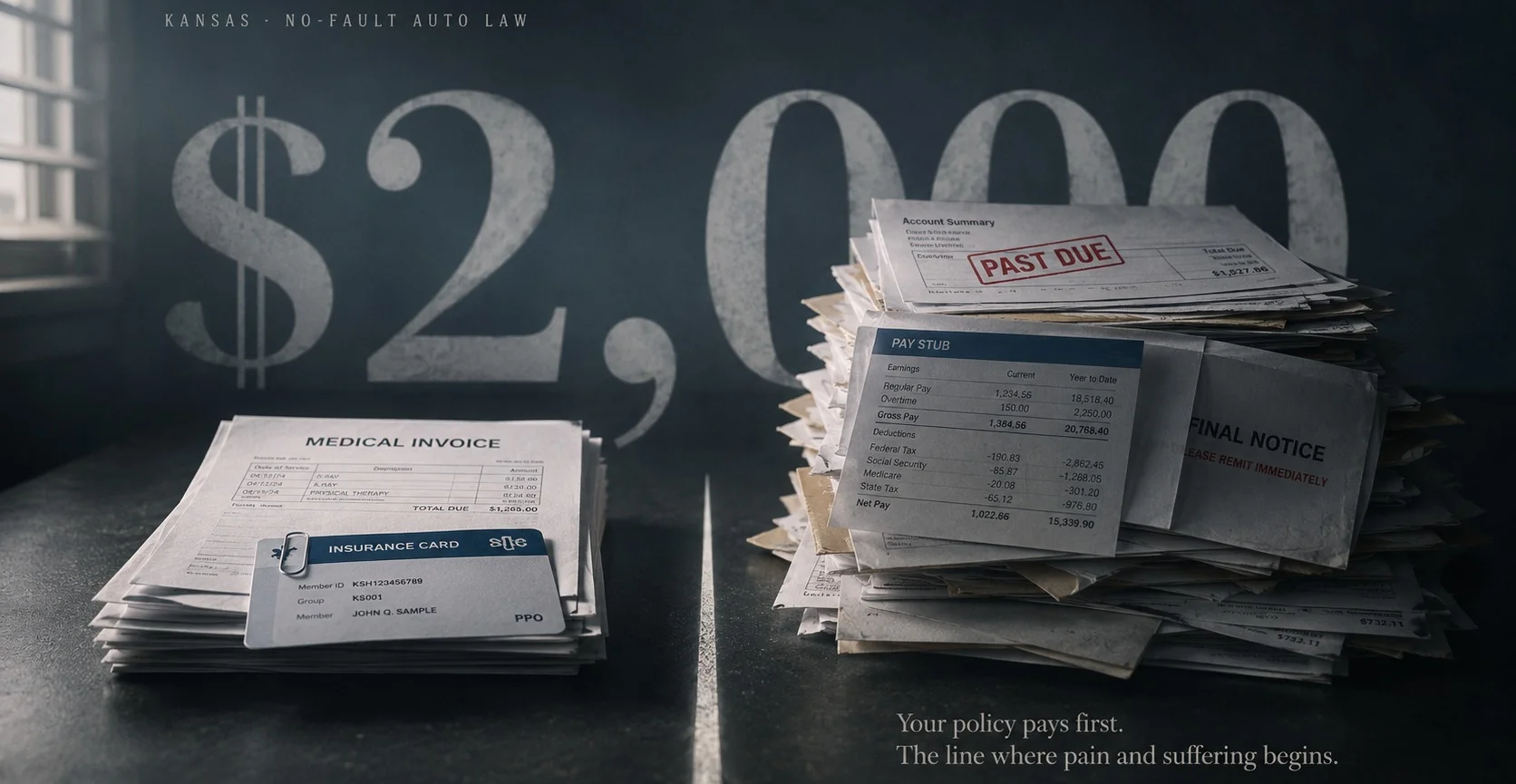
Kansas runs a no-fault auto insurance system and the practical effect of that is your own policy pays your medical bills and lost wages after a crash, does not matter who caused it. Your PIP coverage, personal injury protection, kicks in and handles the immediate costs. Every Kansas auto policy is required to include it under the Kansas Automobile Injury Reparations Act starting at K.S.A. § 40-3101.
PIP covers the basics but it stops at the basics. The state minimum is $4,500 for medical expenses and $900 a month for up to a year of lost income. It also covers $25 a day for in-home services you cannot do because of your injuries and $2,000 for funeral costs if the worst happens. And that is it. PIP does not pay anything for pain and suffering.
To recover non-economic damages, the pain and the disruption and the months of not being able to do the things you used to do, you have to meet a threshold set by K.S.A. § 40-3117. Until you clear it, the no-fault system is the only system you have access to.
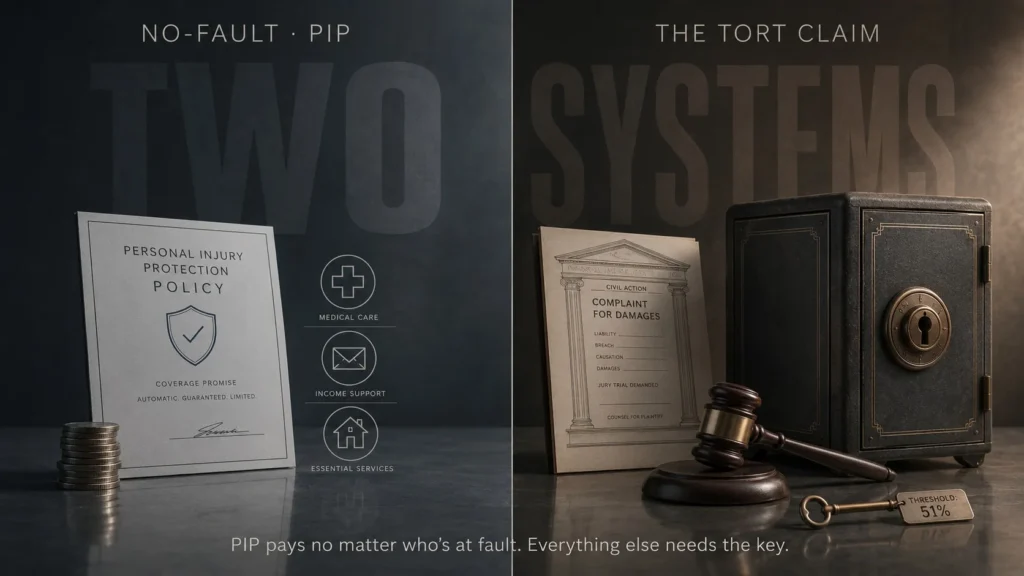
The Threshold Under § 40-3117 Governs Non-Economic Damages Only
One thing that gets lost in how people talk about this online: the $2,000 threshold does not decide whether you can sue the other driver at all. You can still pursue economic damages like medical bills and lost wages outside of PIP regardless of whether your injuries hit the threshold. What § 40-3117 controls is your ability to recover for pain, suffering, mental anguish, inconvenience and other non-pecuniary losses.
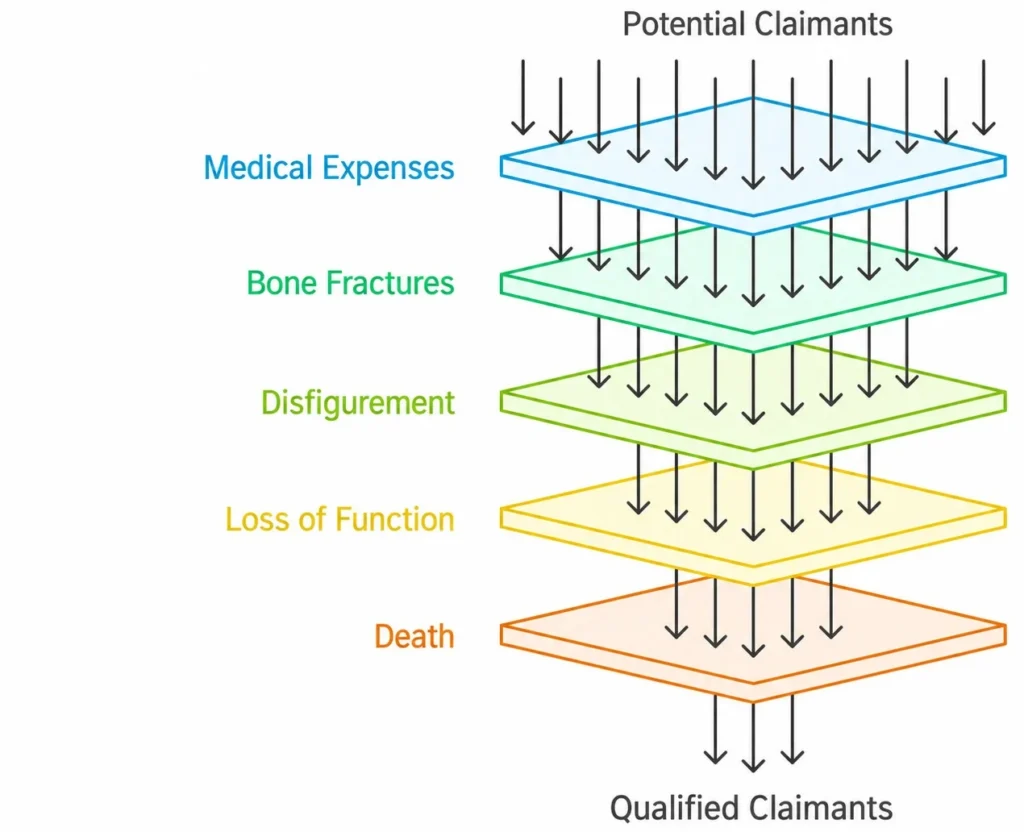
The statute says you can pursue those non-economic damages when at least one of the following applies:
- Medical expenses of $2,000 or more in reasonable value
- Fracture of a weight-bearing bone
- A compound, comminuted, displaced or compressed fracture of any bone
- Permanent disfigurement
- Permanent loss of a body function or organ
- Death
The fracture categories are specific and not every break qualifies
The statute does not say “any fracture.” It distinguishes between a fracture of a weight-bearing bone, which qualifies on it’s own and fractures of other bones, which only qualify if they are compound, comminuted, displaced or compressed. A hairline fracture of a non-weight-bearing bone that heals cleanly might not meet the statutory language depending on how the imaging reads and how the insurer’s medical reviewer characterises it.
That distinction matters because a lot of people assume any broken bone automatically clears the threshold and it might not, at least not without a fight over the medical records.
The $2,000 Medical Threshold and Why the Word “Reasonable” Complicates It
The statute says medical expenses of $2,000 or more “in reasonable value.” Not $2,000 in billed charges. Not $2,000 in what the hospital invoice says. Reasonable value, which means the insurer can look at what was billed and argue that some portion of the treatment was not medically necessary or that the charges exceeded what would be considered reasonable for that type of care.
Let’s say, hypothetically, someone goes through six weeks of physical therapy after a rear-end collision and the total bills come to $2,400. The insurer could bring in a medical reviewer who says three weeks of therapy was sufficient for that type of soft tissue injury and the reasonable value of the treatment was really about $1,600. If that argument holds up, the claimant is below the threshold and non-economic damages are off the table.
Whether insurers routinely do this is something I cannot point to a specific Kansas study or published data set to prove, but the economic incentive is obvious. Every dollar the insurer can shave off the “reasonable value” calculation moves the claimant closer to the line where pain and suffering damages disappear entirely and the structure of the statute creates that incentive by making $2,000 the dividing point.
PIP Is the Floor and the Floor Is Low
Worth sitting with the actual numbers for a second because they are kind of startling when you think about what medical care actually costs.
$4,500 in medical PIP on the minimum policy. A single ER visit with imaging can run two to three thousand dollars depending on the facility. An ambulance ride adds another thousand or more. A night of observation, another few thousand. So a crash that sends someone to the ER by ambulance with a CT scan and an overnight stay can burn through the entire minimum medical PIP benefit in less than 24 hours before any follow-up treatment has even started.
The $900 a month in lost income coverage runs for a year, so that is $10,800 maximum. Somebody earning $50,000 a year takes home roughly $3,500 a month after taxes. PIP replaces about a quarter of that. For three months of missed work that gap between what PIP pays and what the person actually lost is more than $7,000 and that is money the person either absorbs or recovers through a tort claim against the at-fault driver if the threshold is met.
Most people in Kansas carry the minimum PIP because it is what the law requires and the premium difference between minimum and higher limits does not seem worth it until after the crash. Then the math changes fast.
If you are dealing with a situation where your injuries might be near the threshold line and you are not sure whether your medical expenses are going to come in at or above $2,000 in reasonable value, getting car accident legal help in Salina from Bretz Injury Law early is one of those things where the timing actually changes the outcome, because the medical records your doctors create in the first couple of weeks are the records the insurer is going to use when they make the reasonable value determination and how those records describe the treatment and the necessity behind it is something that matters more than most people realise while they are still figuring out whether to go back for that follow-up appointment or skip it because they feel a little better.
Comparative Fault Applies After You Clear the Threshold
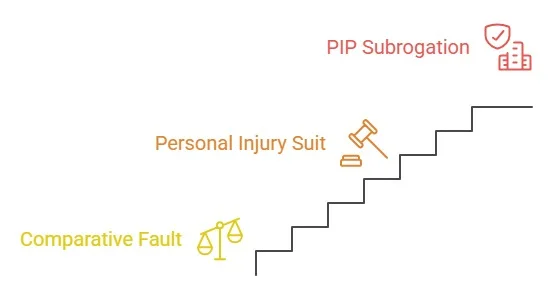
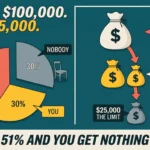
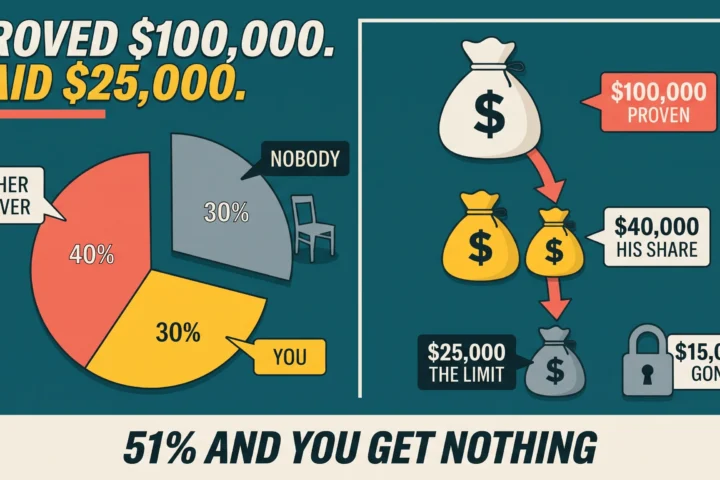
Getting past the § 40-3117 threshold opens the door to non-economic damages but it does not guarantee recovery. Kansas uses modified comparative fault under K.S.A. § 60-258a, which reduces your damages by your percentage of fault and bars recovery entirely if you are 50% or more at fault.
So even with a valid pain and suffering claim, the insurer is going to argue that you contributed to the crash. Speed, following distance, distraction, lane position, anything they can point to that shifts fault onto you is worth money to them because every percentage point reduces what they pay and at 50% the whole thing goes to zero.
The two-year statute of limitations under K.S.A. § 60-513 sets the outside deadline for filing a personal injury lawsuit in Kansas. Separately, K.S.A. § 40-3113a creates an 18-month window specific to the no-fault system: if you do not file a tort action against the at-fault driver within 18 months, your PIP insurer gains the right to pursue subrogation for the PIP benefits it paid, which is a narrower right than your full tort claim but it does change the dynamics of who is driving the recovery process and how the money gets divided if there is a settlement.
Saline County Crash Data
Saline County recorded 6 motor vehicle crash fatalities in 2023 according to NHTSA Fatality Analysis Reporting System data compiled by Stacker, which works out to 11.2 deaths per 100,000 people and ranked 20th among Kansas counties. Statewide, Kansas recorded 347 traffic fatalities in 2024, the lowest number since KDOT began keeping records in 1947.
Salina sits at the junction of I-70 and I-135 which means commercial and passenger highway traffic passes through the area, but the county’s fatality rate is mid-range for the state rather than an outlier. The crashes that happen at highway speeds on those corridors tend to produce injuries that clear the $2,000 threshold without much question. The harder cases, the ones where the threshold fight actually plays out, are the lower-speed collisions around town where the medical bills land somewhere near that line and the reasonable value argument has room to work.
References
- K.S.A. § 40-3101 et seq. Kansas Automobile Injury Reparations Act.
- K.S.A. § 40-3103. Minimum PIP benefits: $4,500 medical, $900/month lost income, $25/day in-home services, $2,000 funeral.
- K.S.A. § 40-3117. Non-economic damages threshold: medical expenses of $2,000 or more in reasonable value, fracture of weight-bearing bone, compound/comminuted/displaced/compressed fracture, permanent disfigurement, permanent loss of function, death. Applies to non-pecuniary damages only.
- K.S.A. § 60-258a. Modified comparative fault, 50% bar.
- K.S.A. § 60-513. Two-year statute of limitations for personal injury.
- K.S.A. § 40-3113a. PIP subrogation rights, 18-month window for tort action, assignment to PIP insurer limited to recovery of duplicative PIP benefits.
- NHTSA Fatality Analysis Reporting System / Stacker (September 2025). Saline County: 6 fatalities, 11.2 per 100,000, ranked #20 among Kansas counties.
- KDOT / KWCH (January 2025). Kansas recorded 347 traffic fatalities in 2024, lowest since records began in 1947.
- Nolo, “Kansas No-Fault Car Insurance” (February 2025). Threshold requirements and PIP minimums.
- Grover Law KC, “Kansas PIP Insurance After a Car Accident” (March 2026). Reasonable value standard.