 Giovanni ( software and services )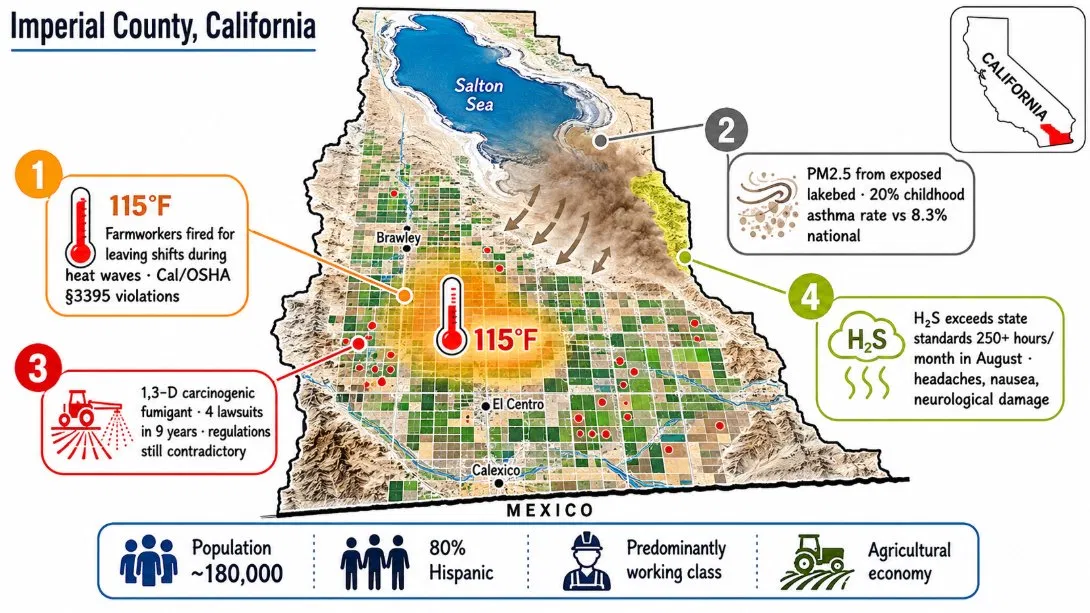
Imperial County sits at the bottom of California, pressed against the Mexican border, and most of the state forgets it exists until something goes wrong. But for the roughly 180,000 people who live here, overwhelmingly Latino, largely working class, disproportionately employed in agriculture, things go wrong with a regularity that the rest of the state does not have to think about.
Twenty percent of children in Imperial County have asthma. The national average is 8.3%. The county has twice the rate of pediatric asthma-related emergency room visits compared to the rest of California. Farmworkers get fired for leaving shifts during heat waves. And a cancer-causing pesticide has been the subject of four separate lawsuits against state regulators over the past nine years and the regulations still do not work.
These are not abstract policy problems. They are legal issues with specific statutes, specific cases, and specific rights that most people in El Centro, Calexico, and the surrounding communities have never been told they have.
Farmworker Heat Injuries and the Law That Exists on Paper
So what happens when you are picking crops in 115-degree heat and your employer won’t let you take a break?
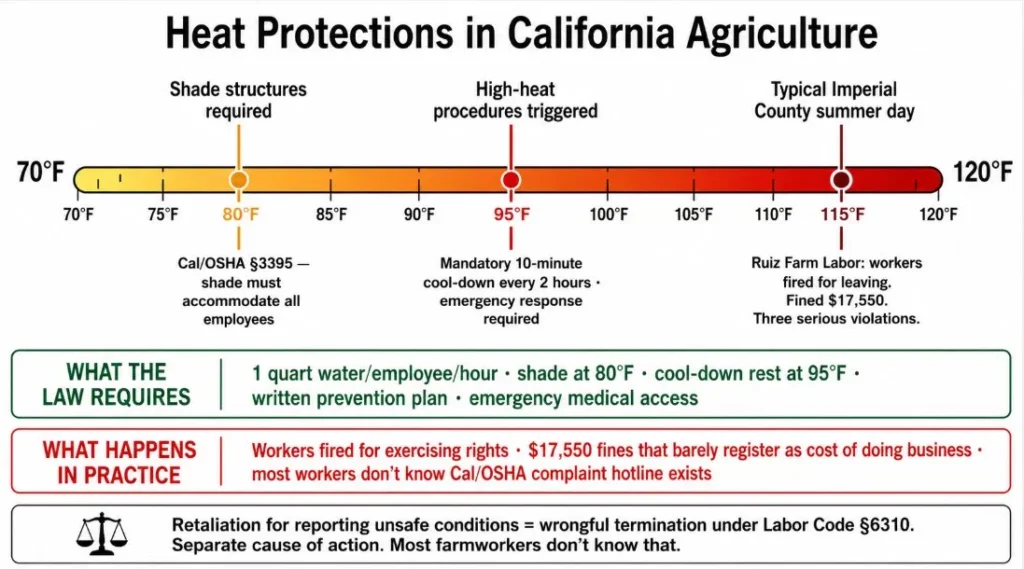
California answered that with one of the most specific heat illness prevention regulations in the country. Cal/OSHA Title 8, §3395, the Heat Illness Prevention Standard, requires agricultural employers to provide:
- Access to fresh cool drinking water, at least one quart per employee per hour, available at all times.
- Shade structures that can accommodate all employees on recovery or rest periods when temperatures exceed 80°F.
- High-heat procedures when temperatures hit 95°F, including mandatory cool-down rest periods of at least 10 minutes every two hours.
- Written heat illness prevention plans and effective training for supervisors and workers.
- Emergency response procedures including the ability to call for emergency medical services immediately.
The regulation is clear. Enforcement is a different conversation.
The Yolo Six, Fired for Trying to Survive
In June 2024, during a heat wave, a group of farmworkers at Ruiz Farm Labor in Dixon left their shifts early because the employer was not providing adequate heat protections. The employer’s response was to turn the workers away.
Cal/OSHA investigated and cited Ruiz Farm Labor $17,550 for three serious-category violations. Failed to implement high-heat procedures. Failed to provide effective training. Failed to have emergency response plans.
Seventeen thousand dollars.
For violations that in different circumstances could have killed someone. Serious violations under Cal/OSHA carry penalties up to $25,000 each and the citations were warranted but the fines barely register as a cost of doing business for operations that cycle through hundreds of workers per season. The legal protections exist on paper. Whether they create real accountability depends on whether workers know they can file complaints, anonymously, through the Cal/OSHA complaint hotline, and whether they have legal support when retaliation follows.
And retaliation does follow. An employer who fires a worker for exercising their right to heat protections is violating California Labor Code §6310 which prohibits retaliation against employees who report unsafe conditions. That is a separate cause of action. That is a wrongful termination claim.
Most farmworkers do not know that.
What Injured Farmworkers Can Actually Recover
If a farmworker suffers a heat-related injury on the job, workers’ compensation covers medical expenses, temporary disability, and permanent disability regardless of immigration status. California Labor Code §3351 defines “employee” broadly and undocumented workers have the same workers’ comp rights as anyone else. That is settled law.
But workers’ comp is often just the floor. When the injury results from an employer’s serious and willful misconduct, like knowingly ignoring heat regulations, the worker may be entitled to a 50% increase in compensation under Labor Code §4553. And when a third party contributed to the injury, a farm labor contractor or equipment manufacturer or property owner, there may be a separate personal injury claim with no cap on damages.
Navigating those layers in a county where most injured workers speak Spanish, Mixtec, or Zapotec, and where employer intimidation is pervasive, requires a personal injury lawyer El Centro families can actually reach and who understands the agricultural landscape of the Imperial Valley. The legal rights exist. The gap is access.
Pesticide Exposure: A Nine-Year Legal Fight That Still Is Not Over
1,3-Dichloropropene, known as 1,3-D, is a fumigant pesticide used heavily in California agriculture. It is also a known carcinogen. The state’s own Office of Environmental Health Hazard Assessment has established that 1,3-D causes cancer and set a “no significant risk level” for exposure.
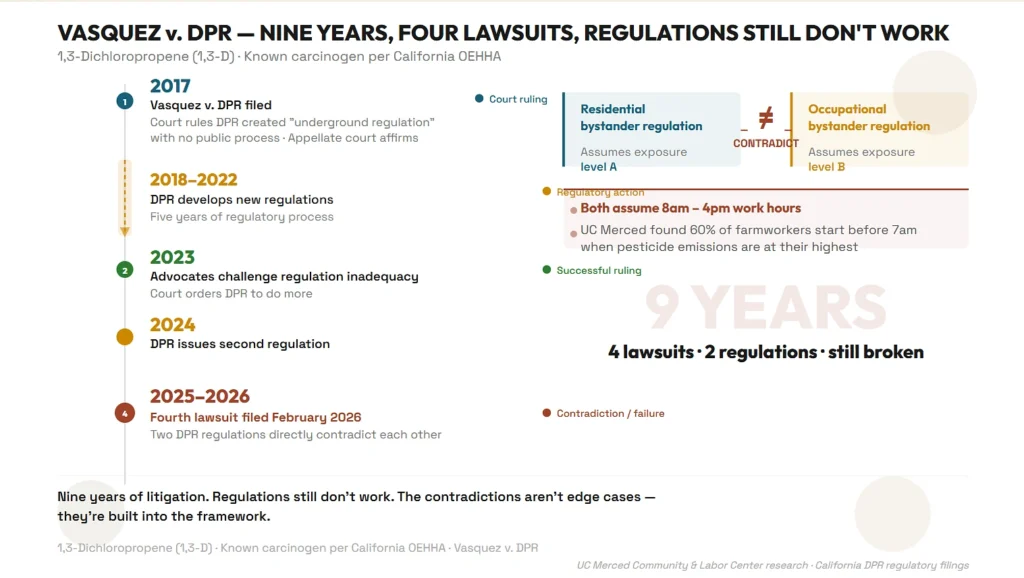
In 2017 farmworker community members filed Vasquez v. Department of Pesticide Regulation challenging the California DPR’s failure to adequately regulate 1,3-D. The court ruled in their favor, finding that DPR had created an “underground regulation” with no public process. The appellate court affirmed.
That should have been the end of it.
DPR developed new regulations. Advocates challenged their inadequacy. The court ordered DPR to do more. DPR issued a second regulation. And in February 2026 advocates filed a fourth lawsuit because the two regulations DPR created directly contradict each other.
The residential bystander regulation assumes one level of acceptable exposure. The occupational bystander regulation, for people who work near 1,3-D applications, assumes a different level. And both regulations assume farmworkers work 8am to 4pm when a UC Merced study found that 60% of farmworkers start before 7am, when pesticide emissions are significantly higher.
The communities most affected are rural, low-income, and predominantly Latino.
That describes Imperial County exactly.
Pesticide Exposure Claims Can Take Multiple Forms
Workers’ compensation for occupational exposure that causes illness. Personal injury claims against the pesticide manufacturer, the applicator, or the employer who failed to follow safety protocols. Class action lawsuits when entire communities are affected by pesticide drift, which is exactly what Vasquez was about.
The legal landscape around pesticide exposure is technically complex and actively evolving. The fact that California’s own regulators are being sued for the fourth time over the same chemical tells you how contested this space is. For Imperial County residents who believe their health has been affected by agricultural pesticide use, joining or initiating a class action lawsuit El Centro residents have standing to pursue is one of the most effective paths available because the harm is not individual. It is systemic.
The Salton Sea Is Dying and the Dust Is Making People Sick
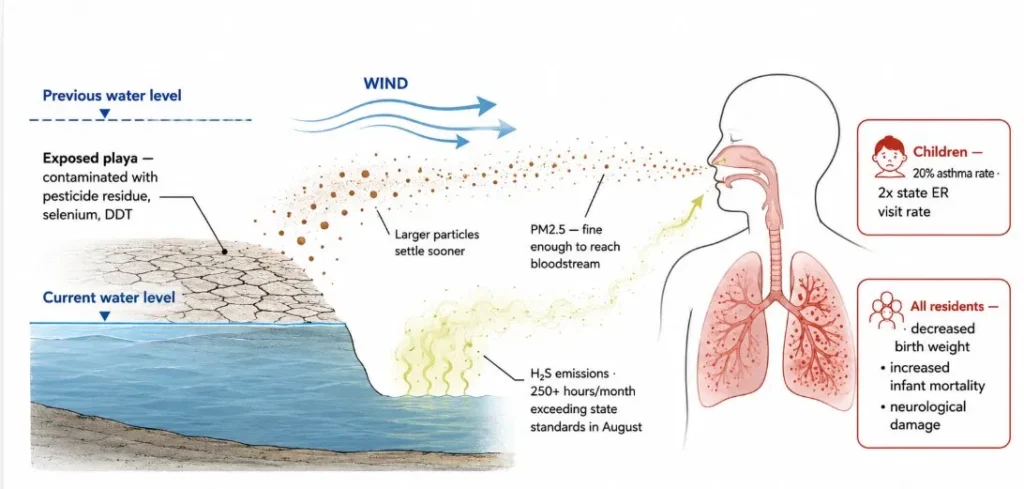
The Salton Sea is California’s largest lake and it is shrinking. As water transfers have redirected agricultural runoff that used to feed the sea, the lakebed has been exposed, sediment contaminated with decades of pesticide residue, selenium, and DDT. Wind picks up that dust and carries it into the lungs of every person living downwind.
A 2024 UC Davis study found that dust pollution from the exposed lakebed is directly driving elevated asthma rates and respiratory illness in surrounding communities. Airborne PM2.5, particulate matter fine enough to reach the bloodstream, has been linked to decreased birth weight and increased infant mortality in the research.
Then there is the hydrogen sulfide. A 2025 Brown University study found the Salton Sea emits hydrogen sulfide at levels that regularly exceed California’s air quality standards. Between 2013 and 2024 the Torres Martinez monitoring site, the one closest to the lake, recorded an average of over 250 hours per month exceeding state standards during August alone. The gas causes headaches, nausea, fatigue, and long-term neurological and respiratory damage.
And now the lithium industry wants in. Environmental justice organizations Comité Cívico del Valle and Earthworks sued Imperial County over its approval of the Hell’s Kitchen lithium extraction project arguing the environmental review underestimated water use and air quality impacts. Trial court dismissed the suit in January 2025. The appeal was filed September 2025 and is currently before the Fourth District Court of Appeal.
Where the Legal Angles Are
Environmental justice claims under CEQA, the California Environmental Quality Act, arguing cumulative impacts on already-burdened communities were not properly evaluated. That is what the Hell’s Kitchen lawsuit is built on.
Public nuisance claims when airborne pollutants from an identifiable source cause widespread health harm.
Toxic tort litigation, individual or class claims for health damages caused by exposure to identifiable toxins from an identifiable source.
The challenge is that many of the responsible parties are government agencies or quasi-governmental water districts which triggers different procedural rules and shorter filing deadlines. But the legal avenues exist and as the science connecting Salton Sea emissions to specific health outcomes gets stronger, the UC Davis dust study, the Brown University hydrogen sulfide data, the evidentiary foundation for litigation grows with it.
What Imperial County Residents Should Understand About Their Own Rights
The legal issues hitting this county are not random. They follow the geography, agricultural land, border proximity, shrinking lake, desert heat. And they follow the demographics, a community that is 80% Hispanic, largely working class, and historically excluded from the political decisions that created these conditions.
California law provides protections that are on paper among the strongest in the country. Heat illness prevention standards. Pesticide exposure regulations. Environmental quality review requirements. Workers’ compensation rights regardless of immigration status. Anti-retaliation protections for reporting unsafe conditions.
But protections only protect if people know about them and if they are enforced and if there are attorneys willing to take the cases. Imperial County is not San Francisco or Los Angeles. The legal infrastructure is thinner here. The intimidation factor in agricultural employment is real. The language barriers are real.
Every case cited in this article, the Yolo Six citations, the Vasquez pesticide litigation, the Hell’s Kitchen CEQA challenge, started because someone decided the situation was bad enough to do something about it. Every one of those actions began with a complaint or a consultation or a phone call to someone who understood the legal framework.
The rights exist. Whether people in Imperial County know about them and use them is a separate problem and it is not one the law can solve on its own.
References
- Cal/OSHA Title 8, §3395 (Heat Illness Prevention in Outdoor Places of Employment). California Code of Regulations.
- Cal/OSHA, “Cal/OSHA cites farm labor contractor for serious heat-related safety violations” (2024). California DIR.
- California Labor Code §6310 (Protection from retaliation for reporting unsafe conditions).
- California Labor Code §3351 (Definition of “employee” for workers’ compensation purposes).
- California Labor Code §4553 (Increased compensation for serious and willful employer misconduct).
- Vasquez v. Department of Pesticide Regulation (2017), Alameda County Superior Court.
- CRLA, “Farmworker Advocates Sue California Over Conflicting Regulations for Cancer-Causing Fumigant Pesticide 1,3-D” (February 2026). CRLA.
- Courthouse News, “Drying Salton Sea has caused dangerous pollution, health problems for nearby communities, study finds” (May 2024). Courthouse News.
- Brown University, “Air-quality monitoring underestimates toxic emissions to Salton Sea communities, study finds” (June 2025). Brown University.
- Calexico Chronicle, “Battle Over Salton Sea Lithium Project Heads to Appeals Court” (September 2025). Calexico Chronicle.
- CalMatters, “The rotten egg smell at the Salton Sea isn’t just a nuisance. It can make people sick.” (September 2025). CalMatters.