 Michael Simmrin (Criminal Lawyer)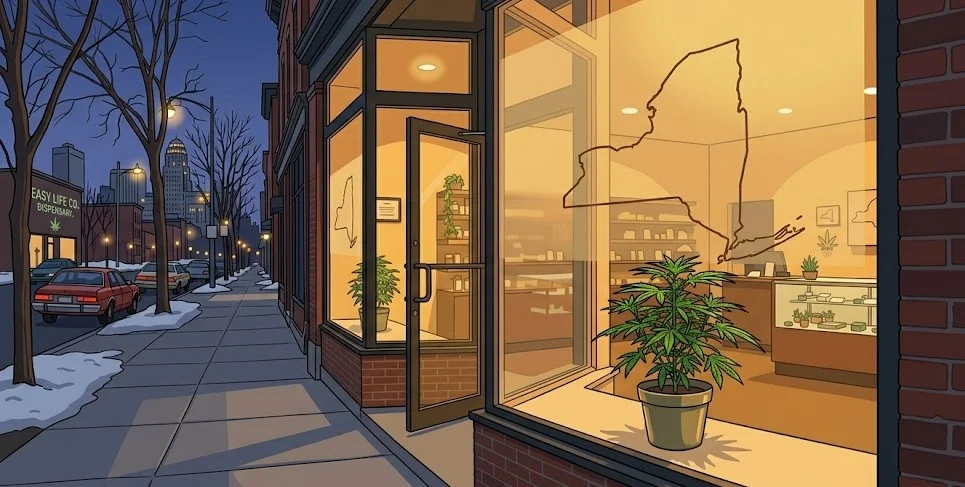
Since 2022, a group of federal cases, dubbed the Variscite NY cases, lawsuit over marijuana distribution in western New York. The core fight? Whether the cannabis licensing regulations of New York unfairly preferred in-state to out-of-state applicants. The answer of the courts was mostly yes. And the spillover, which continues as of April 2026, has put dispensary hopefuls in Buffalo, Niagara and environs in regulatory limbo as illegal shops fill the void.
What Started This Whole Mess
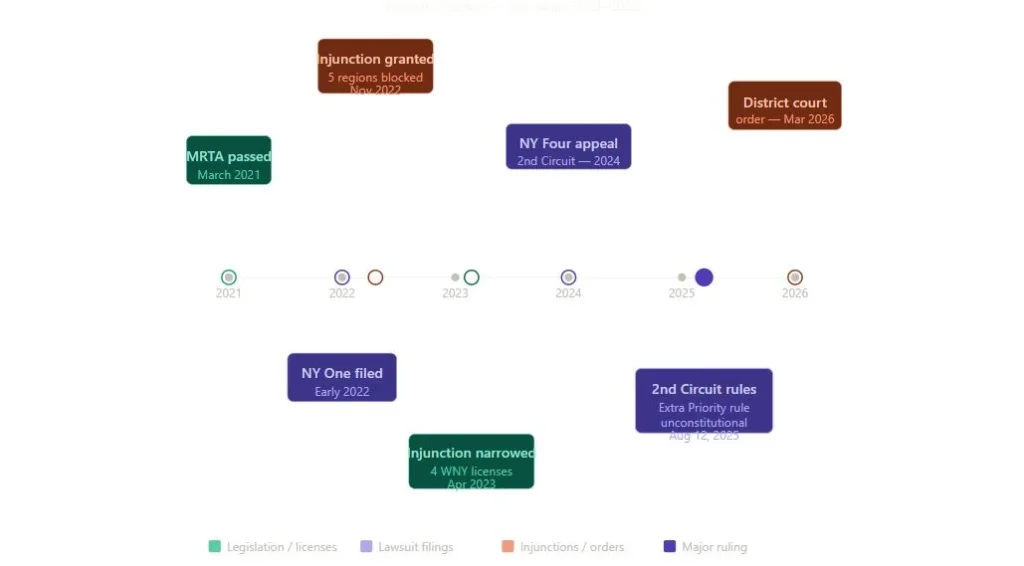
In 2021, recreational cannabis was legalized in New York by the Marijuana Regulation and Taxation Act (MRTA). The legislation put control in the hands of the Office of Cannabis Management (OCM) and the Cannabis Control Board (CCB) and stated a social equity orientation, prioritizing communities most severely affected by decades of prohibition enforcement.
Sounds reasonable. Deep within the licensing regulations were preferences, which the courts later determined were problematic: a preference to applicants with New York-specific marijuana convictions, geographical-based requirements, and queue-based ordering that gave preference to prior applicants of CAURD (Conditional Adult-Use Retail Dispensary) most of whom, it turned out, were New Yorkers.
In comes the Dormant Commerce Clause. It is a constitutional rule that does not allow states to enact laws that will discriminate against the interests of out-of-state economies. And it was the legal hammer which the plaintiffs used to whittle down the New York licensing structure.
The Variscite Lawsuits: A Timeline
The First Case (2022): Five Regions Blocked
In 2022, Variscite NY One, Inc. v. State of New York was in the U.S. District Court, Northern District of New York. The plaintiff, which is majority owned by California residents with outside-state marijuana convictions, claimed that the New York rules of Extra Priority were effectively discriminatory to any one whose cannabis history was not based in New York. Discrimination that, they said. The Dormant Commerce Clause says you can’t do that.
In November 2022, a federal judge agreed enough to grant a preliminary injunction. CAURD license issuance was blocked in five regions:
- Western New York
- Finger Lakes
- Central New York
- Mid-Hudson
- Brooklyn
For Western NY specifically, this meant the legal cannabis rollout essentially froze. No licensed dispensaries opening. No regulated sales. Just a widening window for the illicit market to dig in deeper.
By April 2023, after appeals and partial settlements, the injunction was narrowed enough to allow 13 licenses to move forward in blocked regions — 4 of them in Western New York. Progress, but slow and painful.
The Second Circuit Weighs In (August 2025)
Variscite NY Four, LLC et al. v. New York State Cannabis Control Board pushed the fight to the U.S. Court of Appeals for the Second Circuit (docket 24-384). On August 12, 2025, the court issued a ruling that landed hard on New York’s licensing structure.
Key findings:
- The Dormant Commerce Clause does apply to New York’s cannabis market — the fact that marijuana remains federally illegal doesn’t give states a free pass to be protectionist.
- New York’s Extra Priority rule, which favored NY-specific convictions over equivalent out-of-state ones, was unconstitutionally discriminatory on its face.
- The district court’s earlier denial of preliminary relief was vacated and sent back for further proceedings.
There was a dissent worth noting. Chief Judge Livingston argued the Dormant Commerce Clause shouldn’t apply here at all — Congress’s position on cannabis, she wrote, is to suppress interstate commerce in it, not promote it. But the majority didn’t buy that reasoning.
OCM and CCB were now forced to rethink how future licensing pools would be structured. The equity-focused design New York had built its whole rollout around? Parts of it were unconstitutional.
Where Things Stand in 2026
A district court order came down around March 25, 2026. The full public details are still thin, but it hasn’t triggered a new blanket injunction blocking all WNY licenses. What it has done is add to the pile of litigation-driven uncertainty that’s made OCM’s job a nightmare.
Over 50 lawsuits have been filed against OCM in roughly the past 15 months alone. License reviews are backed up. New distribution outlets are slow to open. And Western New York, which was already behind downstate markets, keeps absorbing the delays.
What This Actually Means for Western NY’s Cannabis Market
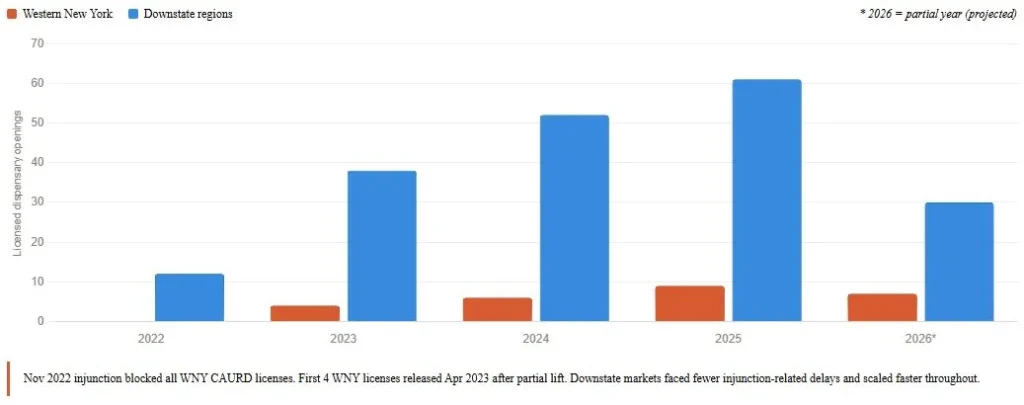
The practical damage breaks down pretty clearly:
| Impact Area | What Happened |
| Legal dispensary openings | Delayed by years due to injunctions and license backlog |
| Illicit market | Expanded to fill the vacuum left by absent legal shops |
| Tax revenue | Lost significantly during delay periods |
| Cultivators & processors | Stuck with limited legal retail outlets to distribute through |
| Out-of-state investors | Blocked from fair participation under original licensing rules |
| WNY vs. downstate gap | WNY consistently lagged in licensed outlets per capita |
Upstream operators — cultivators, processors, distributors — felt this too. If there are no licensed retail dispensaries to sell through, the whole legal supply chain backs up. That’s not just a consumer problem; it’s a business collapse in slow motion for anyone who invested in the legal market early.
Other Lawsuits Piling On
Variscite is the headline, but it’s not the only litigation shaking things up.
The School Distance Measurement Mess (2025)
OCM admitted it had been mismeasuring the required 500 and 1,000-foot buffers between dispensaries and schools — affecting hundreds of already-licensed operators, including some in the Rochester area. Roughly 150+ businesses scrambled for protection through a preliminary injunction that held through early 2026. The state legislature eventually stepped in with protections for pre-2026 licensees, signed into law before February 11, 2026.
Social Equity Promises vs. Reality
A North Country group also sued alleging what they viewed as the lack of promises to communities that the MRTA was expected to serve first. What they were complaining about sounded like a grievance common among the applicants throughout the state: the equity system was good on paper but painfully slow on the ground.
Earlier Cases That Slowed Things Down
- The 2023 Fiore lawsuit temporarily paused CAURD processing.
- Veterans’ advocacy settlements also created brief processing halts.
Each individual case might seem manageable. Combined, they’ve created a litigation traffic jam that’s proven nearly impossible for OCM to navigate at speed.

The Dormant Commerce Clause: A Quick Explainer
Since this legal concept is driving everything, it’s worth understanding what it actually is.
The implied restriction on state authority that derives out of the Commerce Clause in Article I of the Constitution is the Dormant Commerce Clause, which is detailed well by the Legal Information Institute at Cornell Law. It simply states: the states have the power to control commerce inside their borders but they cannot do it in a manner that will discriminate against out-of-state businesses or residents.
New York’s mistake, according to the Second Circuit, was building a licensing system where your chances depended partly on where your prior cannabis conviction was. A person with an equivalent conviction in California got treated worse than someone with the same conviction in New York. That’s exactly what the Dormant Commerce Clause exists to prevent.
Whether this principle should apply to a federally illegal market is genuinely contested — the dissent in Variscite NY Four raises a real argument. But for now, the majority view controls, and New York has to live with it.
What Happens Next
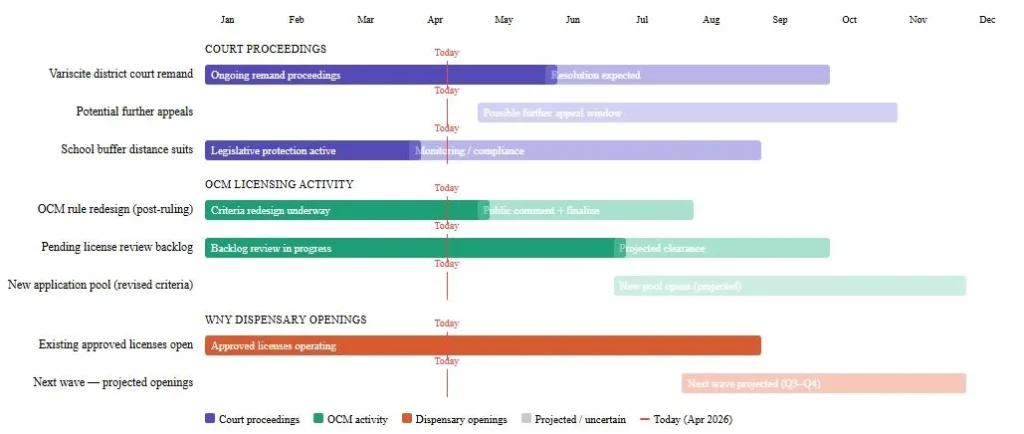
A few things are worth watching:
- OCM licensing reforms: The agency has to redesign criteria that no longer rely on NY-specific conviction preferences. What replaces it — and whether it passes constitutional muster — will shape the next wave of licenses.
- Federal rescheduling: Discussions around reclassifying cannabis at the federal level could ease tax and banking constraints that currently make operating a legal dispensary financially painful. WNY operators are watching this closely.
- Ongoing district court proceedings: The remanded Variscite case still has moves left. Another injunction isn’t off the table if OCM’s revised rules draw new challenges.
- CCB meetings: The board has held sessions in Buffalo in early 2026 specifically to address appeals and regional concerns. These are public meetings — worth attending or following if you have a stake in this market.
The Bottom Line
The market of legal cannabis in Western New York was struck in time and struck hard. The Variscite cases did not merely slow down some license grants by New York, but they revealed the structural weaknesses of how it had crafted its whole equity-based rollout, provided a wave of follow-on cases with plenty of breathing space and gave the illegal market years to breathe that it did not need.
The court’s decision in August 2025, by the Second Circuit was a milestone but not a conclusion. OCM is recreating licensing structures that are under the law question. There are dozens of other cases that remain in the courts. And the difference between WNY and the markets downstate in terms of licensed dispensaries, tax collection and legal employment is a measure of years of delay compounded.
To any person with interest in this field, as an applicant, operator, consumer, or even as a simple observer of the reality of how cannabis policy works in practice, the Variscite saga is the case to watch. See PACER to determine the federal docket (case numbers 1:22-cv-01013 and 1:23-cv-01599, N.N.Y.) or the official site of CCB resolutions and licensing updates of OCM.