 Mohammad Ahsan
Getting hit by a car as a pedestrian in the U.S. doesn’t automatically mean you win a lawsuit — or even get compensated. Your recovery depends on which state you’re in, whether you were jaywalking, how fault gets split and what insurance is in play. This article breaks down the real legal framework: driver duties, pedestrian fault, how damages work and the state-by-state rules that can make or break a claim.
The Numbers First — Because They’re Alarming
Over 7,500 pedestrians were killed in U.S. traffic crashes in 2022. That’s the highest count in more than four decades, according to NHTSA data. Tens of thousands more ended up with serious injuries.
And yet — most people, whether they’re driving through an unfamiliar city or walking one — have no idea what the law actually requires of them. That gap costs people money, health and sometimes the ability to recover anything at all.
What Drivers Are Actually Required to Do
Here’s the thing most people get wrong: a driver’s duty to a pedestrian doesn’t disappear just because the pedestrian is jaywalking. Every state imposes a general duty of reasonable care on drivers — proper lookout, controlled speed, awareness of surroundings.
At marked and unmarked crosswalks, that duty gets sharper. In California, Vehicle Code § 21950 requires drivers to yield to any pedestrian in a crosswalk — marked or not. New York’s VTL § 1146 goes further, explicitly requiring drivers to sound their horn as a warning when needed.
A few things drivers must do that most don’t realize:
- Stop behind a vehicle already stopped at a crosswalk. Passing that stopped car — even if you can’t see the pedestrian — is a violation in most states.
- Slow down near schools, playgrounds and residential areas. Courts apply a higher standard when children are reasonably foreseeable.
- Yield to blind pedestrians using a white cane or guide dog. California makes this explicit in CVC § 21963; many other states have equivalent rules.
Distracted driving is worth it’s own mention. Cell phone use, in-vehicle screens, even eating — all of it can constitute a breach of the duty of care. And plaintiff attorneys are increasingly pulling infotainment system data and cell records to prove it.
Pedestrians Have Duties Too — And Breaking Them Costs You
This is the part that surprises people. Pedestrians aren’t automatically in the right.
Darting into traffic mid-block, crossing against a “Don’t Walk” signal, walking on a highway with your back to traffic — all of these create legal fault that gets assigned to the pedestrian and reduces (or in some states, eliminates) what they can recover.
Common pedestrian fault scenarios:
- Mid-block crossing / jaywalking — typically assigned 20–60% fault depending on circumstances.
- Entering crosswalk on a “Don’t Walk” signal — heavy fault unless the driver had time to stop.
- Walking along a roadway with back to oncoming traffic — statutory violation in many states.
- Intoxicated pedestrian stumbling onto the road — can be a major fault contributor.
California recently decriminalized jaywalking under the Freedom to Walk Act (effective 2023). You won’t get a ticket if it’s safe. But civil fault in an injury claim? Still very much in play.
How Fault Is Split — The State-by-State Table That Matters Most to Travelers
This is where things get genuinely complicated for anyone traveling across state lines. The same accident, the same pedestrian behavior, can produce completely different outcomes depending on which state the crash happens in.
| Fault System | States | What It Means for You |
| Pure Contributory Negligence | AL, MD, NC, VA, DC | Even 1% your fault = $0 recovery |
| Pure Comparative Fault | CA, NY, FL, AZ, WA + 9 others | Recovery reduced by your % of fault — always |
| Modified Comparative (50% bar) | CO, GA, ID, KS, NE, UT + others | 50% or more your fault = $0 |
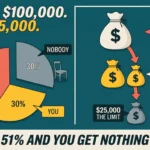
| Modified Comparative (51% bar) | TX, IL, PA, NJ, MA + most others | 51% or more your fault = $0 |
If you’re driving or walking in Virginia or Maryland, the contributory negligence rule is brutal. A pedestrian found even slightly at fault — crossing a second before the walk signal, not looking both ways — gets nothing. No partial recovery, no splitting the difference.
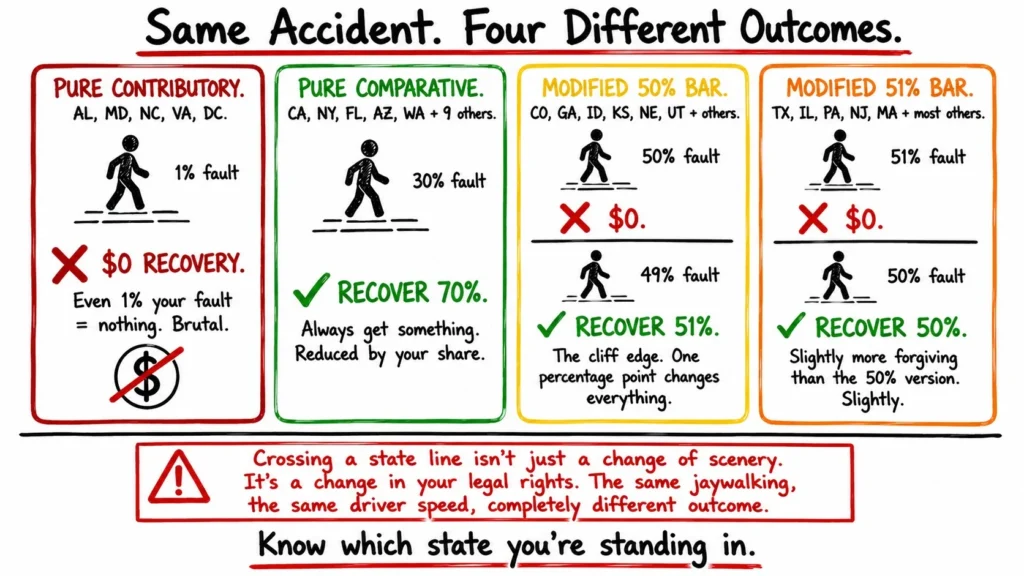
This map should immediately communicate to travelers that crossing state lines isn’t just a change of scenery — it’s a change in your legal rights.
What You Can Actually Recover — Breaking Down Damages
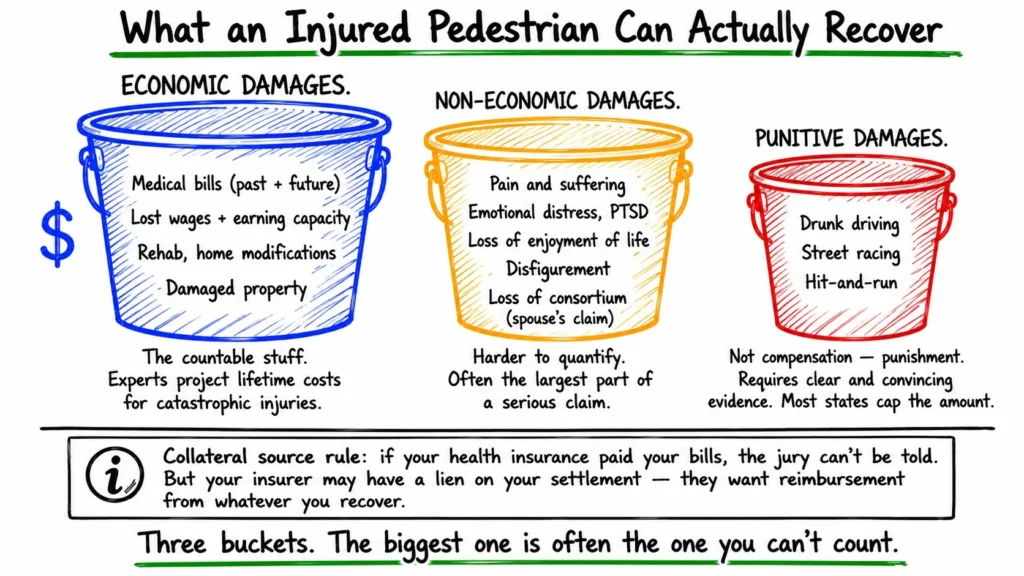
Assuming liability is established and fault is sorted out, what can an injured pedestrian actually claim? There are three buckets.
Economic damages — the straightforward stuff:
- Medical bills, past and future. Emergency transport, surgery, rehab, physical therapy, home modifications. For catastrophic injuries — spinal cord damage, traumatic brain injury — attorneys typically bring in a life care planner to project lifetime costs.
- Lost wages and lost earning capacity. A vocational expert may testify if the injury permanently changes what work the person can do.
- Damaged property — glasses, mobility aids, clothing. Minor compared to medical costs, but recoverable.
Non-economic damages — harder to quantify but often the largest part of a serious claim:
- Pain and suffering.
- Emotional distress, PTSD.
- Loss of enjoyment of life — can’t coach your kid’s soccer team anymore, can’t run, can’t do what you did before.
- Disfigurement and scarring.
- Loss of consortium — a spouse’s claim for loss of companionship and services.
Punitive damages kick in when the driver’s behavior was genuinely reckless — drunk driving, street racing through a crosswalk, hit-and-run. These aren’t about compensating the victim; they’re about punishing the driver. Most states require clear and convincing evidence and many cap the amount.
One thing worth knowing: if your health insurance paid your medical bills, the defendant’s lawyer cannot tell the jury that. That’s the collateral source rule. But your insurer may have a lien on your settlement — meaning they want reimbursement out of whatever you recover. Medicare and Medicaid lien rights are particularly aggressive about this.
Insurance — The Practical Gateway to Getting Paid
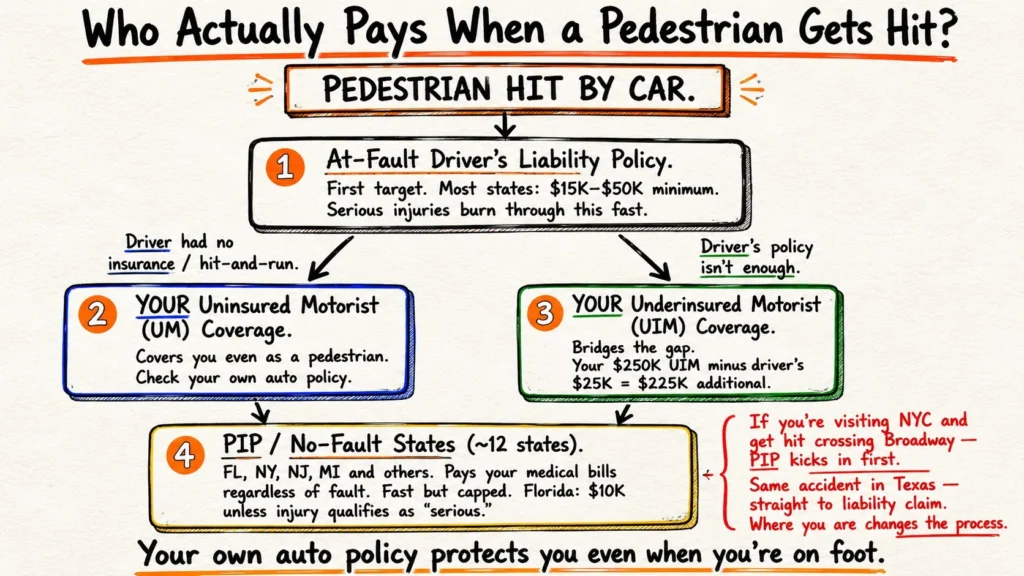
A clean liability case means nothing if there’s no money to collect. Insurance is where the rubber meets the road.
The at-fault driver’s liability policy is the first target. Most states set minimum bodily injury limits somewhere between $15,000 and $50,000 per person. In a serious pedestrian injury — broken pelvis, head trauma, weeks in the ICU — those limits evaporate fast.
That’s where your own auto policy matters, even though you were on foot:
- Uninsured Motorist (UM): Covers you if the driver had no insurance or it was a hit-and-run.
- Underinsured Motorist (UIM): Bridges the gap when the driver’s policy isn’t enough. If your UIM limit is $250,000 and the driver only carried $25,000, UIM picks up the difference.
- PIP / No-Fault coverage: About a dozen states — Florida, New York, New Jersey, Michigan among them — require this. It pays your medical bills and some lost wages regardless of who caused the crash. Fast, but capped. Florida’s limit is $10,000 unless the injury qualifies as “serious.” Florida Statute § 627.736 governs this if you want to read the fine print.
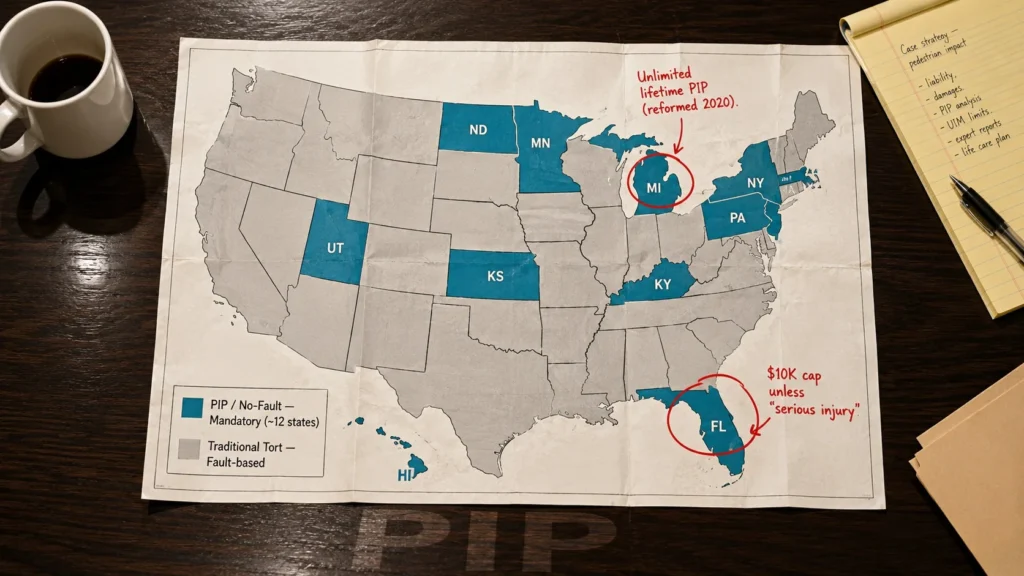
This chart matters for travelers. If you’re visiting New York City and get hit crossing Broadway, your PIP kicks in first regardless of fault. If the same thing happens in Texas, you’re going straight to the liability claim.
Special Situations Travelers Should Know About

Government-owned Roads and Broken Infrastructure
Cracked sidewalk. Missing crosswalk signal. Intersection with a documented history of pedestrian crashes and no improvements made. These can support a claim against a city or municipality — but the rules are strict.
Most states require a formal notice of claim filed within 60 to 180 days of the accident. Miss that window and the claim is gone, regardless of how strong it is. Government entities also enjoy design immunity for roadways that were reasonably approved — unless conditions changed and they failed to act on it.
Construction Zones
Obstructed sidewalks, missing signage, debris in the walking path — all common in cities doing infrastructure work. The general contractor or subcontractor can share liability if their site created the hazard.
The Eggshell Plaintiff Rule
Worth understanding if you have any pre-existing condition. A driver takes you as they find you. If you have osteoporosis and a low-speed collision fractures your hip in three places when it would’ve barely bruised someone else — the driver is still on the hook for the full injury. Courts don’t discount damages because the victim was fragile to begin with.
Drunk Driving Cases
If the driver was overserved at a bar before hitting you, some states allow a direct dram shop claim against the establishment. Illinois, Texas and New Jersey have active dram shop statutes. This matters when the driver has minimum insurance and no assets — the bar may be the deeper pocket.
Statutes of Limitations — The Clock You Can’t Ignore

| State | Time Limit to File |
| Kentucky, Louisiana | 1 year |
| California, Texas, Florida | 2 years |
| New York, Illinois | 3 years |
| Maine | 6 years |
| Government claims (most states) | 60–180 days notice required |
These deadlines are hard. Miss them and the case is over, no matter what the evidence shows. Government claims are especially unforgiving — the notice requirement runs from the date of the accident, not the date you hired a lawyer.
If you or someone you know is injured as a pedestrian anywhere in the U.S., the single most time-sensitive step is finding out which notice deadlines apply in that specific state. The Justia State Laws directory is a reliable starting point for checking your state’s statute.