 Aarthy Venkat Head - Strategy at SignDesk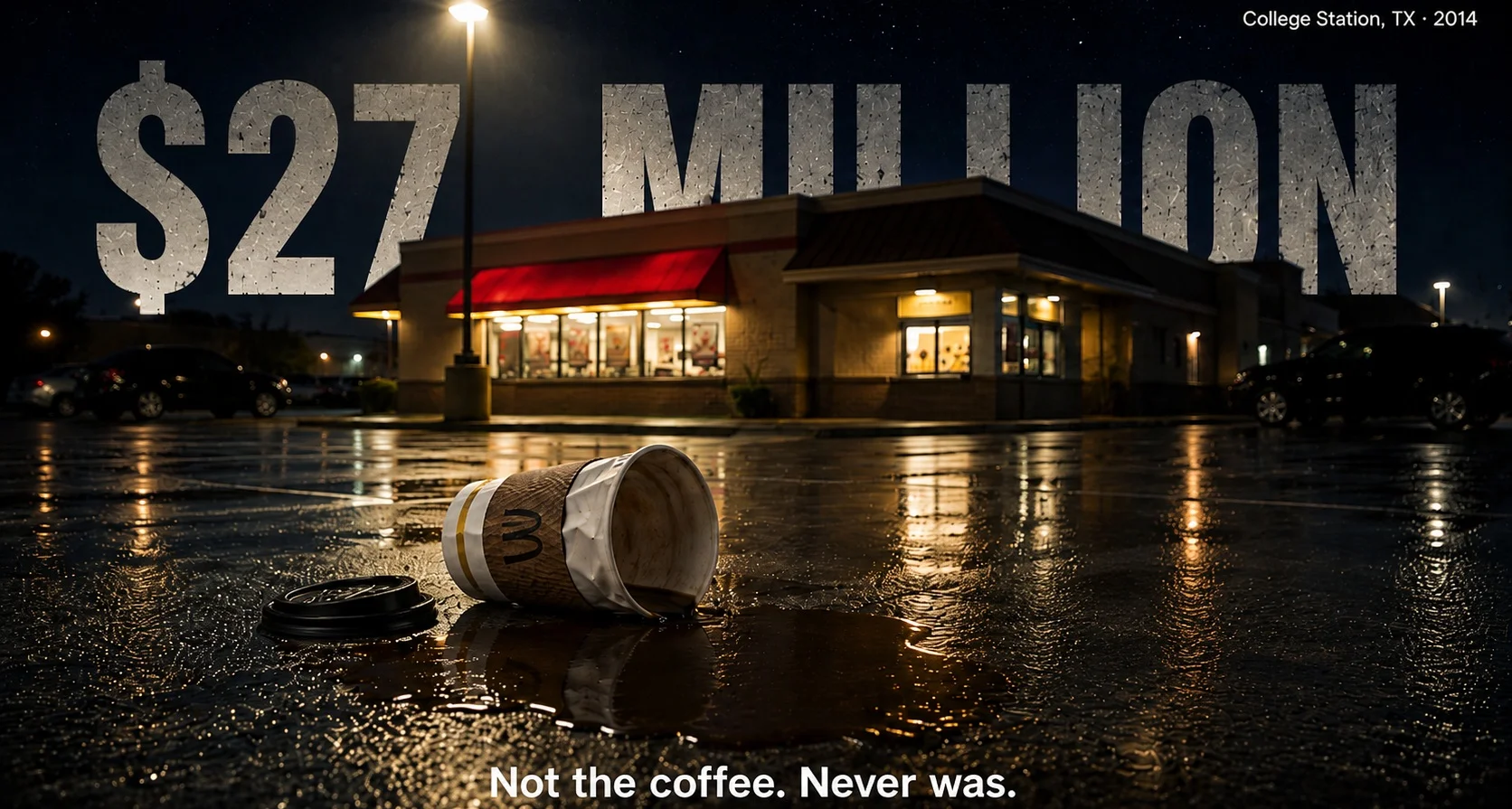
The largest verified jury verdict in a McDonald’s injury case is $27 million, awarded by a Texas jury in 2014 after two teenagers died following a mob attack in a College Station restaurant parking lot — a classic negligent security claim. The jury found McDonald’s 97 percent liable and comparative fault reduced the award slightly to about $26.19 million. It is not the famous “hot coffee” case; that one settled for far less. McDonald’s appealed and like most verdicts this size, the final amount paid was almost certainly lower than the headline number.
The Actual Record: $27 Million in a Texas Courtroom
The case nobody outside Texas seems to remember started at a McDonald’s near the Texas A&M campus, in the early hours of February 18, 2012.
Denton James Ward, 18, was beaten to death by a mob in the parking lot. His girlfriend, Lauren Bailey Crisp, 19, died in a traffic accident during the desperate attempt to get him to a hospital — her friend ran a red light racing toward the ER. Two deaths from one stop for late-night food.
What made this a lawsuit rather than just a tragedy was the location’s record. College Station police officers testified they were regularly called to break up fights and disperse crowds numbering in the hundreds between 2 a.m. and 4 a.m. on weekends. The plaintiff’s position was simple: McDonald’s knew this corner was dangerous after midnight and provided no security anyway. The jury ordered McDonald’s to pay $27 million in actual damages; McDonald’s said it would appeal, as NBC DFW reported at the time.
That’s the legal theory called premises liability — a business that invites you in owes you reasonable protection from foreseeable dangers, including criminal acts it has every reason to anticipate. Twenty-plus police calls in a year is foreseeable.
The Verified Leaderboard
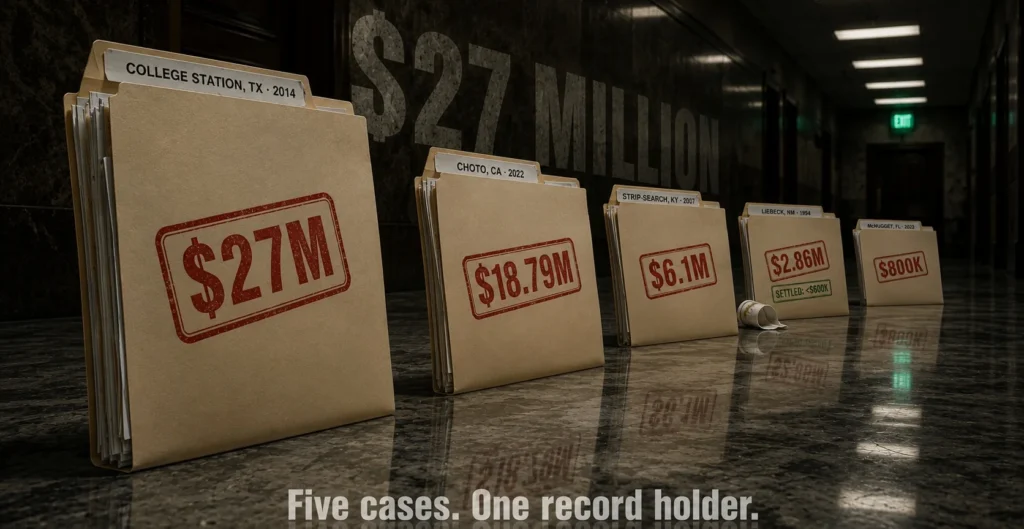
Here’s how the biggest publicly confirmed McDonald’s injury outcomes actually stack up — every figure below traceable to court records or major news coverage:
| Case (Year) | Jury Award | What Happened | Legal Basis |
| College Station, TX deaths (2014) | $27 million | Two teens died after a parking-lot mob attack | Negligent security |
| Choto slip-and-fall, CA (2022) | $18.79 million | Permanent spinal injury from a fall on a greasy floor | Premises liability |
| Strip-search hoax, KY (2007) | $6.1 million | Employee detained and abused after a hoax caller posed as police | Negligence |
| Liebeck hot coffee, NM (1994) | $2.86 million (reduced; settled under $600K) | Third-degree burns from 180°F+ coffee | Product liability |
| McNugget burn, FL (2023) | $800,000 | 4-year-old’s second-degree burns from a hot nugget | Failure to warn |
Why Everyone Thinks It’s the Hot Coffee Case
Say “McDonald’s lawsuit” anywhere in America and someone will mention the coffee. Fair enough — Liebeck v. McDonald’s Restaurants is probably the most argued-about civil case of the past forty years. But the most famous and the largest are different things.
The real facts are worth a paragraph, because almost everyone has them wrong. Stella Liebeck, 79, suffered third-degree burns over 16 percent of her body and nearly died during a two-year recovery. She first asked McDonald’s for $15,000–$20,000 to cover medical bills; the company offered $800. At trial, discovery revealed McDonald’s had received more than 700 burn reports in the prior decade. The jury awarded $200,000 in compensatory damages, cut to $160,000 for her 20% share of fault, plus $2.7 million punitive — the judge called McDonald’s conduct “callous” and slashed the punitive award anyway. Final settlement: under $600,000. A rounding error next to that Texas verdict.
So why the gap in our memory? Spilled coffee makes a better punchline than two dead teenagers. That’s the whole answer and it’s not a flattering one.
What a Traveler Should Actually Take From This
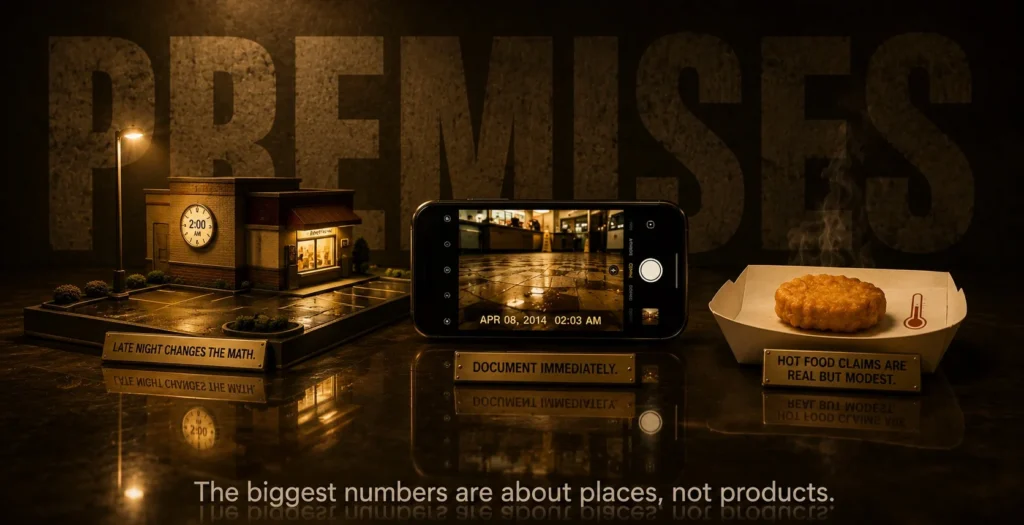
Notice the pattern in that leaderboard. The biggest numbers aren’t about food at all — they’re about places. Parking lots at 2 a.m. Wet floors nobody mopped. The law holds businesses responsible for hazards they knew about and ignored and that knowledge cuts both ways for anyone who eats half their meals at highway exits.
Three practical things, learned from the case files rather than a brochure:
- Late night changes the math. The College Station location was fine at noon and dangerous at 2 a.m. — police had documented it for years. If a parking lot feels off when you pull in for a road-trip stop, trust that and drive on. The drive-thru exists for a reason.
- Report and document immediately. In the $18.79 million California slip-and-fall, McDonald’s produced no video, claimed maintenance records were “misplaced,” and argued the fall was staged. Evidence vanishes fast; photos on your phone don’t.
- Hot food claims are real but modest. The 2023 McNugget verdict was $800,000 — the family had sought $15 million, as NBC News covered. Juries compensate genuine injury; they don’t hand out jackpots.
One last honest caveat: confidential settlements can’t be ranked. Somewhere in McDonald’s legal history there may be a private payout larger than $27 million — the company’s public case record only shows what reached a courtroom. Among what we can verify, Texas holds the record.