 Olivia Florio Roberts ( Florida )
Say your aunt died in Florida and left you her condo in Boca Raton. Two months to sort the paperwork, you figure. Three tops.
Eight months later you’re still paying her HOA fees and still waiting, and your cousin in Texas wrapped up his inheritance in ten weeks flat. Same situation. Different state. What gives?
Florida probate isn’t the worst in the country but it’s up there for slow, and the frustrating part is that none of it is accidental. The state wrote these rules to protect creditors and beneficiaries, and protection takes time, so even a simple estate eats half a year before anyone sees a dime.
The Timeline In Florida

So here’s what actually happens when someone dies in Florida holding more than $75,000 in assets.
The first days feel quiet. You’re planning a funeral, family’s in town, nobody is thinking about courthouse filings. Except the law already is, whoever has the original will is supposed to deposit it with the clerk within 10 days of learning about the death (Florida Statute 732.901). Ten days. Most people are still picking out flowers. And the court wants the original, a photocopy gets you nowhere, if the original is lost you’re looking at another two months of proceedings just to prove the copy is real.
Then formal administration opens, and here Florida does something most states don’t. You need a lawyer. Not “should probably get” one, need one, the probate rules require attorney representation for nearly every formal administration (Florida Probate Rule 5.030) and non-lawyers can’t represent an estate even when the only beneficiary is themselves. California will let you muddle through with court forms. Florida won’t.
The creditor notice is where the calendar really gets away from you. You publish a notice to creditors in a local paper two weeks running, then creditors get three months from first publication to file claims (Florida Statute 733.2121). From publication, mind, not from death. Sit on the publication for six weeks after opening probate and those three months haven’t even started.
Texas gives creditors four months but lets you start distributing after two if nobody shows up. Georgia will let the whole family skip formal probate when every heir signs off. California pushes a lot of estates through a simple affidavit instead. Florida just makes you wait.
Why Florida Makes You Hire a Lawyer (When Most States Don’t)
The attorney rule isn’t pure bureaucracy, to be fair. Florida probate filings have to follow specific formats and the clerks reject anything that doesn’t, and one bounced petition can cost three weeks of docket time. Estates get hung up for months over smaller things than that. A personal representative sells the deceased’s car without court authorization, in Texas an independent executor does that before lunch, in Florida every significant transaction needs either specific authority in the will or a judge’s blessing.
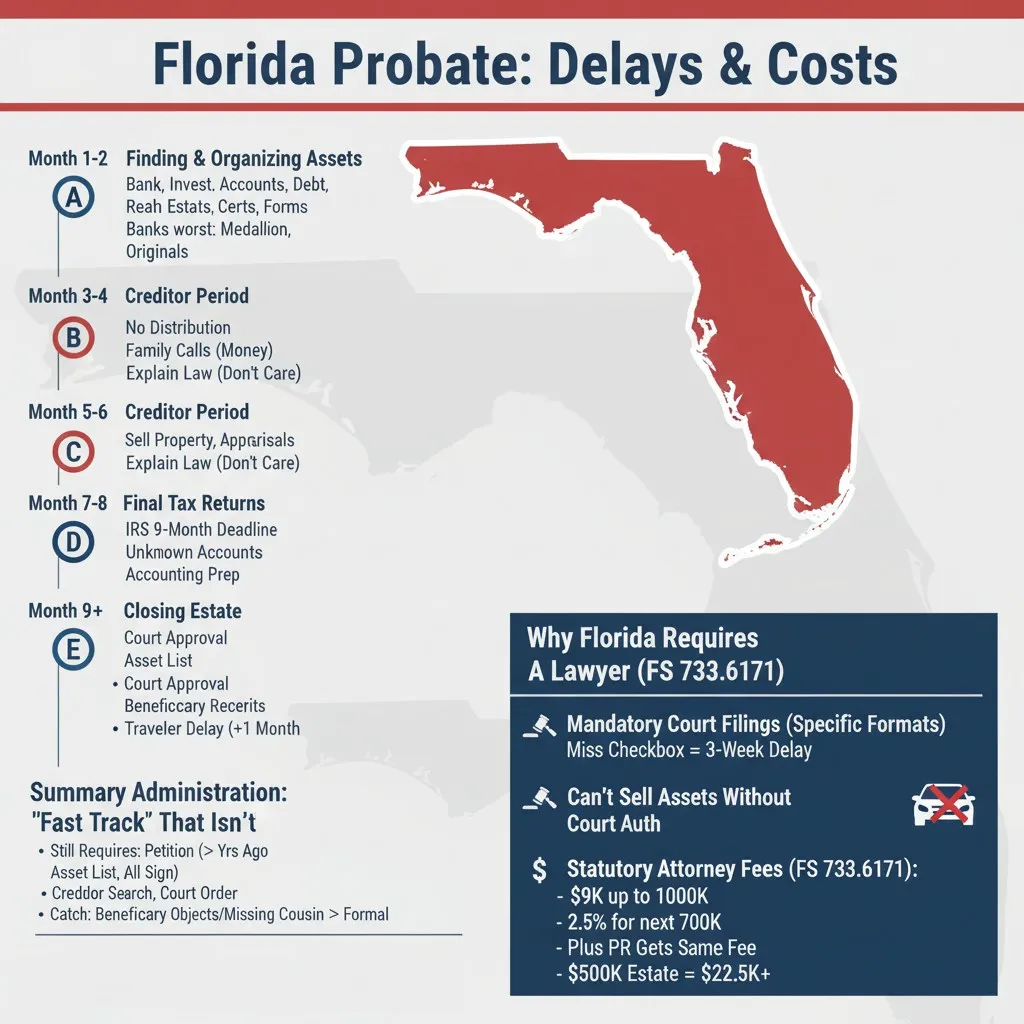
Now the fees. The statute sets what counts as presumptively reasonable attorney compensation (Florida Statute 733.6171): $3,000 on a $100,000 estate, then 3% of everything above that up to $1 million, so a $300,000 estate lands around $9,000 and the percentage steps down past the million mark. The personal representative takes a separate commission on top of that, 3% on the first million (Florida Statute 733.617). Run the math on a $500,000 estate and you’re near $30,000 in combined statutory fees before a single court cost, appraisal, or accounting bill arrives.
Texas handles the same estate with independent administration, minimal court involvement, the executor files an inventory and only comes back if somebody objects.
The Homestead Exception That Breaks Everything
The house you thought your aunt left you? Maybe she didn’t get a say. If she was married or had minor children, the Florida Constitution can override her will outright (Article X, Section 4), and no will language waives it. Other states protect spouses too, sure. Nothing like this.
Jay Fraiser, Pensacola probate lawyer at Moorhead Law Group, points to the scenario that catches families off guard: a woman leaves her house to her daughter from a first marriage while her current husband is living in it. Most states would have him out eventually. Florida hands him a life estate, he stays until he dies, and the daughter technically owns a house she cannot sell, cannot charge him rent for, cannot touch. She waits.
Even the routine version drags. Homestead property needs an order determining its status, separate petitions when minor children are involved, a constitutional read on the devise restrictions, sometimes life estate paperwork on top, and every one of those steps comes with its own hearing, notice, waiting period. A Georgia house can change hands in 60 days. The identical house in Florida, six months if you’re lucky.
The Creditor Protection That Slows Everything Down
The notice goes in a printed newspaper of general circulation in the county where the deceased lived (Florida Statute 733.2121), a website doesn’t satisfy the statute, and if that county has one weekly paper then their print schedule is now your schedule.
Publication starts the three-month claim window. Known creditors are a separate headache, anyone the deceased owed money to that you reasonably should know about has to get actual notice, and if you forget the credit card company they get two whole years to come after the estate. Even after everything’s been handed out.
Other states run this looser:
- Texas: four-month window, distributions allowed after two.
- California: four months, though plenty of estates never enter formal probate at all.
- Pennsylvania: a full year, but the personal representative can distribute early at their own risk.
- North Carolina: three to six months depending on how notice was published.
Florida’s three months bend for nobody. No early distributions, no shortcuts, the estate sits out the full period even when there isn’t a creditor within a hundred miles.
Summary Administration: The “Fast Track” That Isn’t
Estates under $75,000, or any estate where the death was more than two years back, qualify for summary administration (Florida Statute 735.201). People hear “summary” and picture a form and a stamp. What it actually takes is a formal petition signed by every beneficiary, a complete inventory with values on everything, a genuine search for creditors, and then a court order before anything moves. And the whole thing collapses back into formal administration the moment one beneficiary objects or can’t be found. That cousin nobody’s seen since 2020? Full formal process, congratulations.
Even when it works it runs 2-4 months, which is slower than what other states call their slow lane. California waves estates under $184,500 through on an affidavit with no court at all, a Texas small estate affidavit needs one hearing, New York’s voluntary administration handles anything under $50,000 with a stripped-down process.
What Actually Causes the Delays
The statutes explain some of it. The rest is grind:
- Months 1-2: finding everything. Bank accounts, investments, debts, real estate, the car. Every institution wants its own stack of death certificates and court documents, and banks are the worst of the lot, some demand medallion signature guarantees, others take original documents and keep them forever.
- Months 3-4: creditor clock running, nothing can be distributed, and the family calls weekly asking where the money is. You explain the law. They don’t care. Tension builds.
- Months 5-6: marshaling assets, selling property, appraisals, and dealing with that one bank account nobody knew existed until it surfaced last week. The accounting gets prepared somewhere in here too.
- Months 7-8: taxes. The IRS could not care less that Florida requires formal process, estate tax returns come due nine months after death, miss it and there are penalties, extend it and you’ve possibly added six more months.
- Month 9 and beyond: final accounting approval, beneficiary receipts, closing documents. One heir off traveling in Europe and slow with a signature adds a month all by himself.
The Worst-Case Scenarios
When Florida probate goes wrong it goes properly wrong. A contested will adds 12-18 months minimum, formal notice goes to every potential heir including the ones the will never mentions, each gets 20 days to respond, extensions are routine, hearings land months out on crowded dockets.
Missing heirs bring their own machinery. The court appoints an attorney ad litem, paid by the estate, who has to run reasonable searches through social media, genealogy sites, public records. Months, and thousands of dollars, for someone who may never turn up.
Then there are the messy assets. A business interest nobody in the family understood needs full valuation, maybe a formal appraisal, maybe buyout talks with partners. Six months, easy. Real estate multiplies the trouble, homestead fights, life estates, Lady Bird deeds gone wrong, the timeshare nobody wants, and each one spins up its own proceeding inside the probate.
How Other States Do It Better (Or At Least Faster)
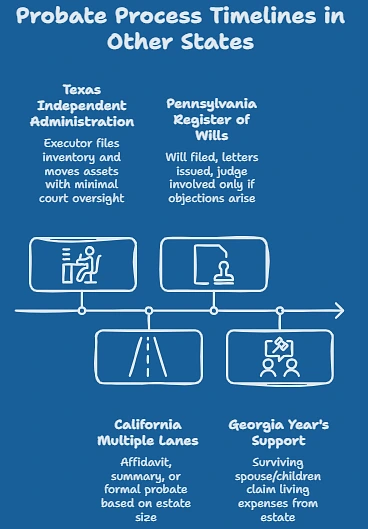
Texas independent administration is the model Florida lawyers privately envy. The will names an independent executor, the court approves them, and after that the court mostly goes away, an inventory gets filed within 90 days and assets move when the executor says they move. Three to six months, typically.
California runs multiple lanes by estate size, affidavit under $184,500 with no court, summary procedures for the simple ones, full formal probate held back for the genuinely complex. Plenty close inside 2-4 months. Pennsylvania’s Register of Wills is an administrative office rather than a courtroom, file the will, take your letters testamentary, get on with it, a judge only appears if somebody objects, call it 4-6 months. And Georgia’s Year’s Support lets a surviving spouse and minor children claim a year of living money from the estate immediately, no creditor wait, take what you need now and sort the rest later.
Practical Workarounds That Actually Help
Living trusts dodge probate entirely, but only for what’s actually inside them. People pay for the trust, feel organized, and never retitle the house. A house still in your personal name goes through probate, trust or no trust, the document is just paper until it’s funded.
Lady Bird deeds, the enhanced life estate deeds, are a genuinely Floridian fix for real estate. Full control while you’re alive, automatic transfer at death, no probate. Real property only though, they do nothing for bank accounts or investments.
Joint ownership with survivorship skips probate and creates a different mess. Put your son on your bank account and that account now sits exposed to his creditors, his divorce, his lawsuits, and gifts above the annual exclusion (around $19,000 per recipient these days) come with reporting requirements of their own.
TOD and POD designations, transfer on death and payable on death, cover financial accounts nicely. Florida won’t allow TOD deeds on real estate the way many states do, that’s what the Lady Bird deed is for. One warning that applies to all of these: beneficiary designations override the will, so update them after a divorce or a death or they’ll pay exactly the wrong person.
Small estate planning helps too. One bank account kept under $75,000 for immediate expenses, everything else in a trust or behind beneficiary designations, and the family has funeral money in days while the formal machinery never gets switched on.
The Reality Check
Florida probate runs 6-12 months because the state chose creditor protection and formal process over speed, and every piece of it, the mandatory lawyer, the rigid notice periods, the homestead rules, adds its own weeks. Inheriting in Florida? Budget a year. Planning an estate here? Look hard at every alternative above, because the cost isn’t just the legal fees, it’s the frustration and the family tension and the frozen accounts right when people need money most.
Other states prove it doesn’t have to work this way. Until Florida’s probate code changes, the workarounds are the only real defense, and they only work when they’re set up before the death. After is too late.