 Christopher Morgan (Bankruptcy & Finance)
These strategies will save your family from the nightmare of probate court, fighting over your stuff, and guessing what you would’ve wanted. We’re talking about the difference between your kids getting your house in 6 weeks versus 18 months, between your spouse accessing bank accounts immediately versus begging a judge for permission to pay the mortgage, and between your family grieving in peace versus hiring lawyers to fight each other. Each strategy builds on the others, and skipping any one of them leaves a hole that lawyers will happily charge $300 an hour to fix later.
Estate planning isn’t about being rich or old – it’s about controlling what happens when you can’t speak for yourself anymore.
The decisions you make today regarding estate planning will determine how efficiently your assets transfer to beneficiaries and how much of your wealth reaches the people you care about most. Compared to hastily prepared documentation, a well-executed estate plan can save hundreds of thousands of dollars in taxes, probate costs, and family disputes.
Understanding essential estate planning strategies ensures your wishes are honored while maximizing the wealth you pass to future generations. Here are strategies for successfully navigating your estate planning process.
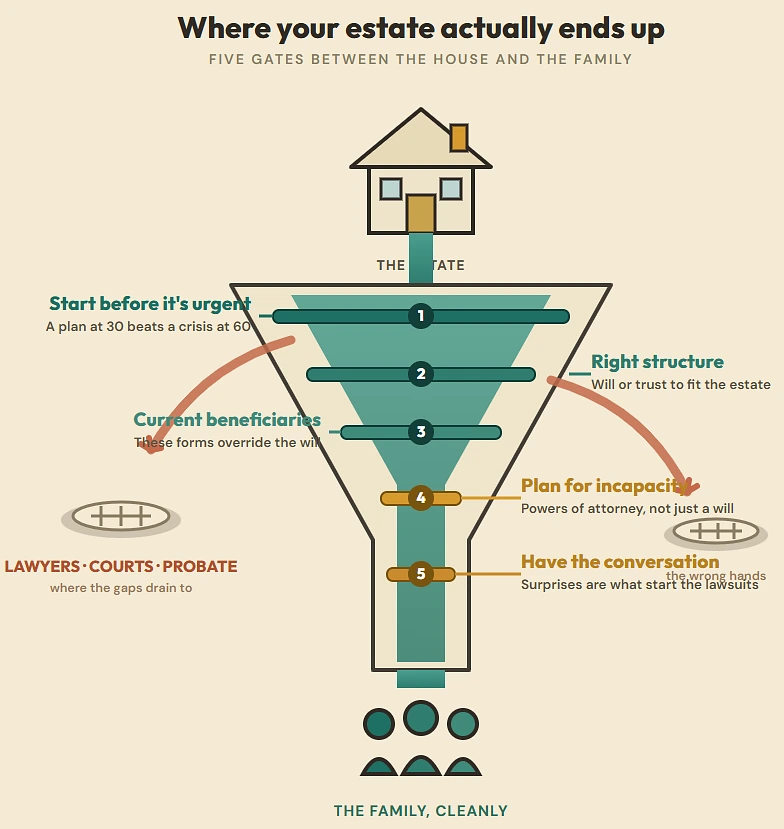
Start Planning Before Life Forces You To
People think estate planning is for retirement. Wrong. The best time was when you bought your first house, had your first kid, or got married. The second-best time is right now, before something happens that makes it urgent.
According to mmalawfirm.com, Jennifer was 38 when her husband Mark had a stroke. No will, no power of attorney, nothing. Mark survived but couldn’t speak or write for six months. Jennifer couldn’t access their joint investment account (needed both signatures), couldn’t sell their second car to pay medical bills, couldn’t even cancel his gym membership. She spent $15,000 in legal fees just to get guardianship of her own husband.
Here’s why starting early actually works: Your estate plan at 30 won’t look like your plan at 60, and that’s fine. A simple will costs $500 now. Emergency guardianship proceedings cost $15,000 later. You update your phone every two years – you can update your estate plan every five.
Start with the basics. Get a will that says who gets what. Add a financial power of attorney so someone can pay your bills if you’re unconscious. Include an advance healthcare directive so doctors know whether you want to be kept on life support. These three documents solve 80% of estate problems.
The practical approach: Schedule it like a dentist appointment. Pick a random Tuesday, take the afternoon off, meet with an estate attorney. Bring your deed, bank statements, retirement account info, and insurance policies. Two hours later, you’re done. Update it when you have another kid, get divorced, or inherit money from grandma.
Young parents especially need this. If you die without naming guardians, the court decides who raises your kids. Your sister who lives nearby? Your parents who are getting older? Your brother who’s great with kids but terrible with money? The judge picks, not you. That decision gets made in about five minutes based on who shows up to court that day.
Choose the Right Structure for Your Actual Situation
Everyone thinks they need a trust because some financial advisor told them trusts avoid probate. True, but incomplete. Like saying a Ferrari is faster than a Honda – correct, but do you need to go 200 mph to get groceries?
A will works fine if you have less than $2 million in assets, own property in only one state, and trust your beneficiaries with money. Costs $500-1,500, takes a week to set up, done. Your house, bank accounts, and personal stuff go through probate, but in most states that’s 6-9 months and costs maybe $5,000 in fees.
A revocable living trust makes sense when you own property in multiple states, have a blended family with kids from different marriages, want to control how money gets distributed over time, or have beneficiaries who shouldn’t get large sums at once. Costs $2,500-5,000 to set up properly, requires re-titling all your assets, needs maintenance over time.
Here’s what actually matters: Tom owned a house in Texas and a cabin in Colorado. Without a trust, his family would’ve gone through probate in both states – two sets of lawyers, two court systems, probably 18 months total. The trust cost $3,500 to set up but saved his family $20,000 and a year of headaches.
But Sarah, who owned a condo in Chicago and had $300,000 in savings? The lawyer who sold her a $4,000 trust package was just padding his bill. A will would’ve worked fine. Illinois probate for simple estates takes six months and costs less than the trust she paid for.
The real-world test: Add up what probate would cost (usually 3-5% of estate value plus a year of hassle). If that’s more than trust setup and maintenance costs, get the trust. If you’ve got minor kids, complicated families, or beneficiaries with drug problems, bankruptcy issues, or special needs – trust all the way.
Don’t forget: Trusts only work if you actually put assets in them. The number of people who pay for trusts then never transfer their house title is staggering. That’s like buying a safe but keeping your money on the kitchen counter.
Update Beneficiaries Every Single Year
Your will says everything goes to your spouse. Sweet. But your 401(k) from that job you left five years ago? Still lists your ex-girlfriend as beneficiary. Guess who gets that money when you die? Not your spouse.
Beneficiary designations override your will. Every time. No exceptions. Your IRA, 401(k), life insurance, pension – these transfer by beneficiary form, not by will. The will could say “everything to my current wife” in giant red letters, but if the beneficiary form says your ex-wife’s name, she gets the money.
David learned this the expensive way. Remarried in 2018, updated his will, thought he was good. Died in 2023. His $800,000 401(k) went to his ex-wife from 2009 because he never updated the beneficiary form. His current wife and two young kids got the house (with a mortgage) and about $50,000 in savings. The ex-wife kept the money legally – the law was completely on her side.
- Here’s your annual routine: Every January, pull every beneficiary form. Life insurance through work, old 401(k)s, IRAs, bank accounts with pay-on-death provisions, even your checking account. Update them all. Takes two hours, costs nothing, saves everything.
- Watch for the traps: Naming “my estate” as beneficiary throws everything into probate. Naming minor children directly means the court appoints someone to manage the money until they’re 18, then hands them a check for the full amount on their birthday. Naming all your kids equally sounds fair until one predeceases you and their kids get nothing.
- The smart play: Name primary and contingent beneficiaries. Spouse as primary, trust for kids as contingent. If the spouse dies first or at the same time, money flows to the trust for the kids automatically. No probate, no court, no 18-year-old buying a Lamborghini with their inheritance.
- Special situation: Second marriages with kids from the first marriage. Never name the new spouse as beneficiary expecting them to “take care of” your kids. They might remarry, their new spouse inherits, your kids get zero. Set up a trust that provides for the spouse while alive, then distributes to your kids.
Plan for Incapacity, Not Just Death
Everyone plans for death. Nobody plans for dementia, strokes, or car accidents that leave you alive but unable to manage affairs. This is where families implode.
Martha had Alzheimer’s. Diagnosed at 72, lived until 84. Twelve years of increasing incapacity. No power of attorney documents. Her daughter Linda tried to help but couldn’t access accounts, sell the house when assisted living became necessary, or make medical decisions. The family spent $100,000 in legal fees over five years just to get guardianship and manage her care.
A durable power of attorney for finances lets someone pay your bills, manage investments, sell property if needed. Costs $200 to create, saves tens of thousands later. But here’s what lawyers don’t tell you: Banks often reject these documents if they’re more than a year old or don’t use the bank’s preferred format. Solution: Update annually and file copies with your main banks in advance.
Healthcare power of attorney is different – it lets someone make medical decisions when you can’t. Not just end-of-life stuff. Whether to do surgery after a car accident, which rehabilitation facility to use, whether to try experimental treatments. Without this, doctors turn to state law default decision-makers, which might be that estranged sibling you haven’t talked to in 10 years.
Living will or advance directive spells out your wishes. Not just “pull the plug” decisions – though that’s important. Do you want feeding tubes? Antibiotics for infections when you’re terminal? CPR that breaks ribs but might give you another month? Write it down so your family doesn’t have to guess while you’re dying.
The practical setup: Name different people for money and health if possible. Your daughter the nurse makes medical decisions, your son the accountant handles finances. Avoids putting too much burden on one person. Name alternates – people get old, move away, or predecease you.
Have the Hard Conversations Now
The biggest estate planning failure isn’t bad documents – it’s family surprises. “Mom always said I could have the house” versus “Dad promised me the business” equals lawyers getting rich while siblings stop speaking.
Schedule a family meeting. Not at Thanksgiving when everyone’s drunk. A real meeting. Saturday morning, coffee and donuts, here’s what we’re doing. Parents explain the plan, kids ask questions, everyone understands before anyone’s emotional or grieving.
Cover the uncomfortable stuff: Why the responsible daughter gets to manage the money instead of the older son with bankruptcy issues. Why the house is being sold and split rather than kept in the family. Why the struggling kid gets more than the successful one. Explain it now while you can defend your decisions.
Robert had three kids. Left everything equally in the will but gave his son Mike the family business “to run” during Robert’s life. When Robert died, the will said divide everything equally. Mike thought the business was his – he’d run it for five years. The daughters thought they each owned a third. Three years of litigation, the business failed during the fighting, everyone lost.
If Robert had one family meeting explaining that Mike would inherit the business but the insurance money would go to the daughters to equalize things, no lawsuit. But he avoided the conversation because it was awkward.
Write a letter of instruction. Not legally binding but emotionally powerful. “I’m leaving the house to Sarah because she took care of me the last five years. I’m leaving the larger IRA to Tom because Sarah got help with her down payment in 2019. I love you all equally, these decisions are about fairness, not favoritism.”
Be specific about personal items. The $50,000 painting causes less fighting than mom’s wedding ring or dad’s watch. Make a list: “Tom gets my tools and truck. Sarah gets mom’s jewelry and the photo albums. Linda gets the furniture and art.” Sign it, date it, attach it to the will.
Regularly Review and Update Your Estate Plan
Estate planning is not a one-time event but an ongoing process that requires regular attention and updates. Life changes, tax law modifications, and evolving family circumstances require plan revisions to ensure continued effectiveness.
Schedule comprehensive estate plan reviews every three to five years or after major life events such as marriage, divorce, births, deaths, significant asset acquisitions, or relocations. Tax laws change frequently, and previous strategies may no longer provide the same benefits.
Monitor beneficiary designations on retirement accounts and insurance policies, as these supersede will instructions. Also, review successor trustees, executors, and guardians to ensure they remain willing and able to serve.
Implement Tax-Efficient Wealth Transfer Strategies
Understanding and minimizing tax implications is crucial for preserving your estate’s value. Federal taxes on gifts and estates can be among the highest assessed on any financial transaction, and some states levy their own estate or inheritance taxes. Developing a comprehensive tax strategy ensures more wealth reaches your intended beneficiaries.
Maximize annual gift tax exclusions by systematically gifting amounts within IRS limits to beneficiaries yearly. This strategy reduces your taxable estate over time while providing immediate benefits to recipients.
Consider advanced strategies like charitable remainder trusts, grantor retained annuitytrusts (GRATs), or qualified personal residence trusts (QPRTs) for high-value estates. These vehicles can significantly reduce estate tax exposure while providing income streams or continued use of assets.