 Christopher Morgan (Bankruptcy & Finance)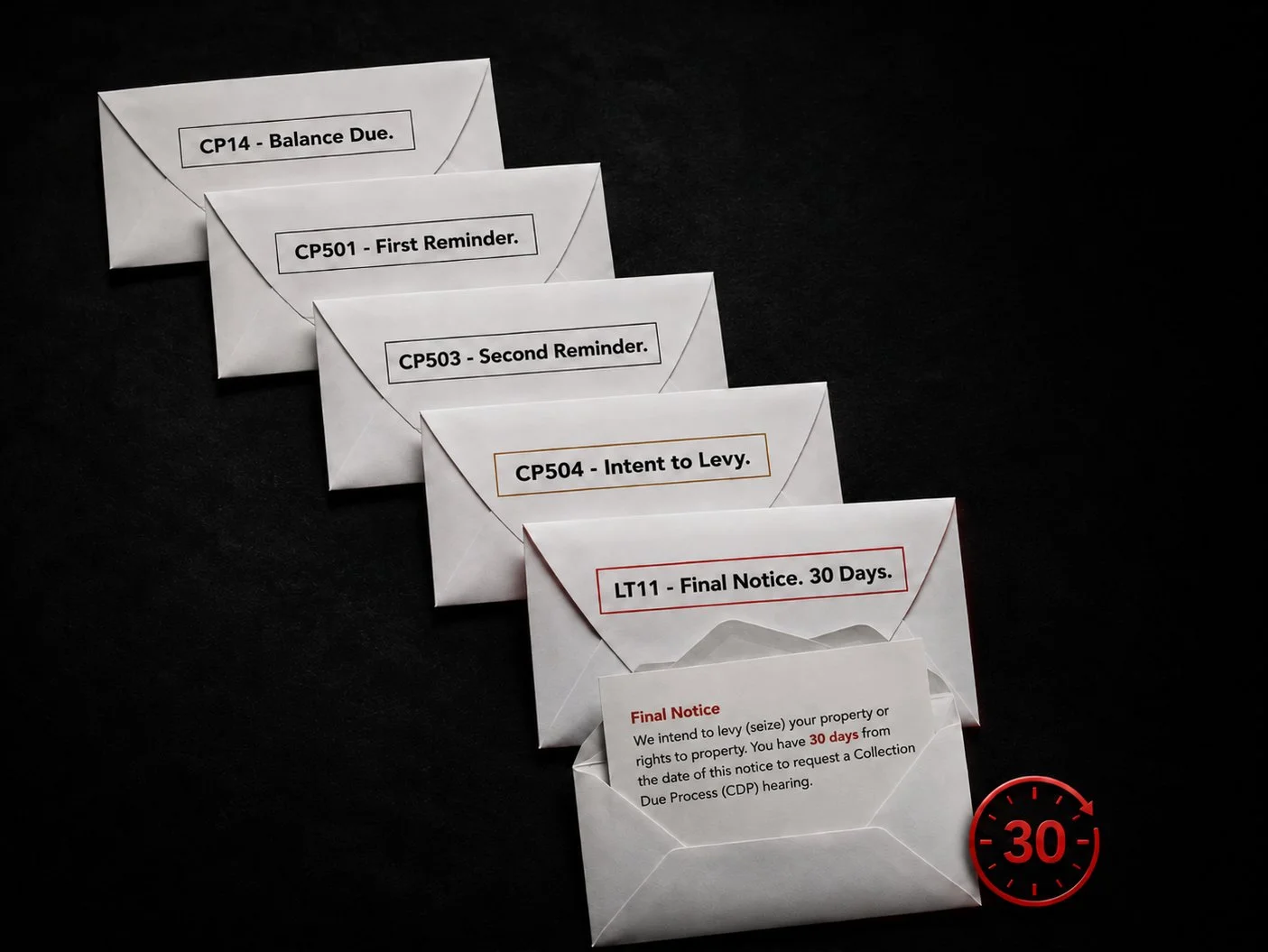
Did you know the IRS collected over $77 billion in unpaid taxes in 2024, and a good chunk of that came from people who had been sitting on collection notices for months without responding? Later it turned into six months of silence. And those six months turned into a federal tax lien on their property. The lien turned into a bank freeze. Eventually the whole thing escalated to a wage garnishment where the government is taking more than half of every paycheck until the balance clears or ten years run out.
The IRS collection process follows a specific letter sequence and each letter gives the taxpayer one more chance to respond before things move to the next level.
- CP14 comes first. Balance due, pay this amount, here is where to send it.
- CP501 follows a few weeks later if nothing happens.
- CP503 is the second reminder and by now penalties and interest are stacking up.
- CP504 is where things shift because the IRS is formally telling you it intends to levy state tax refunds and may file a federal tax lien.
- LT11 is the final notice. It carries a 30-day window to request a Collection Due Process hearing and once that window closes the IRS can move forward with levies and garnishments.
Each letter in that sequence offers options that will not be available at the next stage. If you cannot sort it yourself, getting into tax resolution services before the CP504 arrives is when you still have access to installment agreements, offers in compromise, currently-not-collectible status. Once the LT11 shows up and 30 days pass without a response, most of those doors are already shut.
Once the Federal Tax Lien Has Been Filed It Wraps Around Everything You Own
A federal tax lien is not limited to one asset. Once the IRS files a Notice of Federal Tax Lien it attaches to your house, your car, bank accounts, business equipment, accounts receivable if you are self-employed, even property you pick up later. And because it is a public record anyone running a title search or background check will find it.
If you are trying to sell property while a lien is active, the sale cannot go through with clean title. The IRS needs to be satisfied or agree to subordinate before the transfer closes, so the government collects from the proceeds before you see anything.
If you run a business the damage goes well past the debt itself. I remember hearing about a general contractor out of Texas, his bonding company found a two-year-old tax lien during a routine surety renewal. They pulled the bond. A project he had already been awarded went to a competitor and by the time the tax debt was resolved through an installment agreement, the bonding company had moved on. That confidence did not come back even after the lien was released.
How the lien can be removed
- Pay in full and the IRS releases the lien within 30 days.
- Set up a direct debit installment agreement and in some cases the IRS withdraws the lien filing while payments continue, though it is not guaranteed.
- Apply for subordination if you need to refinance or sell and want the IRS to move its position behind a new lender.
- Submit an Offer in Compromise to settle for less than what is owed, though the IRS only accepted about 21% of OIC applications in 2024 so the odds are worth understanding before you bank on it.
Your Bank Account Gets Frozen for 21 Days and the Clock Had Already Started
A bank levy works differently from a wage garnishment even though people tend to use the terms like they mean the same thing. They do not and the distinction matters.
When the IRS issues a levy on your bank account the bank freezes whatever is in there on the day the notice arrives. Not a percentage. Everything. You cannot withdraw, transfer, or use your card. The money sits frozen for 21 days while the bank processes the levy, and unless something changes during those 21 days the bank sends the full amount to the IRS on day 22.
Though one thing worth knowing. The bank levy is a one-time grab. It only takes what was sitting in the account when the notice hit. If your paycheck deposits three days later that new money is not covered by this particular levy, the IRS would need to issue a fresh one to reach it.
Even so. If your rent bounced. If your insurance auto-pay failed. If you were running payroll through that account and your employees did not get paid. Three weeks of a frozen account creates problems that go well past whatever dollar amount the IRS was actually after.
To get the freeze lifted during those 21 days you need to do one of the following:
- Show that paying would prevent you from covering basic living expenses and file for Currently Not Collectible status
- Get an installment agreement approved before the 21 days run out
- Demonstrate that the levy is creating an immediate economic hardship that outweighs the government’s interest in collecting
All of that requires bank statements, income records, expense documentation, filed with the right IRS unit inside a window that is, if you have not been preparing in advance, extremely tight.
Wage Garnishment Runs Every Paycheck With No Percentage Cap
Private creditors garnishing wages are capped at roughly 25% of disposable income under federal law. The IRS does not follow that cap. Under IRC § 6331(e) they use Publication 1494, which sets a fixed exempt amount based on filing status and dependents. You keep the exempt amount. Everything above it goes to the IRS every paycheck, continuously.
To give you a rough sense of what that looks like:
- Filing status: single, one dependent
- Monthly take-home after mandatory deductions: $4,000
- Approximate exempt amount under 2026 Publication 1494: $1,800 to $2,000
- Amount going to the IRS each month: $2,000 to $2,200
- What is left for rent, food, transportation, everything else: under $2,000
The garnishment continues every pay period until the IRS issues Form 668-D releasing the levy, the debt is paid in full, or the 10-year collection statute expires. No automatic end date. No periodic review unless you request one.
Unless you caught something in the LT11 notice. That final letter includes a statement about your right to request a Collection Due Process hearing under IRC § 6330, and the window is 30 days from the date on the notice. If you file within that window the IRS cannot proceed with the levy until the hearing is resolved. But if those 30 days pass without a request, the hearing right for that tax period is gone. You can still request an equivalent hearing after the deadline but the IRS is not required to stop collection while it is pending, which is a significant difference even though both hearings cover the same ground.
Whether someone catches that 30-day window or misses it often comes down to whether they opened the letter and understood what LT11 actually was. A lot of people by that stage have been ignoring IRS mail for months because every previous notice felt like the same demand repeated, and the one letter that actually carries procedural rights gets treated the same as all the others.
Penalties and Interest Have Been Compounding the Entire Time
The IRS generally has 10 years from the date of assessment to collect under IRC § 6502. After that the debt expires. But the clock can be tolled, meaning paused, for a number of reasons. Filing an Offer in Compromise tolls it. Filing bankruptcy tolls it. Being outside the US for more than six months tolls it. Requesting a CDP hearing tolls it. So the actual time before expiration can stretch well past ten years depending on what happens along the way.
And while the clock is running, the failure-to-pay penalty adds 0.5% per month up to 25% of the unpaid tax, and interest compounds daily at the federal short-term rate plus 3%. A $20,000 tax debt left sitting does not stay at $20,000. After five years of penalties and daily compounding it can grow past $30,000 without the person owing a single additional dollar in original tax.
Waiting out the 10-year clock sounds logical when you look at it from a distance. But the numbers keep building while you wait. The lien sits on your credit report the entire time. And the risk of a levy landing on any given Tuesday hangs over everything until the statute actually runs out, assuming nothing tolled it along the way.