 Christopher Morgan (Bankruptcy & Finance)
If you’ve been using the Amazon Appstore on your Android phone, here’s what you need to know fast: the store shut down on August 20, 2025 and it’s not coming back for third-party Android devices. The bigger question most people have — what happens to my Amazon Coins? Amazon has committed to automatic refunds for unused Coins at $1.00 per 100 Coins, but there’s a catch. If your payment method is expired or closed, that refund won’t go through. Read this before you assume the money found it’s way back to you.
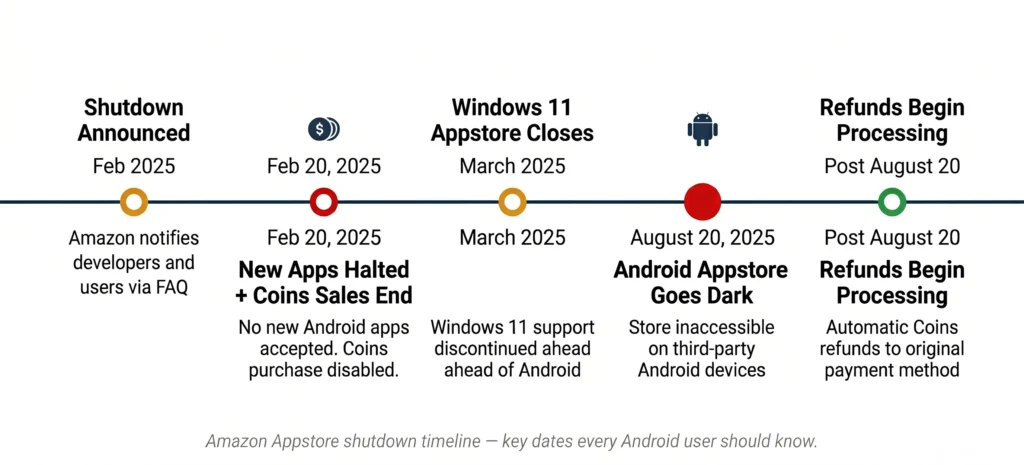
What Actually Happened and When
The shutdown didn’t come out of nowhere. Amazon announced it in February 2025, which gave developers and users roughly six months to figure out next steps. But “six months notice” and “six months of people actually paying attention” are two very different things.
Here’s the condensed version:
| Event | Date |
| Official shutdown announcement | February 2025 |
| New app submissions halted | February 20, 2025 |
| Amazon Coins purchases ended | February 20, 2025 |
| Windows 11 Appstore discontinued | March 2025 |
| Android Appstore goes dark | August 20, 2025 |
The Windows 11 version actually went first — March 2025, quietly, without much fanfare. The Android closure followed in August. Fire Tablets, Fire TV and other Amazon-owned hardware? Still running the Appstore fine. This was specifically about third-party Android devices — your Samsung, your Pixel, whatever you’re carrying around.
Apps you downloaded before the shutdown? They’re still sitting on your phone, but Amazon has been clear: they’re “not guaranteed to operate.” No more security patches, no updates. The company’s recommendation is to uninstall them and find equivalents on Google Play.
Amazon Coins: The Refund You Might Be Missing
This is the part that matters most for a lot of people.
Amazon Coins were the platform’s virtual currency — you’d buy them to spend on apps, games, in-app purchases. Prices were usually slightly discounted when buying in bulk, so people stocked up. Then the rug got pulled.
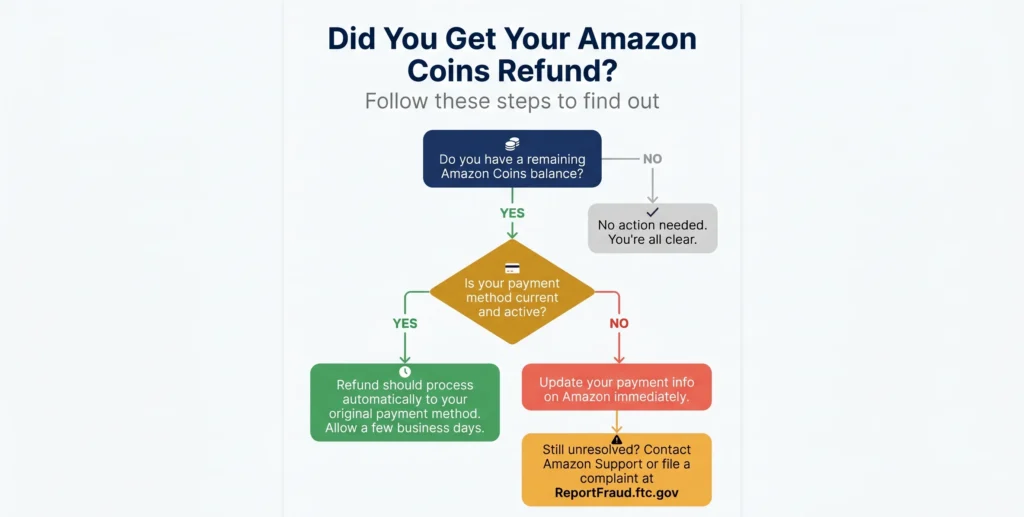
The official Amazon position: any Coins remaining in your account after August 20, 2025 will be refunded automatically. The conversion rate is straightforward — 100 Coins equals $1.00 USD. No hoops, no forms to submit. It goes back to the original payment method.
Sounds clean. Here’s where it gets messy.
Why Your Refund Might Not Have Arrived
The automatic refund only works if Amazon can actually process it. A few things can block that:
- Expired credit card — if the card you originally used to buy Coins is no longer active, the refund has nowhere to go.
- Closed bank account — same problem, different version.
- Missed email from Amazon — the company says it sends notifications asking users to update payment info, but those emails have a habit of landing in promotions folders or getting ignored entirely.
Amazon’s own 2024 annual filing disclosed “tens of millions of dollars” in unredeemed virtual currency liabilities. That’s real consumer money sitting unclaimed. Some of it might be yours.
How to Check Your Coins Balance
Don’t assume it’s been handled. Verify it yourself:
- Open the Amazon Appstore on your Android device or go to Amazon’s website.
- Navigate to Your Apps & Devices.
- Select Your Coins Account.
- Check the balance — if anything’s there, confirm your payment method is current.
- If your payment details have changed, contact Amazon support directly or watch for their email.
What About the Apps You Actually Paid For?
Short answer — Amazon isn’t giving cash refunds for purchased apps. That’s the part of this shutdown that’s drawn the most frustration from users and honestly, it’s worth understanding why that’s legally complicated even if it feels unfair.
When you “bought” an app from the Amazon Appstore, you weren’t really buying software the way you’d buy a physical product. You were purchasing a license — access to that app through Amazon’s platform. The terms of service, which almost nobody reads, typically include language that allows the platform to discontinue access under certain conditions.
Does that make it feel better? Probably not. Does it make it legal? For the most part, yes — though state law can complicate that picture, which we’ll get into.
Active subscriptions are a different story. If you had a subscription running through the Amazon Appstore that extends past August 20, 2025, you’re entitled to cancel it and get a refund for the unused portion. That’s the one area where Amazon has been explicit about offering a remedy beyond just Coins.
Your Legal Rights as a U.S. Consumer
Here’s something most people don’t realize — Amazon’s voluntary refund policy isn’t the only thing protecting you here. Federal and state law both have something to say about what companies can and can’t do when they shut down a paid service. Whether those protections actually help you depends on your specific situation, but knowing they exist matters.
The FTC’s Role
The Federal Trade Commission enforces rules against “unfair or deceptive acts or practices” under Section 5 of the FTC Act. That’s a broad mandate and digital services fall squarely within it.
Amazon’s history with the FTC is relevant here. The agency previously sued Amazon over unauthorized in-app purchases — specifically, kids making purchases without proper parental consent. Amazon lost that one. The takeaway isn’t that the FTC will automatically step in for every Appstore grievance, but rather that regulators have shown they’re willing to scrutinize Amazon’s digital sales practices when consumer harm is clear and widespread.
If Amazon fails to deliver on it’s stated refund commitment — especially given that “tens of millions” in unredeemed Coins liability disclosure — that’s exactly the kind of pattern the FTC watches for. Individual complaints don’t usually trigger enforcement on their own, but enough of them pointing at the same problem? That gets attention.
You can file a complaint at ReportFraud.ftc.gov. It takes about five minutes.
State Laws Often Go Further
Federal law sets a floor. State consumer protection statutes frequently build well above it and a few things are worth flagging specifically for the Appstore situation.
Prepaid balance protections — Several states have laws that directly address virtual currency and prepaid digital balances. The core principle: a company can’t just absorb unused consumer funds when it shuts down a service. If Amazon’s refund process fails and you’re left with a Coins balance that never came back, your state’s consumer fraud statute may give you a direct claim.
Implied covenant of good faith — This one’s more nuanced but genuinely applicable here. Most contracts — including the terms of service you agreed to when using the Appstore — carry an implied duty that neither party will act to undermine the other’s reasonable expectations. Shutting down a platform and rendering paid apps permanently unusable, without any meaningful remedy, is the kind of conduct that courts have found problematic under this doctrine in other contexts.
Unconscionability — If Amazon’s terms of service contained language essentially allowing the company to terminate access to apps you paid for without any refund obligation, a court could potentially find those terms unconscionable. It’s a high bar, but it’s not an imaginary one.
[Image: Simple infographic showing three legal protection layers — FTC (federal), State AG (state) and Private Litigation (individual/class). Caption: U.S. consumers have multiple legal avenues if Amazon’s refund process fails.]
Could There Be a Class Action?
Possibly. No specific class-action lawsuit targeting the Appstore shutdown is publicly confirmed at this point, but the conditions that typically precede one are all present — large user base, discontinued paid service, unredeemed virtual currency with documented dollar value and a company that disclosed the liability in it’s own financial filings.
Class actions in the digital services space aren’t new. Amazon has faced them before for other practices. If you’re interested in monitoring whether one develops around this shutdown, consumer advocacy sites and class-action tracker resources like TopClassActions.com are worth bookmarking — though for the most authoritative updates, check your state bar association or PACER for any filed federal cases.
If Your Refund Doesn’t Come Through — What to Do
Don’t wait around hoping it resolves itself. If you had a Coins balance and haven’t seen a refund, work through these steps in order:
Step 1: Rule Out the Obvious First
Check your payment method. Seriously — this is the most common reason refunds fail and the easiest fix. Log into your Amazon account, go to your payment settings and confirm the card or bank account on file is current and active.
Step 2: Contact Amazon Directly
Amazon’s customer support is the first formal stop. Document everything — screenshot your Coins balance before contacting them, note the date and time of your support interaction and save any email correspondence. If this goes further, that paper trail matters.
You can reach Amazon support through their help pages.
Step 3: File an FTC Complaint
If Amazon can’t or won’t resolve it, ReportFraud.ftc.gov is your next move. The FTC doesn’t resolve individual disputes directly — that’s worth knowing upfront — but complaint volume shapes enforcement priorities. Your report contributes to a larger picture.
Step 4: Contact Your State Attorney General
This one gets underutilized. Most state AG offices have a consumer protection division with an online complaint portal and state-level investigations have teeth. Unlike the FTC, some state AGs will intervene in individual cases, particularly when the dollar amounts are meaningful or the affected population is large.
Find your state AG’s office at usa.gov/state-attorney-general.
Step 5: Talk to a Consumer Rights Attorney
For larger balances or if you believe you have a claim beyond just the Coins refund — paid apps with no remedy, subscriptions handled improperly — a consultation with a consumer rights attorney is worth considering. Many offer free initial consultations. Your state bar association’s referral service is a reliable starting point and most state bars maintain searchable directories at their official .org domains.
The Bottom Line
Most people reading this fall into one of two camps — either the refund already processed and they didn’t notice or it didn’t process and they haven’t checked. Neither is a great situation.
Quick action list before you close this tab:
- Check your Coins balance in Your Apps & Devices on Amazon.
- Verify your payment method is current and active.
- Look for any Amazon emails about updating payment info — check spam and promotions folders.
- Cancel any active Appstore subscriptions if you haven’t already and request a refund for unused time.
- Uninstall apps from the Appstore that no longer work — they won’t receive security patches.
The broader legal landscape offers real protections if Amazon’s process fails you. The FTC, your state AG and potentially private litigation are all available avenues. But realistically, for most people, this comes down to making sure Amazon has a valid place to send the money.
Check the balance. Update the card. Don’t leave your own money sitting there.