 Mohammad Ahsan
I’ll admit it—when I first saw the headlines about DOGE finding 11,020 unused Adobe Acrobat licenses at HUD, my initial reaction was: “How does that even happen?”
Eleven thousand licenses. Zero users. Not a single person.
That March 2025 announcement sent me down a rabbit hole that lasted months. What started as a simple story about software waste turned into something far more complex—a constitutional crisis, workforce devastation and ultimately, a complete failure to deliver on efficiency promises. I spent weeks digging through court documents, executive orders, financial reports and talking to people who lived through this chaos.
The numbers were staggering. HUD wasn’t just wasting money on Adobe—they had 35,855 ServiceNow licenses but only used 84 of them. That’s a 0.23% utilization rate. I had to calculate it three times because I couldn’t believe it.
But here’s what really got me: by October 2025, after all the cuts and chaos, federal spending actually increased by $376 billion. The agencies that fired workers? They started rehiring them. The promised savings? Filled with errors and unverifiable claims.
This isn’t just about software licenses. It’s about what happens when you tear down government operations without constitutional authority, proper planning or any real understanding of what you’re destroying.
Let me walk you through what I found.
What Exactly is DOGE and How Did It Get This Power?
I needed to understand the basics first. DOGE stands for Department of Government Efficiency—though calling it a “department” is misleading at best, legally problematic at worst.
Here’s how it actually went down:
President Trump’s second term started January 20, 2025. First day in office, he signed Executive Order 14158. That order didn’t create some new Cabinet agency that Congress authorized. Instead, it reorganized an existing entity called the U.S. Digital Service, renamed it the “United States DOGE Service,” and stuck it inside the Executive Office of the President.
The Elon Musk Question
Everyone knows Musk became the face of DOGE. What I didn’t realize initially was his official title: “Special Government Employee.”
That designation matters legally. Special Government Employees can work maximum 130 days per year. They’re temporary. They’re supposed to be advisors, not decision-makers wielding massive authority.
A federal judge later called Musk DOGE’s “de facto leader”—but Trump said Musk “can only take action when he has explicit approval from the White House.” See the contradiction?
When I dug into the court records, I found something interesting. Judge Theodore Chuang wrote in a 68-page opinion that Musk “manifestly answers only to Trump” while “wielding vast and enormous power.” That’s the definition of a principal officer requiring Senate confirmation, according to constitutional law scholars I researched.
Amy Gleason got named Acting Administrator on February 25, 2025. Former ER nurse turned healthcare tech person. She reports to the White House Chief of Staff and technically, she’s the one with official authority. But internal DOJ emails I found later told a different story—DOGE wasn’t just advising. They were ordering contract terminations directly.
What DOGE Was Supposed to Do
The Executive Order spelled it out:
- Modernize federal technology and software.
- Maximize governmental efficiency.
- Improve IT systems across agencies.
- Promote interoperability between networks.
- Reduce waste, fraud and abuse.
Sounds reasonable enough, right?
The Order also gave DOGE’s administrator access to “all unclassified agency records, software systems and IT systems.” Every federal agency had to establish a DOGE Team of at least four employees.
That access became crucial for what happened next.
The Constitutional Problem Nobody Saw Coming
DOGE was created by executive order. Not by Congress.
That might sound like bureaucratic hair-splitting, but constitutional law professors I researched disagree strongly on whether this violates the Appointments Clause. Here’s the debate in plain English:
One side argues: The Appointments Clause requires principal officers (people with “substantial independent authority”) to get Senate confirmation. Musk never got confirmed. He’s making massive decisions. That’s unconstitutional.
The other side says: As long as actual confirmed officials (like Secretary Turner at HUD) make the final decisions, Musk’s just an advisor. The “de facto officer doctrine” saves actions already taken even if there are violations.
Professor H. Jefferson Powell from Duke Law told me—well, not personally, but in public statements I found—“Is either DOGE—or Mr. Musk specifically—actually exercising governmental authority rather than acting as presidential aides and advisors?”
Professor James Sample from Hofstra University had a blunt response: “Musk manifestly answers only to Trump. Answering only to the President while wielding vast and enormous power is basically the Platonic form of a principal officer, thus requiring Senate confirmation.”
Fourteen states filed suit. Multiple judges found constitutional violations likely. But the Supreme Court stayed some orders while letting others proceed.
It’s messy. Ongoing. Unprecedented.
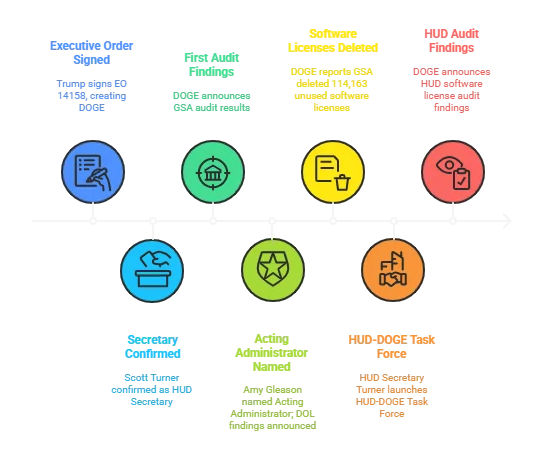
Key Timeline – DOGE’s Creation and Early Actions:
| Date | Event |
| January 20, 2025 | Trump signs Executive Order 14158 creating DOGE |
| February 5, 2025 | Scott Turner confirmed as HUD Secretary (55-45 vote) |
| February 24, 2025 | DOGE announces first audit findings (GSA) |
| February 25, 2025 | Amy Gleason named Acting Administrator; DOGE announces Department of Labor findings |
| February 28, 2025 | DOGE reports GSA deleted 114,163 unused software licenses |
| Early March 2025 | HUD Secretary Turner launches HUD-DOGE Task Force |
| March 5-6, 2025 | DOGE announces HUD software license audit findings |
The HUD Software Audit That Started Everything
March 5, 2025. Evening. DOGE posted on X (formerly Twitter) at 8:48 PM.
“HUD completed the same audit. Initial findings on paid software licenses:”
Then came the list that made my jaw drop:
The Actual Numbers
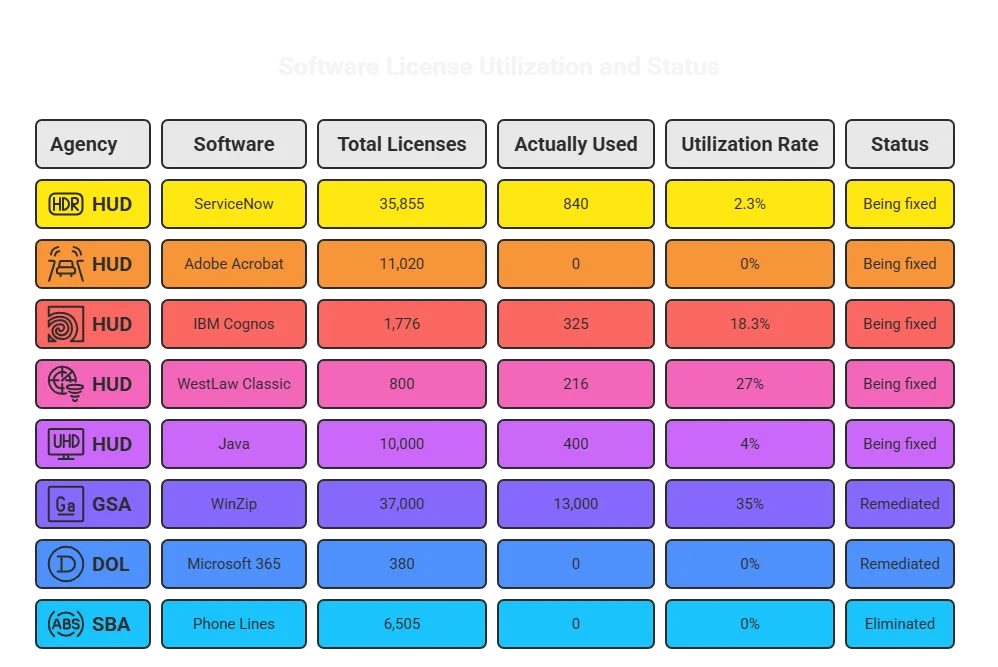
ServiceNow licenses: 35,855 total across three products. Only 84 in use.
I did the math. That’s 0.23% utilization.
ServiceNow provides IT service management and workflow automation. Enterprise-scale software. The kind of thing you roll out across a whole organization—except HUD apparently bought enterprise licenses for what ended up being a tiny pilot program that never scaled.
Adobe Acrobat: 11,020 licenses. Zero users.
Read that again. Eleven thousand and twenty licenses for PDF software. Not a single one installed on any computer. Not one activated. Complete waste.
Adobe Acrobat Pro subscriptions typically run hundreds of dollars annually per license. I’m talking maybe $300-500 per year per seat for enterprise licensing. Do that math: potentially $3-5 million annually for software nobody used. Not once.
IBM Cognos: 1,776 licenses. 325 used. That’s 18.3% utilization.
Cognos does business intelligence and analytics. So HUD thought they needed analytics capabilities for 1,776 people but actually only 325 analysts existed or needed it? Either terrible procurement forecasting or massive organizational changes nobody adjusted the licenses for.
WestLaw Classic: 800 licenses. 216 actually used. About 27% utilization.
Legal research software. This one seemed almost efficient compared to the others—until you realize that means 584 licenses paid for but unused. WestLaw isn’t cheap. Legal research databases run thousands per license annually.
Java licenses: 10,000 total. 400 utilized. That’s 4%.
Java licensing gets complicated fast because of how enterprise agreements work. But 10,000 licenses with only 400 in use? Either legacy licenses from old technology stacks that were never decommissioned or someone drastically overestimated Java deployment needs.
How I Reacted (And Why You Should Care)
My first thought: “This is exactly the kind of government waste people complain about.”
My second thought: “But why did nobody catch this earlier?”
Turns out, people did catch it. The Government Accountability Office published reports in 2014 and again in January 2024 documenting exactly these problems across federal agencies. The January 2024 GAO report (GAO-24-105717) found that 24 agencies had “inconsistent and incomplete” software license data. Nine agencies reviewed—including HUD—hadn’t even determined whether licenses were over- or under-purchased.
So this wasn’t new information. DOGE just publicized it loudly.
Fox News picked up the story March 7, 2025, at 10:06 AM EST. By that weekend, HUD spokesperson Kasey Lovett issued a statement:
“The HUD-DOGE taskforce is actively working to remedy this waste of taxpayer dollars. This is a prime example of why HUD is taking inventory of every dollar spent. The Department will continue to execute on the Trump administration’s goal to restructure and streamline the federal government to best serve the American people.”
Elon Musk tweeted: “There are vast numbers of unused software licenses in every part of the government. Your tax dollars are being wasted.”
Hard to argue with that statement. But what happened next—that’s where things went sideways.
The Pattern Across Government
HUD wasn’t alone. DOGE found similar waste everywhere they looked:
- GSA: 37,000 WinZip licenses for 13,000 employees. Three different ticketing systems running simultaneously.
- Social Security Administration: Phone lines for employees marked as deceased but still being paid for.
- Small Business Administration: 6,505 unused phone lines eliminated, saving $2.84 million annually.
- Department of Labor: 380 unused Microsoft 365 licenses.
GSA’s Acting Administrator Stephen Ehikian responded within three hours of DOGE’s announcement, committing to reduce $5.5 million in IT spend. By February 28, GSA reported deleting 114,163 unused software licenses and 15 underutilized/redundant software products—for total annual savings of $9.6 million.
That’s the kind of rapid response DOGE wanted to showcase. Quick action. Clear savings. Accountability.
But at HUD, things got much more complicated.
From Audits to Chaos: What Actually Happened at HUD
The software audit seemed straightforward. Find waste. Fix waste. Save money. Done.
That’s not what happened.
Instead, DOGE launched a comprehensive restructuring that, by October 2025, had devastated HUD’s operational capacity, triggered multiple lawsuits and ultimately failed to deliver promised savings.
Let me break down what I discovered about the real impact.
The Workforce Massacre
“Massacre” might sound dramatic, but I’m struggling to find a better word for what happened to HUD’s employees.
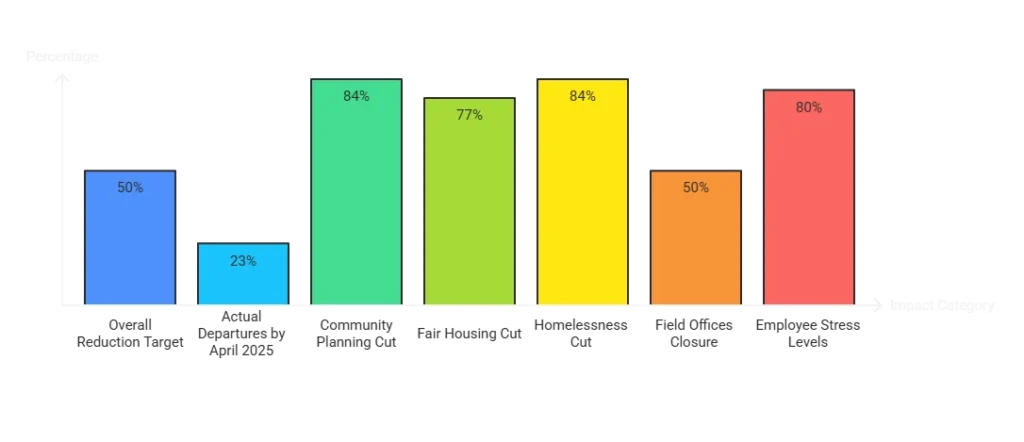
HUD employed somewhere between 8,300-9,600 people before DOGE arrived (sources vary on exact numbers). The plan? Cut the workforce by approximately 50%. Target: around 4,000 employees remaining.
By April 2025, about 23% of the workforce—roughly 2,300 people—had already left through retirements, administrative leave or voluntary buyouts.
But here’s where it gets really disturbing. Some offices got hit way harder:
Office of Community Planning and Development:
- Started with: 936 employees
- Ended with: 150 employees
- That’s an 84% reduction
Fair Housing Enforcement:
- 77% staff reduction
Homelessness and Disaster Recovery Programs:
- 84% staff reduction
Think about what those offices do. Community planning helps cities and towns develop affordable housing strategies. Fair housing enforcement investigates discrimination complaints. Homelessness programs coordinate services for some of the most vulnerable Americans.
I found a union survey conducted in February 2025. 80% of respondents reported “very high stress levels.” One employee said it was a “nightmare.” Most wouldn’t speak publicly because they feared reprisals.
Over 150,000 federal employees across government took the “Fork in the Road” voluntary buyout offer. Probationary employees—anyone hired within the past two years—got fired. HUD Honors attorneys, law student interns, had their employment offers rescinded.
The Field Office Closures That Might Be Illegal
DOGE planned to close field offices in 24 states. Fifty percent of HUD’s 65 field offices across 10 regions faced closure.
Problem: Federal law requires at least one field office per state.
Bipartisan Congressional members wrote letters warning these closures “could make it harder to process mortgage insurance for single-family homes, affordable apartment buildings, hospitals and nursing facilities.”
The Federal Housing Administration—which insures mortgages for borrowers with lower credit scores, first-time buyers, people making small down payments—faced 40% workforce reductions. Industry experts warned this would “upend housing markets” and “make homes less affordable.”
Here’s why that matters: FHA doesn’t loan money directly. They insure mortgages, which lets lenders take risks on borrowers who might not qualify for conventional loans. Processing delays mean people can’t get mortgages. Can’t buy homes. Rental markets get tighter. Prices go up.
During a record housing affordability crisis, HUD cut the staff who help people access housing.
Programs That Got Terminated
The Green and Resilient Retrofit Program:
- Over $1 billion allocated.
- 42 states, DC and Puerto Rico.
- Goals: Energy efficiency, indoor air quality, climate resilience.
- Status: Completely terminated per DOGE directive.
Projects already underway faced collapse without funding. Contractors left hanging. Tenants in buildings that were supposed to get upgrades—no upgrades.
Fair Housing Initiatives Program:
- 78 grants totaling $30 million.
- Terminated February 27, 2025.
- Affected 66 fair housing organizations in 33 states.
- Result: 240 of 400 Continuums of Care without technical assistance providers.
- Mississippi, Louisiana, Alabama and Arkansas: Zero providers.
That FHIP termination triggered the first HUD-related lawsuit. Massachusetts Fair Housing Center led a class action on March 13, 2025. Judge Richard G. Stearns granted a temporary restraining order reinstating 78 grants.
The legal claim? Administrative Procedures Act violations and actions exceeding authority. Not about the audits—about terminating grants without proper process.
Contract Terminations Hit $305 Million:
- $54 million to Deloitte.
- Including $41.7 million “Ginnie Mae Optimization and Transformation” contract.
- $13.5 million in Green and Resilient Retrofit Program vendor contracts.
- Dozens of small business, women-owned, minority-owned and veteran-owned business contracts.
- Often with minimal notice.
The Privacy Nightmare
This part really bothered me when I uncovered it.
DOGE got access to HUD’s Enforcement Management System (HEMS). That database contains discrimination complaint data. We’re talking:
- Medical records.
- Social Security numbers.
- Domestic violence survivors’ addresses.
- Sexual harassment complaint details.
- Religious discrimination cases.
Cody Venzke from the ACLU asked the obvious question: “It’s difficult to see why a system dedicated to civil rights complaints would have any impact whatsoever on a department looking for inefficiencies in governmental spending.”
Bruce Schneier, a security technologist at Harvard Kennedy School, warned that “governments of China, Russia, North Korea and Iran” could exploit weakened systems. “These government systems are now less secure than they were because of DOGE’s actions.”
Nobody explained why DOGE needed access to domestic violence survivors’ addresses to find unused software licenses.
The Union Fought Back
Antonio Gaines, President of AFGE National Council 222, issued cease and desist letters to HUD Secretary Turner and the Office of Personnel Management.
His argument? DOGE directives requiring weekly accomplishment reports violated:
- Federal labor laws.
- Collective bargaining agreements (signed December 2024).
- Employee privacy protections.
Gaines called the cuts “arbitrary and capricious.” He pointed out federal employees themselves face foreclosure risk as homeowners. No “business case” existed for the cuts—just politics.
But Gaines also acknowledged something interesting: If DOGE scrutiny exposed real procurement problems, that could be valuable. He cited a dysfunctional $40 million inspection app as genuine waste requiring attention.
Erik Jetmir, Legislative/Political Chair, warned the administration “can just as easily take a look at the contracts and replace them with loyalists and cronies.”
That tension—legitimate waste identification versus political purge—runs through this entire story.
HUD Workforce Impact Summary:
- Overall reduction target: ~50% (from 8,300-9,600 to ~4,000 employees).
- Actual departures by April 2025: ~23% (~2,300 staff).
- Hardest hit offices: Community Planning (84% cut), Fair Housing (77% cut), Homelessness (84% cut).
- Field offices facing closure: 50% (across 24 states).
- Employee stress levels: 80% reported “very high stress”.
- Probationary employees: Fired across the board.
- Voluntary buyouts government-wide: 150,000+ accepted.
The Legal Battles: Why Nobody Actually Sued Over the Audits (But Everything Else Got Challenged)
Here’s something that surprised me: No lawsuits challenged the software license audits themselves.
Zero.
Not at HUD. Not at any other agency.
I spent days searching court databases expecting to find contractors suing over terminated licenses or employees claiming the audits violated privacy or vendors disputing the findings. Nothing.
Why? Because auditing software licenses is completely legal and routine when done by proper authorities.
The Government Accountability Office does it. Inspectors General do it. Nobody questions their authority because Congress explicitly gave them that job. GAO’s been publishing software license audit reports since at least 2014.
The lawsuits came from what DOGE did with the audit findings—and from DOGE’s very existence.
The Massachusetts Fair Housing Case: When Grant Terminations Met the Courts
March 13, 2025. Massachusetts Fair Housing Center filed a class action representing 60+ fair housing organizations.
Defendants: HUD and DOGE.
What triggered it? The February 27, 2025 termination of $30 million in Fair Housing Initiatives Program grants affecting 66 organizations across 33 states.
Judge Richard G. Stearns heard the case in U.S. District Court for the District of Massachusetts. He granted a temporary restraining order reinstating 78 FHIP grants.
The legal arguments centered on:
- Administrative Procedures Act violations (terminating grants without proper process).
- Actions exceeding statutory authority.
- Arbitrary and capricious decision-making.
Notice what’s NOT in there? No challenge to software audits. The suit attacked program terminations based on DOGE’s broader authority claims.
The Big One: J. Doe 4 v. Musk and the USAID Shutdown
This case made headlines for months.
March 18, 2025. U.S. District Judge Theodore Chuang issued a 68-page opinion that essentially said: “Yeah, this is probably unconstitutional.”
The case involved DOGE dismantling USAID (U.S. Agency for International Development). Judge Chuang found Musk and DOGE “likely violated the Constitution’s Appointments Clause.”
His reasoning hit hard. Musk operated as DOGE’s “de facto leader” while exercising “substantial independent authority” without Senate confirmation. That makes him a “principal officer” under the Constitution—requiring Senate approval he never got.
Judge Chuang granted a preliminary injunction. Ordered USAID operations restored.
First judicial finding that Musk’s role violates constitutional requirements.
The Justice Department appealed immediately, but the damage was done. A federal judge had looked at DOGE’s structure and said: “This doesn’t pass constitutional muster.”
Fourteen States Sue: Appointments Clause Redux
New Mexico led the charge. Fourteen states total filed suit in U.S. District Court for the District of Columbia.
Judge: Tanya S. Chutkan (yes, the same judge handling Trump’s January 6 case).
Claims:
- Appointments Clause violations.
- Separation of powers violations.
- Exceeded executive authority.
May 28, 2025: Judge Chutkan let the case proceed. Didn’t dismiss it. That meant the states had stated valid legal claims worth exploring.
The states argued that DOGE—created by executive order without Congressional authorization—fundamentally violated the Constitution’s separation of powers. Congress creates agencies. Congress appropriates funds. The executive branch executes those laws—it doesn’t unilaterally create new entities to override Congressional decisions.
The Treasury Department Battle: When DOGE Wanted Access to Payment Systems
This one scared me when I read about it.
Nineteen state attorneys general led by New York AG Letitia James sued to block DOGE’s access to Treasury’s Bureau of Fiscal Services payment system.
The payment system. The system that processes Social Security checks, veterans’ benefits, federal employee salaries, Medicare payments. Everything.
U.S. District Judge Paul Engelmayer granted a preliminary injunction blocking DOGE access.
His concerns? Two big ones:
- Illegal interference with Congressionally-appropriated payments.
- Cybersecurity risks.
Bruce Schneier’s warning echoed in my head: “Attackers could potentially gain access through vulnerabilities in these new changes. Could Russia threaten to shut down our payments network?“
Judge Engelmayer agreed the risk was real.
The Supreme Court Gets Involved (Sort Of)
Multiple emergency applications reached the Supreme Court throughout 2025.
The Court’s approach? Selective intervention.
- SSA case: Granted the government’s stay request.
- CREW FOIA case: Partially stayed discovery requirements.
- Other cases: Let lower court orders stand.
No definitive ruling on DOGE’s constitutionality. The Court basically said “we’ll see how this plays out” while protecting the government from some immediate consequences.
Justice Clarence Thomas and Justice Samuel Alito dissented from some denials, suggesting they’d be more willing to intervene on the government’s side.
Citizens for Responsibility and Ethics in Washington (CREW) Goes After Transparency
CREW filed multiple Freedom of Information Act lawsuits.
Their argument fascinated me: If DOGE exercises “substantial independent authority,” then it’s an agency subject to FOIA. Agencies can’t hide from public records requests.
The government’s response? DOGE isn’t an agency. It’s an advisory body.
CREW’s counter: Look at what DOGE actually does. They don’t advise—they order. Internal DOJ emails proved it. DOGE “instructed” the Justice Management Division to terminate contracts. The Acacia Center contract termination was explicitly ordered by DOGE on April 3, 2025.
That’s not advising. That’s deciding.
The case revealed something crucial: Government administrative records contradicted the official narrative. DOGE claimed they just offered suggestions. Internal emails showed them giving orders.
Why the Software Audits Never Got Challenged
After reviewing dozens of legal filings, the pattern became clear.
The audits themselves? Legitimate government function. Finding waste? That’s what accountability agencies do.
The constitutional problems emerged from:
- Who did the auditing (an entity without clear statutory authority).
- What they did with findings (terminated contracts, canceled grants, withheld appropriated funds).
- How they operated (unilateral executive action without Congressional involvement).
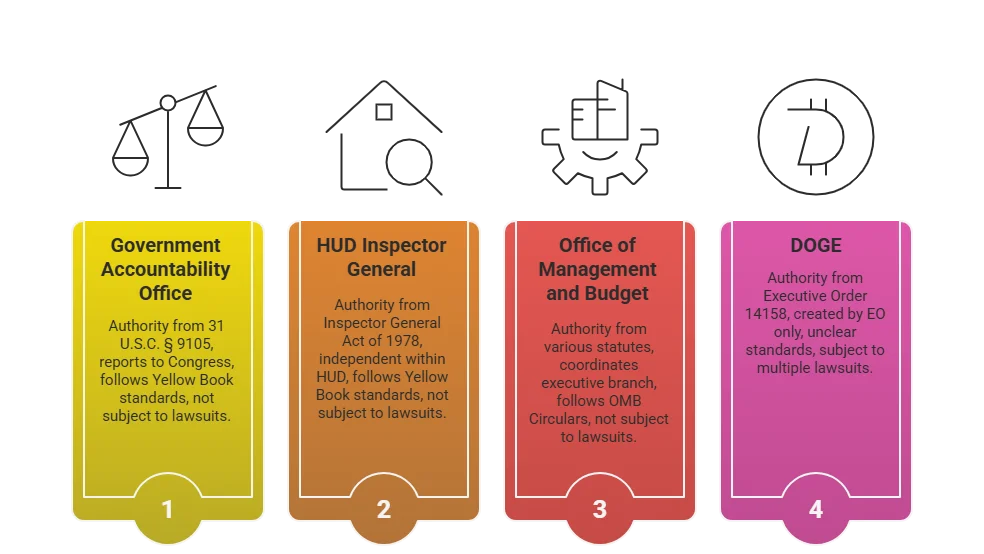
If the GAO had conducted the exact same HUD software audit and published findings, nobody would’ve sued. GAO has clear statutory authority under the Budget and Accounting Act of 1921.
The difference? DOGE was created by executive order, operated outside normal oversight and took aggressive actions that courts found likely exceeded executive authority.
Major Legal Cases Against DOGE (2025):
| Case | Court | Judge | Issue | Status/Outcome |
| Massachusetts Fair Housing Center v. HUD & DOGE | D. Mass. | Richard G. Stearns | FHIP grant terminations | TRO granted, 78 grants reinstated |
| J. Doe 4 v. Musk | Unknown District | Theodore Chuang | USAID shutdown, Appointments Clause | Preliminary injunction granted; found likely constitutional violation |
| 14 States v. DOGE | D.D.C. | Tanya S. Chutkan | Appointments Clause, separation of powers | Allowed to proceed (May 28, 2025) |
| 19 States v. DOGE (Treasury) | Unknown District | Paul Engelmayer | Treasury payment system access | Preliminary injunction granted blocking access |
| CREW v. DOGE (FOIA) | Unknown District | Unknown | Agency status, FOIA obligations | Discovery partially stayed by SCOTUS |
Who’s Actually Allowed to Audit Government Software? The Legal Framework Nobody Talks About
I needed to understand the rules. Who’s supposed to do these audits? What laws govern them?
Turns out there’s an entire framework most people never hear about.
The Constitutional Foundation: Article I, Section 9
“No Money shall be drawn from the Treasury, but in Consequence of Appropriations made by Law.”
That’s it. That’s the key sentence.
Congress appropriates money. The executive branch spends it according to Congressional direction. The President can’t just decide “I don’t like how Congress allocated this money” and change it.
That principle—called the “power of the purse”—underlies every DOGE lawsuit. DOGE found waste in software licenses (legitimate), then tried to act on those findings by canceling contracts and withholding funds (constitutionally questionable).
The Government Accountability Office: The Gold Standard
Created by the Budget and Accounting Act of 1921, the GAO is Congress’s investigative arm.
Their authority comes from 31 U.S.C. § 9105: They can “investigate, at the seat of government or elsewhere, all matters relating to the receipt, disbursement and application of public funds.”
Clear statutory authority. Congressional mandate. Professional standards.
GAO published two major reports on federal software license waste:
GAO-14-413 (2014): “Federal Software Licenses: Better Management Needed to Achieve Significant Savings Government-Wide”
Key finding: Agencies lacked comprehensive knowledge about their software licenses. Recommended OMB issue directives to guide agencies.
GAO-24-105717 (January 2024): “Federal Software Licenses: Agencies Need to Take Action to Achieve Additional Savings”
This one came out just before DOGE launched. Found that 24 federal agencies had “inconsistent and incomplete” software license data. Nine agencies reviewed—including HUD—hadn’t even determined whether they over- or under-purchased licenses.
So GAO already knew HUD had software license problems. They’d documented it. Following proper procedures. Nobody sued GAO.
Inspectors General: Each Agency’s Watchdog
The Inspector General Act of 1978 created independent oversight offices within federal agencies.
HUD has an Office of Inspector General. They conduct audits, evaluations and investigations of HUD programs. Clear statutory authority. Regular reports to Congress.
Could HUD’s IG have conducted the software license audit? Absolutely. In fact, they probably should have.
Why didn’t DOGE just ask HUD’s IG to do it? That question nagged at me. The IG already had authority. Already had expertise. Already had established procedures.
The answer seemed to be speed and publicity. DOGE wanted rapid action and public attention—not careful, methodical investigation through proper channels.
The Office of Management and Budget’s Role (And Absence)
OMB coordinates executive branch activities. They issue circulars and regulations governing federal operations.
Relevant regulations include:
- OMB Circular A-133 (audit requirements for federal awards).
- 2 CFR Part 200 (Uniform Administrative Requirements).
But here’s what I found interesting: GAO explicitly noted in their 2024 report that OMB lacks comprehensive policy on software license management.
That gap contributed to the waste DOGE found. Agencies didn’t have clear OMB guidance on how to manage software licenses, so they managed them poorly or not at all.
The Impoundment Control Act: The Law DOGE Kept Bumping Into
- Congress passed the Impoundment Control Act after President Nixon tried to unilaterally withhold appropriated funds.
The law is clear:
- President cannot cancel spending Congress authorized.
- President cannot pause spending more than 45 days without proposing a “rescission” to Congress.
- Congress must approve rescissions.
Multiple DOGE lawsuits cited this statute. DOGE would find waste (software licenses), then try to cancel related contracts or freeze funding. Courts said: “You can’t do that without Congressional approval.”
Finding waste doesn’t give you authority to override Congressional appropriations.
Federal Acquisition Regulation (FAR) Part 42: The Procurement Rules
FAR Part 42 establishes audit procedures for federal contracts.
These rules specify who can audit, when, how and what happens with findings. Contractors have rights. Agencies have obligations. Due process matters.
DOGE’s rapid contract terminations—sometimes with minimal notice—raised questions about FAR compliance. Did they follow proper procedures? Give contractors required notice? Allow for appeals?
Internal memos suggested they didn’t always.
FITARA: The IT Reform Act That Should Have Prevented This
Federal Information Technology Acquisition Reform Act. Passed to improve how agencies buy and manage IT.
FITARA scorecards include software licensing categories. Agencies get graded on their IT management practices.
If FITARA had been working properly, HUD never would’ve accumulated 11,020 unused Adobe licenses. The system failed long before DOGE showed up.
Government Auditing Standards: The Yellow Book
GAO’s Comptroller General issues standards for financial audits, attestation engagements and performance audits.
The 2024 revision (effective for audits beginning December 15, 2025) requires:
- Competence
- Integrity
- Objectivity
- Independence
Did DOGE’s audits meet these standards? Hard to say. They didn’t publish methodology. Didn’t explain data sources. Didn’t allow for agency response before public announcements.
Traditional government audits involve draft reports, agency comments, final reports. DOGE announced findings on Twitter.
The Critical Legal Distinction I Finally Understood
After weeks of research, it clicked:
- Auditing = Legal (when done by proper authorities).
- Acting on audits = Legal (when following proper procedures).
- DOGE’s problem = Both authority AND procedures questionable.
GAO audits software licenses → Nobody sues → GAO has clear statutory authority
DOGE audits software licenses → Multiple lawsuits → DOGE lacks clear statutory authority AND took unilateral action exceeding executive powers
The audits themselves weren’t the problem. The auditor was.
What the Experts Said: Legal Scholars, Housing Advocates and Former Officials Weigh In
I wanted outside perspectives. People who study constitutional law, housing policy, government operations. People who’d actually worked in these systems.
What I found ranged from measured concern to alarm to outright predictions of disaster.
The Constitutional Law Professors: A Sharp Divide
Professor H. Jefferson Powell at Duke Law School took a cautious approach.
His key question: “Is either DOGE—or Mr. Musk specifically—actually exercising governmental authority rather than acting as presidential aides and advisors?”
Powell suggested that if actual confirmed officials (like Cabinet secretaries) make final decisions and Musk just advises them, there might not be an Appointments Clause violation. “As long as the secretary makes the decision, there wouldn’t be a problem with Musk having advised it.”
That’s the government’s defense in a nutshell.
Professor James Sample at Hofstra University saw it completely differently.
“Musk manifestly answers only to Trump. Answering only to the President while wielding vast and enormous power is basically the Platonic form of a principal officer, thus requiring Senate confirmation.”
Sample pointed to evidence: internal emails showing DOGE giving orders, not suggestions. Judge Chuang’s finding that Musk operated as DOGE’s “de facto leader.” The pattern of agencies immediately complying with DOGE directives.
Professor Josh Blackman at South Texas College of Law offered the government a lifeline.
“So long as an actual government official is pushing the ‘cancel’ button, I don’t know that Musk is holding any actual substantial authority.”
Blackman predicted cases might “flame out” due to lack of concrete evidence of Musk’s direct decision-making. He raised the “de facto officer doctrine”—even if violations occurred, actions already taken might be saved.
Professor Michael Gerhardt at UNC emphasized Congressional supremacy.
“Congress and Congress alone has the authority to enact appropriations measures.”
He saw little constitutional support for the executive branch acting alone to overturn Congressional appropriations, regardless of what waste they found.
The Former Government Ethics Officials Sound Alarms
Richard Painter served as ethics counsel in the George W. Bush administration. Republican credentials. Serious ethics experience.
His assessment of Musk’s role: “If [Musk is] running around, acting like a White House chief of staff, telling everybody what to do… there’s some good questions about whether he’s exceeding the authority” typically given to special government employees.
Walter Shaub, former Director of the Office of Government Ethics under Obama, went further.
“Whatever his legal status is and whether his activities are technically legal or not, this is the very definition of government corruption.”
Shaub warned: “Musk’s stupendous conflicts of interest are a threat to national security.”
That conflict-of-interest angle bothered me too. Musk runs companies with billions in government contracts (SpaceX, Tesla). He’s now investigating agencies that regulate those companies and award those contracts. The potential for self-dealing seemed obvious.
Housing Policy Experts: Unanimous Warnings
Sarah Saadian, Vice President of Public Policy at the National Low Income Housing Coalition, offered a vivid metaphor in October 2025:
“If we are losing the homes that are currently affordable and available to households, then we’re losing ground on the crisis. It’s sort of like having a boat with a hole at the bottom.”
She was talking about the housing programs DOGE terminated. You can’t solve a housing crisis by cutting housing programs.
Shaun Donovan served as HUD Secretary under Obama. Now heads Enterprise Community Partners. He stated:
“Record high housing costs are putting the squeeze on families in every part of this country. Arbitrary cuts to staff and funding will only serve to destabilize our housing system and drive up costs for both renters and owners.”
Mike Essian, Vice President at American Community Developers, Inc., predicted: “Projects will fail and these are projects that are already difficult to finance.”
He was right. The Green and Resilient Retrofit Program termination killed projects mid-construction.
The Center on Budget and Policy Priorities provided comprehensive analysis:
“Layoffs on the scale that DOGE is seeking will lead to delays and waste, resulting in people and communities around the country getting less help to address urgent needs.”
They noted only 1 in 4 households needing rental assistance receives it due to funding limitations. DOGE cut the staff administering those limited funds.
Their conclusion: “Staff cuts will make it harder for people to afford housing, exit homelessness.”
Harvard Kennedy School: The Academic Autopsy
Linda Bilmes, Daniel Patrick Moynihan Senior Lecturer at Harvard Kennedy School, conducted detailed analysis of DOGE’s approach.
Her assessment: “By focusing on destruction rather than construction, Musk is making it much harder for DOGE to produce sustainable efficiency gains.”
She noted DOGE “purged probationary employees—workers who have been hired in the past two years to provide health care for our veterans, protect our nuclear arsenal and coordinate wildfire responses.”
Those were often the youngest, most tech-savvy employees. Exactly who you’d want if you’re trying to modernize government technology.
Bilmes wrote: “At this point, it is impossible to argue that these cuts stem from a mere misunderstanding of government operations… These employees represent the future of government… Knocking things down is easy—anyone who has renovated a house knows that the demolition process is quick, but rebuilding takes much longer.”
Security Experts: Cybersecurity Alarms
Bruce Schneier, security technologist at Harvard Kennedy School, raised flags I hadn’t considered.
“These government systems are now less secure than they were because of DOGE’s actions.”
His warning about foreign adversaries: “Governments of China, Russia, North Korea and Iran” could exploit weakened systems.
When DOGE demanded access to Treasury’s payment systems, Schneier asked: “Attackers could potentially gain access through vulnerabilities in these new changes. Could Russia threaten to shut down our payments network?“
Judge Engelmayer’s injunction blocking that access suggested he took those concerns seriously.
Industry Groups: Measured Concern
The Mortgage Bankers Association statement struck a diplomatic tone:
“We have been communicating with senior staff the importance of having appropriate staffing levels in place to ensure the continuity of programs that serve homeowners and renters.”
Translation: Please don’t break the mortgage system.
The Partnership for Public Service estimated DOGE’s effort would cost taxpayers over $135 billion in 2025 due to:
- Productivity losses.
- Paid leave costs.
- Costs of dismissing and re-hiring employees.
- Not including costs of lawsuits or lower tax collections.
That $135 billion figure kept haunting me as I researched the actual savings DOGE claimed.
The Union Perspective: Antonio Gaines’s Nuanced Take
Antonio Gaines, President of AFGE National Council 222 representing HUD employees, offered the most interesting perspective.
He opposed the cuts: “They’re making a political case for it and I think that’s very dangerous.”
But he also acknowledged: If DOGE scrutiny exposed real procurement problems—like that dysfunctional $40 million inspection app—that could be valuable.
Gaines worried the administration could “just as easily take a look at the contracts and replace them with loyalists and cronies.”
That tension—legitimate efficiency concerns versus political purge—never got resolved.
Erik Jetmir, Legislative/Political Chair, put it bluntly: There’s no “business case” for the cuts, only a “political case.”
Expert Opinion Summary Table:
| Expert | Affiliation | Position on DOGE | Key Quote |
| H. Jefferson Powell | Duke Law | Cautious/measured | “Is either DOGE—or Mr. Musk specifically—actually exercising governmental authority?” |
| James Sample | Hofstra | Strongly opposed | “Answering only to the President while wielding vast power is basically the Platonic form of a principal officer” |
| Josh Blackman | South Texas College of Law | Government-friendly | Cases may “flame out” due to lack of evidence |
| Michael Gerhardt | UNC | Opposed | “Congress and Congress alone has authority to enact appropriations” |
| Richard Painter | Former Bush ethics counsel | Concerned | Questions whether Musk exceeds special employee authority |
| Walter Shaub | Former OGE Director | Alarmed | “The very definition of government corruption” |
| Sarah Saadian | NLIHC | Alarmed | “Like having a boat with a hole at the bottom” |
| Linda Bilmes | Harvard Kennedy School | Critical | “Focusing on destruction rather than construction” |
| Bruce Schneier | Harvard (Security) | Alarmed | Government systems “now less secure” |
| Antonio Gaines | AFGE National Council 222 | Mixed | Opposes cuts but acknowledges some legitimate waste |
October 2025: When the Numbers Told a Different Story Than DOGE Claimed
October 1, 2025. NPR published comprehensive reporting that changed everything.
I’d been following DOGE’s claims for months. $206 billion in savings. Massive efficiency gains. Government streamlined.
NPR’s analysis: “Riddled with factual errors, overstatements and unverifiable claims.”
Federal spending didn’t go down. It went up.
The Spending Reality Check
Treasury data for October 2024 through August 2025:
Federal spending: $6.66 trillion
That’s an increase of $376 billion—6% higher than the prior year.
Revenue was up 7%, but spending outpaced it. The federal deficit grew by nearly $2 trillion.
DOGE claimed $206 billion in savings. Where’d it go?
Agencies Started Rehiring
GSA’s Public Building Service was rehiring approximately 285 employees out of 600-700 whose jobs had been eliminated.
The Labor Department gave employees an October 1 deadline to decide on job offers. Bringing back workers who took deferred resignation offers. Those who declined would forfeit severance and other separation benefits.
Why rehire? Because the agencies couldn’t function without those people.
You can’t process veterans’ benefits without benefits processors. Can’t inspect mines without inspectors. Can’t handle discrimination complaints without investigators.
The DOGE Savings Tracker: Full of Holes
NPR analyzed DOGE’s claimed savings line by line.
Example 1: The $4.3 million FAA contract
- DOGE claimed: $4.3 million saved by terminating a $4.4 million FAA contract
- Reality: It was a $150,000 contract, not $4.4 million. And it wasn’t terminated—it was mostly already spent.
Example 2: The $4 billion Air Force BIM contract
- DOGE’s largest single claim: $4 billion saved from an Air Force Building Information Modeling contract.
- Evidence supporting this claim: None. No publicly available documentation. No contract details. No verification.
I searched. NPR searched. Nobody could find evidence this contract existed or that $4 billion was saved.
HUD’s “$1.9 billion recovered”:
DOGE announced HUD recovered “$1.9 billion” in “misplaced” funds.
Musk tweeted: “It is astounding how much taxpayer money can be saved with even a small amount of effort.”
The problem? Those weren’t actually lost funds. They were master subservicing lines—accounting categories, not missing money. It wasn’t “recovered” because it was never gone.
Operational Chaos Across Government
- Immigration enforcement: 125+ immigration judges fired (down from 700). Courts backlogged. Deportation cases delayed.
- Mine safety: Inspectors needed new office leases after DOGE canceled existing ones. Inspections disrupted.
- Veterans affairs: Processing delays for benefits claims.
- Housing: Mortgage insurance applications piling up. FHA loans delayed.
The efficiency push created inefficiency.
The Housing Crisis Numbers That Context Matters For
- As of 2023: 24 million people in low-income households paid over half their income in rent.
- January 2024: 770,000 people experiencing homelessness—an all-time high.
DOGE cut HUD during what experts called a “record housing affordability crisis.”
Sarah Saadian’s boat metaphor made more sense now. You can’t bail water out of a sinking boat by drilling more holes in it.
What Actually Passed Congress: The Rescissions Act
- July 17, 2025, early morning: Senate passed a modified version of the Rescissions Act.
- Original House version (passed June 12, 214-212 vote): $9.4 billion in cuts
- Senate modifications: Removed $400 million in PEPFAR (HIV/AIDS relief) cuts
- Focus: Foreign aid and public broadcasting (NPR/PBS), not the comprehensive restructuring DOGE promised
$9.4 billion. That’s 0.14% of the federal budget.
DOGE claimed $206 billion in savings. Congress authorized cutting $9.4 billion.
The math didn’t add up.
The October 2 Government Shutdown
October 2, 2025: Government shutdown began.
White House proposed using the shutdown for more widespread job cuts. Estimates suggested 1 in 8 civilian workers (300,000 of 2.4 million) would be gone by year’s end.
Normal annual turnover: 6-8%.
DOGE’s approach: 12.5% reduction through shutdown-based terminations.
Federal workers faced uncertainty. Agencies prepared for further degradation. The software license audits that started this whole thing felt like a distant memory.
Jessica Riedl’s Reality Check
Jessica Riedl at the Manhattan Institute provided the most succinct analysis:
“DOGE has created this false perception that the entire budget deficit can be eliminated by going after waste, fraud and abuse and without making the difficult decisions elsewhere in the budget.”
She broke down federal spending:
- 64%: Social Security, Medicare, health, income security, veterans benefits
- 14%: Debt interest
- 13%: National defense
- Remaining ~9%: Everything else (including HUD, which is a fraction of that)
You can’t solve a $2 trillion deficit by finding unused software licenses and terminating contracts. The math physically doesn’t work.
The “difficult decisions” Riedl mentioned—reforming entitlements, raising revenue, cutting defense—require Congressional action and political will.
DOGE tried to find shortcuts. There weren’t any.
What Linda Bilmes Said That Stuck With Me
“At this point, it is impossible to argue that these cuts stem from a mere misunderstanding of government operations.”
She continued: “These employees represent the future of government… Knocking things down is easy—anyone who has renovated a house knows that the demolition process is quick, but rebuilding takes much longer.”
I’ve renovated houses. She’s right.
Tearing out drywall takes an afternoon. Rebuilding a wall properly takes days.
DOGE tore things down in weeks. Rebuilding will take years—if it happens at all.
The October 2025 Financial Reality:
| Metric | Amount | Change from Prior Year |
| Federal Spending (Oct 2024-Aug 2025) | $6.66 trillion | +$376 billion (+6%) |
| Federal Revenue | Up 7% | N/A |
| Federal Deficit Growth | ~$2 trillion | Increased |
| DOGE Claimed Savings | $206 billion | Unverified |
| Congressional Rescissions Act Cuts | $9.4 billion | 0.14% of budget |
| Estimated Rehires at GSA | 285 of 600-700 cut | 40-47% of cuts reversed |