 Jeffrey S. Kelly Group PLLC (Real Estate)
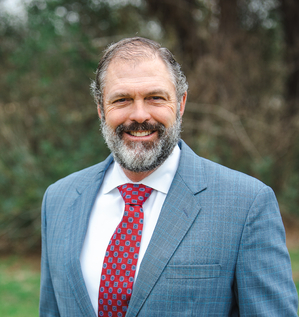
Forty years. Ten re-elections. One county. The brief account of the career of Ed Crapo, as the Property Appraiser of Alachua County – but the history of the figures is far more intriguing and to every one in the practice of property tax law in Florida, really worth knowing.
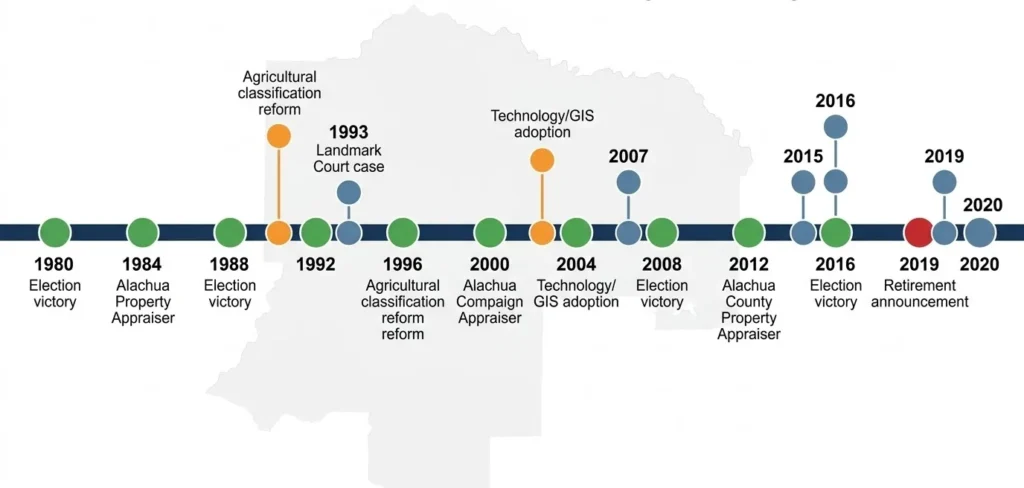
Crapo was born in a small community Jonesville, which is just west of Gainesville. He won the seat of the appraiser in 1980 and served it continuously until 2020, when he retired and did not run again. In any office of a government forty years is a long time. Being a county appraiser is nearly unheard of in the small town sense, as the majority of the residents rarely ever see the face of the appraiser until the tax bill is opened.
During that period, Crapo presided over a radical reinvention of the actual workings of property appraisals: the replacement of the paper-heavy manual assessments by GIS-style digital mapping, the broadening of the range of exemption categories, legislative reforms that opened up (and sometimes closed) the range of activities that the appraisers were and were not allowed to undertake. He was also and more so, a Democrat in a position that does not attract much partisanism. He said that he was always driven by fairness in valuation – steady, defendable in law as far as the court is concerned.
And hold up they did. The office of Crapo was also a habitual defendant and appellant in the district courts of Florida and especially the First District Court of Appeals at Tallahassee. His cases involved educational exemptions, charity use, governmental records, city property as well as the power boundaries of the Value Adjustment Board (VAB). A number of such rulings continue to influence the operations of Florida appraisers to date.
He has declared that he was not going to run again in 2019, saying that the people of Alachua County had given him 40 years of trust. Ayesha Solomon, who succeeded him, became the first Black property appraiser in the county and Crapo publicly celebrated this.
Key Policies and Practices
Crapo was a tight shipper in exemptions. His office was characterized by stringent scrutiny as opposed to rubber stamping approvals- which entailed rejections, appeals and court hearings as part of the proceedings. The principal classifications under his rule went on in the following manner:
Homestead Exemptions
The most widely applicable property tax relief program in Florida is the homestead exemption, which Crapo was very active in and his office used to take thousands of applications every year. Under § 196.031, Fla. Stat.:
- Base exemption: Up to $50,000 off assessed value for a primary residence
- Portability: Homeowners that move within the Florida state may transfer accrued Save Our Homes benefit to a new home.
- Due date: March 1 every year – fail to do it and you wait another year.
- Reasons to deny the application: Commercial use, does not conform to the residency requirements or the property is categorized in the agricultural use.
- Appeals route: Value Adjustment Board (VAB) – Crapo did not hesitate to appeal against the decision of VAB which he found to disagree with.
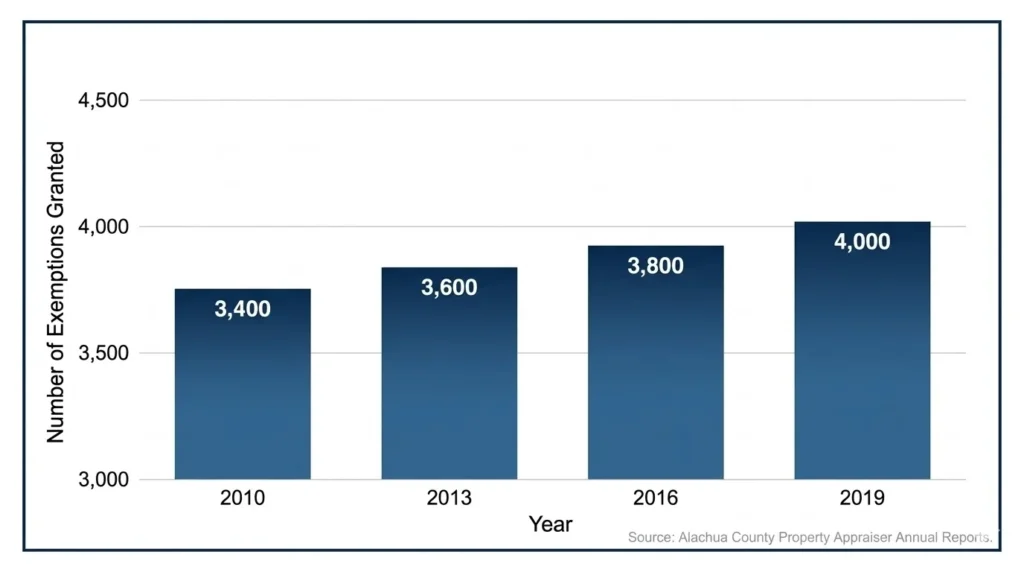
By the close of his reign, in the Alachua County alone, about 4,000 new homestead exemptions were being granted each year. In 2024, an Amendment 5 introduced an inflation modification clause based on the Consumer Price Index, which was directly based on the structure that the office of Crapo had applied over the decades.
Agricultural Classifications
This one generated more litigation than any other area. Agricultural classification under § 193.461, Fla. Stat. allows properties used for bona fide commercial agriculture to be assessed at use value rather than market value — a significant difference in land-rich counties like Alachua.
- Homesteaded portions excluded: Portions of property that receive homestead exemption cannot simultaneously receive agricultural classification — the homestead is residential, not commercial.
- Bona fide requirement: The use had to be genuinely commercial, not just someone running a few chickens to get a tax break.
- Tangible personal property returns: Required annually for equipment, livestock, machinery.
- Non-transferable: Classification didn’t automatically carry over when a property sold — new owners had to re-apply and re-qualify.
Crapo himself noted increased leniency industry-wide over his tenure but maintained what he considered a careful line between legitimate agricultural operations and what practitioners sometimes called ‘hobby farms with ambitions.’
Other Key Exemption Programs
- Veterans: Totally and permanently disabled veterans received full exemptions; partial exemptions available for other service-connected disabilities under § 196.081.
- Low-income seniors (65+): Additional exemption available beyond standard homestead, income-tested.
- Widows/widowers and disabled persons: Modest additional exemptions under § 196.202.
- Charitable/educational institutions: Required proof of active charitable operations — this was a recurring battleground (see the HCA and acupuncture school cases below).
- Tangible personal property: Businesses filing returns by April 1 got a $25,000 exemption on equipment and assets.
Notable Legal Cases
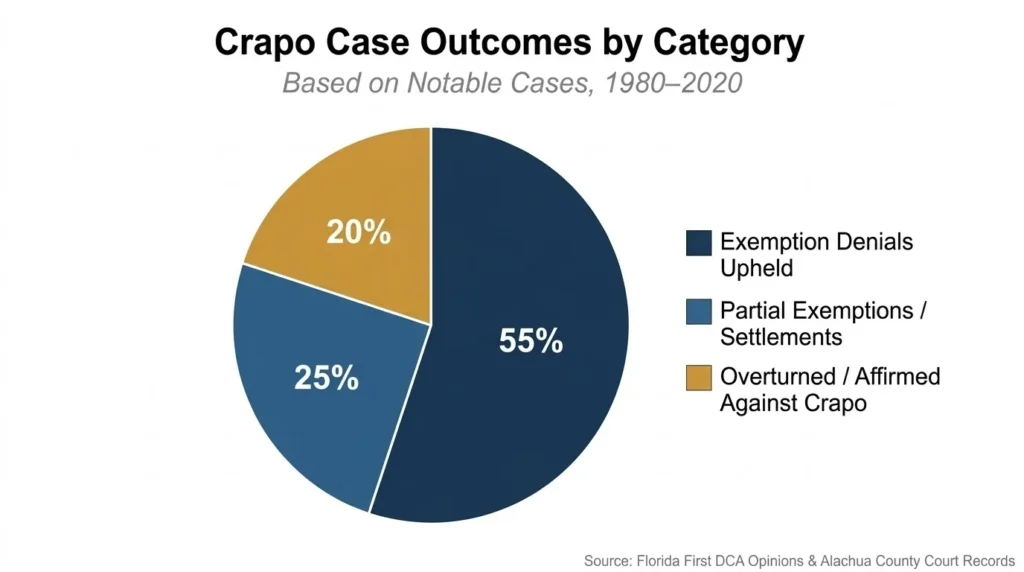
Forty years of aggressive enforcement means forty years of appeals. The table below summarizes the most significant cases from Crapo’s tenure — cases that, between them, touched nearly every major area of Florida property tax exemption law.
| Case Name | Year | Key Issue | Outcome | Implication |
| Crapo v. Palmer (1D15-3999) | 2016 | Public records exemptions — statutory basis required | Affirmed for Palmer | Custodians must cite exact statute for any exemption; no blanket denials |
| Crapo v. Academy for Five Element Acupuncture (1D17-1895) | 2018–2019 | Whether acupuncture school qualified as ‘educational institution’ under § 196.012(5) | Exemption denied | Strict reading of educational exemptions; accreditation standards apply |
| Crapo v. Florida Dept. of Revenue (1D19-2596) | 2020 | Authority to sue VAB without DOR approval | DOR denial affirmed | Appraisers need DOR finding of probable cause before suing VAB |
| City of Gainesville v. Crapo | 2007 | Exemption for municipal properties — public use requirement | Mixed; partial exemptions | Predominant public use test governs government-owned property |
| Crapo v. HCA, Inc. (1D06-5640) | 2007 | Charitable use exemption for hospital | Denial upheld | Healthcare nonprofits face heightened scrutiny |
| Alachua General Hospital v. Crapo | 1993 | Hospital exemption criteria | Denial affirmed | Clear charitable evidence required; purpose alone insufficient |
| Innovation Square LLC v. Crapo | 2015–2019 | Economic development exemptions for innovation hubs | Settlement | High-profile development cases often end in negotiation |
| University Cove Partners v. Crapo | Undated | Student housing exemptions near UF campus | Exemption denied | Private developments near universities not automatically exempt |
Note: Case outcomes sourced from Florida First DCA opinions and Alachua County court records.
Deep Dive: Crapo v. Palmer (2016)
Case No. 1D15-3999, decided March 24, 2016, by Florida’s First District Court of Appeal. This one didn’t involve property values or exemptions at all — it was a public records fight and the outcome mattered well beyond Alachua County.
Henry O. Palmer III filed a public records request with Crapo’s office. Crapo’s team withheld certain records, claiming exemptions. Palmer sued. The circuit court sided with Palmer. Crapo appealed.
The First DCA affirmed — unanimously, per curiam — and the reasoning was pointed. Judges Bilbrey, Jay and Associate Judge McCallum made two things very clear:
- You must cite the specific statute: Under § 119.07(1)(e), Fla. Stat. (2014), a custodian who withholds records can’t just say ‘this is exempt.’ They have to name the exact statutory provision. The court cited Wait v. Florida Power & Light Co., 372 So. 2d 420 (Fla. 1979), which has long held that exemptions from Florida’s public records law must be expressly authorized by statute and construed narrowly.
- Delay has limits: Citing Tribune Co. v. Cannella, 458 So. 2d 1075 (Fla. 1984), the court reiterated that delays in producing records are permissible only for the time reasonably needed to retrieve and redact — not indefinitely while the custodian decides whether they want to comply.
For Crapo’s office specifically, the ruling underscored a tension that property appraisers across Florida deal with constantly: exemption application files contain sensitive personal data — income information, disability status, Social Security numbers. There’s a real privacy interest there. But the path to protecting that information runs through specific statutory exemptions, not general reluctance to produce.
Law firms handling records disputes in Florida — particularly involving county agencies — regularly cite this case. It’s clean precedent for the proposition that broad or vague exemption claims don’t fly. Want to withhold it? Show the statute.
Broader Implications for Florida Property Tax Law
Zoom out from the individual cases and a few consistent themes emerge — themes that matter if you’re advising clients on Florida property tax strategy today.
- The burden is on the applicant. Across Crapo’s caseload, courts consistently reaffirmed that under § 194.301, Fla. Stat., property appraiser’s assessments carry a presumption of correctness. Overcoming that presumption requires preponderant evidence, not just a competing opinion or a lower number. That’s a meaningful burden and it filtered out a lot of appeals.
- Charitable and educational exemptions are not self-executing. The acupuncture school case is a good example. An institution can genuinely believe it’s educational — but if it doesn’t meet the statutory definition under § 196.012(5), the belief is irrelevant. Same story with the HCA hospital case. Being a nonprofit or operating in the healthcare space doesn’t automatically get you an exemption. The use has to be predominantly charitable, consistently and demonstrably so.
- The VAB is powerful — but not unchecked. Crapo’s dispute with the Department of Revenue over his authority to sue the VAB revealed something important: the oversight structure is real. Appraisers can challenge VAB decisions under § 194.036(1)(c), but they need DOR to find probable cause of consistent statutory violations first. It’s a significant procedural hurdle — and one that, in practice, limits the frequency of those suits.
- Technology changed everything. Crapo came into office in an era of paper records and in-person assessments. He left in a world of digital parcel mapping, GIS-driven valuations and online exemption portals. The legal framework evolved more slowly — many of the core statutes he worked under in 2020 would’ve been recognizable in 1985 — but the administrative capacity to apply them consistently across a growing county expanded substantially.
- Public records in tax administration are a live issue. The Palmer case is a reminder that appraiser’s offices hold genuinely sensitive data. Florida’s public records law is one of the strongest in the country — see Art. I, § 24, Fla. Const. — and the tension between transparency and privacy doesn’t go away. Post-2020 developments, including updated Florida Department of Revenue guidance on records access, continue working through exactly these issues.
Conclusion
Ed Crapo spent four decades doing a job most Florida residents barely knew existed — until their assessment arrived and they disagreed with it. His legacy isn’t dramatic in the way that elected officials sometimes seek. It’s quieter than that. It’s in the body of case law that came out of his office’s willingness to defend denials and test the boundaries of statutory authority.
For practitioners, that body of law is actually quite useful. The cases from his tenure clarify the contours of educational and charitable exemptions, define the procedural limits on VAB challenges, establish the specific-citation requirement for public records exemptions and reinforce the burden structure that governs Florida property tax appeals.
His retirement in 2020 closed a particular chapter in Alachua County’s administrative history. But the decisions that came out of his office — and the courts that reviewed them — remain active precedent. If you’re handling a property tax matter in Florida, there’s a reasonable chance something Crapo litigated is sitting somewhere in the relevant case law.