 Jeffrey S. Kelly Group PLLC (Real Estate)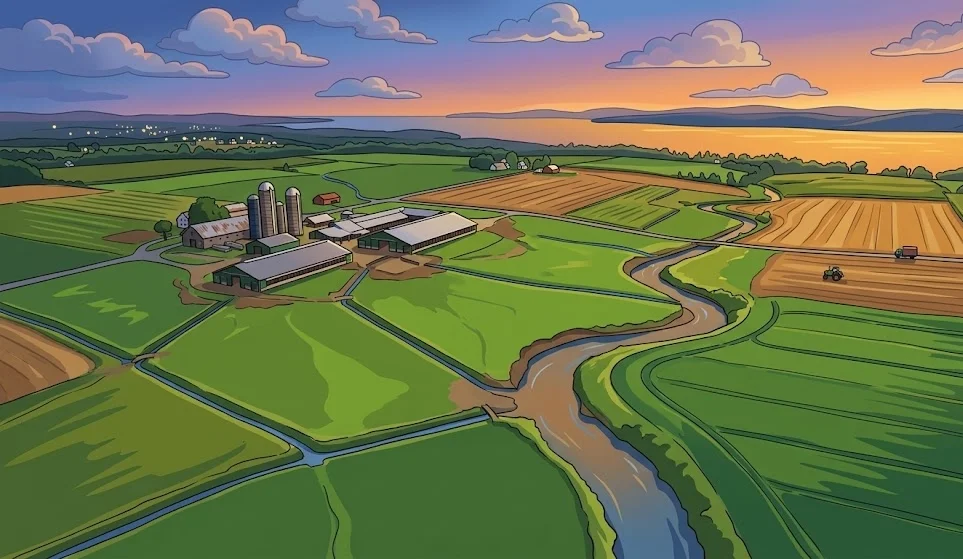
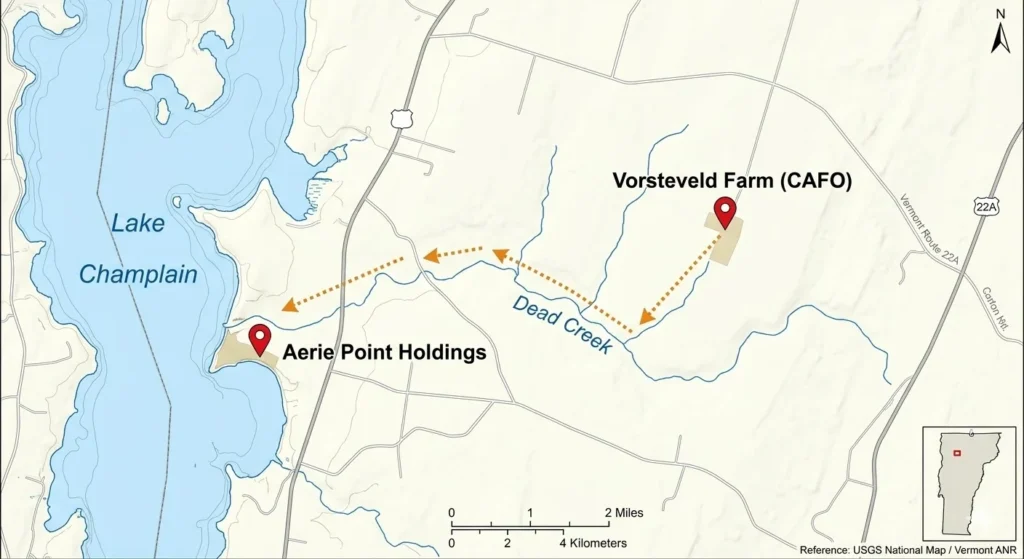
Panton, Vermont. Dairy country. Lake Champlain on the western horizon. Not where you’d expect a legal saga spanning half a decade, four Supreme Court rulings, EPA intervention, and fines hitting $1,000 a day. But that’s exactly what grew out of a 2017 decision to install underground drainage pipes on a large dairy farm and it’s still not over.
The case, Aerie Point Holdings, LLC v. Vorsteveld Farm, LLC, (Vermont Supreme Court No. 23-AP-326, decided May 24, 2024) has become one of the most closely watched agricultural-environmental disputes in Vermont’s recent history. At its core, it asks a question that’ll come up again and again as farms modernize: when does improving your land become damaging someone else’s?
The Parties
Two neighbors. Very different scales.
- Aerie Point Holdings, LLC — The Hopper family’s 138-acre property. Grassland, woodland, Lake Champlain shoreline. Recreational use, limited agriculture. Downslope from the farm, directly in the path of drainage outflows.
- Vorsteveld Farm, LLC — Operated by brothers Rudy, Hans, and Gerard Vorsteveld. A full-scale Concentrated Animal Feeding Operation (CAFO) with over 2,300 dairy cows, roughly 2,800 acres of cropland, and 119 miles of tile drainage pipes running beneath 250 acres of fields.
What the Tile Drains Actually Did?
Before 2017, water moved through the clay-heavy soil between these properties slowly, in small amounts, predictably. The tile drain installation changed all of that. Water that used to seep gradually now moved fast, through eight-inch perforated pipes, and discharged at high velocity into public ditches, culverts under Arnold Bay Road, and directly into two streambeds on Aerie Point’s land.
What changed, specifically:
- Seasonal streams became year-round, widening and deepening their channels.
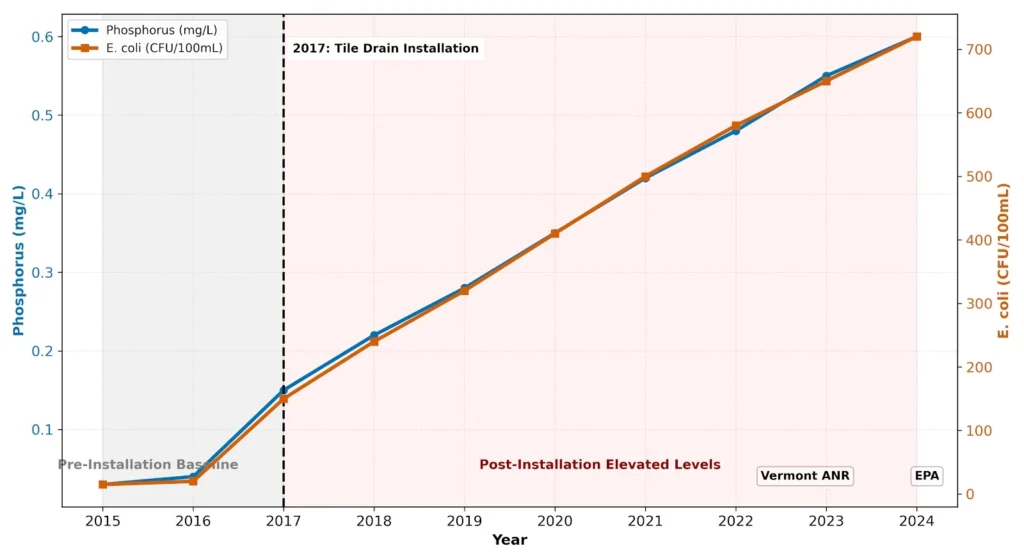
- Sediment, phosphorus, and E. coli moved with every discharge event.
- Aerie Point’s Lake Champlain shoreline eroded visibly.
- Algae blooms appeared in ponds and along the lakeshore.
- Odors from manure pits compounded the interference with property use.
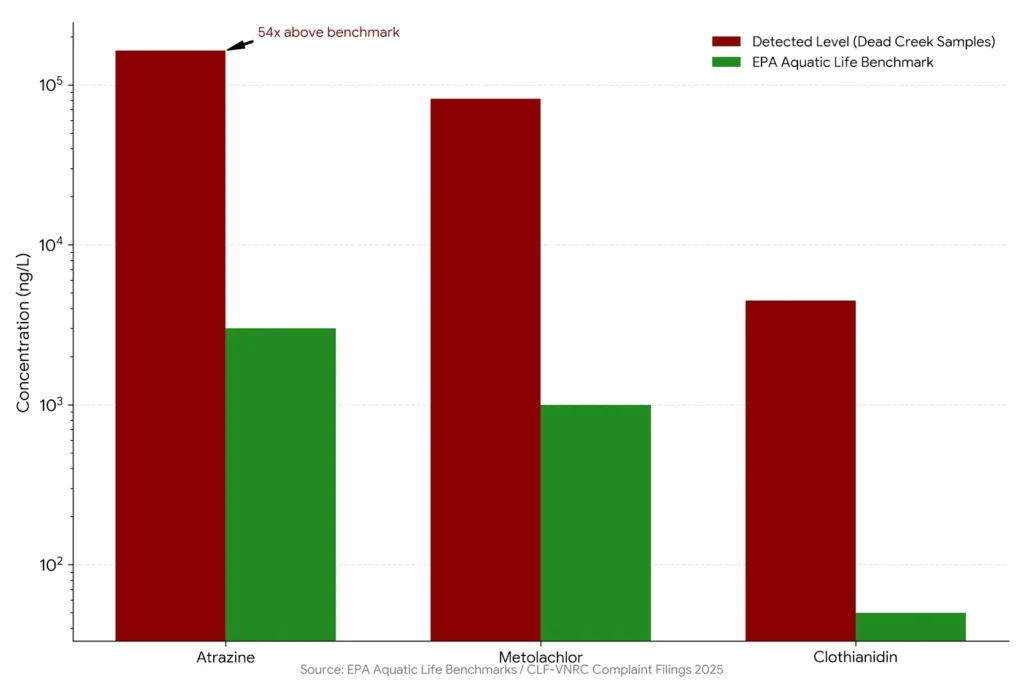
- Pesticides including atrazine, metolachlor, and clothianidin were detected in runoff.
The climate change argument came up Vorsteveld pointed to changing rainfall patterns as a contributing cause. The trial court acknowledged it but didn’t buy it as the primary driver. The pipes were the problem.
Procedural History: Five Years and Counting
This case didn’t resolve quickly it multiplied. Here’s the full timeline:
| Date | Event |
| 2017 | Vorsteveld installs subsurface tile drain system across 250 acres |
| April 2020 | Aerie Point files suit in Addison Superior Court |
| March 2022 | 5-day bench trial; Judge Teachout finds for Aerie Point on trespass and nuisance |
| August 15, 2022 | Injunction issued; prohibits tile drain water from flowing into public ditches/culverts |
| April 2023 | Vermont Supreme Court affirms judgment finality (No. 22-AP-279) |
| August 2023 | Vorsteveld files Rule 60(b) motion seeking relief from injunction |
| June 2023 | Aerie Point moves for contempt discharges continuing |
| January 2024 | Trial court finds contempt by clear and convincing evidence |
| May 2024 | Supreme Court affirms denial of 60(b) motion (2024 VT 29) |
| Summer 2024 | EPA files federal CWA lawsuit for wetland destruction and unpermitted discharges |
| September 2024 | $1,000/day fines begin November 2024; attorney fees ordered |
| December 2025 | CLF/VNRC file citizen suit over Dead Creek discharges from 11+ pipes |
| May 2025 | Supreme Court affirms contempt ruling and fines (No. 24-AP-258) |
The 60(b) motion is worth pausing on. Vorsteveld argued, essentially, that things had changed enough since the original judgment to warrant revisiting the injunction. The EPA had gotten involved (which they framed as a preemptive federal action). Vermont amended its Right-to-Farm law in 2022 to specifically include subsurface drainage. They’d spent money trying to comply. The Supreme Court wasn’t persuaded. “Costs and inconvenience,” the court noted, aren’t the same as inequity requiring relief under Rufo v. Inmates of Suffolk County Jail, 502 U.S. 367 (1992).
Legal Analysis: Why the Farm Kept Losing
Trespass
Vermont common law on water diversion isn’t complicated, but it’s strict. The controlling principle, reinforced in Myrick v. Peck Electric Co., 2017 VT 4, is that redirecting water beyond natural drainage patterns onto someone else’s property is a trespass. Pre-2017, the water moved slowly. Post-drain, it moved fast and concentrated. That change in character not the water itself was the trespass.
Nuisance
Nuisance under Vermont law, going back to Coty v. Ramsey Associates, 149 Vt. 451 (1988), requires unreasonable and substantial interference with use and enjoyment of property. The erosion, the algae, the odors taken together satisfied that test. The court weighed the utility of Vorsteveld’s farming operations against the harm, as nuisance analysis requires. The scale of the harm tipped the balance.
The Right-to-Farm Defense and Why It Failed
This is the part agricultural lawyers should study carefully. Vermont’s Right-to-Farm law, 12 V.S.A. §§ 5751–5754, is a real shield when it applies. It protects established farm operations from nuisance claims when the operation: (1) predates surrounding non-agricultural uses, (2) is conducted in a legal manner, and (3) follows good agricultural practices.
Vorsteveld failed on all three.
- The tile drain system was new — installed in 2017, it didn’t predate Aerie Point’s use of the property.
- The operation wasn’t conducted in a legal manner — CWA violations and EPA scrutiny predated the trial.
- “Good practices” requires more than intent — actual regulatory compliance under 6 V.S.A. § 4802(10) was not demonstrated.
Vermont amended the RTF law in 2022 (Act No. 162) to explicitly include subsurface drainage among protected activities. Then in 2025, Act 61 went further removing the “preexisting” and “unchanged practices” requirements. For future cases, that matters. For Vorsteveld, it came too late and didn’t cure the core compliance failures.
The Clean Water Act Dimension
This is where the case gets expensive and federal. The Clean Water Act, 33 U.S.C. §§ 1251 et seq., prohibits unpermitted discharge of pollutants from point sources into navigable waters. Tile drain pipes are point sources. Dead Creek, which drains into Lake Champlain, is a navigable water under federal jurisdiction.
The CLF/VNRC citizen suit filed in December 2025 brought hard numbers. Atrazine detected at up to 164,000 ng/L versus the EPA’s benchmark of 3,000 ng/L. Clothianidin exceeded benchmarks in 99% of samples collected over two years. That’s not a close call under § 1311(a).
Enforcement Actions at a Glance
| Action | Year | Outcome / Status |
| State Settlement | 2021 | $21,750 fine for wetland violations and CWA non-compliance |
| Private Civil Suit | 2020–present | Injunction issued; $1,000/day fines; contempt affirmed by Supreme Court |
| EPA Federal Lawsuit | 2024–pending | Wetland destruction and unpermitted discharges under CWA §§ 1311, 1344 |
| CLF/VNRC Citizen Suit | 2025–pending | 11+ discharge pipes into Dead Creek; seeks injunction, NPDES permit, penalties |
Broader Implications: What This Case Is Really Telling Us
The Vorsteveld case isn’t just about one farm in Panton. It’s a preview of litigation that’s going to keep happening as agricultural drainage intensifies, water quality standards tighten, and neighboring landowners get more legally sophisticated about their options.
A few things worth flagging:
- RTF laws have real limits. The 2022 and 2025 amendments strengthen protection but they don’t override baseline regulatory compliance. A farm that can’t demonstrate it’s operating legally under state and federal law doesn’t get the shield.
- Contempt fines accumulate. Vorsteveld spent $1.1 million attempting various fixes and still faced $1,000/day fines when discharges continued. Partial effort isn’t compliance.
- Federal and state actions compound, not cancel. The preemption argument that EPA involvement should displace the state injunction was rejected. International Paper Co. v. Ouellette, 479 U.S. 481 (1987) was distinguished. State courts can and will enforce their own injunctions regardless of parallel federal proceedings.
- The NPDES permit question is live. CAFOs discharging via tile drains into waterways may need NPDES permits they don’t currently hold. That’s a regulatory exposure that predates any lawsuit and one worth auditing proactively.
- Expansion approvals don’t equal legal compliance. Vorsteveld received expansion approval in 2025 despite active violations. Regulatory approval and civil/environmental liability are separate tracks.
Drain Infrastructure Is Legal Infrastructure
If there’s one takeaway from watching this case develop, it’s that agricultural infrastructure decisions aren’t just engineering decisions. Installing tile drains across 250 acres didn’t just change water flow it triggered trespass liability, nuisance claims, contempt proceedings, EPA enforcement, and two separate environmental citizen suits. That’s an extraordinary amount of legal exposure from a drainage upgrade.
Vermont’s RTF reforms are moving in a direction that offers farmers more protection than they had five years ago. But those protections hinge on operating legally and following good practices and those aren’t things you establish retroactively after a lawsuit is filed.
For farms operating near wetlands, tributaries, or Lake Champlain’s watershed, the better path is front-end compliance: water quality assessments before major drainage changes, NPDES permit reviews, and early coordination with Vermont’s Agency of Natural Resources. The Vorsteveld case shows what the alternative looks like and it’s expensive.