 Juan L. Guerra (Criminal Defense Lawyer)
Key Takeaways:
- Only the personal representative of the deceased’s estate can file a wrongful death lawsuit in Illinois — not the spouse, not the children, not the parents directly.
- If there’s no will, the probate court appoints a representative. Usually a close family member, but it doesn’t have to be.
- Illinois runs two separate claims from the same death: the Wrongful Death Act (740 ILCS 180) and the Survival Act (755 ILCS 5/27-6). They compensate different people for different losses.
- The statute of limitations is 2 years from the date of death — not the date of injury. Miss it, and you’re done.
- Since August 2023, Illinois families can now pursue punitive damages in wrongful death cases thanks to House Bill 219. No cap on the amount.
- Suing a government entity? Different rules. You need to send written notice within 6 months and file within 1 year.
Who Actually Has Standing to File in Illinois?
It is assumed by the majority of the population that the lawsuit is initiated by the surviving husband or wife. It is the case in Texas and some few states. Not in Illinois.
According to Illinois Wrongful Death Act (740 ILCS 180/1), the action must be initiated by the personal representative of the estate of the deceased person. In the case your husband appointed you to be an executor in his will, then no, you are the one filing. However, without a will there will be no will to the will, and then you will have to apply to the probate court to be appointed as an administrator before the wrongful death case will even start.
That is one of the steps that a family does not anticipate. You are mourning, you are arranging the funeral expenses, and now they tell you that you have to go to the probate court first. It’s not optional.
The personal representative does not retain any of the money, however. Whichever is recovered is passed to the other spouse and the next of kin. The representative is also more of a manager of the legal process rather than a beneficiary.
What “Next of Kin” Means Under Illinois Probate Law
The Illinois Probate Act (755 ILCS 5/) defines next of kin as the deceased’s closest living relatives. The priority order runs like this:
- Surviving spouse — always first in line.
- Children — biological and legally adopted. If the spouse is also alive, both share.
- Parents — if there’s no surviving spouse or children.
- Siblings — only if no one higher on the list is alive.
One thing the competitors ranking for this topic barely mention: fiancé(e)s. Under Illinois law, a fiancé can technically file a wrongful death suit if they’re named executor in the will or appointed by the probate court. But they’re not favoured in practice. Unless a close family member nominates them, courts generally don’t grant fiancé(e)s standing. And even if they file, they can’t recover damages unless the will specifically names them as a beneficiary.
The Difference Between a Wrongful Death Claim and a Survival Action
This confuses almost everyone, including some lawyers who don’t practise in this area regularly.
Illinois has two separate statutes that apply when someone dies because of another person’s negligence. They look similar on paper. They’re not.
- The Wrongful Death Act (740 ILCS 180) compensates the survivors — spouse, kids, parents — for what they lost. Lost income the deceased would have provided. Loss of companionship. Emotional suffering. Funeral expenses. The money goes directly to the family.
- The Survival Act (755 ILCS 5/27-6) is about the deceased person’s own claim. Whatever legal action the dead person could have brought if they’d survived — medical bills from the injury, lost wages between the injury and death, pain and suffering they experienced before dying — that claim doesn’t die with them. It “survives” and the estate can pursue it.
The practical difference matters because the Survival Act money goes to the estate, not directly to family members. It gets distributed according to the will or Illinois intestacy laws if there’s no will. That means creditors might take a cut before family sees anything.
A competent wrongful death lawyer will file both claims from the same incident. Many families don’t realise they’re leaving money on the table by only pursuing one.
How the 2023 Punitive Damages Law Changed Everything
For decades, Illinois was one of sixteen states that blocked punitive damages in wrongful death cases entirely. If someone’s recklessness killed your family member, you could recover compensatory damages — but you couldn’t punish them financially for the behaviour itself.
That was until Aug. 11, 2023, when Gov. J.B. Pritzker signed House Bill 219 into law.
The backstory matters here. The Illinois Supreme Court ruled this way in Marston v. 2009. 358, 929 N.E.2d 110, affirming 232 Ill.2d 432,619 N.E.2d 100 (1993). 3d 337) and overturned a 25 million punitive damage award and that it did not pass upon the plaintiff’s death unless the legislature clearly stated otherwise. The court, in effect, dared the legislature to act. It took them 14 years, but they did.
Currently, where death claims arise after August 11, 2023, the personal representative, spouse and next of kin can all recover punitive damages. Illinois was an exception: There was no cap on the amount that could be recovered. The other 34 states that allow punitive damages in wrongful death cases impose those limits either with a dollar figure set in stone or as a ratio to compensatory damages.
There are exceptions. Punitive damages were never permitted with respect to the acts of a governmental body and they do not apply in actions for medical malpractice or legal malpractice. But as far as everything else—drunk driving deaths, nursing homes negligence, workplace safety failures—the defendants have merely been added to an even larger stack of litigant case files.
The Adams Family Verdict: $12.2 Million for Nursing Home Neglect
Shirley Adams was 79 and lived on Chicago’s West Side. Though she had early-stage dementia, she was in good physical health when her family admitted her to Lakeview Rehabilitation and Nursing Center on the North Side in June 2021.
Three months later, she developed pressure ulcers. She had gone from having to walk, then a wheelchair. The wounds went untreated. By November 2021, the family had pulled her out, sending her to a different facility, but it was too late. The following year and a half, she had more than twenty operations as well as dressing changes every day. She died in February 2023 from infections caused by those pressure sores.
Her family sued. The jury deliberated about an hour and a half following the three-day trial in Cook County and awarded the plaintiff a $12.2 million verdict, which was the largest nursing home wrongful death verdict on record in Illinois history. The case alleged chronic understaffing and insufficient supervision at Lakeview that allowed the wounds to become infected and worsen into something fatal.
The Illinois Department of Public Health’s own records listed Lakeview with multiple violations and penalties, including roughly $27,200 in fines from a July 2024 action alone.
The Landmark of Richton Park Case: $5.5 Million for Missed Dialysis
This one is harder to read.
A senior gentleman aged 85 was admitted into Landmark of Richton Park a nursing home in the south of Chicago due to a severe fall. He was required to get dialysis three times in a week. He was not subjected to any dialysis session during his 13 days stay. Not one.
The facility did not inform his family. Later he was discovered to be unconscious in his room. He died a few days later due to the accumulation of toxic waste, which is a direct consequence of the lack of almost two weeks of dialysis, which was managed by emergency responders.
A jury at Cook County gave a verdict of 5.5 million. The three hours were spent in deliberation. Defence had advised that the jury should give the family a compensation of 350,000. The attorneys of the family claimed that the facility had several chances to get involved, but it did not.
The case took five years to reach trial. The nursing home only admitted liability and causation one week before the trial started — a tactic that actually kept some of the worst evidence out of the courtroom.
The Pregnant Woman Who Lost Her Baby: $7.25 Million Verdict
An Illinois jury returned a $7.25 million verdict in a medical malpractice wrongful death case involving a 35-week pregnant woman who was taken to a county hospital after being involved in an automobile accident (Lappe v. Cook County Health and Hospitals, et al., 2023). She was concerned because her baby hadn’t moved since the wreck.
The hospital staff did not monitor the baby’s heart rate sufficiently. When they finally began proper monitoring, the situation had already deteriorated badly enough to require an emergency C-section. The baby didn’t survive.
Sequelae including neurological disability.”The evidence at trial established that had standard fetal monitoring been performed it would have likely prevented the child’s death without any neurological sequelae. That was the whole point, except for the delay.
This case illustrates something families need to understand about Illinois wrongful death law: when a baby dies during birth or shortly after due to medical negligence, the parents can pursue a wrongful death claim even though the child never earned income or provided financial support. The damages centre on loss of companionship and the emotional devastation of losing a child.
Statute of Limitations: The Deadlines That Kill Cases
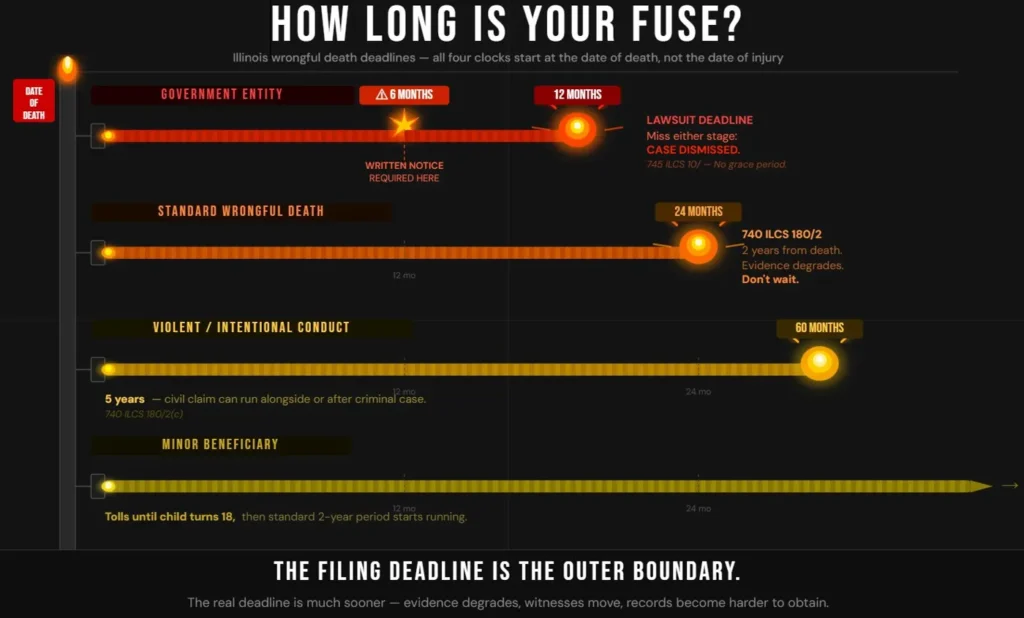
Illinois gives you two years from the date of death to file a wrongful death lawsuit under 740 ILCS 180/2. Not two years from the date of injury — the date of death. If someone gets hurt in January 2024 and dies from those injuries in November 2025, the clock starts ticking in November 2025, and the family has until November 2027.
But there are traps built into this system.
- Government entities play by different rules entirely. Under the Illinois Local Governmental and Governmental Employees Tort Immunity Act (745 ILCS 10/), you need to send written notice within 6 months of the death and file the lawsuit within 1 year. Miss the notice deadline? Case over. Miss the lawsuit deadline? Also over. There’s no grace period.
- Violent intentional conduct actually gives you more time — five years instead of two — under 740 ILCS 180/2(c). So if someone was murdered and the family wants to pursue a civil wrongful death claim alongside or after the criminal case, the window is wider.
- Minors as beneficiaries can extend the timeline too. If a child is an eligible claimant, the statute of limitations may toll until the child turns 18, then the standard 2-year period starts running.
The worst mistake families make? Assuming they have plenty of time. Evidence degrades. Witnesses forget details or move. Medical records get harder to obtain. The filing deadline is the outer boundary. The real deadline is much sooner.
Can You File Without a Lawyer?
Technically, yes. Illinois does not need an attorney to represent it in civil proceedings, and the Wrongful Death Act does not indicate that you need one. Any personal representative may file pro se.
Practically it is a different song when one does it single-handedly against a legal team of an insurance company.
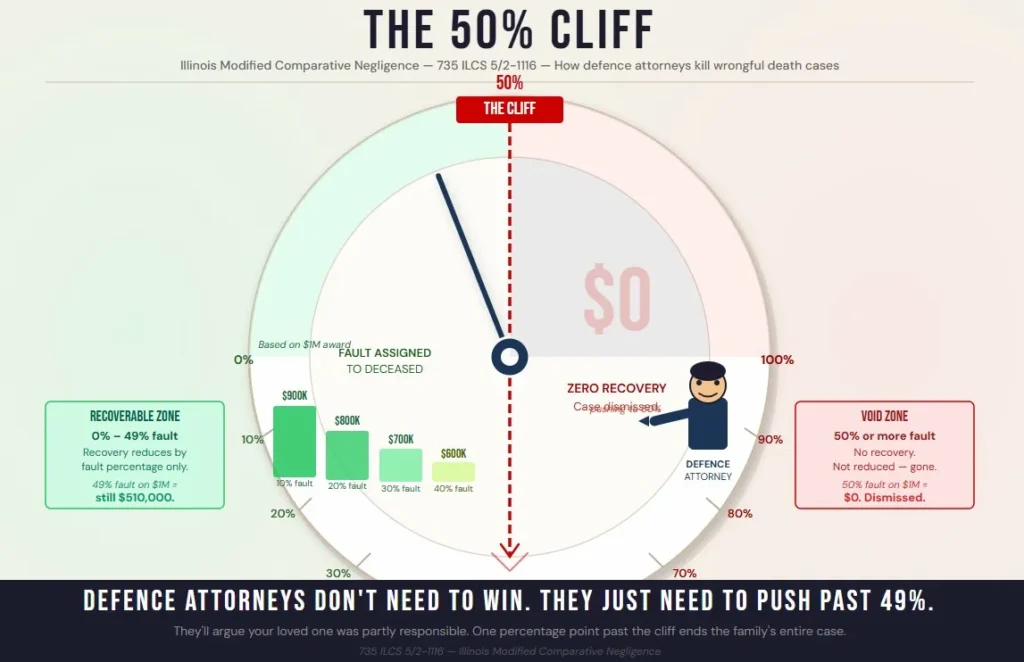
Illinois applies an amended comparative negligence rule in 735 ILCS 5/2-1116. In case the deceased is established to have died 50 percent or above due to his /her faults, then the family is not refunded anything. Zero. Defence lawyers are aware of this and will vehemently present contributory fault in order to pay less or nothing at all. Trying to negotiate the deposition, expert witness, procedural rules of Cook County without legal training is a grave danger.
The finances also prefer taking counsel. The majority of the wrongful death lawyers in Illinois are contingent and have no initial charges, they get a percentage of the gain. So the barrier isn’t cost. The obstacle is that one needs to locate someone who has the experience necessary in your particular case.
What Damages Can the Family Actually Recover?
Illinois doesn’t cap wrongful death damages for claims against private parties. That’s a significant advantage compared to states like Texas, where claims against government entities are capped at $250,000 per person.
The one exception: if you’re suing the State of Illinois itself, total damages are capped at $2 million (adjusted annually for inflation) under 705 ILCS 505/8, unless the death was caused by negligent operation of a state vehicle.
For everyone else, the recoverable damages include:
- Lost financial support — earnings, benefits, gifts, and inheritance the deceased would have provided.
- Loss of consortium — the loss of companionship, affection, and in spousal cases, the loss of a sexual relationship.
- Loss of parental guidance — instruction, education, and moral training the deceased would have given surviving children.
- Funeral and burial costs.
- Punitive damages — for actions filed after August 11, 2023, in cases involving extreme or outrageous misconduct (excluding medical malpractice, legal malpractice, and government defendants).
Under the Survival Act, the estate can also recover the deceased’s medical bills, lost wages from injury to death, and pain and suffering experienced before death. These are separate from and in addition to the wrongful death damages.
What Happens When There’s No Will?
More common than you’d think. If the deceased died intestate — meaning there was no will — the family must petition the probate court for an administrator to be appointed. The appointment is typically given to a spouse or an adult child but not guaranteed.
Until such appointment happens there isn’t anyone who can pursue the wrongful death claim. And the 2-year statute of limitations keeps running so long. The legal clock does not stop when someone dies, which is why families need to start the probate process as soon as they can — and not because they want to do paperwork while mourning.
The appointment of a probate court is also pertinent for the manager of any recovery pursuant to the Survival Act, as any such recovery will go through the estate and will be governed by Illinois intestacy law distribution (755 ILCS 5/2-1). Without a will, the formula of intestacy will divide assets between descendants and spouse in specific proportions. With children, one of the spouses that survives receives half of the inheritance. If there is no spouse, children split all equally.
When to Contact a Wrongful Death Lawyer
The honest answer is immediately. Not because of a sales pitch, but because evidence preservation is time-sensitive and the probate process takes time to initiate. If you’re dealing with a loss in Illinois caused by someone else’s negligence — whether it’s a car accident, medical error, nursing home neglect, or workplace incident — getting a wrongful death lawyer involved early protects the family’s options.
The consultation is usually free. The representation is contingency-based. And the 2-year clock is already running.
References
- Illinois Wrongful Death Act, 740 ILCS 180/1 et seq. — https://www.ilga.gov/legislation/ilcs/ilcs3.asp?ActID=2059
- Illinois Survival Act, 755 ILCS 5/27-6 — https://www.ilga.gov/documents/legislation/ilcs/documents/075500050K27-6.htm
- House Bill 219, Public Act 103-0514 (signed August 11, 2023) — punitive damages amendment to the Wrongful Death Act and Survival Act.
- Marston v. Walgreen Co., 389 Ill. App. 3d 337, 346 (2009) — Illinois Supreme Court ruling that punitive damages do not survive death absent legislative authorisation.
- Adams v. Lakeview Rehabilitation and Nursing Center, LLC — Cook County verdict, $12.2 million (November 2025). Reported by FOX 32 Chicago — https://www.fox32chicago.com/news/chicago-family-verdict-nursing-home-death-case
- Landmark of Richton Park wrongful death verdict — Cook County, $5.5 million (2023). Reported by Malman Law — https://www.malmanlaw.com/malman-law-injury-blog/chicagos-law-firm-awarded-5-5-million-verdict-the-largest-nursing-home-verdict-in-illinois-history/
- Illinois Local Governmental and Governmental Employees Tort Immunity Act, 745 ILCS 10/.
- Illinois Modified Comparative Negligence, 735 ILCS 5/2-1116.