 Aarthy Venkat Head - Strategy at SignDesk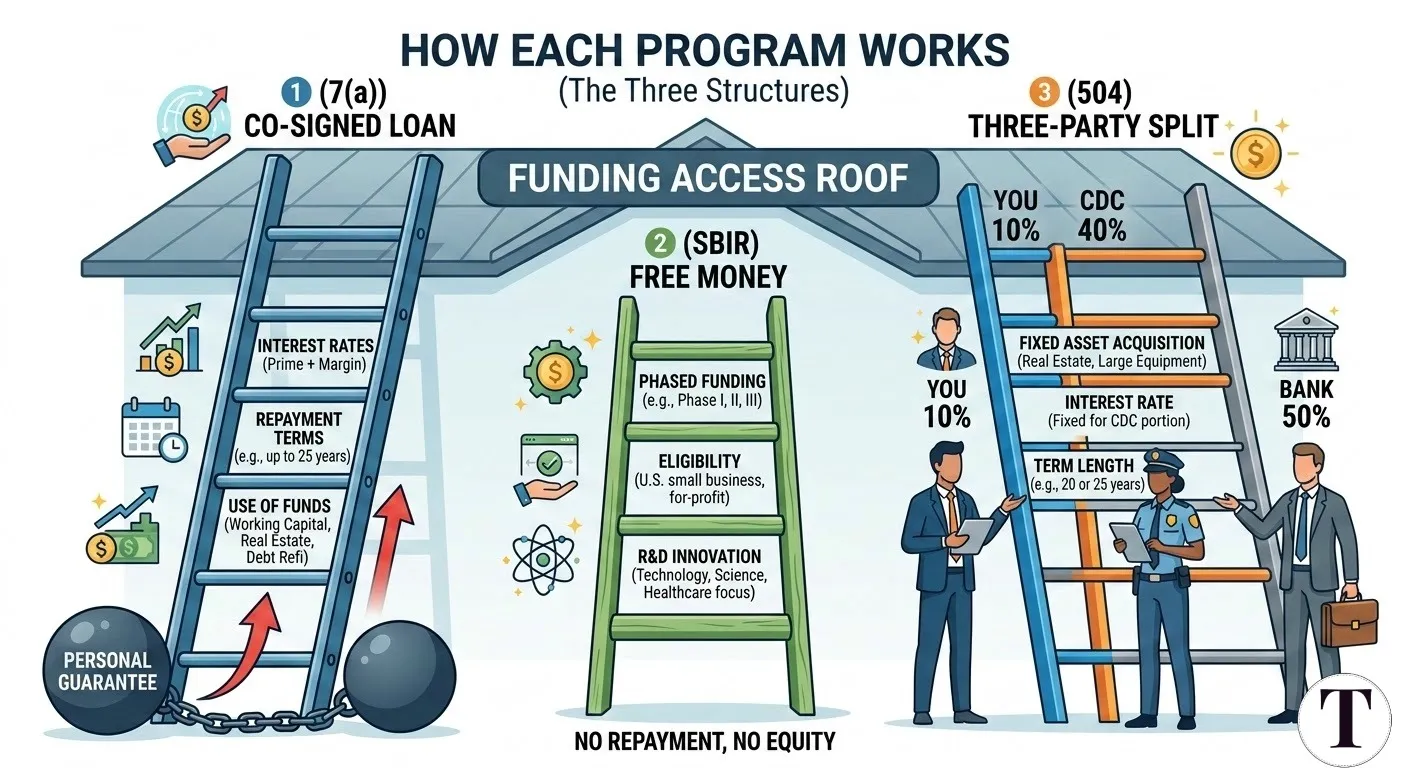
The federal government spent $44.8 billion backing small business loans in fiscal year 2025 alone. Separately, it handed out billions more in grants that never have to be repaid. These aren’t hidden programs. They exist under federal law, administered by agencies with offices in every state, and they’re designed specifically to help businesses grow.
Most business owners have no idea they exist. Or they’ve heard the acronyms — SBA, SBIR, 504 — and assumed the process was too bureaucratic to bother with. That assumption costs them.
What follows are three federal programs rooted in actual statutes, backed by real funding numbers, and illustrated by businesses that used them to do exactly what you might be trying to do right now — expand, hire, build, or survive. Each one comes with legal requirements that trip up applicants who don’t know what they’re walking into. A smart money management strategy isn’t just about budgets and spreadsheets. It starts with knowing what money is available to you and what the law says you need to do to get it.
The SBA 7(a) Loan Program — $37 Billion in Government-Backed Business Loans
The 7(a) loan program is the federal government’s flagship tool for small business lending. It’s authorized under Section 7(a) of the Small Business Act, codified at 15 U.S.C. §636. The SBA doesn’t hand you the money directly. Instead, it guarantees a portion of a loan issued by a private lender — typically a bank — which means the bank takes on less risk and you get approved for financing you’d otherwise be denied.
In fiscal year 2025, the SBA guaranteed 77,600 loans through this program worth $37 billion. That works out to roughly 320 loans approved every workday, averaging about $170 million per day in guaranteed capital flowing to American small businesses.
The guarantee itself is significant. For loans under $150,000, the SBA guarantees up to 85% of the loan amount. For larger loans, the guarantee drops to 75%. That guarantee is what makes lenders willing to say yes to businesses that don’t fit the traditional lending mold — newer companies, owners with limited collateral, or businesses in industries that banks consider higher risk.
I’m a business owner reading this and wondering — so the government basically co-signs my loan? In a sense, yes. But the legal obligations that come with it are where most people get surprised.
What the law requires to qualify:
- The business must operate for profit within the United States.
- It must meet SBA size standards, which vary by industry. A retail business might qualify with up to $7.5 million in annual revenue. A manufacturing operation could have up to 500 employees and still be considered “small.”
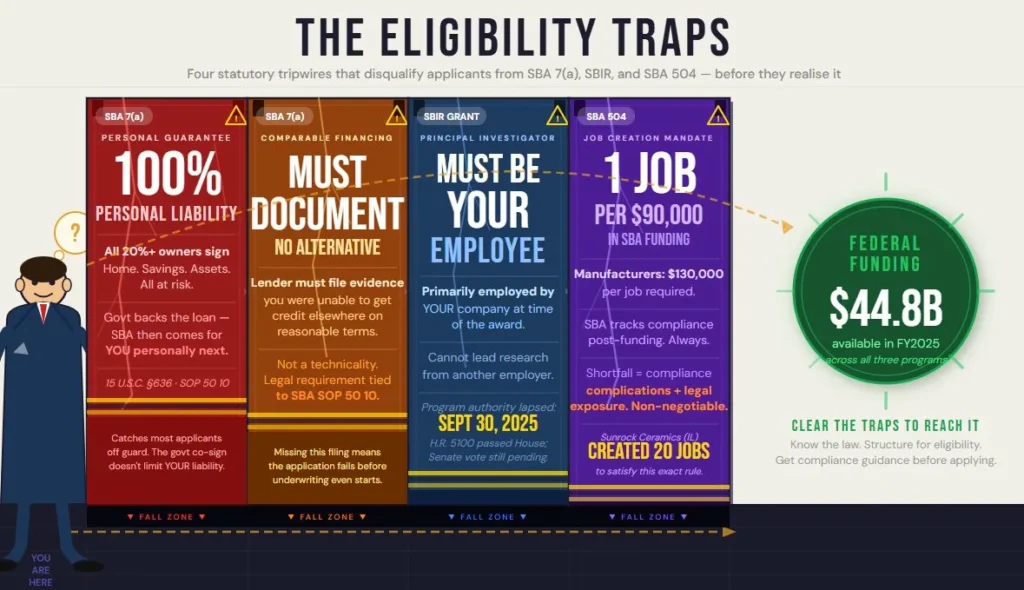
- The owner must demonstrate an inability to get comparable financing elsewhere on reasonable terms. This isn’t a technicality. The SBA requires lenders to document that the borrower couldn’t get the same deal through conventional means.
- Personal guarantees are required from anyone who owns 20% or more of the business. That means your personal assets — home, savings, everything — are on the line if the business defaults.
- The business must not be engaged in speculative activity, lending, gambling, or other ineligible industries defined under 13 CFR §120.110.
That personal guarantee clause catches people off guard. You’re thinking the government is backing the loan, so your personal risk is limited. It’s not. If the business fails and the SBA pays out on its guarantee to the lender, the SBA can — and does — come after the individual guarantors for repayment.
How a Philadelphia Health Care Company Used 7(a) to Scale
A home health care company in Philadelphia was drowning in demand it couldn’t meet. The business needed more staff, better medical equipment, and a digital scheduling platform that could handle a growing patient load. Traditional banks wouldn’t touch the loan — too much perceived risk in a service-based health care operation without hard assets to collateralize.
Through an SBA 7(a) loan, the company secured the capital to hire additional clinical staff, upgrade its equipment, and build out its technology infrastructure. Within six months, the client base had expanded significantly, service efficiency had improved, and revenue had grown enough to cover the loan payments comfortably.
The difference between this company getting funded and getting rejected came down to the SBA guarantee removing the risk that made the bank say no in the first place. But the owner still signed a personal guarantee. Still had to prove the business couldn’t get comparable terms elsewhere. Still had to meet every eligibility requirement in the SBA’s Standard Operating Procedure (SOP 50 10). The program opened the door. The legal compliance is what let them walk through it.
SBIR Grants — Up to $2 Million in Government Money You Never Pay Back
If the 7(a) program is about loans, the Small Business Innovation Research (SBIR) program is about something entirely different: free money. Non-dilutive grants funded by the federal government that require no repayment and no equity surrender.
Congress created SBIR in 1982 through the Small Business Innovation Development Act (P.L. 97-219). The concept is simple but powerful. Every federal agency with an extramural research and development budget exceeding $100 million must set aside 3.2% of that budget to fund small business R&D. In fiscal year 2022, the most recent year with complete data, federal agencies obligated $4.4 billion in SBIR awards and $662.3 million in companion STTR (Small Business Technology Transfer) awards — totalling $4.73 billion across all 50 states, the District of Columbia, and Puerto Rico.
I’m reading those numbers and doing the maths. Nearly five billion dollars a year in grants to small businesses, and most business owners have never filed an application.
The program operates in three phases:
- Phase I funds feasibility research. Awards go up to $314,363 as of October 2024. You’re proving your concept works.
- Phase II funds full development — prototypes, testing, scaling. Awards reach up to $2,095,748. You’re building the thing.
- Phase III is commercialisation. No SBIR money flows here. This is where private investment, government contracts, or revenue takes over.
The legal eligibility requirements are strict:
- The business must be a for-profit company organized in the United States.
- It must be at least 51% owned and controlled by US citizens or permanent residents.
- The company must have fewer than 500 employees.
- The principal investigator — the person leading the research — must be primarily employed by the small business at the time of the award and throughout the project.
- R&D work must generally be performed in the United States, with very limited exceptions for overseas work under “rare and unique” circumstances.
There’s a legal wrinkle that matters right now. The statutory authority for SBIR and STTR expired on September 30, 2025. Congress is actively debating reauthorisation. During the lapse, agencies are not issuing new solicitations and have suspended selection and funding of new awards. Active awards continue, but the program’s future depends on congressional action. The House passed H.R. 5100 in September 2025 to extend authority through September 2026, but the situation remains in flux.
How Qualcomm Went From SBIR Grant to $135 Billion Company
Before Qualcomm was a name synonymous with wireless communications, it was a tiny San Diego startup with an idea and no money. The company’s first outside funding didn’t come from venture capital. It came from the federal government.
SBIR awards from the National Science Foundation and the Department of Defense totalled $1.5 million. That money allowed Qualcomm to hire its first engineers and begin developing the semiconductor chips that would become the foundation of modern wireless technology. The grant funding gave the founders freedom to explore their ideas without surrendering equity to outside investors or taking on debt they couldn’t service.
In 1989, Qualcomm introduced Code Division Multiple Access (CDMA) technology — a radical departure from the industry standard at the time. That technology changed the global wireless landscape and became the foundation for 3G, 4G, and eventually 5G communications. The company went public, grew into a global giant, and today carries a market capitalisation exceeding $135 billion.
The SBIR program didn’t build Qualcomm. But it funded the moment when the company was too small and too unproven for anyone else to take a chance on. That early non-dilutive capital — money that didn’t dilute ownership or create debt — gave the founders runway to prove their concept worked before the private market was willing to listen.
As the SBIR.gov Hall of Fame entry puts it, those grants gave the company “the freedom to explore its founders’ innovative idea and thus pivot from contract research to consumer applications.”
SBA 504 Loans — Fixed-Rate Financing to Buy Buildings and Heavy Equipment
The third program operates in a space most business owners don’t think about until they’re ready to make a major physical investment — purchasing commercial real estate, constructing a new facility, or acquiring heavy machinery that costs more than most houses.
The 504 loan program was created under Section 504 of the Small Business Investment Act of 1958, codified at 15 U.S.C. §697a. In fiscal year 2025, the SBA approved 6,750 of these loans worth $7.8 billion.
The structure is unlike any conventional loan. Three parties share the financing:
- A conventional lender (usually a bank) covers 50% of the project cost and holds the first lien position.
- A Certified Development Company (CDC) — a nonprofit community-based partner certified and regulated by the SBA — covers 40% through an SBA-guaranteed debenture, holding a second lien.
- The business owner puts down just 10%.
That 10% down payment is the headline. In conventional commercial real estate lending, you’re typically looking at 20–30% down. The 504 program cuts that in half or more, preserving cash that growing businesses desperately need for operations, hiring, and inventory.
The CDC portion comes with a fixed interest rate for 10, 20, or 25 years. No variable rate surprises. No balloon payments. For a business owner locking in a facility for the long term, that predictability is enormous.
The legal requirements most owners miss:
- The business must have a tangible net worth below $20 million and average net income below $6.5 million after taxes for the two preceding years.
- The property must be at least 51% owner-occupied within one year of purchase. If it’s new construction, the threshold is 60% immediate occupancy with a plan to reach 80%.
- There are job creation requirements. Generally, the project must create or retain one job for every $90,000 in SBA-guaranteed funding — or $130,000 for manufacturers. This isn’t a suggestion. It’s a compliance obligation that the SBA tracks.
- The maximum 504 loan amount is $5.5 million for manufacturers and energy-related projects, $5 million for all others.
- Business owners must be US citizens or permanent residents holding a green card.
That job creation requirement is the one that bites people. You secure the funding, buy the building, and then the SBA expects to see the employment numbers to justify it. Falling short doesn’t necessarily trigger immediate repayment, but it creates compliance complications that can affect future financing and SBA eligibility.
How Sunrock Ceramics Built a Custom Manufacturing Facility Through 504
Sunrock Ceramics has been manufacturing technical ceramic products in Illinois since 2005 — alumina crucibles, pusher plates for high-temperature furnaces, specialty refractory shapes used in automotive supply chains, battery materials, and fuel cell production. For twenty years, founder Doug Thurman and his team operated from a facility that worked but didn’t fit.
When the time came to build a headquarters designed specifically for their manufacturing process, conventional financing would have demanded a massive down payment that would have drained the working capital the company needed to keep operating. Through the SBA 504 program and a partnership with SomerCor, a Certified Development Company, Sunrock Ceramics financed the ground-up construction of a 162,000-square-foot facility in Broadview, Illinois.
The space was built to the company’s exact operational specifications — equipment layout, workflow design, capacity for future growth. The low down payment meant the company preserved cash for the move, equipment installation, and continued production during the transition. The project created twenty new manufacturing jobs, satisfying the program’s job creation requirements.
That’s the 504 program doing exactly what Congress designed it to do — enabling a small manufacturer to own purpose-built infrastructure without sacrificing the liquidity needed to actually run the business.
Gaining Clear Visibility Into Usable Business Funds
For a growing business, knowing how much money is on hand is not as simple as checking an account and assuming that number can be spent freely. Day-to-day operations involve ongoing commitments that are not always immediately visible, including scheduled payments, internal transfers, and amounts that are temporarily unavailable. When these factors are overlooked, businesses may believe they have more flexibility than they actually do, which can lead to rushed decisions or unexpected shortfalls. This is where understanding how account figures are structured becomes important. The distinction between current balance vs available balance provides insight into why the amount shown on a statement does not always match what can safely be used. By recognizing this difference, business leaders gain a clearer picture of their true spending capacity, allowing them to plan payments, manage obligations, and make operational decisions with greater confidence and control.
What All Three Programs Have in Common & Difference
Each of these programs operates under specific federal statutes. Each one involves legal requirements that go beyond filling out an application form. Personal guarantees, ownership disclosure rules, job creation mandates, research compliance obligations, eligibility thresholds that shift by industry — the details matter, and getting them wrong doesn’t just delay your application. It can disqualify you entirely or create legal exposure you didn’t anticipate.
The businesses that successfully use these programs don’t stumble into them. They plan for them. They understand the legal framework before they apply, structure their operations to meet eligibility criteria, and get professional guidance on the compliance obligations that come attached to federal money.
There’s an old truth in business that applies perfectly here: the money is there for those who know where to look and what the rules are. These three programs represent tens of billions of dollars in annual funding specifically earmarked for businesses like yours. The legal requirements exist not to keep you out, but to make sure the money goes where Congress intended it to go — toward genuine growth, real jobs, and businesses that strengthen the American economy.
Understanding how to access that funding — and how to stay in compliance once you do — is one of the smartest financial moves a growing business can make.
References
- Small Business Act, 15 U.S.C. §636 (Section 7(a) Loan Program). U.S. House of Representatives.
- SBA, “Trump SBA Delivers Record Capital to Small Businesses in FY25” (September 2025). U.S. Small Business Administration.
- SBA, “2024 Capital Impact Report.” U.S. Small Business Administration.
- Small Business Innovation Development Act of 1982, P.L. 97-219. Congress.gov.
- SBA, “FY2022 SBIR/STTR Annual Report.” SBIR.gov.
- Congressional Research Service, “Small Business Research Programs: Selected Issues for Reauthorization” (2025). Congress.gov.
- SBIR.gov, “Qualcomm Inducted into SBIR Hall of Fame.” SBIR.gov.
- Small Business Investment Act of 1958, §504, 15 U.S.C. §697a.
- SBA, “504 Loans.” U.S. Small Business Administration.
- SomerCor, “Sunrock Ceramics: SBA 504 Loan Feature” (December 2025). SomerCor.
- 13 CFR §120.110 (Ineligible businesses for SBA loans). Code of Federal Regulations.