 Jeffrey S. Kelly Group PLLC (Real Estate)
Quick Answer (for those in a hurry): “Possession is 9/10 of the law” isn’t an actual statute — no judge is going to cite it chapter and verse. What it does mean, practically, is that whoever physically controls property holds a significant legal advantage in any dispute over it. Courts presume the person holding something owns it, unless someone else can prove a stronger claim. For travelers, that has real teeth — from baggage disputes at JFK to rental car damage claims in Miami to someone squatting in your Airbnb while you’re halfway across the world.
Where Did This Phrase Even Come From?
It’s older than the United States. The earliest written version shows up in 1616 — Thomas Draxe, in Bibliotheca Scholastica, wrote that “possession is nine points of the Law.” There was even an older Scottish version that went further, claiming possession satisfied eleven of the twelve points needed to prove ownership. The logic was blunt: if you’re holding something, you’ve already demonstrated most of what a court would need to see to believe you own it. Deeds, leases, titles, trusts — possession seemed to check most of those boxes by itself.
The phrase crossed the Atlantic with English common law and embedded itself in American legal reasoning. It’s never been a formal doctrine. No state has a statute called the Nine-Tenths Rule. But the presumption it describes — that physical control of property is strong evidence of ownership — is absolutely real and shows up in federal and state courts regularly.
In Willcox v. Stroup (4th Cir. 2006), a dispute over Civil War-era documents that one family had held for over 140 years, Judge Wilkinson leaned directly on this principle. The court held that actual possession is prima facie evidence of legal title — meaning possession alone is enough to establish ownership unless someone comes forward with proof of a stronger claim. That’s the phrase in action, in a real federal courtroom.
What It Actually Means — No Legalese
Strip away the history and here’s what you’re working with: the person physically holding property is presumed to own it, until someone proves otherwise.
That “until someone proves otherwise” part is called a rebuttable presumption. It can be challenged. But the burden shifts — the non-possessor has to come forward with evidence. A deed. A bill of sale. A registration. Something that shows their title is superior.
Two categories matter here and travelers run into both constantly:
| Type of Possession | What It Means | Travel Example |
| Actual Possession | Item is physically on you or in your direct control | Your passport in your jacket pocket |
| Constructive Possession | Item is under your control, even if not physically held | Luggage checked in your name; items in a hotel safe |
New York Penal Law § 10.00(8) defines possession as having “physical possession or otherwise exercising dominion or control over tangible property” — that “dominion or control” language is what makes constructive possession legally meaningful. Your checked bag is yours even when it’s in a cargo hold 35,000 feet below you.
Texas goes further and splits it out explicitly under Penal Code § 1.07(a)(39) — “actual care, custody, control or management.” Courts there have also clarified that possession sits within a hierarchy of title, meaning a person holding a car doesn’t automatically trump someone who holds the registered title. Possession is strong. A title document is stronger.
For a deeper grounding in the doctrine, Cornell Law School’s Legal Information Institute breaks down how possession-based claims work across U.S. property law — worth bookmarking if you’re dealing with an actual dispute.

When You’re the Traveler: Real Scenarios Where This Actually Matters
This is where it gets practical. The legal history is interesting — but what does any of it mean when an airline loses your bag, a rental company charges you for damage you didn’t cause or you come home to find someone living in your vacation property? Quite a lot, it turns out.
1. Lost or Delayed Luggage — Who “Possesses” Your Bag?
The moment you hand your suitcase to a check-in agent, something legally interesting happens. You’ve transferred physical possession to the airline — but constructive possession stays with you. Your bag is still yours. The airline is acting as a bailee, meaning they’ve accepted temporary custody with a legal obligation to return it.
Here’s where travelers get tripped up. If your bag goes missing and the airline can’t locate it, they will almost certainly offer a settlement figure fast — sometimes within days. That speed isn’t customer service. It’s damage control. Once you accept a settlement and sign off, you’ve typically waived further claims.
What to do instead:
- File a Property Irregularity Report (PIR) at the airport, immediately. Don’t leave without it. This is your documentary evidence that you possessed that luggage when you checked in.
- Keep receipts for anything you buy as a direct result of the delay — clothing, toiletries, medication. Under DOT regulations, airlines operating U.S. routes are liable for up to $3,800 on domestic flights for lost, damaged or delayed baggage.
- For international flights, the Montreal Convention caps liability at approximately 1,288 Special Drawing Rights (roughly $1,700 depending on exchange rates).
The airline possessed your bag. They lost it. The burden is on them — but only if you’ve documented your claim properly.
2. Rental Car Disputes — The Possession Trap
Rental car damage disputes are one of the most common travel legal headaches and the possession principle cuts both ways here.
When you sign a rental agreement, you take on legal responsibility for the vehicle. You have actual possession. That means if the car comes back damaged, the presumption — at least initially — runs against you. The rental company will argue you possessed it, therefore you caused the damage.
This is exactly the dynamic that makes pre-rental documentation so important. Scratches that existed before you drove off the lot become your scratches the moment you sign and take the keys, unless you can prove otherwise.
Practical steps before you drive away:
- Walk the entire vehicle and photograph every panel, the roof, the undercarriage if accessible and the interior.
- Timestamp those photos — your phone does this automatically.
- Email the photos to yourself the moment you take them, creating a server-logged record.
- If an agent notes existing damage on the contract, make sure it’s written on the physical form, not just verbally acknowledged.
There’s a useful thread on r/legaladvice where travelers have documented exactly this kind of dispute — rental companies charging for pre-existing damage and the outcomes varying dramatically based on whether the renter had photographic evidence or not. Documentation is what shifts the presumption.
3. TSA and Customs Confiscation — When the Government Takes Possession
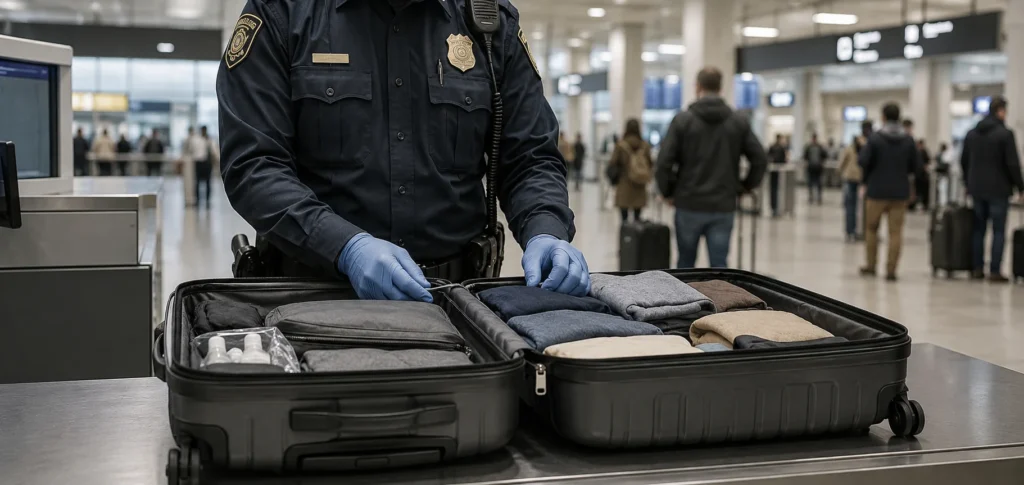
This one surprises people. TSA confiscating a prohibited item doesn’t just mean you lose the item at the checkpoint. In some cases, depending on what’s found and how it’s classified, it can trigger legal consequences — and the government’s act of taking possession of your property has formal legal weight.
Under 49 U.S.C. § 46505, carrying prohibited items onto an aircraft is a federal offense. Confiscation is the least of the consequences if the item is flagged as a weapon or dangerous material.
For customs seizures — cash, undeclared goods, items restricted under import law — the rules are different again. U.S. Customs and Border Protection can seize property under civil asset forfeiture rules. Critically, you can contest a seizure, but the process is time-limited. You typically have 30 days from the date of the seizure notice to file a claim. Miss that window and the government’s possession effectively becomes permanent.
A few things worth knowing:
- Declaring cash over $10,000 when entering or leaving the U.S. is mandatory under 31 U.S.C. § 5316. Failure to declare doesn’t just risk confiscation — it can result in criminal charges.
- If items are seized at customs, request a seizure receipt. That document is your evidence of what was taken and when.
- CBP’s official forfeiture process outlines your rights and the petition process — read it before assuming you have no recourse.
4. Finding Valuables While Traveling — Finders Keepers?
You’re on a beach in Florida, spot a wallet, pocket it. Is it yours? Almost certainly not — at least not yet and maybe not ever.
Most U.S. states have found property statutes that require you to hand found items over to local law enforcement or a designated authority. If no one claims the property within a statutory period, then the finder may acquire legal title. Florida, for example, has Florida Statute § 705.103, which sets out exactly this process.
Pocketing found valuables and saying nothing isn’t a gray area in most states — it’s theft by finding. The original owner’s claim doesn’t evaporate just because they’re not present.
What actually protects you legally:
- Report the find to the nearest authority (hotel management, local police, airport lost and found).
- Get a receipt or report number.
- Note the exact location and time.
If the item is genuinely unclaimed after the statutory period, that paper trail is what gives you a legitimate claim to it.
Vacation Rentals, Squatters and the Scenario Nobody Wants to Come Home To
This is the one that keeps property owners up at night. You’ve got a vacation home — maybe a cabin in the Smokies, a condo in Scottsdale, a beach house on the Gulf Coast. You leave for six months. Someone moves in while you’re gone. Now what?
5. Squatters in Your Vacation Property — Possession Working Against You
Here’s the uncomfortable reality: squatters can, under certain conditions, acquire legal rights to property they don’t own. It takes time, it’s not easy and it requires meeting specific legal tests — but it happens. The doctrine is called adverse possession and it’s the clearest modern expression of “possession is 9/10 of the law” in action.
Cornell Law’s overview of adverse possession lays out the standard elements a squatter typically needs to satisfy:
- Actual possession — physically occupying and using the property.
- Open and notorious — not hiding the occupation; neighbors could see it.
- Exclusive — not sharing possession with the true owner.
- Hostile — without the owner’s permission.
- Continuous — for the full statutory period required by that state.
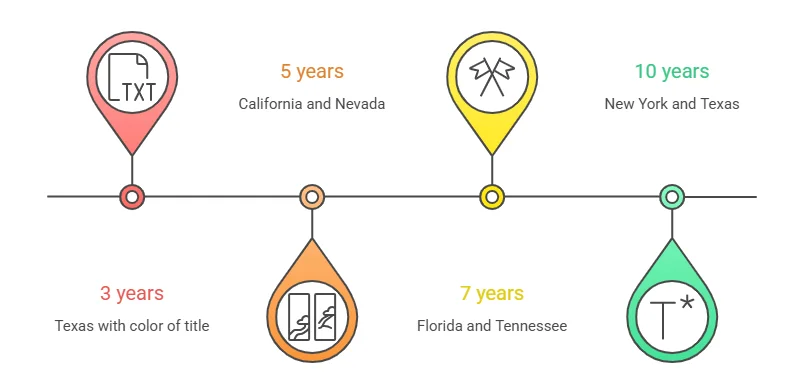
That last one — the statutory period — is where states diverge significantly.
| State | Adverse Possession Period | Key Condition |
| California | 5 years | Must pay property taxes |
| Florida | 7 years | Must pay property taxes |
| Texas | 10 years (general) | 3 years with color of title |
| New York | 10 years | Claim must be “adverse” |
| Nevada | 5 years | Must pay property taxes |
| Tennessee | 7 years | Must have color of title |
California’s five-year window is the tightest. A vacation property left unmonitored, unvisited and with someone quietly paying the taxes on it — that’s not a hypothetical. It’s happened.
The good news is that most adverse possession claims fail at the “continuous” or “exclusive” hurdles. But “most” isn’t “all.” If you own a vacation property and visit it twice a year for a long weekend, you’re not doing enough to interrupt a squatter’s claim in some jurisdictions.
What actually protects you:
- Visit regularly and document those visits — dated photos, utility bills in your name, maintenance records.
- Post “No Trespassing” signs (this matters legally in several states).
- Respond to any unauthorized occupation immediately with a formal eviction notice rather than informal negotiation — the clock on adverse possession stops when you take legal action.
- Consider a property management company if you’re absent for extended periods.

6. Timeshares — Fractional Ownership and Possession Disputes
Timeshares sit in their own strange legal category. You don’t own the property outright — you own the right to possess it during a defined period. Which means possession disputes here aren’t about squatters; they’re about contractual rights to occupy.
The practical issues travelers hit:
Double-booking. The management company has overbooked your week. You show up with your family and someone else is already in the unit. Who has legal possession? Technically, both of you have contractual claims — but the person physically present has actual possession and removing them isn’t as simple as calling the front desk.
Abandoned timeshares. The original owner stopped paying fees and walked away. In some states, the resort can pursue collection through the courts and depending on the structure of the agreement, the “abandoned” unit can become subject to adverse possession claims or reversion to the developer.
Resale fraud. Someone is “selling” a timeshare they no longer have active rights to — essentially transferring possession rights they don’t hold. The FTC has documented this as a recurring scam targeting timeshare owners looking to exit their contracts.
If you’re buying into a timeshare or contesting a possession dispute within one, the deed structure matters enormously — deeded timeshares (where you own a fractional interest in real property) carry different legal weight than right-to-use agreements, which are essentially long-term licenses.
The “Other Tenth” — What Actually Beats Possession
So if possession is nine-tenths, what’s the remaining tenth? It’s the piece of paper. Always.
A deed. A bill of sale. A vehicle registration. A court judgment. Any document that establishes superior title to the property in question. That’s what courts look for when possession alone isn’t enough to settle the dispute — and that’s why travelers should carry or have immediate digital access to documentation for anything valuable.
Key Legal Takeaways for Travelers
- Document possession before it transfers. Photograph rental cars, hotel rooms and luggage before and after. The moment you hand something over — to an airline, a rental company, a hotel valet — get a receipt.
- Constructive possession is real possession. Your checked luggage, items in a hotel safe, a car parked in a hotel lot — these remain legally yours even when not physically on you. Act like it by keeping documentation.
- Government confiscation has a clock. TSA and customs seizures come with contest windows. Missing a 30-day deadline can permanently end your claim. Never assume silence equals acceptance.
- Found property isn’t free property. Report it, get a receipt, wait out the statutory period. That’s the only legally clean path to a finder’s claim.
- Vacant property is vulnerable property. If you own a vacation home, absence is your biggest legal liability. Regular visits, documented occupancy and swift response to any unauthorized use are non-negotiable.
- The document wins. Possession creates a presumption. A superior title document defeats it. Keep digital copies of deeds, registration documents, purchase receipts and rental agreements accessible while traveling.
A Final Word
The phrase has outlasted the legal system that coined it by four centuries. That’s not an accident — it keeps surviving because the core idea keeps proving true. Physical control of property matters. Courts recognize it. Presumptions flow from it. And travelers, more than almost anyone, are constantly in situations where possession is changing hands — luggage, vehicles, accommodation, found items, personal effects moving through security.
Knowing the principle doesn’t make you a lawyer. But it does make you someone who understands why documentation matters, why you shouldn’t leave a rental car lot without photographing every panel and why showing up to a vacation property twice a year with dated photos on your phone is worth more than it sounds.
The tenth point — the superior title, the deed, the bill of sale — is always what ultimately wins. Make sure you have yours.