 Nicholas J. Rego Accident Lawyer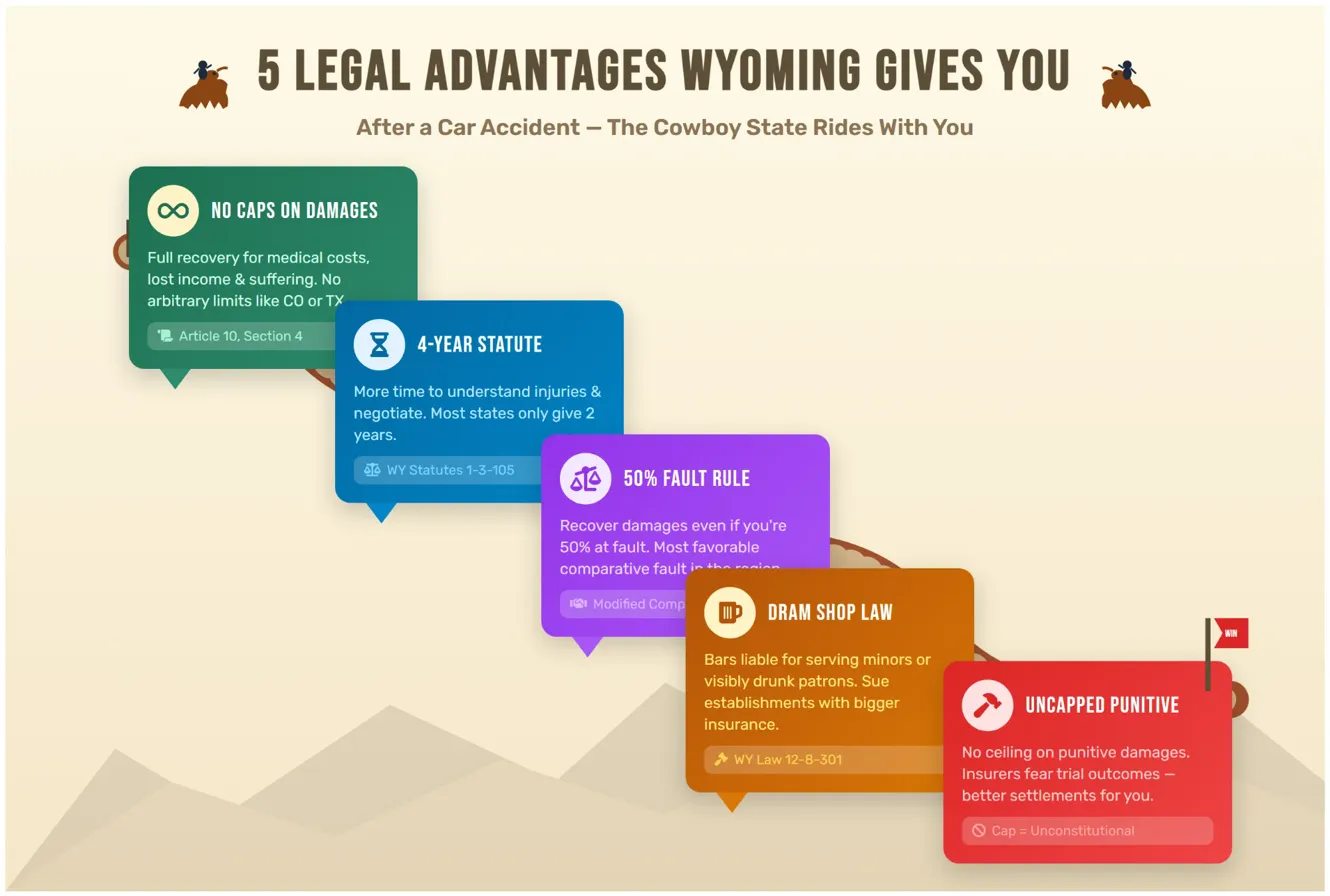
- There are No Caps on Damages: Wyoming Constitution Article 10, Section 4, states that the legislature may not limit damages recoverable due to death or personal injury. Because of this, plaintiffs can fully recover costs related to medical expenses, lost income, suffering, and other losses, without the arbitrary limits found in states like Colorado or Texas.
- Longer Statutes of Limitations: The Wyoming Statutes 1-3-105, allows victims four years from the date of the accident to bring a lawsuit. This gives victims time to fully appreciate their injuries, which could improve their negotiating position against the insurance companies. This is a longer period when compared to two-year limits in most other surrounding states.
- Most Favorable Comparative Fault Rules: Wyoming has the most favorable comparative fault laws and a victim can recover damages even if they are at fault up to 50%. Some states may not allow this, but Wyoming laws allow for compensation even when fault is divided equally.
- Dram Shop Liability for Illegal Service: Under Wyoming Law 12-8-301, bars and restaurants are immune from civil liability for serving alcohol; however, they lose liability for service to minors or to patrons who are clearly intoxicated. This provides additional avenues of recovery from underinsured drunk drivers who cause accidents because these establishments tend to have larger insurance policies.
- Uncapped Punitive Damages Potential – As the damages cap is unconstitutional, there is an unrestricted barrier on punitive damages (to punish extreme forms of drunk driving, etc.). Although they are presumed to be reasonable (i.e., not more than 4 times the compensatory damages), this leaves room for ambiguity, which can create a more balanced outcome. This is because insurance companies are more likely to worry about the outcome of a trial rather than the outcome of a settlement.
People who get into car accidents, especially in Wyoming, don’t know that the state’s laws are more favorable to them in comparison to other states. These are not tricks, or loopholes in the sneaky sense. These are legal statutes, and constitutional provisions that will help you increase the amount of money you will get from the insurance company. Knowing about them before you settle with an insurance company will make a huge difference for you instead of just getting lowballed to being paid what you deserve.
1. Wyoming’s Constitution Denies Damage Limits
People are typically surprised to learn that Wyoming is one of a handful of states in the U.S. where the state’s constitution says that the state’s legislature does not have the power to place a limit on how much money an individual can receive from the state for damages.The Wyoming Constitution, in Article 10, Section 4, states, “No law shall be enacted limiting the amount of damages to be recovered for causing the injury or death of any person.”
This means that if your medical expenses, lost income, and emotional distress totals $800,000, you can sue for $800,000. In states like Colorado or Texas, there are caps on damages that are non-economic, which means the pain and suffering part, and those caps range from $250,000 to $500,000 depending on the case. Wyoming, however, does not impose those limits because it does not have that option with the Constitution.
Insurance adjusters sometimes act like there’s some invisible ceiling on what they’ll pay. There isn’t. The Wyoming Supreme Court has upheld this constitutional provision multiple times, and it applies to:
- Medical expenses (past and future)
- Lost income and earning capacity
- Pain and suffering
- Emotional distress
- Loss of enjoyment of life
- Permanent disability or disfigurement
No arbitrary number where the court says “that’s enough, you can’t get more.” If a jury thinks your damages are worth $1.2 million, that’s what you get.
2. You Get Four Years to File (Most States Give You Two)
Wyoming Statute 1-3-105 gives you four years from the date of a car accident to file a lawsuit. That might not sound like a big deal until you compare it to neighboring states where you get two years or even less.
Why does this matter? Because some injuries don’t show their full extent right away. You might think you’re fine after a rear-end collision, then six months later you’re dealing with chronic back problems that need surgery. Or you settle quickly because you need the money, and then discover the other driver had a $500,000 umbrella policy you didn’t know about.
Four years gives you room to:
- Understand the full medical picture before settling
- Gather evidence properly without rushing
- Negotiate from a position where the insurance company knows you still have plenty of time to sue if they lowball you
That said, don’t sit on your hands thinking you have all the time in the world. Evidence disappears, witnesses forget things, and surveillance footage gets recorded over. The four years is a maximum, not a suggestion to wait.
One exception worth knowing: if the person who hit you was a government employee driving a government vehicle (think highway department truck, state vehicle, county worker), the rules change completely. You have to file a formal claim within two years, then you only get one more year after that to actually sue. The Wyoming Governmental Claims Act is its own animal and the timelines are much tighter.
3. The 50% Fault Rule Works in Your Favor
Wyoming’s Statute 1*1*109, sets modified comparative negligence as the standard, and the way Wyoming puts this statute helps claimants more than many other states.
With this statute, the first thing to understand is that if you, the claimant, are in any way responsible for the accident, your compensation gets reduced according to your fraction of the blame as involved.
For example, if your damages were $100,000 and you were 20% at fault for the accident, then you would get $80,000. So, this would be your award that would compensate you for your damages.
However, Wyoming is one of the few states that allows you to recover, as long as you do not bear more than 50 % of the fault for the accident. While some states, like Colorado, do not let you recover anything if you are found to be 50% responsible for the accident, Wyoming allows you to recover if you are 50% at fault; you just can’t be more than 51% at fault.
For example, if you were driving around Cheyenne, and someone runs a red light and hits you in a way that causes a T-bone collision. Most observers would say that the other driver is fully at fault. However, if you get to the insurance company and the adjuster gets your case, they see you were breaking the speed limit and driving 7 miles per hour over it when the accident occurred. So, they can reasonably attribute some fault to you, as they would argue that if you were driving at the speed limit, you would have arrived at the intersection clear of the other driver before they ran the light. this would cause you a loss of at least $20,000 on the case.
In an example, a jury could determine that you are 15% to blame. On a $200,000 settlement, you would receive $170,000 instead of nothing. Under the comparative fault system, the results are not all-or-nothing.
Where this gets people in trouble is in giving recorded statements to insurance adjusters, thinking through everything. You might say, “I possibly should have been more attentive” and that gets used to increase your percentage of fault. Attorneys tell you not to leave detailed statements because the adjusters are not bound to the same legal system you are.
4. Bars and Restaurants Can Be Liable If They Broke the Law
Wyoming laws provide drinking establishments with immunity regarding any drunk driving incidents involving their customers post-service. With statute 12-8-301, if one was “legally” provided alcohol, they will not be held responsible for anything the inebriated person does afterward.
However, the term “legally” is quite powerful here.
Should the establishment serve alcohol to the individual illegally, which can include, but isn’t limited to, minors, those violating their liquor license, or customers who have been cut off, they lose their protective immunity. They can be responsible for anything involving the accidents.
This matters because drunk drivers can carry insufficient insurance to cover the injuries caused. The minimum liability coverage in Wyoming is $25,000 per person, which is, in fact, the most carried. If one is hit by someone with $25,000 coverage and in need of $300,000 worth of medical care, that is a problem.
That being said, what if the driver is 19 years old and served alcohol at a bar that failed to check identification? The bar’s insurance would be applicable. Bars understand the risk and typically carry higher liability coverage.
Proving this requires:
- Evidence of what the driver was drinking and where
- Proof that the establishment violated liquor laws
- Connecting the illegal service to the intoxication that caused the accident
It’s not easy, but it opens up what lawyers call “additional pockets” — more sources of money to cover your damages when the driver’s own coverage falls short.
5. No Caps Means Punitive Damages Are Actually on the Table
This ties back to the constitutional provision, but it deserves its own mention because punitive damages work differently than regular compensation.
Regular damages (called “compensatory damages”) pay you back for what you lost — medical bills, lost wages, pain and suffering. Punitive damages exist to punish the defendant for especially bad behavior and discourage others from doing the same thing.
In a lot of states, punitive damages are capped at some multiple of compensatory damages, or at a flat number like $500,000. Wyoming can’t do that because of Article 10, Section 4.
Now, punitive damages don’t apply to your average fender-bender. They come into play when the defendant’s conduct was reckless, willful, or showed a complete disregard for safety. Think:
- Drunk drivers with prior DUI convictions
- Commercial truckers who falsified their log books to drive longer than legally allowed
- Someone texting and driving at 90 mph through a school zone
Wyoming courts have noted the Supreme Court’s guidance that punitive damages, on average, should not exceed a 4:1 ratio to compensatory damages. However, that ratio is a guideline to avoid constitutional conflict, not a hard cap under state law. In cases involving more extreme conduct, courts have upheld punitive damages in any ratio.
Thus, the potential for punitive damages in Wyoming encourages defendants to settle rather than gamble on a trial. The potential for punitive damages creates uncertainty for insurers that is not present with a cap on punitive damages.
What Does This Mean for Your Case?
These legal advantages don’t mean much if you don’t know how to leverage them. Insurance defense counsel know Wyoming law as well as any attorney, because their job is to pay as little as the law allows. Most claimants don’t have this level of knowledge. This is why insurers are able to settle cases for much less than their value.
When an insurance adjuster offers you $50,000 to settle a claim worth $150,000, they won’t tell you Wyoming is a defendant’s paradise, with no damage caps. As they rush you to sign a release by next week, they won’t tell you that you have four years to file. That’s not how the game works.
If you’ve been in a wreck that’s left you dealing with real injuries and real bills, find a car accident lawyer in Wyoming and discussing your case with a lwyer is a good idea before you accept any settlement offer. Most offer free consultations, they work on contingency (meaning they don’t get paid unless you do), and they understand which of these legal provisions apply to your specific situation.
Wyoming’s laws give injured people more room to pursue full compensation than a lot of other states. Whether you actually get that compensation depends on whether you know what you’re entitled to and whether you’re willing to push for it.