 Mason (Driving Law Expert)
A piece of wood flew off a lathe in 1957 and hit William Greenman in the forehead. The power tool’s set screws had vibrated loose—a design flaw that could have been prevented with better fastening. Six years later, the California Supreme Court used his case to establish strict product liability, fundamentally changing how manufacturers answer for defective products.
That decision still shapes how California courts handle defective vehicle claims today. But the analysis isn’t simple. When a brake system fails and causes a crash, courts have to untangle whether the manufacturer built a defective product, whether the driver ignored warning signs, or whether both share blame.
California has specific frameworks for each question. Understanding how they interact determines who pays when something goes wrong.
The Numbers Behind Vehicle Defects
Mechanical failures don’t cause most crashes—human error does. But when equipment fails, the consequences can be catastrophic.
| Defect Type | Annual Injury Crashes (CA) | Annual Fatalities (CA) |
|---|---|---|
| Defective brakes | 36 | — |
| Other equipment failures | 90+ | 2.4 |
| Truck brake defects | 8.5 | 1.5 |
| Defective lights | 51 | 2 |
Source: CHP SWITRS Annual Reports, averaged across multiple years
According to California Highway Patrol data from the Statewide Integrated Traffic Records System (SWITRS), mechanical failures contribute to approximately 10.5-12% of crashes when including contributing factors. In 2020 alone, California recorded 3,982 persons killed and 203,888 persons injured across all crash types. Vehicle and equipment failure appears as a factor in a consistent subset of these incidents.
Driver Responsibility Under California Vehicle Code
California Vehicle Code Section 24002 makes it unlawful to operate any vehicle “which is in an unsafe condition” or “which presents an immediate safety hazard.” The statute also prohibits driving vehicles not equipped as required by code—working headlights, functional turn signals, adequate brakes.
The actual statutory language:
(a) It is unlawful to operate any vehicle or combination of vehicles which is in an unsafe condition, or which is not safely loaded, and which presents an immediate safety hazard.
(b) It is unlawful to operate any vehicle or combination of vehicles which is not equipped as provided in this code.
What this means for liability depends on what the driver knew or should have known.
- Known defects create clear responsibility. If your brake warning light has been on for two weeks and you keep driving, you’re operating an unsafe vehicle with knowledge of the hazard. That exposes you to both traffic violations and civil liability if someone gets hurt.
- Hidden defects shift the analysis. A manufacturing flaw in a brake line that fails without warning isn’t something a reasonable driver could detect during normal use. No amount of tire-kicking in your driveway would reveal a defective weld inside a sealed component.
The gray area involves maintenance failures. Bald tires, worn brake pads, steering components that should have been inspected—these fall somewhere between hidden and known. Courts look at whether a reasonable driver following normal maintenance schedules would have discovered the problem.
Manufacturers sometimes argue that drivers contributed to accidents by failing to maintain their vehicles properly. This argument has traction when maintenance intervals were clearly specified and ignored. It has less force when the defect existed from the factory and maintenance wouldn’t have prevented it.
Manufacturer Liability: California’s Strict Product Liability Standard
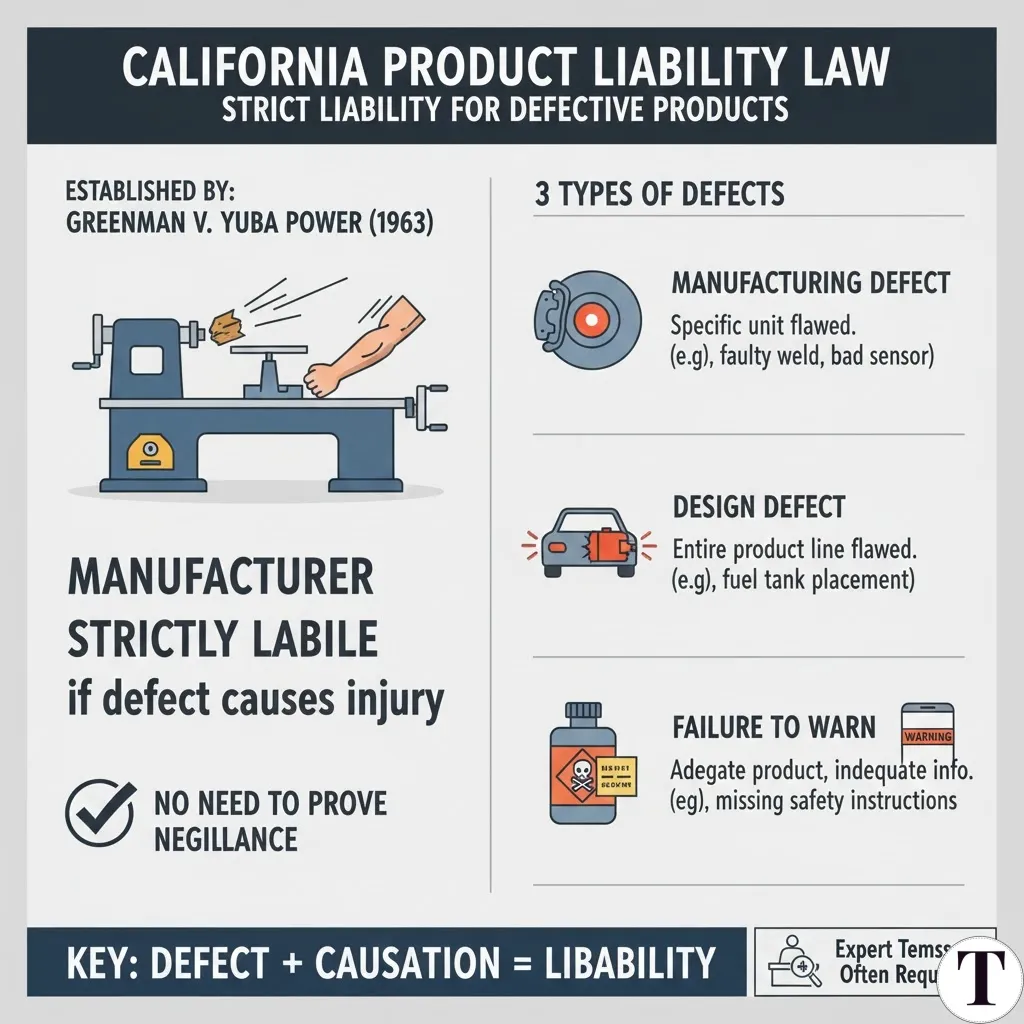
Greenman v. Yuba Power Products, Inc. (59 Cal. 2d 57, 1963) established that California manufacturers are strictly liable when defective products cause injury. Justice Roger Traynor’s opinion cut through contract and warranty frameworks entirely:
“A manufacturer is strictly liable in tort when an article he places on the market, knowing that it is to be used without inspection for defects, proves to have a defect that causes injury to a human being.”
The practical effect: plaintiffs don’t need to prove the manufacturer was careless. They need to prove the product was defective and the defect caused harm.
California recognizes three categories of product defects:
- Manufacturing defects occur when a specific unit deviates from the intended design. The blueprint was fine; something went wrong on the assembly line. A brake caliper with an air bubble in the casting, a weld that didn’t fully penetrate, a sensor that wasn’t properly calibrated.
- Design defects exist when the entire product line shares a flaw. Even perfectly manufactured units are dangerous because the design itself creates unreasonable risk. The Greenman case involved a design defect—set screws that couldn’t withstand normal vibration. In vehicles, this might be a fuel tank positioned where rear impacts cause fires, or a suspension geometry that promotes rollovers.
- Failure to warn defects involve adequate products that become dangerous without proper instructions or warnings. A vehicle with unusual handling characteristics at high speeds might need specific warnings. A maintenance requirement that isn’t clearly communicated could create liability when components fail.
For vehicle defect cases, plaintiffs typically need expert testimony establishing that the defect existed, that it caused the accident, and that alternative designs or manufacturing processes would have prevented the harm. Manufacturers defend by challenging causation, arguing the defect didn’t actually cause the crash, or showing the plaintiff misused the product in unforeseeable ways.
How California Divides Fault: Pure Comparative Negligence
California operates under pure comparative negligence, established in Li v. Yellow Cab Co. (13 Cal. 3d 804, 1975). A plaintiff can recover damages even if they were primarily responsible for their own injuries—the award simply gets reduced by their percentage of fault.
Daly v. General Motors Corp. (20 Cal. 3d 725, 1978) extended this principle specifically to strict product liability. Even when a manufacturer is strictly liable for a defective product, the consumer’s own negligence reduces recovery proportionally.
The calculation works like this:
| Scenario | Jury Award | Plaintiff Fault | Recovery |
|---|---|---|---|
| Defective brakes, no driver negligence | $500,000 | 0% | $500,000 |
| Defective brakes, driver ignored warning light | $500,000 | 40% | $300,000 |
| Defective brakes, driver was speeding and texting | $500,000 | 70% | $150,000 |
California’s pure comparative system differs from “modified” comparative fault states, where plaintiffs who are 50% or 51% responsible recover nothing. Here, even a plaintiff found 90% at fault collects 10% of their damages.
For economic damages—medical bills, lost wages, property damage—California’s joint and several liability rules allow plaintiffs to collect the full amount from any defendant, who then seeks contribution from others. For non-economic damages like pain and suffering, California Civil Code § 1431.2 limits each defendant to their specific percentage of fault.
This framework creates strategic considerations in defective vehicle cases. Manufacturers argue driver negligence to reduce their exposure. Plaintiffs argue the defect was the primary cause and any driver negligence was minor or irrelevant to the harm.
When the Vehicle Keeps Failing: California’s Lemon Law Protections
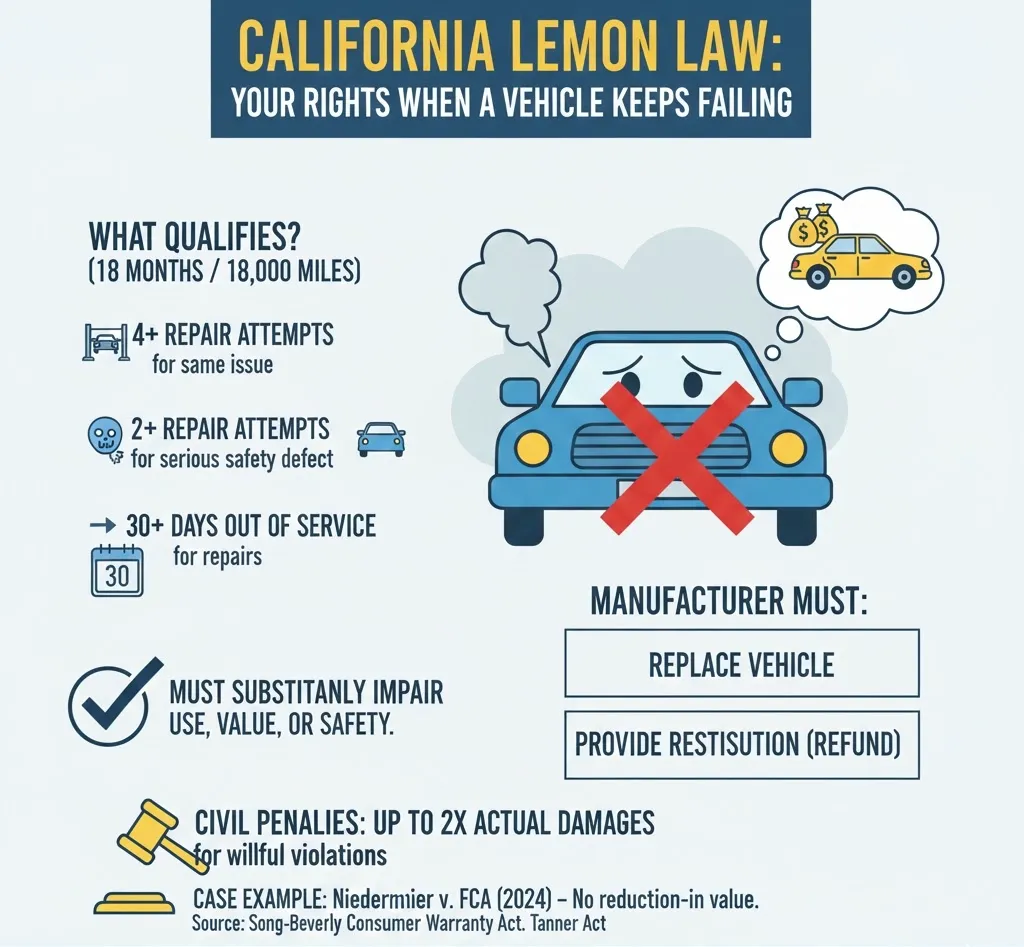
Not every defective vehicle causes an accident. Some just keep breaking down. California’s Song-Beverly Consumer Warranty Act (Civil Code §§ 1790-1795.8) addresses ongoing defects that manufacturers can’t or won’t fix.
The Tanner Consumer Protection Act (Civil Code § 1793.22) creates presumptions that trigger manufacturer obligations. Within 18 months or 18,000 miles, whichever comes first:
- 4 repair attempts for the same nonconformity, or
- 2 repair attempts for defects likely to cause death or serious bodily injury, or
- 30+ cumulative days out of service for repairs
Meeting any of these thresholds creates a rebuttable presumption that the manufacturer had a “reasonable number of attempts” to fix the problem. At that point, the manufacturer must either replace the vehicle or provide restitution.
The nonconformity must “substantially impair the use, value, or safety” of the vehicle—minor annoyances don’t qualify. But courts have interpreted this broadly. Persistent electrical problems, recurring transmission issues, or safety systems that intermittently fail can all meet the standard.
Recent case outcomes show the stakes:
- Niedermeier v. FCA US LLC (2024): The California Supreme Court ruled that manufacturers cannot reduce restitution by trade-in credits consumers received when disposing of defective vehicles. Original jury award: $98,961.08 plus $59,376.65 in civil penalties for a defective Jeep Wrangler.
- Doppes v. Bentley Motors, Inc. (2009): After Bentley hid evidence of a known “obnoxious odor” defect during discovery, the court issued terminating sanctions. Result: full refund plus $200,000 in civil penalties and substantial attorney fees.
Civil penalties under Song-Beverly can reach twice the actual damages when manufacturers willfully violate the act. This is where a california lemon law attorney becomes essential—not just for accident cases, but when a manufacturer stonewalls legitimate warranty claims and the consumer needs leverage.
Where These Frameworks Intersect
A vehicle can be defective under strict liability, covered by lemon law, and involve driver negligence all at once. The legal frameworks aren’t mutually exclusive.
Consider a scenario: A transmission defect causes sudden acceleration. The driver had noticed occasional rough shifting but didn’t report it during the warranty period. The vehicle crashes, causing injuries.
The manufacturer faces strict liability for the defective transmission. The driver might face comparative fault arguments for continuing to drive with symptoms of a problem. The vehicle might also qualify as a lemon if there were previous repair attempts. And California Vehicle Code § 24002 could theoretically apply if the driver knew the vehicle was unsafe.
Each legal theory has different elements, different damages, and different strategic considerations. Strict liability addresses the injury claim. Lemon law addresses the consumer’s right to a functional vehicle. Comparative negligence determines how fault gets allocated.
California’s framework gives injured consumers multiple paths to recovery while acknowledging that responsibility for defective vehicles rarely falls entirely on one party.
References
- California Civil Code §§ 1790-1795.8 (Song-Beverly Consumer Warranty Act) – https://leginfo.legislature.ca.gov/faces/codes_displayText.xhtml?division=2.&part=4.&lawCode=CIV&title=1.7
- California Civil Code § 1793.22 (Tanner Consumer Protection Act) – https://leginfo.legislature.ca.gov/faces/codes_displaySection.xhtml?sectionNum=1793.22&lawCode=CIV
- California Vehicle Code § 24002 – https://leginfo.legislature.ca.gov/faces/codes_displaySection.xhtml?lawCode=VEH§ionNum=24002
- Greenman v. Yuba Power Products, Inc., 59 Cal. 2d 57 (1963) – https://scholar.google.com/scholar_case?case=8503080694547831906
- Li v. Yellow Cab Co., 13 Cal. 3d 804 (1975) – https://scholar.google.com/scholar_case?case=1762886756623668102
- Daly v. General Motors Corp., 20 Cal. 3d 725 (1978) – https://scholar.google.com/scholar_case?case=15340050730412850431
- Niedermeier v. FCA US LLC (2024) – https://law.justia.com/cases/california/supreme-court/2024/s266034.html
- Doppes v. Bentley Motors, Inc. (2009) – https://scholar.google.com/scholar_case?case=15366432386629986381
- CHP SWITRS Data – https://www.chp.ca.gov/programs-services/services-information/switrs-internet-statewide-integrated-traffic-records-system
- California Civil Jury Instructions (CACI) No. 405 – https://www.justia.com/trials-litigation/docs/caci/400/405/