 Mohammad Ahsan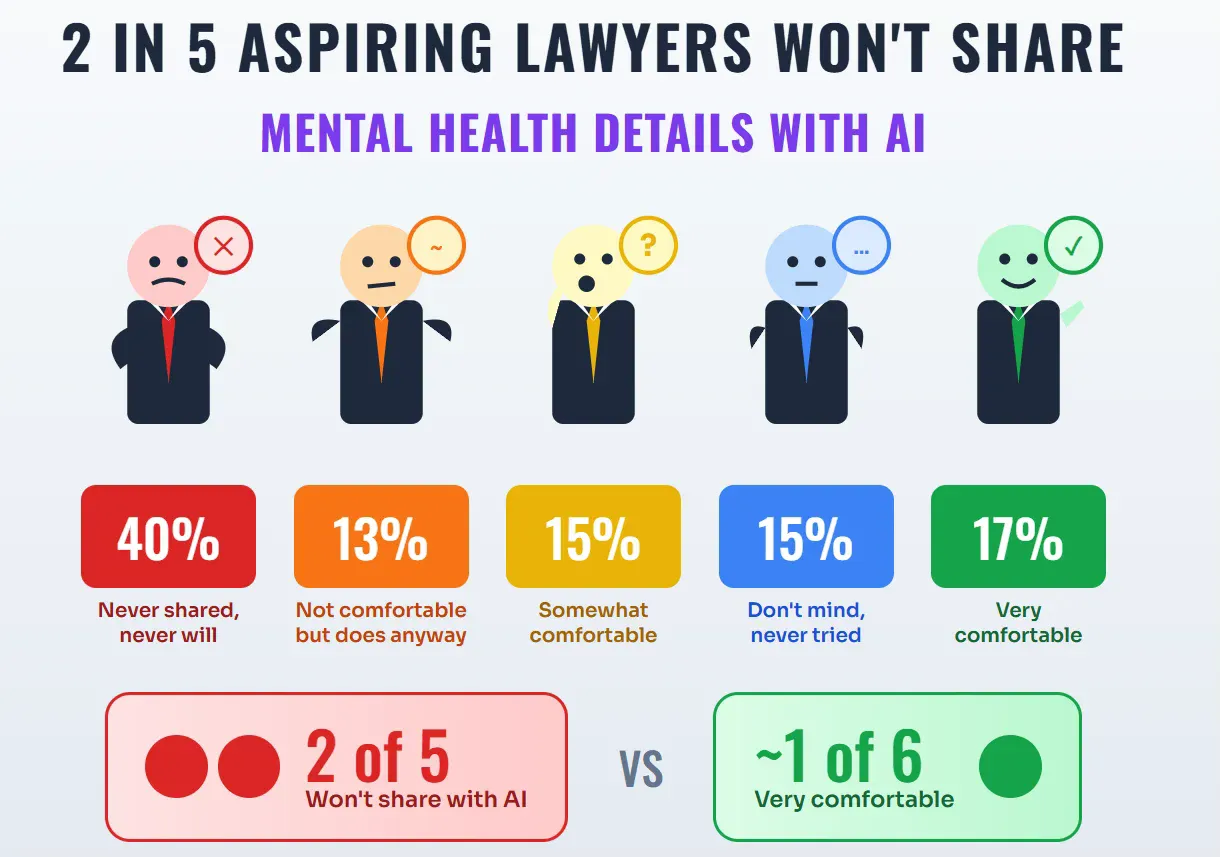
A new survey conducted by Juris Education reveals that almost 40% of aspiring lawyers don’t feel comfortable sharing sensitive mental health or personal details with AI, yet almost 13% said they do it anyway.
The survey, which interviewed 248 aspiring lawyers, was conducted by Juris Education, a leading edtech resource for students pursuing careers in the legal field. to understand the concerns about sharing sensitive mental health-related details with an AI chatbot. The respondents answered the survey anonymously through a Google Form.
40% of law students don’t trust AI with their mental health information
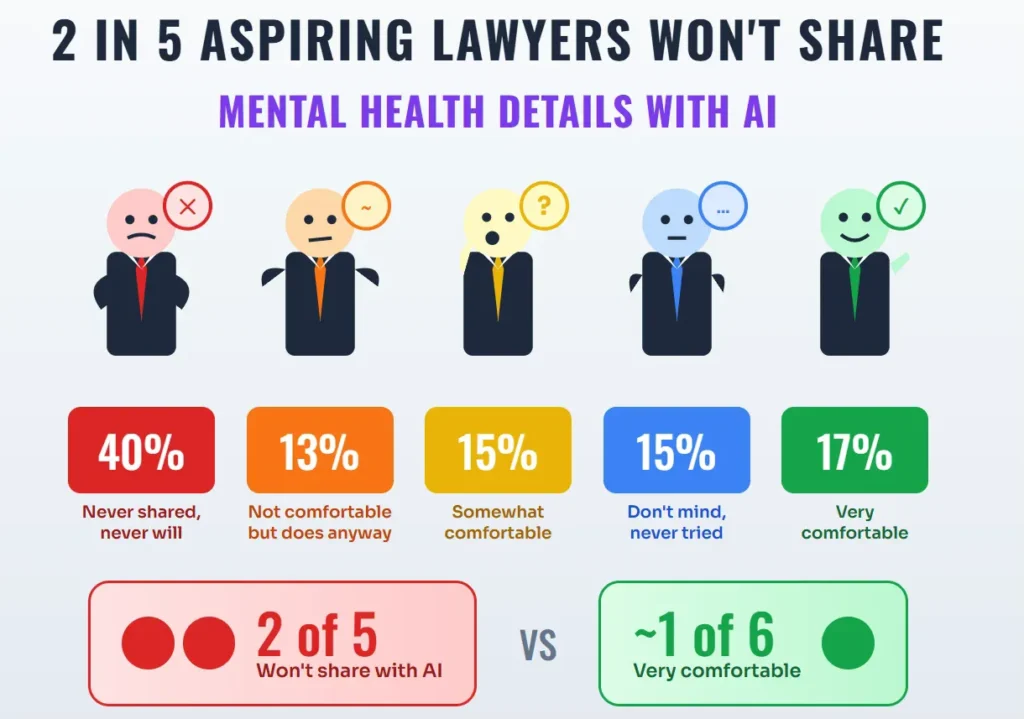
The survey results show that 40% of aspiring lawyers have never shared sensitive mental health information with AI chatbots, and do not intend to in the future. On the other hand, 17% of aspiring lawyers said they are very comfortable sharing sensitive mental health details with AI chatbots.
Of the aspiring lawyers surveyed, 15.3% said they don’t mind sharing sensitive mental health information with AI, but have never done it. 14.9% of the future lawyers said they are “somewhat comfortable” which leaves them on the fence. 12.9% of the aspiring lawyers said that they are not comfortable sharing sensitive details with AI but do share those details.
Most Students Don’t Believe AI Tools Will Positively Impact the Mental Health of Aspiring Lawyers In and Out of the Profession
Juris Education conducted a survey asking prospective lawyers the degree to which they think AI tools could alleviate mental stress during pre-law school preparation and while practicing law. The largest group of respondents was 41.8%, who claimed that they did not think AI would be beneficial to the mental health of law school applicants or practicing lawyers. Conversely, 38.6% thought AI could be beneficial to the mental health of law school applicants and practicing lawyers.
Senior admissions consultant at Juris Education and an NY attorney, Jesse Wang, via remote explained some applicant’s potential reasoning for using AI. “Some attorneys might consider AI useful for basic, introductory-level legal research and some of the more administrative tasks like drafting emails and editing for conciseness. Some studies show that non-substantive, repetitive, and monotonous tasks can be mentally draining and are a major contributor to attorney burnout. If it’s used strategically, and within the boundaries of the firm’s policies and legal ethics, AI can enhance psychological wellness and reduce the mental burden created by basic routine tasks,” Wang explained.
While 10% of the surveyed participants indicated that they believe AI can facilitate and improve the mental health of applicants, the same does not hold true for practicing attorneys. Meanwhile, 3.6% of the participants indicated a belief that, AI can facilitate and improve mental health, but only when they are practicing attorneys.
More Than 1 in 2 Aspiring Lawyers Think Assigning Tasks to AI Can Improve Mental Health
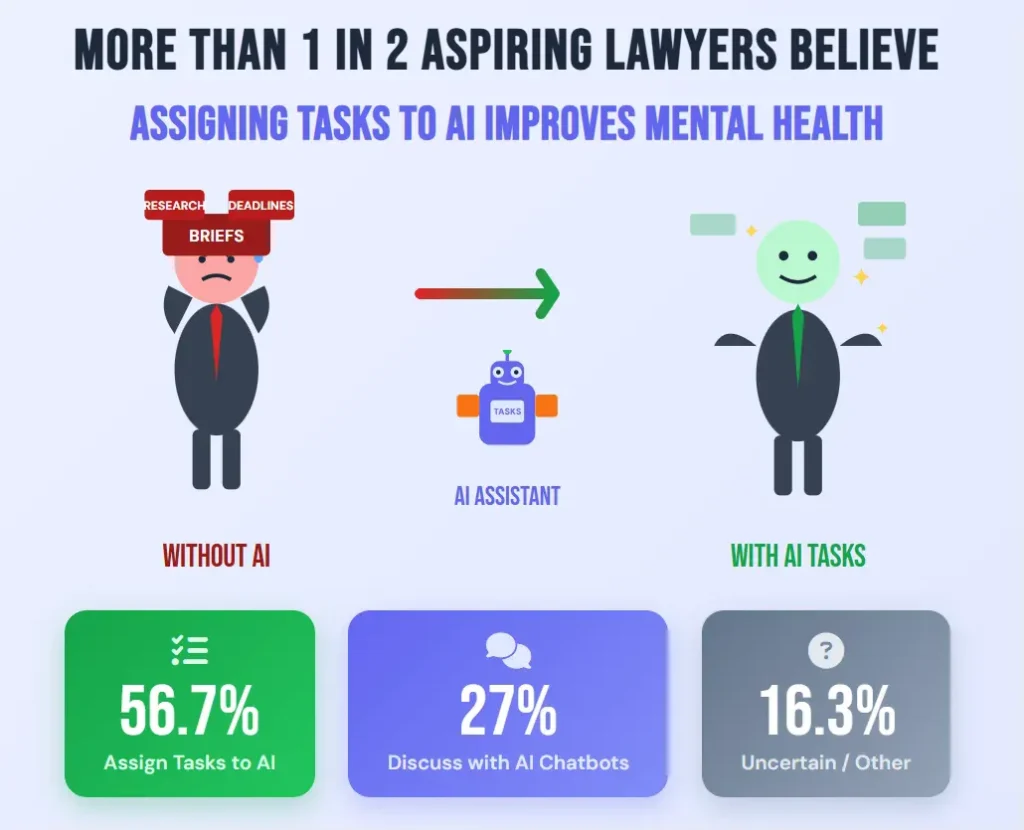
For the aspiring lawyers who responded “yes” to AI improving their mental health, Juris Education asked how they think the use of AI tools in the legal field can support their mental health. Overwhelmingly, 56.7% of those individuals said AI can improve their mental health by assigning tasks to it. Only 27% of respondents admitted that they think discussing mental health with AI chatbots can lead to solutions.
However, 16.3% of respondents marked “other,” with many noting uncertainty about how AI can improve their mental health.
What Does the Data Tell Us?
According to the 248 respondents in Juris Education’s survey, nearly all aspiring lawyers (96%) experience at least occasional overwhelm, and about 70% have considered therapy. However, 52.8% feel uncomfortable or opposed to sharing sensitive mental health details with AI, and 12.5% used AI despite their discomfort.
“We’re seeing a cohort of students who are engaging with AI tools regularly,” said Arush Chandna, co-founder of Juris Education. “The 31.8% who report at least some comfort sharing sensitive information suggests that a meaningful segment of future lawyers are already integrating AI into their workflows.”
According to the American Bar Association (ABA), in the 2025 Legal Technology Survey Report, 31% of practicing lawyers are already using AI tools. The report also highlights that 39% of firms with 51 or more attorneys use AI, compared with 20% of smaller firms with 50 or fewer layers.
“What we’re seeing is an acceleration,” Chandna explained. “Practicing lawyers are deploying AI at scale, and students are watching this unfold. They’re entering a profession where AI is a reality. The disconnect between their comfort level and the reality of the field is significant.”
Looking Ahead
The Juris Education survey provides a baseline for understanding how aspiring lawyers currently view AI and data privacy. With AI adoption accelerating in law firms and AI instruction expanding in law schools, these attitudes might evolve further.
Even with the rapid AI integration into the legal field, one must exercise caution and use it responsibly, Wang said.
“Ultimately, AI in the practice of law right now is still in its nascent stage, as privacy concerns, such as protecting proprietary information or privileged materials, remain a major reason for hesitation in adopting AI within the legal field. Still, there is room for gradual improvement and responsible integration, and those who dismiss AI entirely may ultimately fall behind peers who approach it with greater openness,” Wang added.