 Jeffrey S. Kelly Group PLLC (Real Estate)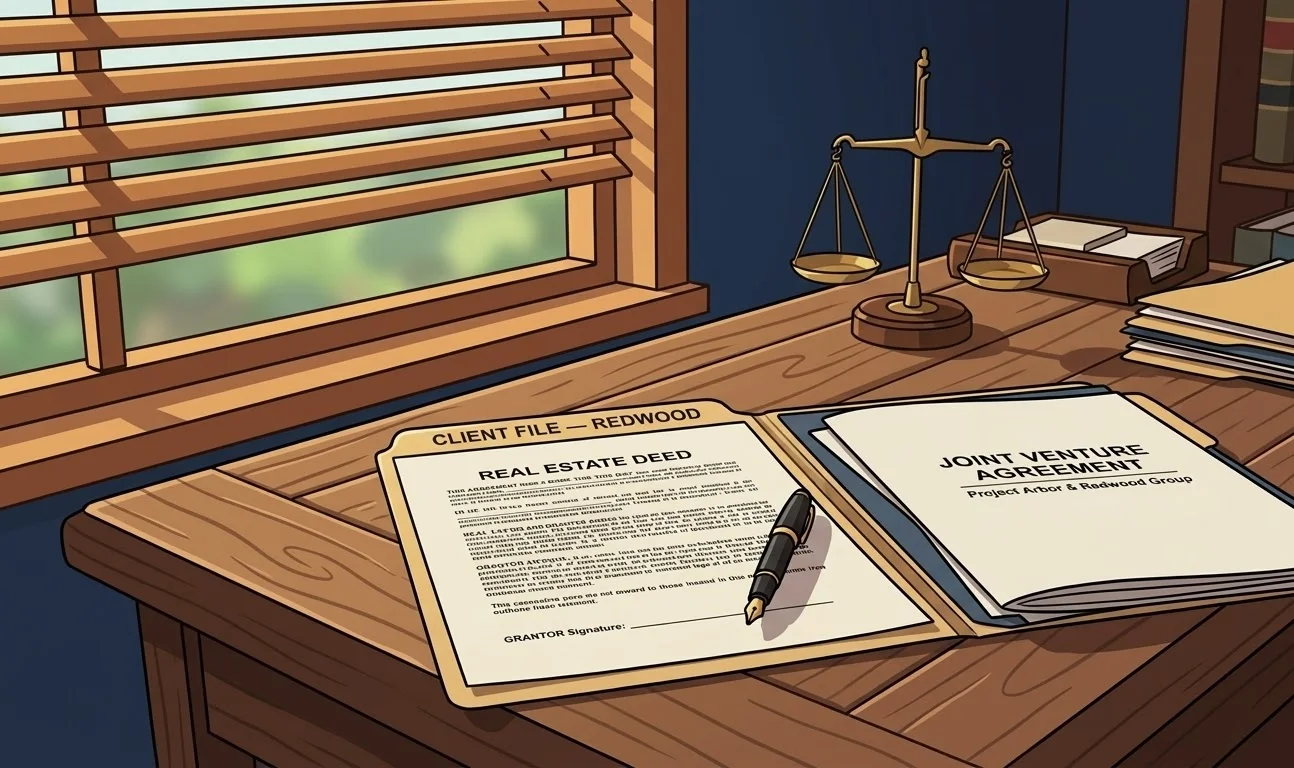
Here’s something I’ve seen play out more times than I’d like to admit: two people who know each other maybe from church, maybe the gym shake hands on a real estate deal. Both of them are experienced. Both know how business works. And somehow, they still end up in litigation.
Costantini v. GJP Developers, Inc., C.A. No. 9423-VCN (Del. Ch. Aug. 24, 2015), is exactly that story. Joseph Costantini and Gary Papa weren’t strangers. They were acquaintances. The deal made sense on paper a discounted mortgage note, a distressed property in Wildwood, New Jersey, a mini-golf course. Real potential. But when Papa never recorded the deed transferring his property to the joint venture, the whole thing unraveled fast.
What Vice Chancellor Noble’s opinion gives practitioners isn’t just a cautionary tale. It’s a fairly detailed roadmap of how Delaware Chancery thinks through failed joint ventures where contract terms end and equity begins and what happens when the gap between a handshake and a formal closing costs someone over a million dollars.
For business owners, real estate developers and younger attorneys alike, this case is worth understanding. The lessons are simple. The documentation failures that caused it? Entirely preventable.
Case Background & Facts
The Parties and the Deal
The deal started in early 2013. Costantini a construction business owne had acquired a distressed mortgage note on two Wildwood, New Jersey properties: 447 and 437 West Rio Grande Avenue. Originally a $2.34 million judgment, he picked it up for $500,000. That’s a significant discount and it formed the entire financial foundation of what the parties envisioned together.
Papa owned GJP Developers, Inc., a Pennsylvania construction and development company with over 37 years in the industry. His contribution to the joint venture was supposed to be the 447 property itself transferred into one of two Delaware LLCs formed specifically for this project: St. Thomas Group, LLC (to hold the property) and Wildwood Mini Golf, LLC (to operate the course).
What Costantini Put In
By the time things fell apart, Costantini had contributed roughly $1.29 million total in cash advances and in-kind construction services. The breakdown:
| Contribution Item | Amount |
| Discounted mortgage note purchase | $500,000 |
| April 23, 2013 wire transfer | $250,000 |
| June 10, 2013 check | $92,289.61 |
| June 25, 2013 wire transfer | $230,000 |
| July 27, 2013 check | $50,000 |
| August 8, 2013 check | $40,000 |
| In-kind construction services | $130,000 |
| Total Costantini Contributions | ~$1.29 million |
The Term Sheets — and the Deadline That Mattered
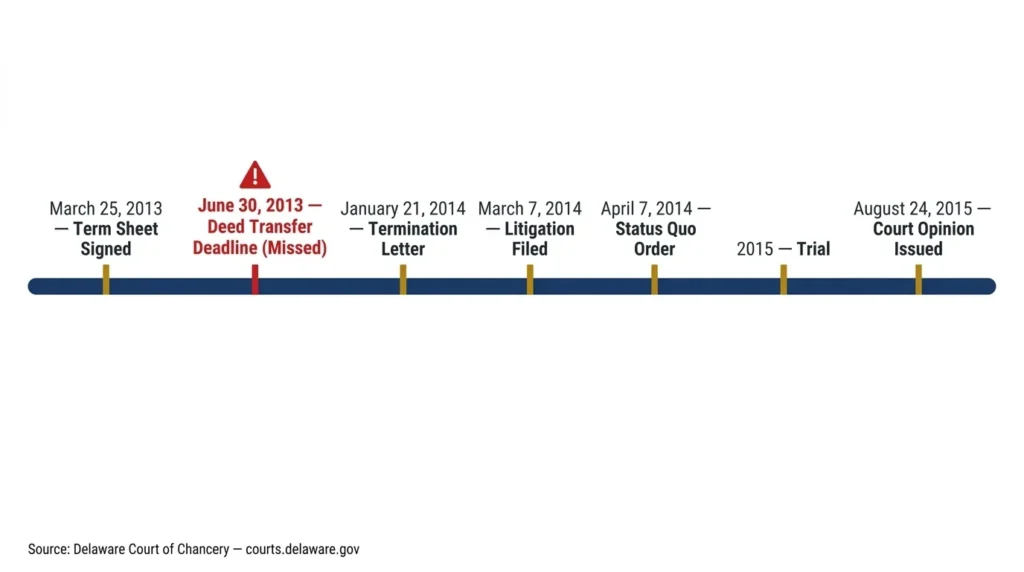
The parties signed a Term Sheet on March 25, 2013, then an Additional Term Sheet on April 23, 2013. Both parties later stipulated these documents controlled not the LLC operating agreements executed afterward. Under the Term Sheets, the venture had to be “formed and funded” including Papa’s property transfer by June 30, 2013.
That deadline came and went. Papa never recorded the deed.
The mini-golf course did operate during the 2013 season. Profits were shared. But the fundamental obligation property transfer into the LLC never happened. By January 2014, Costantini had seen enough. He sent a termination letter on January 21, 2014. Litigation followed March 7, 2014.
Legal Analysis & Key Rulings
Vice Chancellor Noble worked through three core questions at trial: which documents governed, whether Papa’s failure constituted a material breach and what remedies the court should fashion. Let’s take each in turn.
1. Governing Documents: The Term Sheets Won
This is where drafting really matters. The LLC agreements executed after the Term Sheets didn’t contain any provisions about what happens if the venture never successfully forms. The Term Sheets did. Sections 4–6 laid out specific termination rights and remedies if formation and funding didn’t happen on time.
Plain language ruled. The LLC agreements didn’t supersede the Term Sheets on this point because they simply didn’t address it. This happens more than you’d think parties execute an LLC agreement assuming it supersedes everything, but if it doesn’t speak to the specific situation at issue, the earlier document controls.
2. Material Breach: The Deed That Never Got Recorded
The court applied the Restatement (Second) of Contracts § 241 factors to determine whether Papa’s failure rose to a material breach. The analysis:
| Restatement § 241 Factor | Court’s Finding |
| Injured party deprived of expected benefit | Costantini contributed ~$1.29M expecting property transfer into the LLC; the core exchange never occurred |
| Adequacy of damages alone | Full compensation required structured equitable remedy, not simple money damages |
| Likelihood of timely cure | Papa’s testimony about signing the deed lacked credibility; cure was not likely |
| Extent of partial performance | Operating the golf course in 2013 did not substitute for funding the LLC with the property |
| Good faith and fair dealing | Non-transfer of the deed undermined the good faith basis of the entire venture |
Papa’s argument essentially that shared profits in 2013 should excuse the missing deed didn’t hold up. The court distinguished this from In re Mobilactive Media, LLC, where partial performance had more direct bearing on the core bargain. Running a golf course wasn’t the same thing as actually funding the LLC with the property that was supposed to anchor it.
3. Termination: Valid — No ADR Required First
Papa argued the ADR clause in the LLC agreement should have been triggered before Costantini could terminate. Noble rejected this cleanly. The ADR clause applied to disputes arising after a successful formation not to situations where the LLC was never properly funded. Costantini’s January 21, 2014 letter validly exercised his termination rights under the Term Sheets.
Scope your ADR clauses carefully. A clause drafted to govern disputes ‘between members’ of an LLC may not reach situations where the LLC was never properly formed. If you want ADR to apply to formation failures too, that has to be explicit.
4. Remedies: Equity Trimmed the Windfall on Both Sides
Costantini wanted nearly $3.9 million or the full note judgment amount. The court wasn’t going to award that; it would have been a windfall well beyond the parties’ actual bargain. But the court also wasn’t about to let Papa walk away after benefiting from over $1.29 million in contributions.
“Equity regards that as done which in good conscience ought to be done.”
Vice Chancellor Noble built a remedy around the parties’ actual bargained expectations:
| Remedy Component | Amount / Terms |
| Note payoff (Term Sheet’s understood principal) | $800,000 |
| Other proven itemized cash advances | ~$750,000 |
| Additional differential amount ($800k principal minus $500k purchase price) | $300,000 |
| Interest rate on all amounts | 10% per annum from date of each advance |
| First $150k of additional amount triggered by | Termination effective January 21, 2014 |
| Second $150k triggered by | 45 days after termination |
| Financing window before enforcement | 60 days for Defendants to obtain financing |
| Restaurant rent collection right (437 W. Rio Grande) | Applied to reduce outstanding obligation |
The note was confirmed in Costantini’s personal name, not in St. Thomas LLC’s name. On the LLC itself, the court suggested a 50/50 split of any remaining Wildwood Mini Golf LLC funds after repayment, though full dissolution records were incomplete.
Practical Lessons & Takeaways
Twenty-plus years of practice has taught me that most joint venture disputes aren’t really about greed. They’re about assumptions. Each side assumes the other will handle something. Nobody writes it down. Then something goes sideways and everyone remembers the deal differently.
Here’s what Costantini tells practitioners and clients:
Lesson 1 — Term Sheets Are Binding. Treat Them That Way.
Parties routinely sign term sheets thinking they’re just a starting point. Delaware courts read them for what they actually say. If your term sheet has deadlines, those deadlines are enforceable. If it has termination remedies, those remedies are real. Don’t sign something you haven’t actually negotiated and don’t assume the LLC agreement you execute later will quietly override it.
Lesson 2 — Document Every Contribution, Cash and In-Kind.
Costantini recovered on $130,000 in in-kind services because he could prove them. Vague claims about what you ‘put into the deal’ don’t survive trial. Wire confirmations, check copies, service logs keep all of it from day one, not after the dispute begins.
Lesson 3 — Deed Recording Is a Closing Condition, Not an Afterthought.
The entire case turns on one thing: Papa never recorded the deed. That should have been a hard, Day 1 closing condition. If property transfer is fundamental to your joint venture and it usually is in real estate deals make it a condition precedent. No transfer, no deal proceeds. Period.
Lesson 4 — ADR Clauses Don’t Always Reach Pre-Formation Disputes.
Scope your arbitration or mediation clauses with precision. A clause covering disputes ‘between members’ may have nothing to say about a situation where the entity was never properly funded to begin with. If you want ADR to apply to formation failures, drafting that has to be explicit.
Lesson 5 — Delaware Equity Is Flexible, but Not a Safety Net.
The court didn’t just apply contract math. It fashioned a remedy that prevented unjust enrichment on both sides that flexibility is a genuine feature of Delaware Chancery. But it’s not a backstop for poor drafting. The better your documents, the less room there is for expensive uncertainty at trial.
Contributions made
$1.29M
Court’s equitable remedy
$1.85M
Original claim sought
$3.9M
Costantini v. GJP Developers, Inc. — C.A. No. 9423-VCN (Del. Ch. 2015) | Interest included in equitable remedy figure
Quick-Reference Drafting Checklist for Real Estate JV Term Sheets
Use this before signing any joint venture term sheet where real property is involved:
- Hard deadline for all property transfers, with an explicit cure period and automatic termination trigger if the deadline is missed.
- Escrow of contributed cash until all closing conditions including deed recording are confirmed met.
- Deed recording as a written condition precedent. Not ‘to be completed’ an affirmative condition with teeth.
- ADR clause scope clearly defined: does it reach pre-formation disputes or only post-formation member disputes?
- Itemized documentation of all in-kind contributions at the time of contribution, signed off by both parties.
- Express conflict clause: if the LLC agreement and the term sheet conflict, which one controls and on what subjects?
Conclusion
Costantini v. GJP Developers, Inc. isn’t a blockbuster case. It won’t anchor a law school JV unit. But for practitioners handling real estate joint ventures especially smaller deals between people who know each other it’s genuinely useful reading.
The lesson isn’t ‘don’t trust people you know in business.’ It’s that goodwill doesn’t substitute for clear documents and Delaware courts will read exactly what you wrote. A term sheet with a June 30 deadline means June 30. An obligation to transfer property is an obligation. When it doesn’t happen, the downstream consequences are real and expensive.
For business owners and developers: get it in writing, document your contributions and make deed recording a hard closing condition. For attorneys drafting these agreements: scope your ADR clauses carefully, assume the LLC agreement won’t fix earlier ambiguity unless you write it to and never let a contribution like $130,000 in services go undocumented.
Delaware Chancery remains one of the most efficient, sophisticated forums in the country for exactly these disputes. What Costantini reinforces is both what that court will enforce and how far it’ll go to make an equitable remedy fit the actual bargain, even when the parties didn’t do the cleanest job of writing one themselves.