 Armand Avazian (US Immigration Lawyer)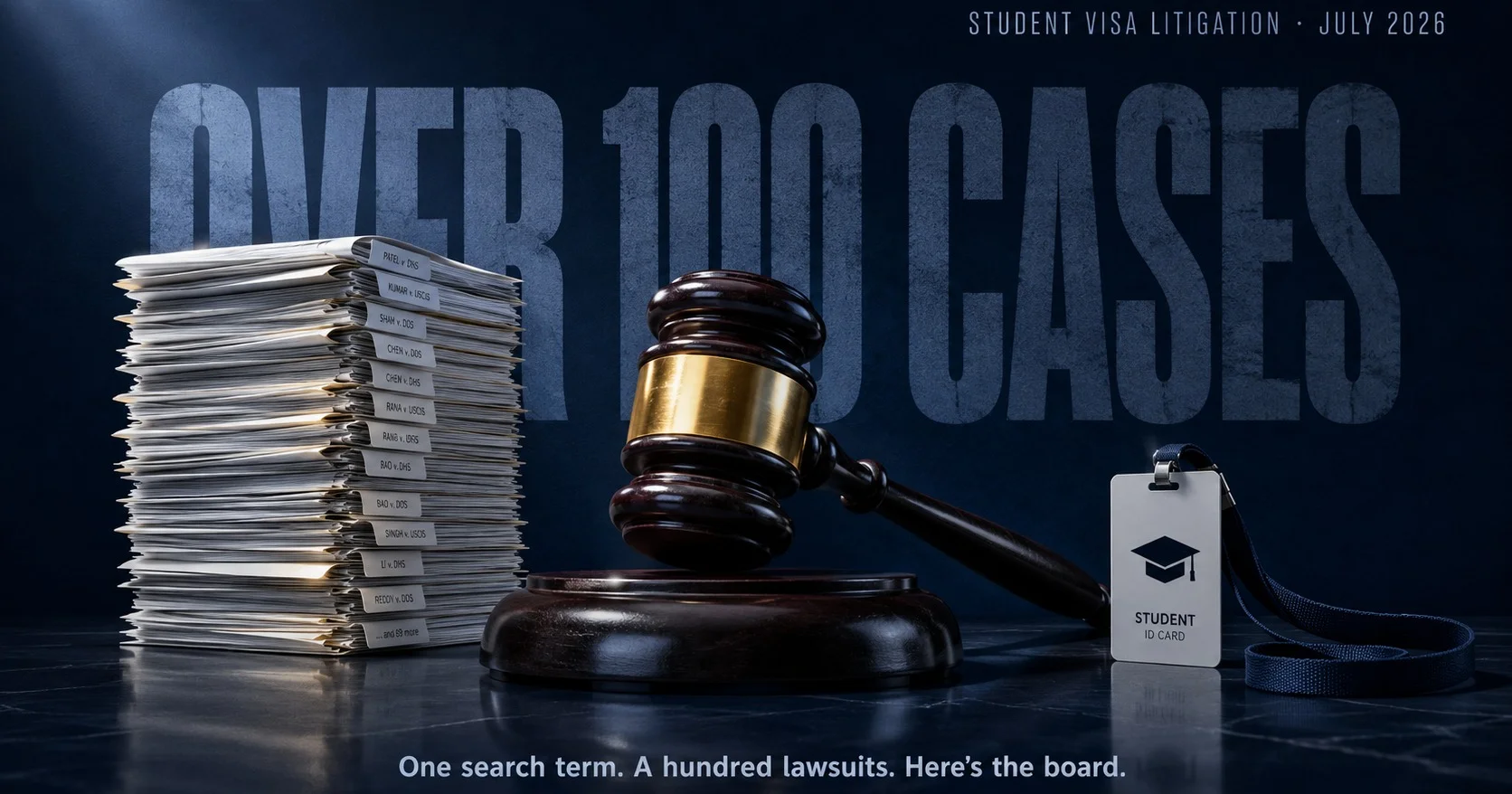
There is no single homeland security student visa lawsuit. Since spring 2025 the government’s student visa enforcement has drawn well over a hundred federal cases and by now most searches on this topic land on stale or garbled summaries. So here is the board first, current as of July 15, 2026 and the story after.
| The fight | Where | What happened | Where it stands now |
|---|---|---|---|
| Mass SEVIS terminations | N.D. Cal. (Judge Jeffrey White), plus 100+ suits nationwide | First nationwide injunction issued May 22, 2025 | Injunction in force, cases proceeding |
| AAUP v. Rubio, ideological deportations | D. Mass., No. 1:25-cv-10685 (Judge William Young) | Policy ruled unconstitutional Sept. 30, 2025 | On appeal, enforcement sanction stayed |
| Individual habeas cases (Ozturk, Mahdawi, Khalil) | D. Vt., D.N.J. | Releases ordered April through June 2025 | Individual proceedings continue |
| Harvard’s SEVP certification | D. Mass., No. 1:25-cv-11472 | Enrollment authority preserved | Ongoing |
| Duration-of-status rule | Not a case yet, rulemaking stage | Cleared OMB review June 17, 2026 | Publication imminent, challenges expected after |
Two of those rows carry most of the weight and the last row is the one that will matter most by autumn. Taken in turn.
The SEVIS fight, in the order it actually happened
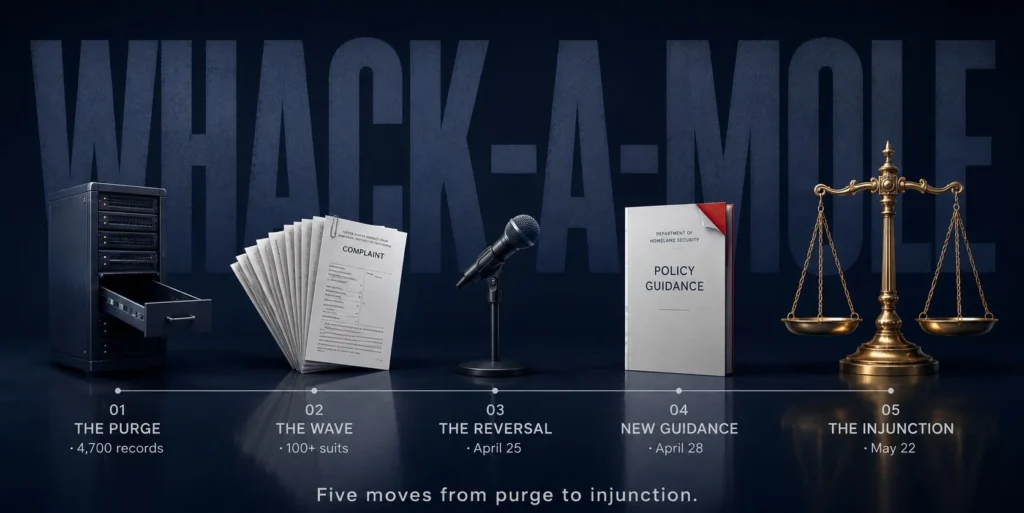
The shortest way to understand the first front is as a sequence, because the government’s position changed almost weekly.
Five moves from purge to injunction
- Spring 2025. ICE runs international student’s names through federal criminal databases under the Student Criminal Alien Initiative and deletes their SEVIS records, more than 4,700 students in all, many over dismissed charges or mere police encounters.
- April 2025. Students sue in dozens of districts at once. The wave passes 100 lawsuits, with judges in more than 50 cases ordering the administration to temporarily undo it’s actions.
- April 25, 2025. Losing nearly everywhere, a Justice Department lawyer announces in court that ICE has started reinstating the terminated records.
- April 28, 2025. A court filing reveals new ICE guidance permitting SEVIS terminations on broader grounds, including visa revocation itself.
- May 22, 2025. Judge White issues the decisive order. The nationwide injunction bars the government from arresting, detaining or transferring the plaintiffs or similarly situated students and bars it from reversing the reinstatements.
What Judge White’s order locked in
Two things in that ruling still shape everything. White rejected as unpersuasive the government’s core argument that a SEVIS record is separate from a student’s legal status, finding the terminations altered student’s legal status. And he was openly skeptical of the government’s shifting posture, writing that it was unclear how this “game of whack-a-mole” would end without an injunction. The government’s standing position, for it’s part, is that visas and SEVIS are distinct and that the State Department revokes visas daily to protect the border. The injunction shields the students caught in the 2025 purge; the broader replacement policy remains live.
AAUP v. Rubio: the ruling under appeal
The habeas wins that opened the front
The second front concerns speech. Beginning in March 2025, DHS detained students and scholars after pro-Palestinian advocacy, in several instances invoking an obscure provision of the Immigration and Nationality Act in ways it had never been used before. Federal judges in Vermont and New Jersey ordered the release of Rumeysa Ozturk, Mohsen Mahdawi and Mahmoud Khalil in individual habeas cases between April and June 2025, on First Amendment and due process theories.
A motion that became a trial
The consolidated challenge is AAUP v. Rubio, filed March 25, 2025 by the American Association of University Professors, three of it’s campus chapters and the Middle East Studies Association, represented by the Knight First Amendment Institute. Judge Young converted the preliminary injunction briefing into a trial on the merits and the nine-day trial in July 2025, with fifteen witnesses, became the first major trial of the second Trump term.
The September ruling and the January remedy
The ruling came on September 30, 2025, in a 161-page opinion. The court held that officials pursued a policy of arresting, detaining and deporting noncitizen students and faculty who engaged in pro-Palestinian protest, that it’s purpose was to chill that speech and that it was impermissibly viewpoint discriminatory under the First Amendment and arbitrary and capricious under the APA. On whether noncitizens hold the same speech rights as citizens, Young answered “yes, they do.”
The remedy arrived on January 22, 2026: an order declaring the policy unconstitutional and setting it aside under the APA, plus a sanction designed to let AAUP and MESA members quickly challenge adverse immigration actions, which the appeals court stayed pending further review. Under the district court’s framework, adverse actions against members during the litigation are presumed retaliatory unless the government rebuts that by clear and convincing evidence. The appeal is live and reviewing courts may put greater emphasis on presidential foreign policy powers than the trial court did. Treat this one as decided but not final. A related institutional fight is worth one line here: Harvard’s suit over it’s SEVP certification, President and Fellows of Harvard College v. DHS, No. 1:25-cv-11472, kept the university’s ability to enroll international students intact through 2025.
The lawsuit that cannot exist yet
The most consequential change of all, ending “duration of status,” has produced zero lawsuits, because there is nothing final to sue over. Any source describing universities already litigating a final duration-of-status rule is describing a case that does not exist. DHS proposed the rule on August 28, 2025, reviving a substantially similar 2020 proposal that was withdrawn in 2021 and it drew more than 34,800 public comments, the majority opposed. The final rule went to OMB on May 5, 2026 and OMB concluded it’s review on June 17, 2026, marked “consistent with change,” with the rule taking effect 60 days after Federal Register publication.
What actually changes for students
| Today, under duration of status | Under the new rule |
|---|---|
| Admitted for as long as status is maintained, no fixed I-94 end date | Fixed admission tied to the program end date, capped at four years |
| Extensions handled by the school’s DSO in SEVIS | Formal extension filings with USCIS required to stay longer |
| 60-day grace period after an F-1 program ends | Grace period cut to 30 days |
| Unlawful presence only after a formal government finding | Unlawful presence accrues automatically the day after the admission period expires |
One honesty note that most coverage skips: until the final text publishes in the Federal Register, every provision above reflects the proposed rule, not confirmed final law.