 Armand Avazian (US Immigration Lawyer)
EB-2 is often discussed alongside EB-1 and EB-3. Compared to EB-3, which is for skilled workers and professionals, EB-2 generally requires a higher level of education or a stronger record of expertise. Compared to EB-1, which is reserved for individuals with extraordinary ability or certain top-tier research or management profiles, EB-2 is usually more accessible, but still requires substantial evidence, particularly for applicants pursuing a National Interest Waiver.
Broadly speaking, there are two main ‘paths’ to EB-2:
- Standard EB-2 (employer-sponsored, usually involving a PERM labour certification).
- An EB-2 National Interest Waiver (NIW) can waive the job offer and PERM requirements.
Whether an employer is willing and able to sponsor you through the labour certification process depends on your credentials and work plans.
The EB-2 visa is a US employment-based immigrant category that can lead to lawful permanent residence (a green card). It is intended for foreign nationals whose education or professional background is considered particularly valuable to the US economy, research ecosystem, healthcare system or other areas of national interest.
The three core EB-2 eligibility frameworks
1) Advanced degree professional
You may qualify if the position you are applying for requires an advanced degree and you have one. In practice, ‘advanced degree’ usually refers to a U.S. master’s degree (or higher) or an equivalent qualification from another country. In some cases, a bachelor’s degree plus additional progressive post-bachelor experience may qualify if this combination is considered equivalent within the specific EB-2 framework.
Key idea: it’s not just about your diploma; it’s also about whether the job is genuinely an advanced-degree role, and whether the employer can consistently document the requirements.
2) Exceptional ability
This option is aimed at individuals who can demonstrate expertise that is significantly higher than what is usually found in a given field. It can be applied to many different areas, including engineering, business, healthcare and data science.
Evidence often comprises a variety of elements.
- Academic records (e.g. degrees and specialised training).
- Letters documenting experience
- professional licences or certifications
- High salary compared to that of peers.
- Membership of professional associations
- Recognition of achievements, such as awards, press coverage, invitations to speak, peer-reviewed publications and patents.
No single item ‘wins the case’. An EB-2 case is usually built as a credible narrative supported by multiple pieces of independent evidence.
3) National Interest Waiver (NIW):
The NIW is a special EB-2 route in which applicants can request that the U.S. government waive the standard requirements of a permanent job offer and PERM labour certification, on the basis that their proposed work will benefit the United States.
This is popular among researchers, founders, clinicians and specialists working in high-impact areas. It is also popular among applicants who want more flexibility than an employer-sponsored PERM case allows.
NIW is not a ‘shortcut’. In fact, it often requires more strategy and documentation than a standard employer-sponsored EB-2, since you must prove both the national interest argument and your ability to advance it.
Practical differences between EB-2 with PERM and EB-2 NIW
Employer-sponsored EB-2 (PERM route).
In many EB-2 cases, the employer must first complete the PERM labour certification process. This demonstrates that there are no qualified, willing and available US workers for the position at the prevailing wage under the specified conditions. PERM also requires careful record keeping and strict compliance with recruitment rules.
This path is strong when:
- The employer is a stable and experienced company that can offer sponsorship.
- It is clear that this is an EB-2-level role.
- The applicant’s credentials align perfectly with the role.
- The employer can meet the timeline and documentation requirements.
Potential friction points:
- If the role appears to be under-leveled (i.e. looks like an EB-3 job), the EB-2 classification can be challenged.
- Changes to job duties, location or requirements may necessitate rework.
- Audits can increase the time and complexity involved.
The EB-2 National Interest Waiver (NIW) route.
The NIW shifts the focus from ’employer recruitment compliance’ to ‘evidence of national benefit and personal capacity’.
A NIW can be effective when:
- You can explain what your proposed endeavour will entail (i.e. what you will do in the U.S.).
- The endeavour has credible national value in terms of economics, public health, research, security and infrastructure.
- You can demonstrate traction through publications, patents, contracts, product adoption, clinical outcomes, grants, letters from independent experts or measurable impact.
- You are well-placed to succeed, with a proven track record and a realistic plan.
Common NIW weaknesses:
- A vague endeavour, such as ‘I will work in tech’, without a defined mission or deliverables.
- The evidence is impressive, but not tied to the benefit of the United States.
- Letters that are generic or written only by close colleagues who lack an independent perspective.
- Overclaiming involves promising outcomes rather than documenting credible probabilities and past results.
The EB-2 Process in Plain Terms
While details vary by path, EB-2 cases usually involve these stages:
Step 1: Building the Eligibility Record
For PERM cases, this is the employer’s job description, wage level, and recruitment plan plus your matching credentials.
For NIW, this is your proposed endeavor and evidence package that proves both national importance and your ability to advance it.
Step 2: Filing the Immigrant Petition (I-140)
The I-140 is the formal immigrant petition for EB-2. In PERM cases, it is usually filed after labor certification is approved. In NIW cases, it is filed without PERM.
At this stage, the government focuses heavily on whether the evidence fits EB-2 standards and whether the narrative is coherent, consistent, and well-supported.
Step 3: Waiting for a Visa Number (Priority Date and Visa Bulletin)
EB categories are subject to annual limits and per-country caps. When demand is high, some countries face backlogs. The “priority date” is essentially your place in line (often tied to the PERM filing date, or the I-140 filing date for NIW). Whether you can move forward depends on your priority date becoming current under the Visa Bulletin.
This is a key reality check: even a strong EB-2 petition may not immediately translate into the final green card step if the category is backlogged for your country of chargeability.
Step 4: The final green card stage (AOS or consular processing).
If you are in the US and eligible, you can apply for an Adjustment of Status (AOS). If you are outside the US, consular processing is usually the method used.
Both routes involve background checks and medical requirements. AOS also frequently raises practical issues such as maintaining lawful status, the timing of work authorisation, and travel planning.
Evidence That Actually Matters (And Why)
EB-2 decisions are evidence-driven. Think in terms of “independent verification” and “impact signals,” not just a resume.
Strong evidence tends to fall into these buckets:
- Education and specialized training: degrees, transcripts, specialized coursework, fellowships
- Work history: detailed experience letters showing role complexity, progression, and achievements
- Recognition and external validation: awards, selective memberships, invited talks, press coverage
- High responsibility or influence: leading projects, managing budgets, supervising teams, technical leadership
- Measurable outcomes: revenue growth, cost savings, publications and citations, patents, clinical metrics, product adoption, policy influence
- Independent expert letters: especially persuasive in NIW if writers are not close collaborators and can explain why your work matters to U.S. interests
A frequent mistake is to submit “many documents” without a clear story. Quantity does not replace relevance. The best EB-2 files read like a structured argument where each exhibit supports a specific claim.
Common Reasons EB-2 Cases Get Delayed or Challenged
- Mismatch between job requirements and candidate credentials (PERM route)
If the employer’s stated minimum requirements don’t match the reality of the role—or if requirements appear inflated for the purpose of sponsorship—cases can get complicated. - Inconsistent timelines or job history
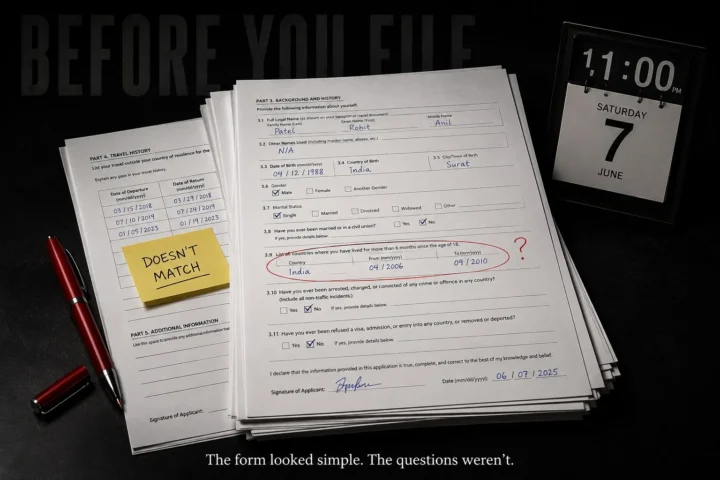
Even small inconsistencies between resumes, letters, and forms can trigger questions. - Weak or generic recommendation letters (NIW route)
Letters that praise you without explaining specific impact and national value are easy to discount. - Overbroad national interest claims
“Technology is important” is not enough. The argument must connect your specific work to concrete national-level value. - Under-documenting results
If you claim impact, show it: citations, adoption, contracts, performance metrics, published outcomes, third-party validation.
Planning Considerations: Status, Flexibility, and Timing
EB-2 strategy is often as much about logistics as it is about eligibility.
- Maintaining lawful status in the U.S. matters until you are in the stage where you can file AOS (if applicable). People often underestimate how status gaps can complicate the later stages.
- Job changes can be sensitive in PERM-based cases, because PERM is tied to a specific role, location, and set of requirements.
- NIW offers more flexibility, but the evidence must show you are realistically continuing in your proposed endeavor, not switching to something unrelated right after approval.
- Country backlogs can shape everything. EB-2 timing can look very different depending on chargeability and the visa bulletin movement.
A good approach is to plan in “modules”: petition quality (I-140), priority date strategy, and final-stage readiness (AOS/consular), each with its own risks and contingencies.
What ‘strong’ usually looks like for EB-2 in 2026
Strong EB-2 cases in recent years often share these qualities, without relying on hype:
- A precise and credible professional profile, rather than a generic ‘I’m talented’ narrative.
- Clear, documented achievements that can be validated by third parties.
- Consistent documentation throughout all forms and exhibits.
- For NIW, you need to demonstrate a focused endeavour with plausible national value, as well as evidence that you are already advancing it.
The category is competitive because it occupies the ‘high-value professional’ middle ground: it is more accessible than EB-1 for many applicants, but it is still demanding enough that cases with weak documentation can struggle.
final thoughts
EB-2 is not a single pathway; it’s a framework with multiple routes and different standards of proof. Approaching it like a structured evidence case rather than a checklist makes the process clearer: first, define which EB-2 route fits; then, build documentation that proves each legal element; finally, plan realistically around timing and visa availability.
A calm, factual and well-supported EB-2 file will usually perform better than one that tries to impress with bold claims. In U.S. immigration, credibility is a form of evidence.
Let me know if you want me to explain the differences between the EB-2 NIW and the EB-2 via employer/PERM tracks, and specify your field (tech, healthcare, research or business). I’ll adapt the non-commercial style to create a more tailored guide with a tighter evidence checklist for that scenario.