 Attorney Kyle Persaud (Family Lawyer)
Colorado recognizes common law marriage — no ceremony, no license — but it’s not as automatic as people think. Both partners must be 18+, genuinely agree to be married, live together and openly present themselves as a couple to the world. Get it wrong and you could be legally married without realizing it or fail to prove a marriage that you’re counting on.
What Is a Common Law Marriage in Colorado?
No rings, no officiant, no venue deposit — Colorado lets couples become legally married through conduct and mutual intent alone. It’s one of maybe eight or nine states that still recognize this, which makes it a genuinely unusual corner of American family law.
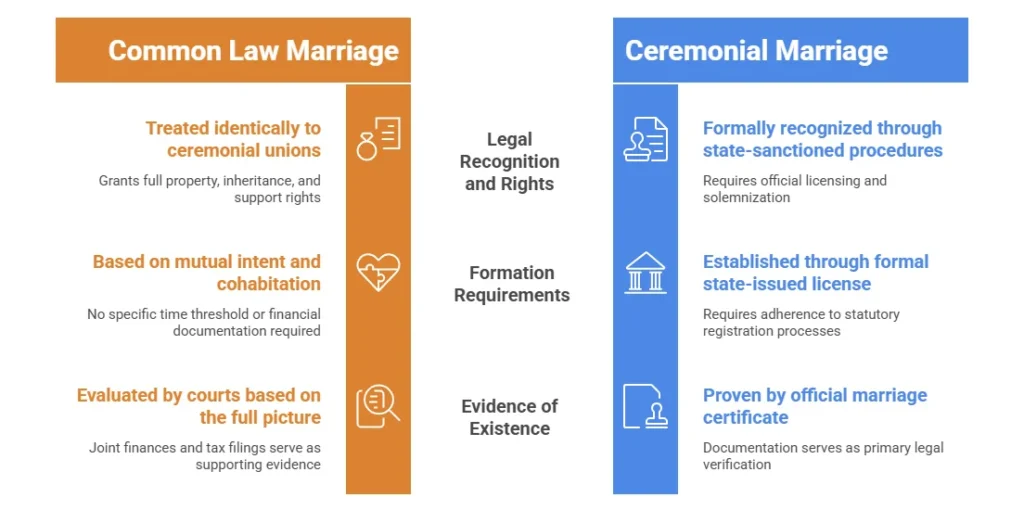
And it’s not a “lesser” marriage. A valid common law marriage in Colorado carries the exact same legal weight as one with a $30,000 reception behind it — same property rights, same inheritance, same everything. Which is exactly why it matters whether you’re in one or not.
If you’re relocating to Denver, Boulder or anywhere else in the state — or even just spending an extended stretch here — it’s worth understanding the rules. Not because you’ll accidentally stumble into a marriage over a long weekend, but because if you’ve been with someone for years and things go sideways, a Colorado court might have opinions about your relationship that surprise you.
What Are the Legal Requirements?
There are two layers here: what the statute says and what courts have built on top of it through case law.
The Statutory Basics (C.R.S. § 14-2-109.5)
For any common law marriage entered into on or after September 1, 2006, both of these must be true:
- Both people are at least 18 years old.
- Neither person is already married to someone else — no bigamy, no workarounds.
Miss either one and there’s no common law marriage. Full stop.
The Three Case-Law Elements
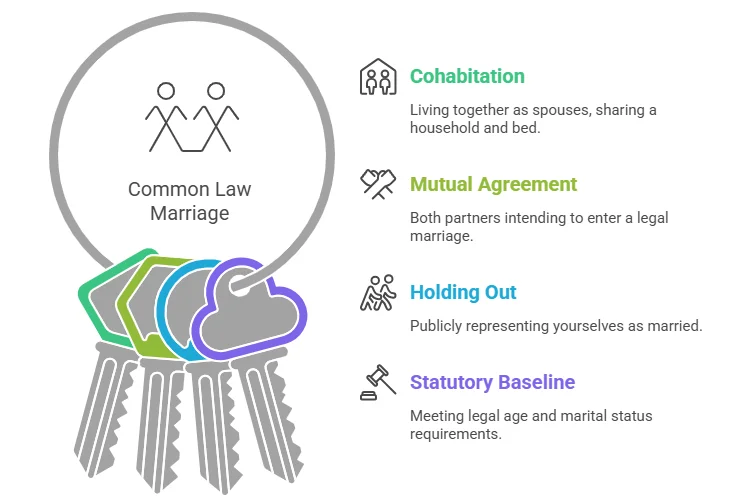
Beyond the statute, Colorado courts look for three things — all three, not just one or two:
1. Cohabitation You have to actually live together. There’s no minimum time requirement though — courts have found cohabitation established quickly. The distinction is living as spouses, not just sharing an address. Two grad students splitting rent don’t qualify. Two people running a household together, sharing a bed, splitting groceries — different story.
2. Mutual Agreement to Be Married Both people need to genuinely intend to be married — not just committed, not just “serious,” but specifically agreeing to enter the legal and social institution of marriage. This can be an explicit conversation (“we are married”) or inferred from how you live. But one person secretly deciding they’re married while the other thinks they’re just dating? That doesn’t count.
3. Holding Out as Married This is the big one people underestimate. You have to consistently represent yourselves to the public as a married couple — to friends, family, coworkers, neighbors. Not occasionally, not when it’s convenient for an insurance form. Consistently. Courts look for a reputation in the community: do the people in your life actually think you’re married?
One quick example of each, since these get abstract fast:
| Element | What it looks like in practice |
| Cohabitation | Sharing a lease in Capitol Hill, both names on the utility bills |
| Mutual agreement | Telling each other and others “we’re married” — even without a ceremony |
| Holding out | Your family invites you both to Thanksgiving as a couple, introduces your partner as your spouse |
How Do You Prove You’re Common Law Married?
This is where things get genuinely complicated — and honestly, where most disputes end up. No certificate exists. No record was filed. So when a court needs to decide whether two people were married, it goes digging through their life together.
The standard is clear and convincing evidence — higher than a typical civil case. You’re not just tipping the scales; you’re making the court genuinely confident the marriage existed.
Here’s what they’re actually looking at:
| Type of Evidence | What It Shows | Real-World Example |
| Joint finances | Shared economic life, not just cohabitation | Joint checking account, both names on a mortgage |
| Tax returns | Official, sworn declaration of marital status | Filed as “married filing jointly” with the IRS |
| Wearing rings | Public symbol of commitment | Both wearing wedding bands, especially if exchanged intentionally |
| Same last name | Public assumption of marital identity | One partner took the other’s surname, used it on documents |
| Beneficiary designations | Legal recognition of spousal role | Named as spouse on life insurance or 401(k) |
| Social introductions | How you present to the world | “This is my husband/wife” — consistently, not just occasionally |
| Community reputation | What others actually believe | Family, friends, coworkers all understand you to be married |
Courts don’t treat all of these equally. Official documents — joint tax returns, health insurance designations listing someone as a spouse — carry serious weight. Cohabitation alone, even for decades, ranks low on it’s own. That surprises people.
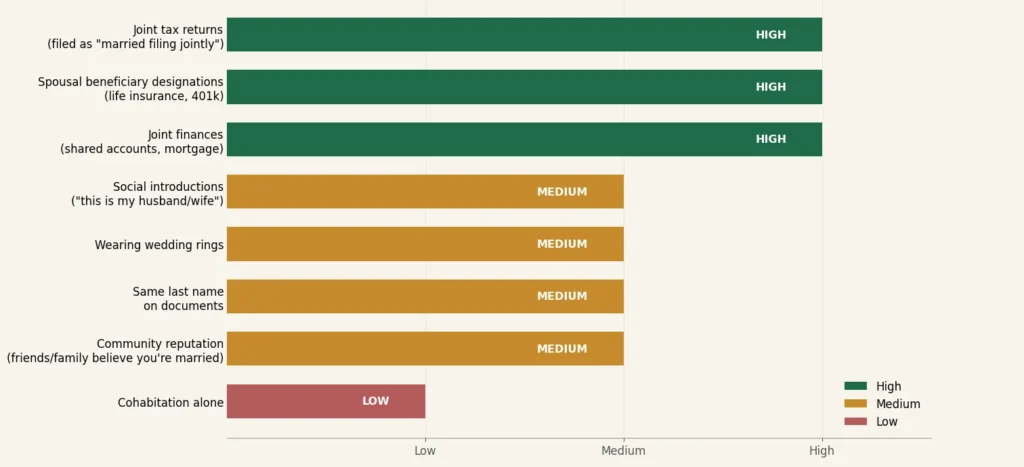
One thing worth knowing: not having joint taxes doesn’t automatically kill a claim. Courts look at everything together. A couple that kept finances separate but openly called each other spouse for fifteen years, shared a home and listed each other on medical paperwork — that’s a real case. But you’d want a good attorney making it.
What Rights and Obligations Kick In?
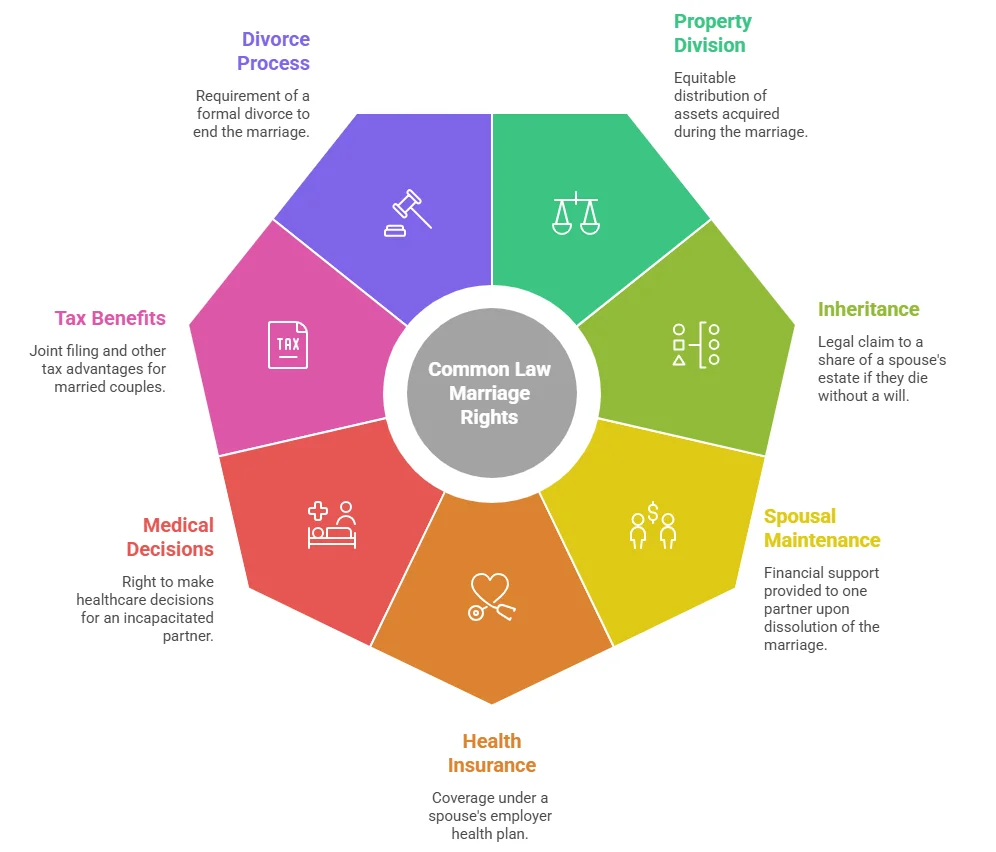
Once a Colorado court recognizes a common law marriage, the legal consequences are identical to any other marriage. There’s no “common law lite” version.
Here’s what that actually means:
- Property division — Anything acquired during the marriage is marital property, subject to equitable distribution if you split. Colorado doesn’t do 50/50 automatically; it does “fair,” which is it’s own can of worms.
- Inheritance — If your common law spouse dies without a will, you have legal claim to a share of their estate under Colorado intestacy law. No marriage recognition, no automatic inheritance.
- Spousal maintenance — Better known as alimony. Either partner can seek it upon dissolution, based on factors like length of the relationship and financial disparity.
- Health insurance — You can be covered under a spouse’s employer plan. Relevant if you’re relocating for a partner’s job and need coverage.
- Medical decisions — If your partner is incapacitated, you have the right to make medical decisions for them. Without recognized marriage, that right isn’t guaranteed — and hospitals don’t always have time to sort out ambiguity.
- Tax benefits — Joint filing, spousal deductions, estate tax advantages. These cut both ways; filing jointly can sometimes cost more depending on income.
The relocation angle matters here more than people expect. Say you moved to Colorado two years ago with a long-term partner. You’ve been living together, calling each other spouse at parties, filing jointly. If things fall apart, you don’t just pack boxes and walk away — you may be dissolving a legal marriage. That means attorneys, courts and potentially spousal support discussions. Worth knowing before you’re in it.
Ending a Common Law Marriage
Here’s the part that catches people off guard. There’s no “common law breakup.” You can’t just stop cohabitating, update your Facebook status and call it done. If a Colorado court would recognize your relationship as a marriage, ending it requires an actual divorce — formally called a dissolution of marriage.
Same process as any other divorce. Same paperwork, same court, same potential for things to get expensive.
A few specifics:
- Residency requirement — At least one spouse must have lived in Colorado for 91 days before filing.
- Property — Divided under C.R.S. § 14-10-113, equitable distribution principles.
- Kids — If children are involved, the court handles parental responsibilities and child support the same way it would in any divorce.
- Spousal maintenance — Either party can request it; courts weigh income, length of the relationship and standard of living.
Now, what happens when one partner says “we were never married” and the other disagrees? That’s not uncommon. In those cases, the court has to resolve the threshold question — did a valid common law marriage exist? — before it can even begin dividing anything. That preliminary hearing can itself become a full contested proceeding, with witnesses, documents, the works. It’s it’s own litigation before the actual divorce litigation.
If you’re in a long-term relationship and genuinely unsure whether Colorado law would consider you married, that ambiguity is worth resolving before a crisis forces the question.
A Special Note for Same-Sex Couples
The legal history here took a while to catch up with reality and Colorado courts have been thoughtful about acknowledging that.
In 2021, the Colorado Supreme Court decided both In re Marriage of Hogsett and In re Marriage of LaFleur & Pyfer — two cases that changed things significantly. The core holding: same-sex couples who were together before Colorado or the U.S. recognized same-sex marriage can have their relationship recognized retroactively as a valid common law marriage.
The reasoning matters. Before Obergefell v. Hodges in 2015 and before Colorado’s own recognition in 2014 — same-sex couples couldn’t openly hold themselves out as married without real consequences. They couldn’t file joint federal tax returns. Many couldn’t list a partner on official documents without professional or social risk. Applying the traditional “holding out” standard rigidly to those couples would’ve been deeply unfair given the legal environment they were navigating.
So courts now apply a flexible test for same-sex couples evaluating pre-recognition relationships. The core question remains the same — did both people mutually intend to be in a marital relationship and live as spouses? — but the evidence gets interpreted in historical context. A couple that kept things quiet out of necessity isn’t automatically penalized for not shouting their relationship from the rooftops.
If you’re in a same-sex relationship that predates marriage equality and questions about your legal status have come up — inheritance, property, benefits — it’s genuinely worth talking to a Colorado family law attorney. The law here is more favorable than many people realize.
Common Myths (and the Truth)
A lot of what people “know” about common law marriage is wrong. Some of it is harmlessly wrong. Some of it leads to genuinely bad decisions.
- “If we live together seven years, we’re automatically married.” No. There is no time threshold in Colorado law — not seven years, not twenty. Cohabitation duration alone has never been the test. You could live together for three decades and have zero legal marriage if the other elements aren’t there.
- “We’d need joint finances to qualify.” Joint accounts and shared tax returns are strong evidence, but they’re not a legal requirement. Courts look at the full picture. Plenty of couples keep finances separate for legitimate reasons — that alone doesn’t close the door on proving a common law marriage.
- “You can accidentally end up common law married.” Both people have to genuinely, mutually intend to be married. If one person thinks they’re in a serious relationship and the other secretly considers themselves married, that gap in intent matters. Accidental marriage isn’t really a thing here — though people absolutely end up surprised by what a court concludes based on their conduct.
- “Common law married couples have to file taxes jointly.” Filing jointly is evidence of a marriage — it’s not a requirement to have one. And once married, you can still choose filing status that works for your situation. This one goes both ways: filing jointly when you don’t intend to be married can create complications you didn’t anticipate.
- “It’s not a real marriage.” It absolutely is. Colorado Revised Statutes treat it identically to a ceremonial marriage in every legal respect. Other states that recognize common law marriage will treat a valid Colorado common law marriage the same way. And even states that don’t allow new common law marriages typically recognize valid ones from states that do.
The Affidavit of Common Law Marriage — Should You Sign One?
An affidavit of common law marriage is a notarized document where both partners declare, in writing, that they consider themselves common law married. You can file it with your county clerk and recorder’s office in Colorado.
It doesn’t create a marriage. That’s worth saying clearly — signing an affidavit doesn’t make you married if the legal elements aren’t already there. What it does is create a strong, official piece of evidence that the marriage exists. If you ever need to prove the marriage to an employer, insurer, hospital or court, having a filed affidavit is a lot cleaner than reconstructing years of circumstantial evidence.
Practical tip for anyone crossing state lines: if you’re relocating from Colorado to a state that doesn’t recognize new common law marriages — say, moving to California or Florida for work — having a properly executed affidavit on file can save real headaches. HR departments and insurance providers in those states aren’t always equipped to evaluate a common law marriage claim from scratch. A notarized, filed document gives them something concrete to work with.
One caution though. If you sign an affidavit and later one of you disputes whether the marriage existed, that document is going to feature prominently in court. It’s not a casual thing to sign.
Frequently Asked Questions From Movers and Travelers
I just moved to Colorado with my partner. Are we automatically married?
No. Moving to Colorado doesn’t trigger anything on it’s own. What matters is whether you meet the elements — mutual intent to be married, cohabitation as spouses and consistently holding yourselves out as married. If you’ve been together for years in another state and you arrive here presenting as a married couple, filing jointly, the whole picture — a court could find a marriage existed. But the move itself isn’t the event.
We’ve been together ten years but never filed joint taxes. Could a court still consider us married?
Possibly, yes. Joint tax returns carry real weight as evidence, but their absence isn’t automatically fatal to a claim. If you’ve lived together, introduced each other as spouses, listed each other on insurance or beneficiary forms and your families and friends consider you married — a court will look at all of that. Ten years of consistent conduct adds up even without the tax returns.
Can we get common law married while just vacationing in Colorado?
Technically the law doesn’t require a minimum residency period and cohabitation can be established quickly. But realistically? A vacation stay would face serious scrutiny. Courts look for a genuine, settled life together — shared home, community reputation, established patterns. A two-week trip doesn’t build that. You’d struggle to prove the “holding out” element in any meaningful way.
What if my partner says we weren’t married, but I think we were?
This is more common than people admit. If you separate and one of you claims a marriage existed while the other denies it, a court decides — and it decides based on evidence. That’s why documentation matters throughout a long-term relationship. Texts, emails, how you filed taxes, what your families believed, what documents you signed together — all of it becomes relevant. It’s not a comfortable process, but Colorado courts handle it regularly.
Does Colorado recognize a common law marriage from Texas?
Yes. If you formed a valid common law marriage in Texas — which also recognizes them — Colorado will recognize it under the Full Faith and Credit principles and comity between states. Same goes for other states that allow common law marriage. What Colorado won’t do is validate a claimed common law marriage from a state that doesn’t recognize them at all.
Colorado’s approach to common law marriage is genuinely one of the more nuanced corners of family law — more flexible than most states, more consequential than people expect. If any of this feels relevant to your situation, the smartest move is a conversation with a Colorado family law attorney who can look at your specific facts. General rules only get you so far.
Whatever brings you to Colorado — a job, a partner, a fresh start or just the mountains — hope it goes well.