 Sheila LaCivita
About 68% of Americans don’t have a will. That number comes from survey data and it’s been roughly the same for years, which tells you something about how comfortable people are with this subject. Most families avoid talking about wills, trusts, powers of attorney and end-of-life planning because it feels morbid or premature or just heavy, and that avoidance creates problems that land on the adult children at exactly the worst possible moment.
Probate takes 9 to 20 months on average in the United States. According to Trust & Will’s 2024 State of Probate study, only 2% of Americans believed it would take that long and 56% had no idea what it costs. The process eats 3% to 7% of the gross estate value in attorney fees, court filing fees, executor compensation and appraisals. So a $500,000 estate – not even a large one by most standards – could lose $15,000 to $35,000 just getting through the court system.
All of that is preventable. Not partially, not theoretically. Actually preventable with documents that cost a fraction of what probate eventually costs and take a fraction of the time that probate eventually takes. The problem is that nobody sets them up because nobody wants to have the conversation, and by the time the conversation becomes unavoidable it’s usually too late to have it calmly.
A Will Does Not Skip Probate – It Just Tells the Court What to Do
This catches people out constantly and it might be the single most expensive misconception in American estate planning. Families assume that if mum or dad has a will, everything passes smoothly to the kids and the court stays out of it. That is not what happens.
A valid will goes through probate. Every time. The court has to validate it, appoint the executor, notify creditors, allow time for claims, supervise asset distribution and issue a final accounting before anything gets released. In California that process takes 9 to 18 months with a mandatory four-month creditor claim period built in. Texas moves faster if the will allows independent administration – roughly 4 to 8 months – but that’s still half a year minimum where the family can’t touch the house, can’t close accounts, can’t distribute anything without court approval.
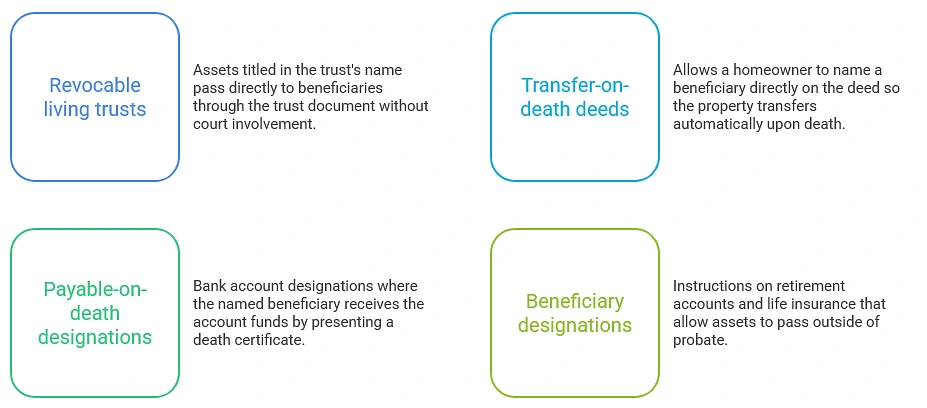
So what actually avoids probate? A few specific legal tools, and none of them are the will:
- Revocable living trusts. Assets titled in the trust’s name pass directly to beneficiaries through the trust document without court involvement. The trust becomes irrevocable when the person dies, the successor trustee distributes assets per the instructions, and the court never enters the picture.
- Transfer-on-death deeds (TOD deeds). Available in about 30 states, these let a homeowner name a beneficiary directly on the deed. When the owner dies the property transfers automatically.
- Payable-on-death (POD) designations on bank accounts, which work the same way – the named beneficiary walks into the bank with a death certificate and the account transfers.
- Beneficiary designations on retirement accounts and life insurance, which pass outside probate by design.
The will handles everything that doesn’t have one of those mechanisms attached to it. And for a lot of families, “everything” means the house, the car, the savings account and whatever personal property accumulated over forty or fifty years of life. All of it sitting in probate court while the family waits.
You’re reading this and thinking your parents probably have a will and probably think that’s enough. For most families it isn’t, and the gap between what they think they’ve covered and what actually happens after they die is where the stress, the cost and the family conflict all live.
Power of Attorney Isn’t About Death – It’s About the Years Before It
The conversation about estate planning almost always focuses on what happens after someone dies and almost never addresses what happens if they become incapacitated while still alive, which statistically speaking is more likely to happen first and creates a completely different kind of crisis.
What happens if your parent has a stroke, develops dementia or is in an accident and can’t manage their own finances or medical decisions?
Without a power of attorney already in place, nobody – not the spouse, not the adult children, nobody – has legal authority to pay their bills, access their bank accounts, make medical decisions on their behalf or manage their property. The family has to petition the court for guardianship or conservatorship, which involves filing a formal case, getting a court hearing, sometimes hiring an attorney for the incapacitated parent as well, and waiting weeks or months for a judge to decide who gets authority and how much.
That process costs anywhere from $2,000 to $10,000 depending on the state and whether anyone contests it. And while it’s happening, the bills don’t stop, the mortgage doesn’t pause, the medical decisions don’t wait. The family is stuck.
Two documents prevent this entirely. A durable financial power of attorney gives a named person authority to handle financial matters, and a healthcare power of attorney (sometimes called a healthcare proxy) gives a named person authority to make medical decisions. Both take effect only when the parent can no longer act for themselves, and both cost a few hundred dollars to set up with an attorney.
The timing matters though because you cannot create a power of attorney for someone who has already lost capacity. The document requires the person granting authority to be of sound mind when they sign it. Once dementia has progressed past a certain point or a stroke has left someone unable to understand what they’re signing, the window is closed and guardianship court is the only option left. This is why the conversation has to happen while everyone is healthy and nobody thinks they need it, because by the time they need it it’s too late to create it.
Beneficiary Designations Override the Will and Nobody Checks Them
This one creates lawsuits between family members who had no intention of fighting with each other, and it happens because of a form that was filled out twenty years ago and forgotten about completely.
Beneficiary designations on life insurance policies, 401(k) plans, IRAs and pension accounts operate independently of the will. They pass directly to whoever is named on the account, regardless of what the will says. If your father’s will says everything goes to his three children equally but his old 401(k) still names his ex-wife from a marriage that ended in 2005, the ex-wife gets the 401(k). The will doesn’t override it. The kids can contest it but the default legal position is that the beneficiary designation controls.
Does this actually happen? Constantly. People update their wills after a divorce or a remarriage or the birth of a grandchild but forget to update the beneficiary forms on financial accounts because those forms sit inside the account portal at Fidelity or Vanguard or wherever and nobody thinks to look at them. Some people don’t even remember which accounts have beneficiary designations attached.
The fix is a review. Pull every financial account, every insurance policy, every retirement plan, and check who’s named. Compare that list to the current will. Where they don’t match, update the beneficiary designation – not the will – because the designation is what actually controls the money. This takes an afternoon and it prevents the kind of family dispute that takes years and costs everyone involved more than the money was worth to begin with.
Digital Accounts Get Locked and Families Lose Access to Everything
Twenty years ago this wasn’t a category anyone thought about during estate planning. Now it’s one of the most practically frustrating parts of settling an estate because so much of a person’s financial life exists online and almost none of it is accessible to anyone else.
Bank accounts with online-only access, investment platforms, email accounts that receive tax documents and account statements, utility accounts set to autopay, subscription services still charging the credit card, social media profiles, cloud storage with family photos – all of it locked behind passwords that nobody else has and security questions that nobody else can answer.
Some platforms have legacy contact features or inactive account policies but most require a death certificate and legal documentation before they’ll even talk to a family member, and the process varies wildly from company to company. Apple has a Digital Legacy programme. Google has an Inactive Account Manager. Facebook lets you designate a legacy contact. Most financial institutions require the executor to provide letters testamentary from the probate court before they’ll grant access, which means you need the probate process to have started before you can even begin dealing with the digital accounts.
The practical solution is unsexy but effective. Keep a secure document – physical or in a password manager with shared access – that lists every account, every login, and every recovery method. Update it regularly. Make sure at least one trusted family member or the named executor knows where it is and how to access it. Without that, the executor spends weeks or months tracking down accounts, calling customer service lines, mailing death certificates to corporate offices, and dealing with automated systems that were not designed to handle the death of the account holder.
The Real Cost of Waiting Until Someone Gets Sick
Most families don’t start planning because nobody is sick yet and it feels unnecessary. Then someone gets a diagnosis or has a fall or starts showing signs of cognitive decline and suddenly everything is urgent and none of the documents exist and the family is trying to set up trusts and powers of attorney and beneficiary reviews all at once while simultaneously managing a medical crisis.
That urgency makes everything harder and more expensive. Attorneys charge more for rush work. Courts move at their own pace regardless of how urgently the family needs a guardianship order. Family members who haven’t discussed any of this before start disagreeing about what mum or dad would have wanted, and those disagreements harden into positions that sometimes become lawsuits.
Planning early costs less, takes less time, creates less stress and produces better results in every measurable way. A basic estate plan – will, revocable trust, durable power of attorney, healthcare directive, beneficiary review – runs somewhere between $1,500 and $5,000 depending on complexity and location. That’s a fraction of what probate costs, a fraction of what guardianship court costs, and a fraction of the emotional damage that unplanned estate settlement inflicts on families who were close before someone died and aren’t anymore.
The conversation is uncomfortable. Nobody enjoys sitting down with their parents to talk about incapacity and death and who gets the house. But the alternative – making those same decisions in a hospital corridor or a probate courtroom or through an attorney’s office after the funeral – is worse in every way that matters. The people who plan early aren’t being morbid. They’re being practical about the fact that this is going to happen eventually and the only variable is how prepared the family is when it does.
References
- Trust & Will, “The State of Probate in America” (2024). Trust & Will.
- ProbateByState, “Probate in All 50 States” (2026). ProbateByState.
- American Bar Association, “Guide to Wills and Estates – Probate Process” (2024).
- LegalZoom, “How Long Does Probate Take?” (2025). LegalZoom.
- Uniform Law Commission, Uniform Real Property Transfer on Death Act (URPTODA).
- 48HourProbate, “How Long Does Probate Take? A State-by-State Guide” (2026). 48HourProbate.