 Nicholas J. Rego Accident Lawyer
A car accident. Not your fault. Six months of treatment, physical therapy three times a week, an MRI, two specialist referrals. Your employer health plan covered the bills. $40,000 in total.
Your attorney settles the case for $100,000 against the at-fault driver’s insurer. Good result. You are expecting a check.
Then the math happens.
Attorney contingency fee, 33%: $33,000
Your health plan’s subrogation lien: $40,000
Remaining to you: $27,000
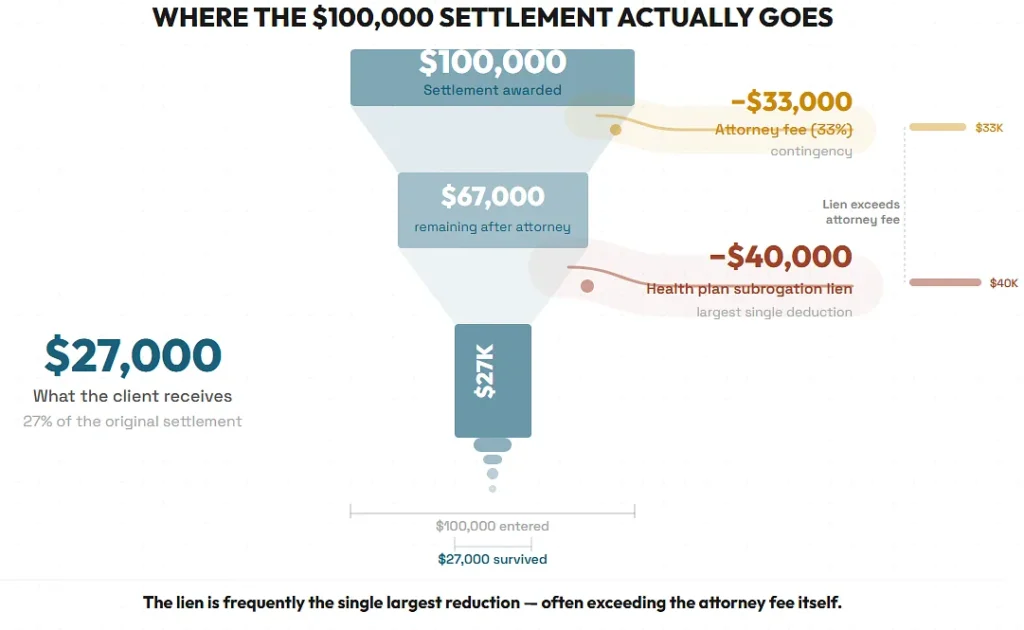
That is not a hypothetical. That is how subrogation works in the majority of personal injury settlements when the injured person has employer-sponsored health coverage. The health plan that paid your medical bills has a contractual and, in many cases, federal legal right to take that money back out of your settlement before you see a dollar of it.
Most people find out about this after the settlement is signed.
Your Health Insurer Paid Your Bills, and Now They Want It Back From You
Not from the person who hit you. From you. From your settlement.
When your employer health plan covers accident-related medical expenses, the plan’s subrogation clause gives it the right to recover those payments from any third-party settlement or judgment you receive. The plan paid $40,000. You recovered $100,000 from the at-fault driver. The plan says: we covered those bills because you had coverage, but someone else was responsible for your injuries, so now that you have been compensated, give us our $40,000 back.
The legal authority depends on what kind of plan you have, and this distinction is where most people’s understanding falls apart.
Self-Funded Plans vs Insured Plans: One Is Governed by Federal Law and the Other Is Not
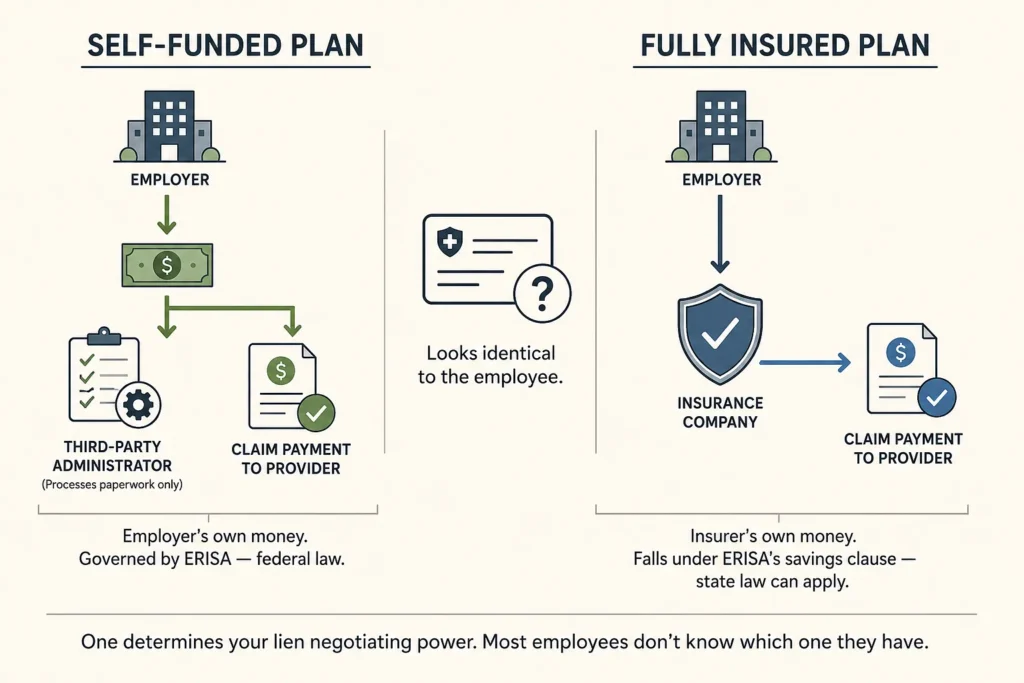
Is your employer health plan self-funded or fully insured?
If you do not know the answer, you are not alone. Most employees have no idea. But this single question determines whether federal law or state law governs the lien against your settlement, and the difference in what you can negotiate is enormous.
Self-funded plans are where the employer itself pays claims out of its own funds, often using a third-party administrator (names like Optum, Rawlings, Equian show up here) to process everything. The employee sees a health insurance card and assumes an insurance company is paying. The insurance company is just processing. The money comes from the employer. These plans are governed by ERISA, the Employee Retirement Income Security Act, 29 U.S.C. § 1132(a)(3). Federal law. Federal preemption. State anti-subrogation protections do not apply.
Fully insured plans are where the employer pays premiums to an actual insurance company and the insurer pays claims with its own money. These plans are still technically under ERISA but they fall within ERISA’s “savings clause,” which means state insurance laws can regulate them. If your state restricts or prohibits subrogation by health insurers, that protection may apply to your plan.
According to U.S. Census Bureau data, 54.5% of Americans have employer-based health insurance. The majority of large-employer plans are self-funded. If you work for a company with 500 or more employees, the odds that your plan is self-funded and governed by federal ERISA preemption are high.
As noted by Farmer & Morris injury compensation lawyer in their analysis of accident claim recoveries, the subrogation lien is frequently the single largest reduction to a client’s net settlement, often exceeding the attorney fee in dollar terms. Identifying the plan type early in the case, before the settlement is even negotiated, determines what leverage exists to reduce or eliminate the lien.
The Supreme Court Case That Made ERISA Liens Harder to Fight
US Airways, Inc. v. McCutchen, 569 U.S. 100 (2013).
James McCutchen was in a car accident. His employer health plan, administered under ERISA, paid $66,866 in medical bills. McCutchen’s attorney recovered $110,000 from the at-fault driver and a third party. The plan demanded full reimbursement of the $66,866.
McCutchen argued two things. First, he had not been “made whole,” meaning his $110,000 recovery did not fully compensate him for all his damages, so the plan should not be able to take money that left him undercompensated. Second, the plan should share in the cost of the attorney fees that produced the recovery, since the plan benefited from his lawyer’s work.
The Supreme Court’s ruling split the difference in a way that made ERISA liens significantly harder to negotiate:
Plan language controls. If the plan document explicitly says the plan gets first-dollar reimbursement regardless of whether the participant is fully compensated, that language is enforceable. The “made whole” doctrine, which would have required the plan to wait until the participant was fully compensated before taking anything, does not override clear plan language.
But if the plan is silent on attorney fees, the common fund doctrine applies as a default. Meaning if the plan document does not address how attorney fees are allocated, the plan must bear a proportionate share of the fees that created the settlement fund it is collecting from.
After McCutchen, plans rewrote their documents. Most large self-funded plans now include language explicitly disclaiming the made-whole doctrine and addressing attorney fee allocation in ways that preserve the plan’s full reimbursement rights. The window that McCutchen opened on the fee side has been closing as plan administrators update their documents.
Three Ways the Lien Gets Reduced in Practice
Lien negotiation is where the money that actually reaches the injured person gets determined. The settlement amount is the headline. The lien reduction is the fine print that changes the check.
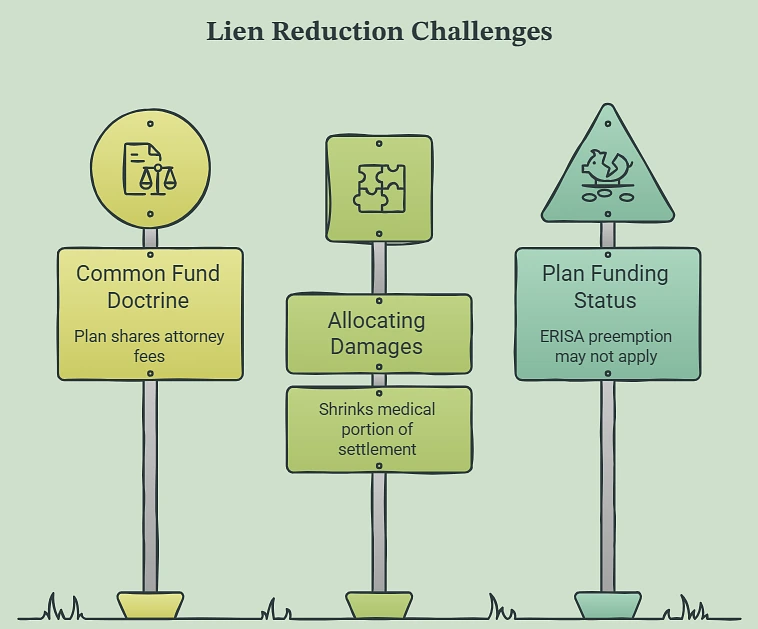
Common fund doctrine. If the plan document does not address attorney fees, McCutchen says the plan shares in the cost. A 33% contingency fee means the plan’s $40,000 lien should arguably be reduced by 33%, to roughly $26,600. Not every plan agrees. But when the plan language is silent, the argument has legal backing from the Supreme Court.
Allocating the settlement to non-medical damages. The plan’s lien only attaches to the portion of the settlement that compensates for medical expenses. If the settlement is structured or documented to allocate a larger share to pain and suffering, lost wages, or other non-medical categories, the medical portion shrinks and the lien attaches to a smaller number. This requires careful documentation in the settlement agreement and it does not work if the plan document claims reimbursement from “any recovery” regardless of allocation.
Arguing the plan is not self-funded. If investigation of the plan documents reveals the plan is actually fully insured rather than self-funded, ERISA preemption may not apply. State law takes over. Many states restrict or prohibit health insurer subrogation. Missouri bans it entirely for insured plans. Other states cap the amount or require the insurer to share in attorney fees by statute. Reclassifying the plan from self-funded to insured can eliminate the lien completely depending on the state.
The Vendor Letter That Shows Up After You Settle
Most people’s first encounter with their plan’s subrogation rights is a letter from a company they have never heard of. Optum. Rawlings. Equian. Conduent. These are third-party subrogation recovery vendors hired by employer health plans to identify potential recoveries and assert liens.
The vendors use algorithms to scan claims data for patterns that suggest third-party liability. Car accident billing codes. ER visits followed by specialist referrals. Injury-coded claims that look like they might lead to a lawsuit. When the algorithm flags a claim, the vendor sends a letter to the participant or their attorney asserting the plan’s subrogation rights and requesting information about the case.
These letters often arrive before the case has even settled. They are asserting a lien on a settlement that does not exist yet, which can feel aggressive but is legally permitted under most plan documents.
Ignoring the letter does not make the lien go away. The plan’s rights exist whether or not the participant responds to the vendor’s correspondence. But engaging with the vendor early, through an attorney, is where lien reductions happen. Vendors have settlement authority. They negotiate. The opening demand is almost never the final number, especially when the attorney raises common fund arguments or challenges whether the plan is actually self-funded.
Medicare and Medicaid Have Their Own Recovery Rights and They Do Not Negotiate the Same Way
If the injured person has Medicare or Medicaid rather than employer-sponsored coverage, the subrogation rules change entirely.
Medicare has a statutory right of recovery under the Medicare Secondary Payer Act, 42 U.S.C. § 1395y(b). Medicare’s lien is enforced by the Benefits Coordination & Recovery Center (BCRC). The lien must be resolved before settlement funds can be distributed, and failing to account for Medicare’s interest can create personal liability for the attorney and the plaintiff.
Medicaid recovery rights vary by state but are also statutory. Federal law under 42 U.S.C. § 1396k requires states to seek recovery of Medicaid payments from liable third parties.
Government liens operate differently from private ERISA liens because the negotiation dynamics are different. ERISA plan vendors have commercial incentives to settle quickly. Government recovery programs operate on statutory mandates with less flexibility and longer processing times.
The Number That Matters Is Not the Settlement. It Is What You Keep.
A $100,000 settlement sounds like $100,000 until the attorney fee comes out, then the lien comes out, then the case costs come out, and the person who spent six months in treatment and lost wages and dealt with pain and disruption to their life is holding a check for a fraction of what they expected.
The settlement negotiation is one job. The lien negotiation is a second job that runs parallel and determines what the client actually takes home. An attorney who settles the case for a strong number but does not negotiate the lien has done half the work.
Knowing the plan type, reviewing the plan documents early, engaging the subrogation vendor before the settlement is finalized, and structuring the settlement allocation to minimize the lien’s reach, that is where net recovery gets maximized. None of that happens if nobody looks at the lien until after the settlement check arrives.
References
- Employee Retirement Income Security Act of 1974 (ERISA), 29 U.S.C. § 1132(a)(3). Equitable relief to enforce plan terms including subrogation and reimbursement provisions.
- US Airways, Inc. v. McCutchen, 569 U.S. 100 (2013). Plan language controls reimbursement rights. Common fund doctrine applies as default when plan is silent on attorney fees.
- Sereboff v. Mid Atlantic Medical Services, 547 U.S. 356 (2006). Plans can enforce equitable liens by agreement on specifically identified settlement funds.
- FMC Corp. v. Holliday, 498 U.S. 52 (1990). State anti-subrogation laws preempted as applied to self-funded ERISA plans.
- Medicare Secondary Payer Act, 42 U.S.C. § 1395y(b). Medicare’s statutory right of recovery from third-party settlements.
- 42 U.S.C. § 1396k. Federal requirement for state Medicaid programs to seek third-party recovery.
- U.S. Census Bureau, Health Insurance Coverage in the United States: 2022. 54.5% of population with employer-based coverage.