 Muhammad Usman
Millions of Android users browsed the web thinking Incognito mode kept them anonymous. It didn’t — at least not from Meta. Between September 2024 and June 2025, Facebook and Instagram apps were allegedly exploiting a vulnerability in Android’s local networking to silently identify users across thousands of third-party websites, linking their anonymous browsing history to their real-name profiles. Now Meta is facing class-action lawsuits on three continents.
Here’s what actually happened and why courts from San Francisco to Berlin are paying attention.
How Meta Allegedly Tracked You Without Cookies
Forget data breaches or hacked passwords. This wasn’t that kind of privacy story. The tracking mechanism at the center of these lawsuits was quieter and in some ways, more troubling.
It started with the Meta Pixel — a small piece of JavaScript code that Meta has, for years, encouraged third-party website owners to embed on their pages. Millions of sites use it. Most users have no idea it’s there.
Here’s how the alleged localhost exploit worked, step by step:
- A website embeds Meta’s Pixel tracking code on it’s pages.
- An Android user with Facebook or Instagram installed visits that website.
- Meta’s app on the device is silently listening on specific local data ports.
- The Pixel sends the user’s unique Facebook ID from the browser to the Meta app running locally on the same phone.
- That handshake links the user’s entire browsing session pages visited, searches made to their real Facebook identity.
Clearing cookies? Didn’t help. Using Incognito mode? Also useless. The tracking bypassed both, operating at a level those tools simply don’t reach.
Researchers identified between 11,890 and 13,468 websites in the US and Europe transmitting data through this channel — many, allegedly, without meaningful user consent.
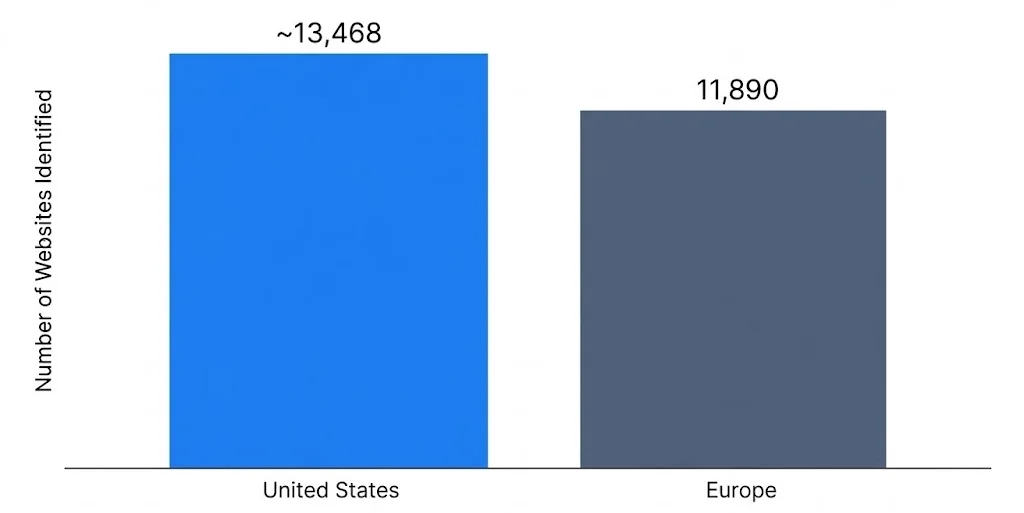
It’s worth noting Yandex apparently used similar methods as far back as 2017. Meta’s window, though — the one these lawsuits focus on — ran from September 2024 until June 2, 2025, when the scheme was publicly exposed.
The Lawsuits: Three Continents, One Exploit
The legal fallout spread fast. Within months of the research going public, class actions were filed in California, Canada, Germany and Spain. Same core allegation, different legal frameworks and that distinction matters more than it might seem.
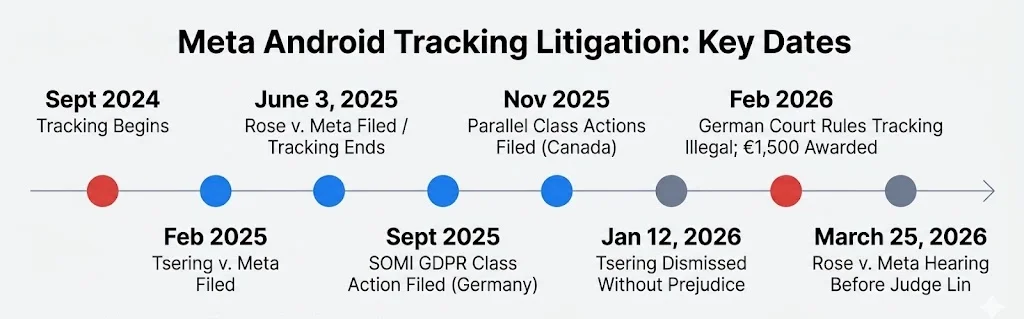
Here’s where things stand across the major cases:
| Case | Court | Core Allegation | Current Status |
| Rose v. Meta | N.D. California | Localhost exploit violates ECPA, CIPA, intrusion upon seclusion | Pending; motions to dismiss under consideration (April 2026) |
| Tsering v. Meta | N.D. California | SDK geolocation tracking via third-party apps | Dismissed without prejudice Jan 2026; amendment permitted |
| Woodward v. Meta & Google | N.D. California | Browser data compromise, state/federal privacy violations | Active investigation |
| Canada (BC & Quebec) | Provincial courts | Android backend channel breached provincial privacy law | Filed Nov 2025; active |
| SOMI v. Meta (Germany) | German courts | GDPR violations via Business Tools and Android tracking | Feb 2026 ruling: tracking illegal; €1,500 awarded |
| Spain | Spanish regulatory body | Broad privacy investigation | Government investigation ongoing |
Rose v. Meta — The One to Watch
Filed June 3, 2025 by plaintiff Devin Rose Rose v. Meta complaint – PACER N.D. Cal., this is the case that most directly confronts the localhost exploit. The complaint describes Meta’s conduct as a deliberate scheme to de-anonymize millions of Android users and enrich detailed profiles linked to their Facebook and Instagram accounts.
Three main legal claims:
- Violation of the Electronic Communications Privacy Act (ECPA).
- Violation of California’s Invasion of Privacy Act (CIPA).
- Common law intrusion upon seclusion.
Meta’s defense has two main planks: users consented through the privacy policy and nobody suffered concrete harm. Plaintiffs’ counter is straightforward you can’t meaningfully consent to a tracking mechanism that was never disclosed to you.
At a March 25, 2026 hearing, Judge Rita F. Lin didn’t sound neutral. She questioned whether Meta’s actions violated “background social expectations” — comparing the data sharing to rifling an underwear drawer. That’s pointed language from a federal judge weighing a motion to dismiss.
Tsering — A Cautionary Tale on Pleading Standards
The Tsering case Tsering v. Meta – court filing or news coverage targeted something slightly different: Meta’s SDKs embedded inside third-party apps like Candy Crush, Solitaire and Nextdoor, allegedly collecting precise geolocation data without consent.
Judge Lin dismissed it in January 2026 — not because the underlying conduct was acceptable, but because plaintiffs couldn’t sufficiently allege that Meta knew it lacked permission. That’s a high pleading bar and it signals how technically demanding these US cases are to survive at the motion-to-dismiss stage.
The dismissal was without prejudice. Plaintiffs had until February 9, 2026 to file an amended complaint.
Shall I continue with the next sections — covering the European and Canadian fronts, the central legal questions and the future implications?
Canada — Provincial Privacy Law Enters the Picture
In November 2025, Vancouver-based firm Slater Vecchio LLP filed parallel class actions in both British Columbia and Quebec Slater Vecchio LLP announcement or Canadian court filing. The timing wasn’t coincidental. it came roughly five months after the tracking window closed and the US litigation had already started gaining traction.
The Canadian cases allege Meta intentionally exploited Android’s backend architecture to intercept private browsing data for profit, framing it as a deliberate breach of provincial privacy statutes rather than just negligence. That word intentionally matters. It raises the stakes considerably compared to claims that merely allege carelessness.
Canada’s privacy framework sits somewhere between the US and Europe in terms of teeth. Not as fragmented as American state-by-state law, but not GDPR either. How these cases develop could shape how Canadian courts interpret consent in the mobile tracking context, a question that’s genuinely unsettled there.
Europe — Where Courts Are Already Ruling
This is where it gets interesting. While US courts are still wrestling with motions to dismiss, European courts are already handing down decisions.
Germany moved fastest. In September 2025, Dutch consumer group SOMI filed a GDPR class action in German courts seeking up to €3,000 per affected user for covert surveillance through Meta’s Business Tools and Android tracking methods.
Then in February 2026 before the Rose case even had it’s first major hearing a German court ruled that Business Tools data collection was illegal under GDPR and awarded €1,500 in compensation to an affected Instagram user.
That ruling is significant for a few reasons. It establishes that at least one European court views this type of covert tracking as straightforwardly illegal not a gray area, not a consent technicality. And €1,500 per user, multiplied across millions of affected Europeans, produces numbers that become genuinely uncomfortable for Meta’s legal team to model out.
Spain launched a parallel government investigation into Meta’s privacy practices, though that’s still in earlier stages compared to Germany.
The European front matters beyond Europe too. GDPR rulings create pressure legal, reputational, financial — that feeds back into how US litigation plays out and how aggressively Meta defends itself globally.
The Central Legal Question Nobody Has Cleanly Answered Yet
Strip away the case names and jurisdictions and you’re left with one question running through all of this:
Does exploiting a mobile operating system to de-anonymize users — in ways they’d never reasonably anticipate — require it’s own separate consent, beyond whatever a platform’s general privacy policy says?
Meta’s position is essentially no. You agreed to the privacy policy, the privacy policy is broad, that covers it.
Plaintiffs across every jurisdiction are arguing yes and that the specific mechanism here was so far outside what any reasonable user would expect that blanket policy acceptance can’t cover it. Clicking “I agree” on a privacy policy while signing up for Facebook in 2019 doesn’t mean you understood that, five years later, your phone’s local ports would be used to track your browsing on unrelated websites in Incognito mode.
There’s also a wiretapping dimension that’s particularly sharp in the US cases. ECPA wasn’t written with localhost exploits in mind, it was built for phone taps and electronic interceptions. Whether silently routing data between a browser and an app on the same device constitutes an “interception” under that statute is genuinely unsettled law. Courts will have to stretch or clarify old frameworks to fit new technical realities.
Europe sidesteps some of that ambiguity. GDPR requires that data collection be lawful, transparent and limited to what’s necessary. Covert de-anonymization through a mobile OS exploit fails on multiple counts, which is probably why German courts got to a ruling faster than California did.
What Happens Next And Why It Matters
The Rose case is the one to watch in the immediate term. Judge Lin’s decision on Meta’s motion to dismiss will land sometime in 2026 and will answer a threshold question: does this lawsuit even get to proceed?
If it survives, discovery begins and that’s where these cases tend to get genuinely revealing. Internal documents, engineering decisions, what Meta knew and when. That phase alone, regardless of eventual outcome, tends to produce disclosures that reshape public understanding of how these systems actually work.
A few scenarios worth tracking:
- Rose proceeds to discovery: Significant. Sets a template for how ECPA and CIPA apply to app-level tracking. Creates document disclosure pressure on Meta.
- Rose gets dismissed: Plaintiffs will almost certainly appeal. Could ultimately reach the Ninth Circuit, which would then set binding precedent across the western US federal courts.
- German GDPR cases expand: If SOMI’s class action succeeds at scale, the €3,000-per-user figure applied across millions of European users produces liability numbers that would be among the largest in GDPR history.
- Canadian courts weigh in: A ruling there would add a third major legal framework’s interpretation of consent in mobile tracking cases.
Beyond Meta specifically, whoever wins these cases is partly writing the rules for the entire mobile advertising industry. The localhost exploit may be gone now, but the underlying tension isn’t: ad-supported platforms have structural incentives to collect as much data as possible and privacy controls are only useful if they actually work.
Final Thought
What makes this litigation unusual isn’t just the scale or the technical sophistication. It’s that the exploit specifically targeted privacy tools Incognito mode, cookie clearing — that users actively chose to use. That’s not passive data collection. That’s defeating a deliberate user choice.
Judge Lin’s underwear drawer analogy stuck because it captured something real. Users expected a boundary. The allegation is that Meta built a system specifically designed to cross it without being noticed.
Courts in three jurisdictions are now deciding whether that matters legally. In Germany, they’ve already said it does.