 Attorney Kyle Persaud (Family Lawyer)
And, in case you have had a child support case in the last year, you have likely felt that the ground is shifting under your feet. It was one of the most active years on child support reform in recent years and Congress enacted significant federal legislation and about a dozen states enacted significant reforms that will impact the calculation and collection and modification of support. Some of these changes are the technical housekeeping. Other ones such as the income cap leaped by Texas or the reorganization of the economic table by Washington will have significant implications on the amount paid and received by the parents at the end of every month.
The Federal Picture
Most child support law lives at the state level, but the federal framework sets the rails. Two developments stand out this year.
Supporting America’s Children and Families Act
On January 4, 2025, President Biden signed the Supporting America’s Children and Families Act (P.L. 118-258) and most of it’s provisions will take effect on October 1, 2025. The bill reauthorizes Title IV-B child welfare programs to the fiscal year 2029 and tightens up Title IV-D enforcement program that most child support practitioners deal with on a daily basis.
A few pieces worth flagging:
- Tribal access to federal tax information. Tribal IV-D agencies and their contractors can now tap into FTI the same way state agencies do — a long-overdue fix that should improve enforcement on tribal lands.
- More money for prevention. Promoting Safe and Stable Families funding bumps up by $75 million to $420 million starting in FY2026.
- Court Improvement Program boost. The set-aside grows from $30 million to $40 million annually and the tribal court reserve doubles to $2 million.
- Notice of legal representation. States must now inform parents and children in abuse and neglect proceedings about their right to independent counsel.
- Modernization. Virtual caseworker visits are now permitted for youth over 18 and data collection requirements got an update.
Federal Office of Child Support Enforcement also rebranded, unannounced, to Office of Child Support Services in late 2024, which is bigger than a name change but is an indication that the organization is now more of a service than a punitive agency.
Unborn Child Support Act (Still Pending)
S. 230,. Introduced January 23, 2025, 230 would allow mothers to request child support when pregnant and the payments could be retroactive to conception. It is not out of committee, but one to consider with the bigger legal debates on fetal personhood.
State-by-State: The Big Ones
Texas
No state changed numerically the most this year as Texas did. The monthly net-resource limit, not visited in some time, shot up significantly and the Office of the Attorney General implemented a new case management system that is already transferring real dollars.
| Metric | Before Sept. 1, 2025 | After Sept. 1, 2025 |
| Monthly net-resource cap | $9,200 | $11,700 |
| Maximum support, 1 child (20%) | $1,840 | $2,340 |
| Maximum support, 2 children (25%) | $2,300 | $2,925 |
| Maximum support, 3 children (30%) | $2,760 | $3,510 |
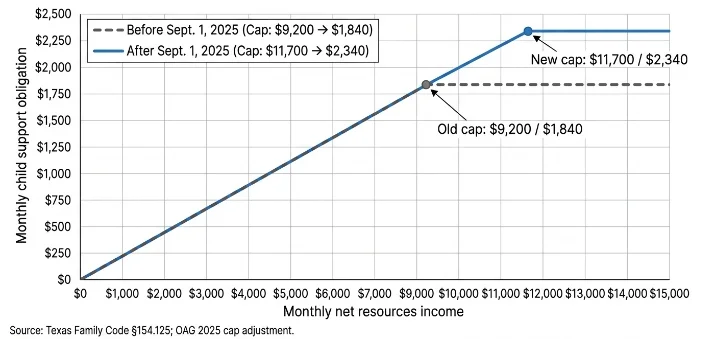
Beyond the dollar figures, two other Texas changes matter:
- ChAMP rollout. The OAG’s cloud-based Child Support Administrative Management Platform launched June 12, 2025 and processed $614 million in it’s first six weeks. If you’ve ever waited months for a status update, this should help.
- SB 1403 requires the IV-D agency to review and adjust support when the obligor is incarcerated for 180 days or more, bringing Texas in line with federal expectations.
Washington
Washington’s EHB 1014 was signed in May 2025 and implements recommendations from the 2023 child support work group. This is a more comprehensive overhaul than Texas’s — it touches the table, the floor, the self-support reserve and adds new abatement provisions.
| Provision | Old Rule | New Rule (EHB 1014) |
| Top of economic table | ~$12,000/month | $50,000/month |
| Presumptive minimum order | ~$50/month | $2,200/month floor (combined) |
| Self-support reserve | 125% of FPL | 180% of FPL |
| Cap on total obligation | None codified | 45% of net income |
Key features practitioners should know:
- Temporary abatement. A parent enrolled in a court-ordered mental health or substance abuse program can request abatement of up to six months. This is genuinely new ground for Washington and recognizes that orders set during crisis don’t get paid anyway.
- Insurance premium deduction. Mandatory state insurance premiums now come off gross income before the calculation runs.
- 45% net cap. Total child support can’t exceed 45% of net income absent good cause — a meaningful protection for obligors with multiple orders.
Massachusetts
The product of the quadrennial review is the Massachusetts 2025 Child Support Guidelines, which will go into effect on December 1, 2025. It is income threshold that will change the headline, but the formula adjustments and new parenting time guidance will have a greater impact on cases day to day.
| Metric | Old | New (Eff. Dec. 1, 2025) |
| Maximum income threshold for base support | $400,000/year | $450,000/year |
| Formula at $2,000 weekly income | (prior formula) | $346 + 18% of income above $1,600 |
Other practical changes:
- Parenting time middle ground. Courts now have explicit guidance to consider deviation when parenting time is substantially more than one-third but less than 50%. This addresses the long-standing complaint that the old binary approach didn’t reflect real custody arrangements.
- Childcare clarification. Only out-of-pocket childcare costs count — third-party payments (think grandparents, employer benefits or subsidies) don’t get factored in.
- Childcare vs. extracurriculars. New factors help courts distinguish actual childcare from things like piano lessons or travel sports, which had been a gray area.
Maryland
Maryland’s HB 275 (Chapter 532) tweaks the definition of “adjusted actual income” effective October 1, 2025. The change requires a deduction for children living in the parent’s home who aren’t subject to a support order. It’s a small thing on paper but it can materially lower a parent’s calculated income — especially for parents in blended-family situations where one set of kids is on a court order and another isn’t.
District of Columbia
DC’s Child Support Reform Amendment Act of 2025 raises the TANF pass-through from $150 to $200 per month. Federal rules allow up to $200 to flow through to families without affecting the state’s federal match and DC is now taking full advantage. For TANF families, this is an extra $600 per year in their pocket — modest but meaningful at that income level.
Illinois
Illinois SB 27 narrows the definition of “child” for support purposes. Previously, support could continue for kids age 19 or younger; now it’s a child under 18 or under 19 and still in high school. If you have a client whose 19-year-old graduated last June and is taking a gap year, this matters.
Mississippi
Two Mississippi bills are worth attention:
- SB 2505 requires courts to account for health insurance costs when setting support and mandates that all orders include reasonable medical support. Federal regulations have required medical support provisions for years, but Mississippi was inconsistent in practice. This standardizes things.
- SB 2452 creates a presumption that support for a disabled child can continue past majority. The court still has to hold a hearing with medical evidence, but the burden has flipped — which is significant for families dealing with intellectual disabilities, severe autism or chronic medical conditions.
Nebraska
LB 704 addresses something that’s frustrated lawyers and judges for years: what happens when an obligor goes to prison and arrears pile up faster than they could ever realistically pay. Nebraska now mandates automatic review of child support orders when the non-custodial parent is incarcerated for 180 days or more. The old process was, to put it diplomatically, murky. Now it’s automatic.
Other Notables
A few smaller changes worth a quick mention:
- Idaho HB 274 is a comprehensive amendment to the state child support laws, which are pending their way through the Health and Welfare Committee, in February of 2025.
- On April 1, 2025, Kansas implemented policy changes that specify how child support and alimony income is averaged to determine benefit eligibility and permit virtual hearings.
- Connecticut SB 1359 has technical changes to child support laws; the bill passed the Senate in June 2025.
Trends Worth Watching
Shared-Parenting Presumptions
A handful of states are debating bills that would create a rebuttable presumption of joint custody or equal parenting time. Connecticut’s SB 1026,New York’s S4128 and A4786 and North Carolina’s SB 162 are all examples. None have crossed the finish line yet and domestic violence advocates have raised serious concerns — but the conversation is happening in more legislatures than it was a few years ago. Reddit threads on r/Custody reflect how polarized this debate has become among parents themselves.
Adult Disabled Children
Mississippi’s SB 2452 is the cleanest 2025 example, but Florida, Ohio, Louisiana and Texas already have or are refining provisions for continued support past majority when a child has a qualifying disability. Practitioners with younger clients should be flagging this issue early — well before a child turns 18.
Income Threshold Updates Across the Board
The simple fact is that wages and costs have increased significantly and Texas, Washington and Massachusetts were all increasing their income caps or floors this year. Even Canada revised it’s federal child support tables that became effective on October 1, 2025 and increased the income floor to $16,000.
Enforcement Goes Digital
The most prominent example is Texas ChAMP system, but in most states the modernization in enforcing is going unnoticed. Some of the friction that parents have experienced in the decades of bureaucracy should be alleviated by cloud-based platforms, virtual hearings and improved data-sharing between agencies.
Incarcerated Parent Modifications
Both Nebraska’s LB 704 and Texas’s SB 1403 reflect a federal nudge — outlined in federal regulations at 45 CFR 303.8 — toward treating incarceration as an involuntary change in circumstances rather than voluntary unemployment. More states will follow.

What This Means in Practice
For everyone reading this who wants the bottom line, here’s how I’d frame the practical takeaways:
- Update your worksheets now. If you practice in Texas, Washington, Massachusetts, Maryland, DC, Illinois or Mississippi, your calculation tools from a year ago are out of date. Don’t get caught at a hearing.
- Re-evaluate cases above the old caps. Texas and Massachusetts clients whose income exceeded the prior thresholds may now have a basis to modify upward — or to defend against a modification.
- Flag incarceration cases for review. If you have a client whose ex is doing 180+ days, the rules in Nebraska and Texas have changed in ways that may help or hurt depending on which side you’re on.
- Talk to disabled-child families early. Mississippi’s presumption is new, but the issue isn’t going away. Get the medical documentation in order before majority.
- Don’t sleep on the parenting time middle ground. Massachusetts now invites courts to deviate when one parent has substantially more than one-third of overnights. That’s a negotiation tool.
- For TANF families in DC — make sure the new $200 pass-through is actually showing up. Bureaucratic implementation lags policy.
- Tribal practitioners — federal tax information access is a meaningful new tool for locating non-custodial parents and verifying income.
- Watch your state’s session. Several of the bills mentioned here are still moving. The landscape on January 1, 2026 will look different than today.
FAQ
My income went up since my last order. Can the other parent ask for more under the new Texas cap?
Possibly. If your income was already above the old $9,200 cap, you were paying the maximum and that maximum just went up. The other parent would still need to file for modification and show a material and substantial change in circumstances, but the new cap gives them more room to ask for a higher number.
I live in Washington and I’m in court-ordered substance abuse treatment. Can I really stop paying child support?
Not stop — abate. EHB 1014 lets you ask the court for a temporary abatement of up to six months while you’re enrolled in a qualifying program. You’ll need to actually be in the program and follow the procedural requirements. Talk to a lawyer before you stop sending money.
My ex is going to prison for a year. Do I still get child support?
In most states, yes — the order remains in place. But in Nebraska and Texas (and many others now), the agency will automatically review the order after 180 days of incarceration. The order may be reduced to reflect what the incarcerated parent can actually pay, with arrears continuing to accrue at the new rate. You don’t lose the support owed; you just may collect less for the duration.
My child turns 18 in Illinois next month and is starting college. Will support continue?
Under SB 27, no — unless they’re under 19 and still in high school. College attendance alone doesn’t extend support in Illinois. Educational expenses for college are handled separately under 750 ILCS 5/513.
My child has Down syndrome and turns 18 next year. Will support automatically continue in Mississippi?
Not automatically, but the presumption now favors continuation. You’ll need to request a hearing and provide medical evidence of the disability and it’s impact on the child’s ability to be self-supporting. Start gathering documentation now.