 Jeffrey S. Kelly Group PLLC (Real Estate)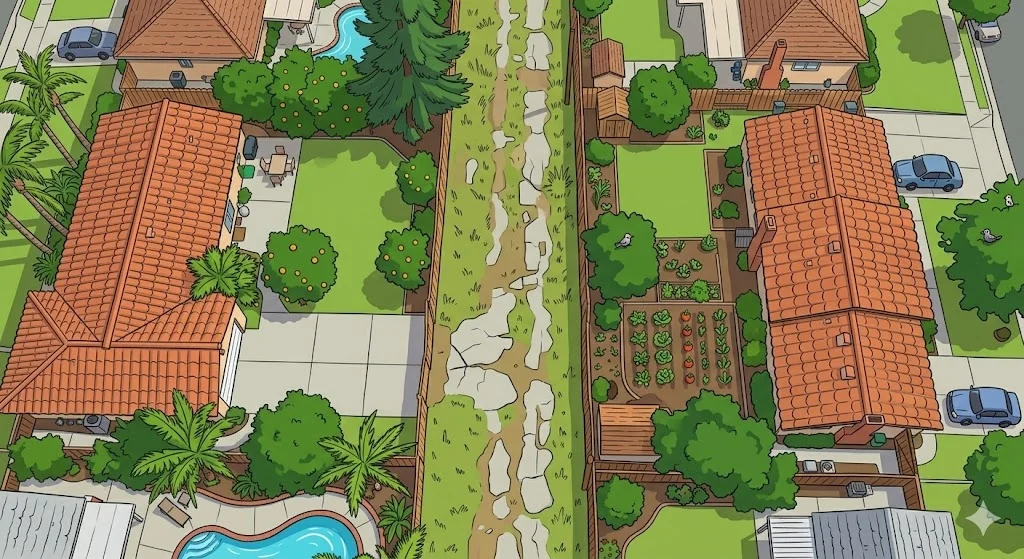
Here’s something that surprises a lot of property owners, developers and even some title officers when they first encounter it: you might own the land under a road or street right next to your property and have no idea.
That’s not a hypothetical. It happens all the time in California and it’s been happening since 1872 when the state enacted Civil Code § 831. The statute reads, almost deceptively simply: “An owner of land bounded by a road or street is presumed to own to the center of the way, but the contrary may be shown.”
Twenty-four words. Decades of litigation. Real money on the table.
This article walks through what that presumption actually means, why courts treat it as “highly favored in the law,” and maybe more importantly what it means for you if you’re buying, selling, developing or just trying to understand what you actually own.
Origins & Purpose: Why Does This Law Exist?
California’s original Civil Code, drafted in 1872 on the model of David Dudley Field’s civil code, codified something courts had already been doing at common law for years. The idea wasn’t complicated it was practical.
When land gets divided and sold, roads and streets get drawn onto maps. Sometimes those roads get built. Sometimes they don’t. Sometimes they get vacated years later. Without a clear rule about who owns the land under them, you end up with narrow, leftover strips of land that are essentially useless except, of course, to the people whose properties sit on either side. And that’s when lawyers get involved.
Courts have been consistent about the purpose. The California Supreme Court put it plainly in the 1940 Machado decision: the presumption rests on “the supposed intention of the parties and the improbability of the grantor desiring or intending to reserve his interest in the street when he had parted with his title to adjoining land.”
In other words, why would a seller keep a strip of road-width land after selling everything on both sides? The answer, almost always, is that they wouldn’t. So the law presumes they didn’t. It pairs naturally with Civil Code § 1112, which says a deed bounded by a highway passes title to it’s center unless the deed says otherwise.
How the Presumption Works?
The mechanics are pretty straightforward once you see the picture. When your property deed describes land bounded by a road, alley or street, California law presumes your ownership extends to the centerline of that road not just it’s edge.
A few things worth knowing about how this plays out:
- The presumption applies to public roads, alleys, private streets and roads shown on subdivision maps, basically anything that qualifies as a “way” under California law.
- It applies even to vacated or abandoned roads. When a county or city vacates a street, the public easement goes away, but the underlying fee title doesn’t disappear into thin air. It stays with the abutting owners, to the centerline.
- If you bought your lot by reference to a recorded subdivision map showing bounding streets, you likely already own to the centerline of those streets.
- The presumption is rebuttable, courts say it’s “highly favored,” which means you need real evidence to overcome it, not just a guess.
What the Courts Have Said: Key Cases
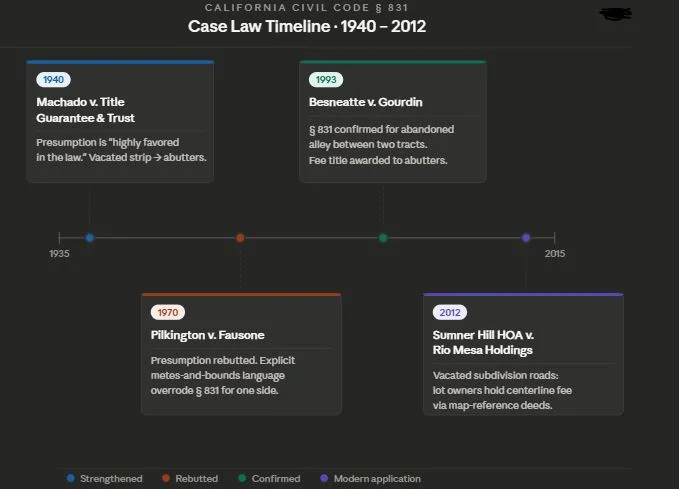
The case law on this goes back over 80 years. A few decisions shaped how § 831 works in practice.
Machado v. Title Guarantee & Trust Co. (1940) 15 Cal.2d 180
This is the foundational case, still cited today. A 2.6-acre strip had been set apart as a road during a rancho partition, was never improved and was formally vacated in 1905. Decades later, the question was: who owned that strip?
The California Supreme Court held the § 831 presumption applied. Even metes-and-bounds descriptions in the partition decree weren’t enough to rebut it. The strip went to the abutting owners. And the court used that memorable phrase, the presumption is “highly favored in the law” which courts have been quoting ever since.
Pilkington v. Fausone (1970) 11 Cal.App.3d 349
This one shows the presumption can be beaten but it takes clear, specific language. A 20-foot dedicated alley was abandoned in 1966. One side’s original owner had conveyed property with a metes-and-bounds description that expressly included the entire alley. The court found that was enough to rebut the presumption for the other side. Specific description, specific intent. The whole alley went to one side.
Important takeaway: the presumption yields to clear contrary evidence. Vague descriptions don’t cut it but explicit ones can.
Sumner Hill Homeowners Assn. v. Rio Mesa Holdings, LLC (2012) 205 Cal.App.4th 55
A more recent, very practical case. Subdivision roads were vacated by the county. Lot owners argued successfully that their map-reference deeds had already conveyed fee title to the centerline under § 831. The public easement was gone after vacation, sure. But the underlying fee? That had been with the lot owners all along.
The court’s language here is worth keeping: “It is well settled that where land is conveyed by a deed describing the property conveyed as a specifically numbered lot or block … the grant will be considered as extending to the center of the street or highway, unless it clearly appears that it was intended to make a side line instead of the center line the boundary.”
For HOA communities and private-road subdivisions, this case still matters a lot.
How to Rebut the Presumption?
The presumption can be overcome courts are clear on that but they don’t make it easy. Here’s what actually works:
- An express reservation or exclusion in the deed meaning the grantor specifically kept the road strip and the deed language says so.
- Proof the grantor never owned the fee to the center in the first place (e.g., the road was separately acquired via condemnation before the adjacent land was sold).
- Circumstances showing the subdivider retained ownership on both sides of a proposed road in that case, there’s no abutting-owner transfer happening.
- Clear contrary language on a recorded subdivision map or dedication document, expressly showing that the street fee is retained separately.
What doesn’t work: vague metes-and-bounds descriptions that stop at a road edge without specifically excluding the centerline or a general assumption that “public road = city/county owns it.” Courts have consistently rejected those arguments.
California Civil Code § 831
Fee title vs. easement only — by ownership scenario
Ownership rights abutting owners receive under the centerline presumption compared to what public agencies typically hold
Real-World Applications Today
You might be wondering when does this actually come up? More often than you’d think. Here are the scenarios where § 831 shows up in practice:
§ 831 Scenario Reference Guide
| Scenario | § 831 Impact | Why It Matters |
|---|---|---|
| Street / road vacation | Abutting owners acquire fee to centerline automatically upon vacation | No separate conveyance needed but title search must confirm |
| Subdivision lot purchase | Map-reference deed presumptively conveys centerline of bounding streets | Affects ALTA survey, title policy and financing |
| Alley quiet title disputes | § 831 presumption governs who owns the alley strip | Common in older urban plats; litigation risk if ignored |
| HOA / private roads | Lot owners (not HOA) may hold fee title to road centerlines | HOA maintenance rights vs. ownership rights can conflict |
| Utility / encroachment disputes | Street easement doesn’t authorize all private uses | Radford case: meter placement on abutting fee triggered liability |
| Eminent domain / condemnation | Government condemning a road must compensate for fee, not just easement | Undervaluation risk if fee ownership not established |
Practical Tips for Property Owners, Developers & Title Officers
If you’re working with California property buying, selling, developing or insuring here’s what to actually do with this information:
- Always check if any streets on your plat map have been vacated. A vacated street doesn’t mean clean land it often means the abutting owners got fee title via § 831, which may or may not be in their current deed description.
- Review your deed and survey for centerline treatment. Does your ALTA survey show the road centerline as your boundary? It should, in most cases. If it stops at the road edge, ask why.
- Look at the title insurance policy exceptions. Road and alley fee ownership is often included or specifically excepted. Know which one you have.
- If you’re a developer buying land adjacent to a vacated road: confirm whether that strip has been separately conveyed or whether § 831 already put it in your ownership chain. Strip-and-gore title defects are expensive to fix after the fact.
- For quiet title situations: the presumption is “highly favored.” If you’re on the abutting side and someone is claiming fee to an old alley strip, § 831 is your starting point. If you’re claiming against it, bring strong evidence.
- Public agencies are not immune. Counties and cities typically hold only an easement in public roads, not fee title, unless they specifically acquired fee via condemnation or express deed language. A 2005 California Attorney General Opinion (No. 04-809) confirms this.
The Bottom Line
California Civil Code § 831 is one of those statutes that almost never gets mentioned until something goes wrong. A road gets vacated. A developer stumbles onto a title gap. An HOA and a homeowner disagree about who owns the private street running through the community. And suddenly a 24-word statute from 1872 is very relevant.
The presumption itself is strong courts have consistently called it “highly favored” for 80+ years and the case law from Machado through Sumner Hill has only reinforced that. But it’s rebuttable and the way it gets rebutted is through specific, clear deed language or documented contrary intent.
So whether you’re a homeowner curious about what you actually own, a developer running due diligence or a title officer reviewing a vacation order don’t assume. Pull the plat map, read the deed, check the vacation history and talk to a real property attorney if anything looks unclear. Strip-and-gore title defects are solvable. They’re just a lot easier to solve before you close.